Friday, June 5, 2026
Embody me.
Flare up like flame
and make big shadows I can move in.
—Rainer Maria Rilke, Rilke’s Book of Hours
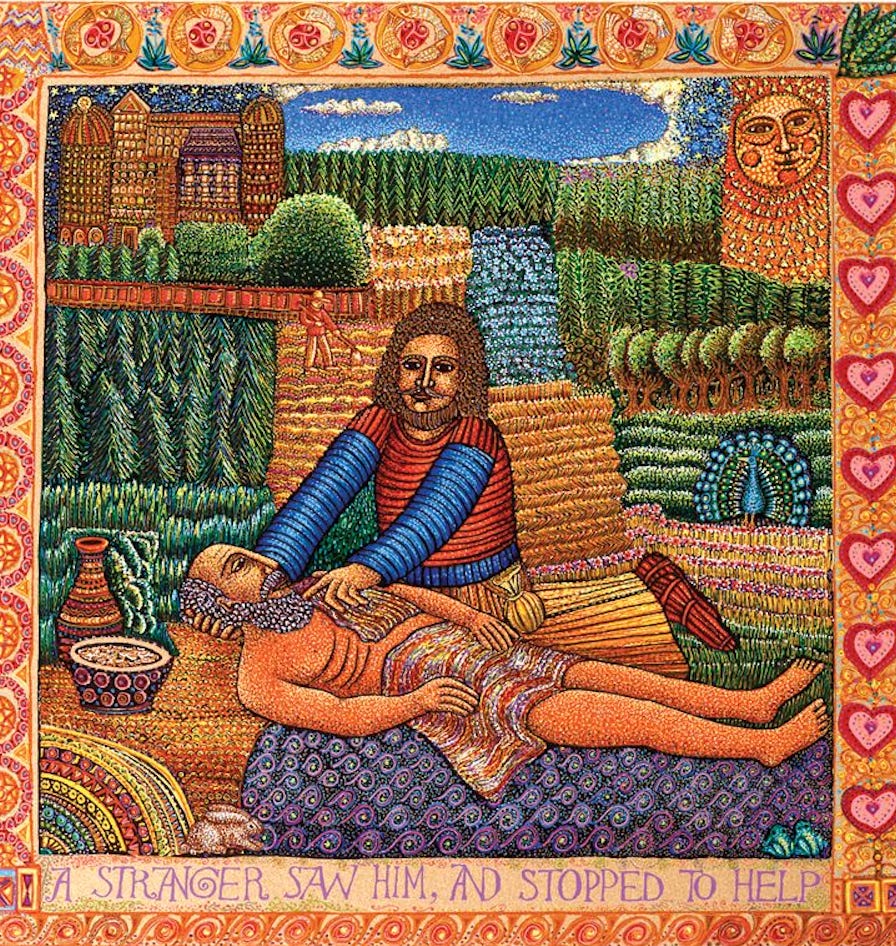
Father Richard invites us to know and honor ourselves and others in all our complexity:
For you who have loved Jesus, do you recognize that any God worthy of the name includes and transcends creeds and denominations, time and place, nations and ethnicities, and all the vagaries of gender and sexual orientation, extending to the limits of all we can see, suffer, and enjoy? We are not only our gender, our nationality, our ethnicity, our skin color, or our social class. These are not the qualities of our true self in God! Why, oh why, do we allow temporary costumes, or what Thomas Merton called the “false self,” to pass for the substantial self, the soul, which is always “hidden with Christ in God” (Colossians 3:3)?
You are a child of God, and always will be, even when you don’t believe it. And so is everyone else! God created us all. We are all God’s children.
Now don’t get me wrong. I’m not saying that social identifiers don’t make a difference in our lives. We must be in relationship with and value the “other” in all their individuality and uniqueness, before we can see ourselves as “one.”
God loves and creates each one of us as a unique being with different gifts and challenges. If we stay small and “hide our light” under a bushel basket, there is almost no place for God to move in, through, and with us for the sake of the world!
Episcopal priest Elizabeth Edman recounts a story of challenging expectations as a child:
I was born in Fort Smith, Arkansas in 1962. The world I grew up in was defined by rigid binaries: white/black, capitalist/communist, north/south. Oh yeah, and male/female. That one didn’t work for this tomboy.
When I was five, I had to drag my mother into the boy’s section of the shoe store to look at sneakers. “Mama, c’mere! Let me show you the ones I want!”…
When I presented the shoes to the clerk, he said, “Those are boys’ shoes.”
My mother cut him off: “Yes, size four, please.”
My mother was a singer. Being who she was meant having the courage to witness God’s presence in the sacred music she loved. You could see her put her whole trust in God, entering into this space between heaven and earth where her best voice, her best self, emerged.
Christianity is all about being who you are. That’s what Jesus was trying to tell us: Orient your whole being to the sacred, he insisted. Not because I’m telling you to, not because it’s what Scripture demands; do it because it’s who you are. It’s who God created you to be. God made us to be complex creatures, every one of us, for a reason. So if you want to honor God, here’s the first step: Know who you are. Be who you are. Be the person God created you to be. Amen.
==================
John Chaffee’s Friday Five
1.
“If you are willing to serenely bear the trial of being displeased with yourself, you will be a pleasant shelter for Jesus.”
– Therese of Lisieux, French Carmelite Nun
Some of us are so displeased with ourselves that we are violent, angry, and condescending to ourselves. And, according to Therese of Lisieux, this makes our hearts/minds/souls an uncomfortable place for Jesus to dwell.
If only we could learn to be more tender with ourselves, I am sure many of our issues would soften.
2.
“No sinner can escape future judgment without experiencing in this life either voluntary hardships or afflictions he has not chosen.”
– Maximus the Confessor, in Four Hundred Centuries on Love (2.66)
We reap what we sow.
We should not be fooled.
There is always a price to pay.
God is judicious (He knows what is good and bad for us) and at the same time God is not judgmental (He does not look down on us condescendingly for our mistakes).
God does not spare us from the consequences of our own decisions.
God gives us the freedom to make some terrible mistakes that hurt us and/or those around us.
Again, there is always a price to pay.
Do we want the hardship of living a life of as much virtue as possible… Or do we want a life of hardship from living a self-destructive life that drags others down with us?
Some forms of Christianity falsely believe that consequences and punishment only happen to those who are unbelievers, and that if we are church-going people, we should be spared from the consequences of our own decisions. However, I believe orthodox Christianity (of which Maximus the Confessor helped to shape) teaches us that “all will be held accountable, first the Jew and then the Gentile, for what he has done.”
We just have a hard time separating accountability from punishment. I believe God will hold each of us accountable AND will perform the necessary, painful act of pruning us of our self-destructive and sinful patterns.
3.
“To follow Jesus is to be a wholemaker, essentially to love the world into new being and life.”
– Ilia Delio, Franciscan Theologian and Neuroscientist
There is a philosophical shift happening in some scientific circles.
There is one mindset that sees the world as composed of parts and that we need to break things down to understand each layer of smaller and smaller parts.
Meanwhile, another mindset sees the world as composed of whole things that come together to form larger wholes with greater and greater complexity.
Think about it.
Whole atoms make up whole molecules that make up whole cells that make up whole organs that make up whole persons who make up whole families who make up whole communities who make up whole states who make up whole nations who make up whole continents who make up the whole world… that make up solar systems that make up universes that make up the whole cosmos that makes up… something else?
Either way, it is a mystery all the way up or all the way down, but the difference is whether we see things as parts or as wholes.
Seeing the world as parts means we do not yet recognize or value the relationships between things.
However, seeing things as wholes implies a certain a priori appreciation of relationships.
Ilia Delio is the theologian who first made me realize that Jesus is a wholemaker, who values relationship, interdependence, and coming together to fix what is broken or to bring something new into existence.
4.
“Where our money is, there our theology will be also.”
– Joash P. Thomas, Episcopal Priest
Dang. That’s an interesting one, right?
It is Joash’s first book, and it takes some big swings. And of all the big swings, this one actually landed the most for me.
I believe our theology and how we think about money are closely tied. Not only that, but how many of us would be willing to change our theology to something that might eventually become a financial loss for us? How often do we defend or endorse a theology simply because it financially benefits us?
Is money our actual metric for orthodoxy? If it is… it shouldn’t be.
A few weeks ago, I was reading Basil of Caesarea’s book called Social Justice. It takes to task the way that the early church interpreted the Gospel stories of the young man who turned away from Jesus, sad because he could not give up his material possessions.
Basil pulled no punches. As a youth, Basil grew up in a very wealthy family, so it is fascinating how strongly he turned against the accumulation of wealth. I am not yet done reading Basil’s work, so I probably shouldn’t comment further, but back to the main point: Joash is onto something here… Our theologies are often too influenced by our money.
5.
“I drink beer whenever I can lay my hands on any. I love beer, and by that very fact, the world.”
– Thomas Merton, Trappist Monk
I am not a big drinker. It can take me a few months to get through a six-pack of beer or more than a year to get through a bottle of whiskey. I will say, though, that a cold beer on a hot summer day does hit the spot for me.
When I read this quote from Merton, I chuckle.
It feels very human and yet at the same time quite grand and connected to the whole of everything.
How we do the small things is how we do the big things, right?
Individual Reflection
What part of yourself have you been most reluctant to let God inhabit?
Group Discussion — choose one:
- Where in your life are you still wearing a costume Rohr would call the false self — and what would it cost to take it off?
- Therese says serenely bearing disappointment with yourself makes you a shelter for Jesus. What would that kind of tenderness toward yourself actually look like today?
- Merton drinks a beer and loves the world. Where does ordinary delight open you to something larger?