Archive for the ‘Uncategorized’ category

May 6th, 2024

Happy Birthday, Dave! 

We wish you joy and peace on this day and every day in your new year. Thank you for being part of our Center for Action and Contemplation family. Know you’re foundationally chosen and beloved, woven into the fabric of a benevolent universe.

Peace and Every Good,

Center for Action and Contemplation

Holy Homesickness

Letting go into God is coming home to our true selves.
—Ilia Delio, Oneing, Fall 2023 

Richard Rohr considers how the spiritual journey of “homecoming” requires holding the tension between the past and future:  

The archetypal idea of ‘‘home’’ points in two directions at once. It points backward toward an original hint and taste for union, starting in our mother’s body. We all came from some kind of home—at times, bad ones—that always plants the foundational seed of a possible and ideal paradise. It also points forward, urging us toward the realization that this hint and taste of union might actually be true. It guides us like an inner compass or a homing device. In Homer’s Odyssey, it’s the same home, the island Ithaca, that is both the beginning and the end of the journey. Carl Jung offered this concise, momentous insight: “Life, so-called, is a short episode between two great mysteries, which yet are one.” [1]  

Somehow, the end is in the beginning, and the beginning points toward the end. We are told that even children with sad or abusive childhoods still long for ‘‘home’’ or ‘‘mother’’ in some idealized form and still yearn to return to it somehow, maybe just to do it right this time. What is going on there? I believe the One Great Mystery is revealed at the beginning and forever beckons us forward toward its full realization. Most of us cannot let go of this implanted promise. Some would call this homing device their soul, some would call it the indwelling Holy Spirit, and some might just call it nostalgia or dreamtime. All I know is that it will not be ignored. It calls us both backward and forward, to our foundation and our future, at the same time. It also feels like grace from within us and, at the same time, beyond us. The soul lives in such eternally deep time. Wouldn’t it make sense that God would plant in us a desire for what God already wants to give us? I am sure of it.  

To understand better, let’s look at the telling word homesick. This usually connotes something sad or nostalgic, an emptiness that looks either backward or forward for satisfaction. I am going to use it in an entirely different way. I want to propose that we are both sent and drawn by the same force, which is precisely what Christians mean when they say the Cosmic Christ is both alpha and omega. We are both driven and called forward by a kind of deep homesickness, it seems. There is an inherent and desirous dissatisfaction that both sends and draws us forward, and it comes from our original and radical union with God. What appears to be past and future is in fact the same home, the same call, and the same God, for whom ‘‘a thousand years are like a single day’’ (Psalm 90:4) and a single day like a thousand years. 

God Is Bringing Us Home

We shall not cease from exploration / And the end of all our exploring / Will be to arrive where we started / And know the place for the first time.
—T. S. Eliot, Four Quartets 

In the Everything Belongs podcast, Father Richard speaks about the spiritual path that winds both away from and toward one’s true home:  

The first going out from home we can say is the creation of the ego. While this is a necessary creating, it is also the creating of a separation. It’s taking myself as central. We probably need to do that, at least until we reach middle age. But then we need to allow what we’ve created to be uncreated. Maybe I was a great basketball player, but that’s gone now. Or maybe I was good-looking, but that’s gone now.  (Hi JD)

When we can say “yes” to that uncreation and still be happy, we’ve done our work. My True Self is in God and not in what I’ve created. My self-created self gave me a nice trail to walk on, and something to do each day, but it isn’t really me. It might be my career or my vocation; yet as good as it is, it isn’t my True Self.  

In the metaphor of life as a journey, I think it’s finally about coming back home to where we started. As I approach death, I’m thinking about that a lot, because I think the best way to describe what’s coming next is not “I’m dying,” but “I’m finally going home.” I don’t know what it’s like yet, but in my older age I can really trust that it is home. I don’t know where that trust comes from or even what home is like, but I know I’m not going to someplace new. I’m going to all the places I’ve known deeply. They’re pointing me to the big deep, the Big Real. I do think homecoming is what it’s all about. [1]  

Father Richard continues to reflect upon finding his home in God in this season of his life:  

Well first, I have to say, I don’t fully know how to live there. I’m used to living for 80 years out of building an education, a persona, a reputation, a career. When we’ve worked at those things for so long, on a very real level we don’t know how to live without them. But thank God, they’re taken away from us. God slows us down, I think necessarily, or we won’t fall into the True Self.  

My understanding of the second half of life is mostly homesickness for the True Self. I want to learn to be who God really created me to be. And I think all God wants me to be is who I really am. [2]  

Do You Think Jesus Was Serious?
Years ago I taught a class about the Sermon on the Mount. On the first day, we read the entire sermon (Matthew 5-7), which contains many of Jesus’ most familiar teachings including his counter-intuitive calls to not worry, not retaliate, and to love your enemies. I asked the class, “Do you think Jesus was serious? Does he actually expect us to live this way?” I was surprised to discover most of the adults in the class did not take the Sermon on the Mount seriously despite being committed Christians. They had accepted a popular interpretation that says Jesus’ ethical teachings are impossibly high standards and he didn’t intend for his followers to obey them. Instead, Jesus’ commands should help us recognize our moral imperfections and therefore our need for God’s grace.

While this interpretation of the Sermon on the Mount fits neatly within certain theological systems, it fails for three reasons. First, the Apostles appeared to take the sermon seriously. Matthew said that the disciples who heard Jesus’ sermon were “astonished” because Jesus taught with authority, and many of the commands in the sermon are repeated in later parts of the New Testament written by Paul, Peter, James, and John. For example, the command to love one’s enemy is reiterated by Paul in Romans 12 without any hint of insincerity.

Second, Jesus lived out the commands in the Sermon on the Mount and calls us to copy his example. Throughout the gospels we find Jesus doing the very counter-intuitive things he spoke about in the sermon. Most notably, he loved and forgave his enemies. He also commands us to love one another as he has loved us (John 13:34). None of this makes sense if the sermon was merely a long-winded way for Jesus to make a theological point and he didn’t intend for us to actually practice it.

Third, Jesus concluded the Sermon on the Mount with a parable about the terrible consequences of not taking his commands seriously. “Everyone then who hears these words of mine and does them will be like a wise man who built his house on the rock…” To be clear, the rock in the parable is not intended to represent God, or Jesus, or proper doctrine. The rock is the security that comes from hearing and obeying Jesus’ words. The person who builds his house on the rock is the one who takes his commands in the Sermon on the Mount seriously and does them, not simply the person who goes to church, affirms the right doctrines, or who displays a Christian identity. The rock is not identifying yourself with Jesus but actually obeying him.

Taken together these three points make it abundantly clear that we are to practice and obey the radical teachings we find in the Sermon on the Mount. If you find yourself in a Christian community that tries to minimize, dismiss, or limit the seriousness of Jesus’ commands, that ministry may appear popular and impressive but beneath the surface its foundations are sand.

DAILY SCRIPTURE
MATTHEW 7:24-27 
JOHN 14:23-24 
MATTHEW 21:28-32


WEEKLY PRAYER
From Charles Kingsley (1819 – 1875)

Lift up our hearts, O Christ, above the false shows of things, above laziness and fear, above selfishness and covetousness, above whim and fashion, up to the everlasting Truth that you are; that we may live joyfully and freely, in the faith that you are our King and Savior, our Example and our Judge, and that, so long as we are loyal to you, all will ultimately be well.
Amen.

Praying Simply

May 3rd, 2024

Going to the deepest level of communication,  
Where back and forth has never stopped.   
Where I am not the initiator but the transmission wire itself.
—Richard Rohr  

Episcopal priest and activist Adam Bucko describes a simple prayer practice that sustains him:  

One of the greatest lessons in my life about prayer came from a renegade rabbi who spent decades working on the streets of New York City rescuing kids from homelessness and prostitution—a holy man who dedicated his life to seeking God in the darkest shadows of Manhattan. He helped to make prayer real by giving me these simple instructions: “When you pray, talk to God just as if you were talking to your best friend. Tell the Holy One everything. Especially, dedicate specific times each day when you tell God about all your worries, all your hurts, all of your problems. Take off your mask and just speak. If you do that, if you really let your whole essence speak to God like that, some days there will be a lot of tears. But that’s a good thing. And when you are done telling God about your hurts, … just silently rest in God, letting God hold you. And then for the rest of the day practice joy and optimism knowing that you are God’s beloved child, knowing that you are loved, and knowing that you are carrying a great gift in your heart….”  

In some of the most difficult times in my life, this way of prayer is what saved me—telling God everything, crying with God, wrestling with God, and then when all is said and done, just resting in God, feeling loved into newness, feeling loved into aliveness and joy. [1]   

Father Richard lately has been enjoying a simple form of prayer he calls interlocution:   

God is the constant Interlocutor with the soul.  
This voice so constant and insistent, you do not know how to differentiate it from yourself.  
YOU are so in charge here, that what you choose the voice to be, is what it is! You are always calling the shots.  
YOU know this voice so much, you take it as a given and for granted.  
It cannot be taught, because teaching is about what you don’t know.  
You know this voice as your own interior dialogue about everything, so it really cannot be taught. It can only be heard.  
When I can just stop and enjoy this interlocution, it is an ENJOYMENT.  
When I refuse to recognize or honor this voice, it is an ABSENCE.  
You really do not have to try hard, nothing perfect needs to be done.  
God leaves you (the soul) in charge of what it wants—all the way to heaven and hell. It is a rather total surrender on God’s part. And on yours!  
Why would you resist this?  
Why not let it be Love!  
For you and everything else. [2]  

______________________________________________

Sarah Young Jesus Calling

  You cannot serve two masters. If I am truly your Master, you will desire to please Me above all others. If pleasing people is your goal, you will be enslaved to them. People can be harsh taskmasters when you give them this power over you.
     If I am the Master of your life, I will also be your First Love. Your serving Me is rooted and grounded in My vast, unconditional Love for you. The lower you bow down before Me, the higher I lift you up into intimate relationship with Me. The Joy of living in My Presence outshines all other pleasures. I want you to reflect My joyous Light by living in increasing intimacy with Me.

RELATED SCRIPTURE:

Matthew 6:24 NLT
24 “No one can serve two masters. For you will hate one and love the other; you will be devoted to one and despise the other. You cannot serve both God and money.

Additional insight regarding Matthew 6:24: Jesus says we can only have one master. We live in a materialistic society where many people serve money. They spend all their lives collecting and storing it, only to die and leave it behind. Their desire for money and what it can buy far outweighs their commitment to God and spiritual matters. Whatever you store up, you will spend much of your time and energy thinking about. Don’t fall into the materialistic trap, because “the love of money is the root of all kinds of evil” (1st Timothy 6:10). Can you honestly say that God, and not money, is your master? One test is to ask yourself which one occupies more of your thoughts, time, and efforts.

Revelation 2:4 NLT
4 “But I have this complaint against you. You don’t love me or each other as you did at first!

Additional insight regarding Revelation 2:4: Paul had once commended the church of Ephesus for its love for God and others (Ephesians 1:15), but many of the church founders had died, and many of the second-generation believers had lost their zeal for God. They were a busy church – the members did much to benefit themselves and the community but they were acting out of the wrong motives. Work for God must be motivated by love for God, or it will not last.

Ephesians 3:16-17 NLT
16 I pray that from his glorious, unlimited resources he will empower you with inner strength through his Spirit. 17 Then Christ will make his home in your hearts as you trust in him. Your roots will grow down into God’s love and keep you strong.

Additional insight regarding Ephesians 3:16-17: God’s love is total, says Paul. It reaches every corner of our experience. It is wide – it covers the breadth of our experience, and it reaches out to the whole world. God’s love is long – it continues the length of our lives. It is high – it rises to the heights of our celebrations and elation. His love is deep – it reaches to the depths of discouragement, despair, and even death. When you feel shut out or isolated, remember that you can never buy God’s love. For another prayer about God’s immeasurable and inexhaustible love, see Paul’s worlds in Romans 8:38-39:

Romans 8:38-39 NLT
38 And I am convinced that nothing can ever separate us from God’s love. Neither death nor life, neither angels nor demons, neither our fears for today nor our worries about tomorrow—not even the powers of hell can separate us from God’s love. 39 No power in the sky above or in the earth below—indeed, nothing in all creation will ever be able to separate us from the love of God that is revealed in Christ Jesus our Lord.

Set Free from Holding Tightly

May 2nd, 2024

Episcopal priest and spiritual director Margaret Guenther (1929–2016) reflects upon the challenge of “true” simplicity:  

Simplicity is not one of the cardinal virtues, but perhaps it should be. The old Shaker gift-song tells us that “When true Simplicity is gained / To bow and to bend we shan’t be ashamed. / To turn, turn will be our delight, / ’Till by turning, turning we come ’round right! [1] 

This is scarcely a new or radical idea for Christians. Jesus teaches that we should avoid distracting encumbrances: the disciples are sent out without so much as a backpack. They are “to take nothing for their journey except a staff; no bread, no bag, no money in their belts; but to wear sandals and not to put on two tunics” (Mark 6:8–9). This is simplicity carried to the point of austerity and—in my midwestern view—improvidence. I would want at least an umbrella, a change of clothes, and a twenty-dollar bill tucked into a secure pocket. And maybe a few sandwiches. And a credit card. Just in case.  

To embrace simplicity calls for a radical trust that does not come easily. Simplicity is not a gift; along with the freedom that it brings it is the gift. But it must be, in the words of the song, true simplicity….  

We grow in generosity as we embrace simplicity. We are able to hold all things lightly and, if need be, let them go—our possessions, our money, our pretensions, even our anger, our prejudices, and our fears. But the letting-go, if it is the fruit of generous simplicity, can never be coerced. It must be joyful, and it must be voluntary. It is not to be confused with spiritual deadness, living without passion. Indeed, we live more passionately because we are set free from the burdensome work of holding on tightly to anything that comes within our grasp. [2]  

For Benedictine monk Augustin Belisle, simplicity provides a necessary self-emptying so we can dwell more fully in the presence of God.  

To live simply, simply to listen, to be simple in our response to persons and events, to speak with simplicity, to simplify our surroundings—simplicity helps to clear our vision. It dissipates the cloudiness which tends to fog our daily responses to God’s Word. Simplicity helps clear the confusion which can easily bombard us from so many directions…. It corrects the myopia we experience when we hold on to the possessive drive. This shortsighted obsession … adds to the burdens of others around us.… Simplicity works against our proclivities toward obsession—with self, guilt, weakness, and things. If we are not obsessed, we can be possessed by the sacred. If we know the emptiness which yearns to be filled—if we recognize the potential spiritual energy which lies within the heart—then we can feel at home with this emptiness. Our souls will be vibrated by it. To live the present in the presence of God is our aim. [3]  

__________________________________________

Sarah Young Jesus Calling

Trust Me, and don’t be afraid. Many things feel out of control. Your routines are not running smoothly. You tend to feel more secure when your life is predictable. Let Me lead you to the rock that is higher than you and your circumstances. Take refuge in the shelter of My wings, where you are absolutely secure.

When you are shaken out of your comfortable routines, grip My hand tightly and look for growth opportunities. Instead of bemoaning the loss of your comfort, accept the challenge of something new. I lead you on from glory to glory, making you fit for My kingdom. Say yes to the ways I work in your life. Trust Me, and don’t be afraid.

RECOMMENDED BIBLE VERSES:
Isaiah 12:2 (NLV)
2 See, God saves me. I will trust and not be afraid. For the Lord God is my strength and song. And He has become the One Who saves me.”

Additional insight regarding Isaiah 12:1-16: Isaiah offers his personal hymn of praise – another vivid description of the joy the people will have when Jesus Christ comes to reign over the earth. These verses will preview what will take place as described in Isaiah 44-66. Even now we need to express our gratitude to God, thanking him, praising him, and telling others about him. From hearts filled with gratitude come deeply felt praise and the desire to share the Good News with others.
Psalm 61:2-4 (NLV)
2 I call to You from the end of the earth when my heart is weak. Lead me to the rock that is higher than I. 3 For You have been a safe place for me, a tower of strength where I am safe from those who fight against me. 4 Let me live in Your tent forever. Let me be safe under the covering of Your wings.

Additional insight regarding Psalm 61:1-2: David must have been far from home when he wrote this psalm. Fortunately, God is not limited to any geographic location. Even when we are among unfamiliar people and surroundings, God never abandons us. A towering rock would be a place of refuge and safety. God’s all-surpassing strength is always with us.

2nd Corinthians 3:18 (NLV)
18 All of us, with no covering on our faces, show the shining-greatness of the Lord as in a mirror. All the time we are being changed to look like Him, with more and more of His shining-greatness. This change is from the Lord Who is the Spirit.

Additional insight regarding 2nd Corinthians 3:18: The Holy Spirit’s way of transformation works better and lasts longer than even Moses’ glorious experience. With the freedom the Holy Spirit gives, our false beliefs and misconceptions fall away. We can clearly see what God wants and better reflect it to others. The Spirit works progressively in us to point out where we need to change. Step-by-step, he gives us insights on how to do it and empowers us with his love. Some change happens quickly, but God works in his own timing. The process may be slow in some areas, so never give up if you don’t see the spiritual progress you desire. God will work it out (Philippians 1:6).

Today’s Prayer: 

Dear Lord,

In times of uncertainty, help me to trust You without fear. When my routines falter and comfort eludes me, lead me to the refuge of Your everlasting strength. Guide me to embrace growth amidst change and to see Your hand shaping me for Your kingdom. Let me find security under the shelter of Your wings, and may I reflect Your glory as I journey from strength to strength. In your name, Amen.

The Joy of Simplicity

May 1st, 2024

Richard considers Francis and Clare of Assisi models of the liberation and joy of letting go.  

When Francis said, after kissing the leper, “I left the world,” he was saying that he was giving up on the usual payoffs, constraints, and rewards of business-as-usual and was choosing to live in the largest kingdom of all. To pray and actually mean “thy kingdom come,” we must also be able to say, “my kingdoms go.” At best, most Christians split their loyalties between God and Caesar, but Francis and Clare did not. Their first citizenship was always, and in every case, elsewhere, which paradoxically allowed them to live in this world with joy, detachment, and freedom (see Philippians 3:20). 

When we agree to live simply, we put ourselves outside of others’ ability to buy us off, reward us falsely, or control us by money, status, punishment, and loss or gain. This is the most radical level of freedom, but, of course, it’s not easy to come by. Francis and Clare created a life in which they had little to lose, no desire for gain, no debts to pay, and no luxuries they needed or wanted. Most of us can only envy them. 

When we agree to live simply, we can understand what Francis meant when he said, “A man had not yet given up everything for God as long as he held on to the moneybag of his own opinions.” [1] Most of us find that this purse is far more dangerous than a money purse, and we seldom let go of it.  

When we agree to live simply, we don’t consider people who are immigrants, refugees, or unhoused as a threat or as competition. We’ve chosen their marginal state for ourselves—freely and consciously becoming “visitors and pilgrims” in this world, as Francis puts it (quoting 1 Peter 2:11). A simple lifestyle is quite simply an act of solidarity with the way most people have lived since the beginnings of humanity.  

When we voluntarily agree to live simply, we don’t need to get into the frenzy of work for the sake of salary or the ability to buy nonessentials or raise our social standing. We enjoy the freedom of not climbing. We might climb for the sake of others, but not just for ourselves. 

When we agree to live simply, we have time for spiritual and corporal works of mercy, prayer, service, and justice work, because we have renegotiated in our minds and hearts our very understanding of time and its purposes. Time is not money, despite the common aphorism. Time is life itself! 

When we agree to live simply, people cease to be possessions and objects for our consumption or use. Our lust for relationships or for others to serve us, our need for admiration, our desire to use people or things as commodities for our personal pleasure, and any need to control and manipulate others, slowly—yes, very slowly—falls away. Only then are we truly free to love.

==============================

There is No Escape Clause
No one can deny that mobile phones have profoundly changed the way we live, and many people now consider the devices essential to their lives. A Pew Research study found many teens put their phones in the same category as air and water, and would rather have a finger amputated than give up their smartphone.The rise of devotion to our phones has had an inverse effect on our commitment to virtually everything else. In the past, less immediate communication meant plans had to be made and committed to well in advance. Today, plans are held loosely, can be amended on the fly with a quick text, or can be dropped at the last minute. Mobile access to social media also fuels FOMO (fear of missing out), which further erodes any incentive to make firm commitments. Options must be kept open in case something more exciting appears. This constant access to information and communication means our commitments now carry an implicit or explicit escape clause. “I’ll be at the dinner unless a better opportunity comes along in which case I’ll text you.”For every decision or commitment we make, we are forsaking all of the other decisions we could have made instead. Economists refer to this as the “opportunity cost.” Consider how much easier it is to order at Chipotle with its very limited menu versus ordering at The Cheesecake Factory where the menu is a 21-page spiral-bound book.  When we perceive there to be few opportunities, it’s easier to make commitments. But the more opportunities we have, the more difficult it becomes to choose just one. Smartphones are an infinite scroll of opportunities; an endless menu of people and experiences. It’s no wonder Millennials are suffering from prolonged adolescence. Maturing into adulthood, after all, is defined by the ability to make and keep commitments.Our generation’s aversion to commitment makes Jesus’ parables about discipleship that much more challenging. He tells us to “count the cost” before we make the choice to follow. Those costs including the many opportunities we will miss because we’ve chosen Jesus’ way rather than another path. And unlike the loose commitments that we expect in our culture, when we commit to Jesus there is no escape clause in the contract. There is no going back, no reverse gear, no jumping ship when something better comes along. And, as the parables make clear, the failure to complete what we’ve started will bring shame and ridicule.Therefore, we must ask ourselves and those who identify themselves as a follower of Jesus whether we’re committed to finishing what we’ve begun. Do we have what it takes to stay the course? Will we abandon Jesus when a better opportunity presents itself or when the first signs of trouble appear? As Klyne Snodgrass says, “To say ‘Jesus is Lord,” does not mean ‘Jesus is Lord unless….’”

DAILY SCRIPTURE

LUKE 14:25-32 
LUKE 9:57-62 
ROMANS 5:1-5


WEEKLY PRAYERFrom G.K. Chesterton (1874 – 1936)

O God of earth and altar,
Bow down and hear our cry,
Our earthly rulers falter,
Our people drift and die;
The walls of gold entomb us,
The swords of scorn divide,
Take not your thunder from us,
but take away our pride!
From all that terror teaches,
From lies of tongue and pen,
From all the easy speeches,
That comfort cruel men,
From sale and profanation
Of honor and the sword,
From sleep and from damnation,
Deliver us, good Lord.
Amen.

A Simple but Not Easy Task

April 30th, 2024

Franciscan sister José Hobday encourages us to live simply, instead of simply thinking about it: 

Some folks admire simple living. They tell me they want to simplify their lives. They would love to unclutter. They would love to walk freely. But they really don’t want to do it because they don’t do it. To live simply, we must take the actual steps. We must physically clear out the excess, you must take steps to prevent accumulation. We can’t do it in our heads. Simplicity is not just an idea.  

That means it walks around our home with us. It gets in our car and goes to work with us. It shops with us. Our body is in on the act. Our body wears the clothes. Our body eats. Our body fasts. Our body is a sacramental presentation to all who accept that this is real, healthy, and whole. The visibility of simplicity makes it a witness and accounts for some of its influence on others. Simplicity is an inner harmony others can see….  

Thinking about simplicity can occupy us for centuries. Head trips never end. People can speculate forever about what can be done or what is possible and helpful. Jesus didn’t speculate. He walked the streets. He got dusty, dirty, and probably smelly. He was out in the sun. He appreciated a footwash so much that John records it. [1] 

Spiritual writer Paula Huston considers how Jesus invited people to simplicity.  

When adopted with a whole heart and for a lifetime, simplicity leads to an often striking tranquility….  

At least some of the “good news” that Jesus brought had to do with this kind of liberation. The New Testament is filled with reassurances that this world is a safe place for us to be. Time and again, Jesus reminds us that God loves us and will provide what we need. “Therefore I tell you, do not worry about your life and what you will eat, or about your body and what you will wear,” he says. “For life is more than food and the body more than clothing” (Luke 12:22–23)….

Jesus doesn’t promise that we will find this a comfortable way to live, but he does assure us that even when human life seems to be a terrible struggle, we are not alone. He says, “Do not be afraid any longer, little flock, for your Father is pleased to give you the kingdom” (Luke 12:32). In other words: Calm yourselves. Be still. Listen….  

The reasons I might have set out on this course of simplicity are myriad: it is better for the environment; it is “fairer” to the rest of the world if I adopt a simpler lifestyle; … it is infinitely more enjoyable; I am a nicer person when I let go of things…. I’ve found, however, that to sustain the experiment, … I’ve had to anchor myself in a single central reality—my longing for God—and allow everything else to arrange itself accordingly. 

===========================================

Bigger Isn’t Alway Better
Years ago, while serving as an editor at Christianity Today, I would receive dozens of books each week from Christian publishers looking for publicity. Many of the ones written for pastors were little more than business management books with a spiritual veneer. To be fair, some of these books were both thoughtful and immensely helpful to those responsible for managing a ministry’s staff, budget, and resources. Other books, however, saw the church as just another corporation trying to sell a product to consumers, and the authors made no attempt to subjugate market values to those of God’s kingdom.For example, one book written by two pastors about church growth included a chapter titled “Bigger is Better.” The authors said, “a church should always be bigger than it was. It should be constantly growing.” And they, “firmly believe that bigger is what God intended for his church. Consider Jesus’ ministry on earth. Wherever he went, growing crowds gathered to hear what he had to say.”My jaw dropped when I read that. Had these pastors ever read the gospels? I wondered. If they had it was a very selective reading that fixated on the scenes of large crowds, but conveniently overlooked the many times when Jesus was ridiculed or rejected. They ignored the fact that Jesus’ earthly ministry was not “constantly growing.” In some towns, he was expelled and another tried to throw him off a cliff. And despite thousands gathering to hear him preach in Galilee, by the end of his earthly ministry only a handful of followers remained. Everyone else had either abandoned or betrayed him.The gospels reveal that Jesus was not interested in growing crowds; he was interested in growing disciples. Sometimes those two things were opposed to one another. For example, in John 6 huge crowds were following Jesus after he had miraculously fed them with just a few loaves and fish. They were attracted by his signs and wonders and they wanted more. Instead, Jesus began to teach them some very challenging ideas and called them to a profound, costly allegiance to himself. By the end of the chapter, the crowds had abandoned him and only his 12 disciples remained. Apparently, Jesus hadn’t yet heard that in ministry bigger is always better.Scripture is clear that God desires all people to find life in him, but sometimes ministry leaders can become more fixated on how manyare coming rather than why they are coming. Finding life with God can become secondary to the institutional metrics of success. After all, an institutional church can survive if people don’t find Christ there, but not if people don’t give money and volunteer to operate its programs. That is why Jesus’ parables in Luke 14 are so important for us to remember. Rather than lowering the bar to ensure as many people as possible joined his crowd of fans, Jesus raised the bar and called any would-be disciples to count the costs.

DAILY SCRIPTURE
LUKE 14:25-32 
JOHN 6:60-69 
1 TIMOTHY 2:3-6


WEEKLY PRAYERFrom G.K. Chesterton (1874 – 1936)

O God of earth and altar,
Bow down and hear our cry,
Our earthly rulers falter,
Our people drift and die;
The walls of gold entomb us,
The swords of scorn divide,
Take not your thunder from us,
but take away our pride!
From all that terror teaches,
From lies of tongue and pen,
From all the easy speeches,
That comfort cruel men,
From sale and profanation
Of honor and the sword,
From sleep and from damnation,
Deliver us, good Lord.
Amen.

April 29th, 2024

Purity of Heart

My food is to do the will of the one who sent me and to finish his work. 
—John 4:34 

I cannot do anything on my own; I judge as I hear, and my judgment is just, because I do not seek my own will but the will of the one who sent me. 
—John 5:30 

My Father, if it is possible, let this cup pass from me; yet, not as I will, but as you will. 
—Matthew 26:39 

Richard Rohr finds a model of simplicity in Jesus’ single-mindedness and purity of heart.  

When we read the above statements, it’s quite clear that Jesus was entirely single-hearted. His life was all about doing the will of the One who sent him, the One he loved above all. To Jesus, it was that simple. As we grow spiritually, our lives become more and more centered and simple. There are only a few things that matter, and eventually really only one. [1] 

As Søren Kierkegaard so beautifully put it, “purity of heart is to will one thing.” [2] No wonder Jesus said that the pure of heart would see God (Matthew 5:8). They alone keep their eyes in one constant and consistent direction, and thus overcome the divisions created by the divided hearts and loyalties which plague the rest of us. [3] 

Like Jesus, my spiritual father Francis of Assisi (1182–1226) was connected to the Source. He truly experienced radical participation in God’s very life. Such practical knowing of his value and true identity allowed Francis to let go of status, privilege, and wealth. Francis knew he was part of God’s plan, connected to creation and other beings, inherently in communion and in love. Francis taught his followers to own nothing so they would not be owned by their possessions. Francis said: 

My brothers! My brothers! God has called me by the way of [humility] and showed me the way of simplicity…. And the Lord told me what He wanted: He wanted me to be a new fool in the world. God did not wish to lead us by any way other than this knowledge. [4] 

If we don’t live from within our own center of connection and communion with God, we’ll go spinning around other things. The goal of all religion is to lead us back to the place where everything is one, to the experience of radical unity with all of humanity and all of creation, and hence to the experience of unity with God, the Great Includer of all. [5]  

When we live in pure consciousness, letting the naked being of all reality touch our own naked being, we experience foundational participation. Out of that plentitude—a sense of satisfaction and inner enoughness—we find it much easier to live simply. We realize we don’t “need” as much. We’ve found our satisfaction at an inner place, at a deeper level inside. We’re able to draw from this abundance and share it freely with others. [6]

A System of Too Much

I have just three things to teach: simplicity, patience, compassion.
—Lao Tzu, Tao Te Ching 

Father Richard names the tension created by gospel teachings on simplicity and cultural expectations of abundance:  

Most of us have grown up with a capitalist worldview which makes a virtue and goal out of accumulation, consumption, and collecting. It has taught us to assume, quite falsely, that more is better. It’s hard for us to recognize this unsustainable and unhappy trap because it’s the only game in town. When parents perform multiple duties all day and into the night, that’s the story line their children surely absorb. “I produce therefore I am” and “I consume therefore I am” might be today’s answers to Descartes’ “I think therefore I am.” These identities are all terribly mistaken, but we can’t discover the truth until we remove the clutter. 

The course we are on assures us of a predictable future of strained individualism, environmental destruction, severe competition as resources dwindle for a growing population, and perpetual war. Our culture ingrains in us the belief that there isn’t enough to go around, which determines most of our politics and spending. In the United States there is never enough money for adequate health care, education, the arts, or even basic infrastructure. At the same time, the largest budget is always for war, bombs, and military gadgets. I hope we can all recognize how the tragic consequences of these decisions are being played out right now. 

E. F. Schumacher said years ago, “Small is beautiful,” [1] and many other wise people have come to know that less stuff invariably leaves room for more soul. In fact, possessions and soul seem to operate in inverse proportion to one another. Only through simplicity can we find deep contentment instead of perpetually striving and living unsatisfied. Simple living is the foundational social justice teaching of Jesus, Francis and Clare of Assisi, Dorothy Day, Pope Francis, and hermits, mystics, prophets, and seers since time immemorial. 

Franciscan spirituality asks us to let go, to recognize that there is enough to go around to meet everyone’s need but not everyone’s greed. A worldview of enoughness will predictably emerge in us as we realize our naked being in God instead of thinking that more of anything or more frenetic doing can fill up our infinite longing and restlessness. Francis did not just tolerate or endure simplicity; he loved it and called it poverty. Francis dove into simplicity and found his freedom there. This is hard for most of us to even comprehend.  

Francis knew that climbing ladders to nowhere would never make us happy nor create peace and justice on this earth. Too many have to stay at the bottom of the ladder so some can be at the top. Living simply helps level the playing field and offers abundance and enoughness to all, regardless of our status or state of belonging to religion or group. 

====================

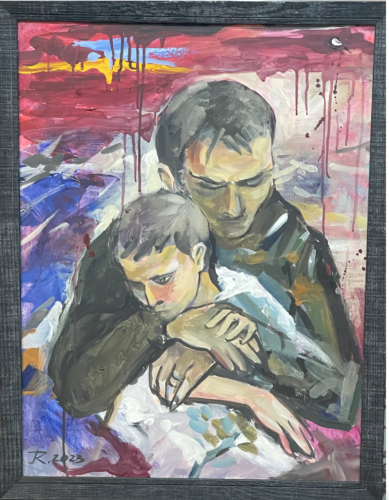
Take a moment for a heart “Check In” regarding this painting. The man is our friend, delivering supplies and love in Ukraine in the first weeks of the war. The boy just lost his parents to the bombing. What’s your heart say on this? Check In #2. What do you hear Jesus saying? weeping? loving? There is a “rest of the story”. Looking forward to the sharing on this………DJR

A Place of Belonging

April 26th, 2024

Father Richard describes Francis of Assisi’s early days of ministry and how he related to nature:   

Francis sets out on the road, excited because he knows his vocation is to be a contemplative, spending time in nature in solitude and prayer, and to be in active ministry and to preach to people what he’s experienced. Along the way, he sees a tree filled with birds. He approaches the tree and the birds don’t fly away, so he starts talking to them. We have several accounts of this first sermon which is not to human beings but to animals, to birds. Maybe it’s been romanticized, but the story is that they stayed and listened to him. At the end of the sermon he says, now go off, because I’ve told you who you are.   

For the rest of his life, Francis is in relationship with a variety of animals, birds, fish, trees, and flowers. He always tells these creatures, “Do you realize that by your very existence, you are inherently giving glory to God? So just be who you are. Every animal, every created being has a unique thing to do. Each of you, do your thing; and in that doing, you are giving glory to God!” He would take delight in everything doing its thing. This is a mutual mirroring and I think it allowed him to do his own thing. He realized that just by being Francis, in all his freedom and joy, he also was giving glory to God. He has no trouble being alone because mirrors are everywhere.    

The only reason I can talk about Francis’ relationship with nature with some confidence is because it’s honestly what I have experienced on my Lenten retreats in the desert. I know it may sound fanciful, but everything becomes a mirror—whether the shape of rocks or the color. I’d collect a whole pile of rocks by the end of the five weeks because they were always naming something about me, and I didn’t even know what it was. All I’m saying is the whole world comes to life: every kind of cactus, every kind of tree or dead branch, the sunrise, the sunset, the different kinds of birds. I find myself in the middle of a universe of belonging.     

David Whyte echoes this message in his poem “The Sun.” Father Richard shares an excerpt:   

… I want to walk   
through life   
amazed and inarticulate   
with thanks….     

I want to know   
when I lean down to the lilies   
by the water   
and feel their small and   
perfect reflection   
on my face….    

I want to know   
what I am   
and what I am    
involved with by loving   
this world   
as I do….  

I want to be found by love,   
… I want to come alive   
in the holiness   
of that belonging. [1]  

___________________________________________

Sarah Young, Jesus Calling

     As you look into the day that stretches out before you, you see many choice-points along the way. The myriad possibilities these choices present can confuse you. Draw your mind back to the threshold of this day, where I stand beside you, lovingly preparing you for what is ahead.
     You must make your choices one at a time, since each is contingent upon the decision that precedes it. Instead of trying to create a mental map of your path through this day, focus on My loving Presence with you. I will equip you as you go, so that you can handle whatever comes your way. Trust Me to supply what you need when you need it.

RECOMMENDED BIBLE VERSES:

Lamentations 3:22-26 NLT
22 The faithful love of the LORD never ends! His mercies never cease.
23 Great is his faithfulness; his mercies begin afresh each morning.
24 I say to myself, “The LORD is my inheritance; therefore, I will hope in him!”
25 The LORD is good to those who depend on him, to those who search for him.
26 So it is good to wait quietly for salvation from the LORD.

Additional insight regarding Lamentations 3:21-23: Jeremia saw one ray of hope in all the sin and sorrow surrounding him: “The faithful love of the Lord never ends……Great is his faithfulness; his mercies begin fresh every morning.” God willingly responds with help when we ask. Perhaps there is some sin in your life that you thought God would not forgive. God’s steadfast love and mercy are greater than any sin, and he promises forgiveness.

Additional insight regarding Lamentations 3:23: Jeremiah knew from personal experience about God’s faithfulness. God had promised that punishment would follow disobedience, and it did. But God also had promised future restoration and blessing, and Jeremiah knew that God would keep that promise also. Trusting in God’s faithfulness day by day makes us confident in his great promises for the future.

Psalm 34:8 NLT
8 Taste and see that the LORD is good. Oh, the joys of those who take refuge in him!

Additional insight regarding Psalm 34:8: “Taste and see” does not mean, “Check out God’s credentials.” Instead, it is a warm invitation: “Try this; I know you’ll like it.” When we take that first step of obedience in following God, we will discover that he is good and kind. When we begin the Christian life, our knowledge of God is partial and incomplete. As we trust him daily, we experience how good he is!

Where the Spirit Speaks

April 25th, 2024

Theologian Randy Woodley tells of being invited by a friend to a contemplative prayer gathering: 

I came one time and they sat around in a room that was completely closed with orange shag carpeting. There were no windows. You could tell the carpet was old, and the idea was to sit there and listen to the Spirit. I sat through the gathering and a lot of silence. Afterwards my friend was smiling and asked, “How did you like it?” I said, “Well, to be honest, I didn’t like it…. Why weren’t you guys sitting outside? It’s a beautiful day out. You’re in this dark room.”   

Of course, there are a lot of different contemplative traditions when it comes to silence. In our Native way, we are more or less listening, not just to ourselves or what we would say the Spirit puts in our hearts, but to what’s going on around us. We’re listening to the birds to see what kind of message they have. We’re listening to the wind to see if there’s a song in it for us. It might sound esoteric, but we’re listening to the way that we “spin in silence” by hearing what I believe is perhaps Creator’s most communicative means on earth—which is creation.   

I think of that when I read Luke chapter 4, the story where Jesus goes out into the wilderness for forty days. The idea we’ve been taught is that he is tempted for forty days, but everybody knows that you can’t be tempted for forty days. Let’s say the temptations took up ten days—well, what about the other thirty? What was he doing? Jesus was watching creation. He was observing what was going on around him. He was listening. The reason that we know that is because when he comes back, he talks about creation for the rest of his life. He talks about flowers and birds and trees and seeds and crops and the earth, and the soil. He could have talked about all kinds of things—Roman chariots and their power and aqueducts and the ingenuity involved—but that’s not what we have a record of. What we have a record of is someone who seemed to be at peace with the quietness of creation.… 
 
The Spirit is so contrary to what we might think or desire sometimes. At one time in my life, it was like every time I wanted to hear from God, God would speak through some person. And every time I wanted wisdom from a person, I couldn’t get it, and I could only hear it in silence from God…. When I go out and I listen in creation and I’m listening to the birds, then all of a sudden the Spirit speaks in my heart. It’s not necessarily always silence. Engaged listening is such a sacred thing, and the Spirit works through that so often.  

____________________________________________

Sarah Young Jesus Calling

Rest in My Presence, allowing Me to take charge of this day. Do not bolt into the day like a racehorse suddenly released. Instead, walk purposefully with Me, letting Me direct your course one step at a time. Thank Me for each blessing along the way; this brings Joy to both you and Me. A grateful heart protects you from negative thinking. Thankfulness enables you to see the abundance I shower upon you daily. Your prayers and petitions are winged into heaven’s throne room when they are permeated with thanksgiving. In everything give thanks, for this is My will for you. 

RELATED SCRIPTURE: 

Colossians 4:2 NLT

An Encouragement for Prayer

2 Devote yourselves to prayer with an alert mind and a thankful heart.

1st Thessalonians 5:18 NLT

18 Be thankful in all circumstances, for this is God’s will for you who belong to Christ Jesus.

The Preaching of the Trees

April 24th, 2024

Barbara Mahany writes of the converting experience the Book of Nature had on the Christian mystic Brother Lawrence: 

Sometimes, when closely reading the Book of Nature, the profoundest of lessons are learned from the quietest, most quotidian of happenstance. Suddenly seeing what you might have walked past countless dozens of times. Being awake to gospel in the plainest of wrappers. A buck-naked tree, perhaps. A tree whose very nakedness suddenly offers aha

Brother Lawrence [1611–1691], the seventeenth-century barefoot friar who found God in the pots and pans of his monastery kitchen in Paris, told one such story. In his one published work [1], a collection of fourteen letters, a wisp of an eighty-page volume I once unearthed from a library’s musky archives, he wrote how a tree in winter, stripped of its leaves, played the pivotal role in his uncanny conversion. It seems the good brother absorbed the tree’s stark emptiness, and, in that way that saints and wise souls do, he saw beyond it. He imagined the possible. As it’s recorded in his little book’s preface, the soon-to-be-friar stood before the naked tree picturing its branches soon filled with tiny leaves as if clasped in prayer. And thus he was hit, head-on. The surging sense of the immensity of the Holy One all but knocked him down, realizing the life force, the beautiful that would burst from the barren. In his little book’s preface, I was struck most of all by how strange it is that divine attributes can sometimes be seen in something so common. And how we’ll miss the whole of it if we refuse to be stopped in our tracks. 

Mahany describes some of the sermons offered by the Book of Nature: 

What are the sermons that the woods—those places of betweenness, repositories of ancient stories—might impart from their fretwork of branches and twigs, their columnar trunks and the boughs that hold up the sky? Certainly, there are tales of resilience, the way they stand against whatever time and the weather gods hurl their way, tornado or drought, ice storm or Noah-like rains. And lessons to be learned of holy communion, the way the woods and the birds and the scampering critters all keep watch, share food, warn each other of danger, create ecosystems that moderate heat and cold, store water, and generate necessary humidity. What else of the time-tested truths, laid down like the rings revealed in a fallen tree’s stump?… 

My temple, my mosque, my church of the woods, where the center aisle is earth rubbed raw, threadbare, not unlike a great aunt’s mothballed Persian rugs, where the vaulted halls are awash in shifting shadow and numinous light, bathed in a mystical halo, it is the holy place to which I return and return. It is a woods that preaches to me, fills me with wordless wisdoms. It is the place where I behold the awe-inspiring mystery of how I hope heaven will someday be. 

__________________________________________________

Sarah Young Jesus Calling

Be still in the Light of My Presence, while I communicate Love to you. There is no force in the universe as powerful as My Love. You are constantly aware of limitations: your own and others’. But there is no limit to My Love; it fills all of space, time, and eternity.

    Now you see through a glass, darkly, but someday you will see Me face to Face. Then you will be able to experience fully how wide and long and high and deep is My Love for you. If you were to experience that now, you would be overwhelmed to the point of feeling crushed. But you have an eternity ahead of you, absolutely guaranteed, during when you can enjoy My Presence in unrestricted ecstasy. For now, the knowledge of My loving Presence is sufficient to carry you through each day.

RELATED SCRIPTURE: 

1st Corinthians 13:12 NLT

12 Now we see things imperfectly, like puzzling reflections in a mirror, but then we will see everything with perfect clarity. All that I know now is partial and incomplete, but then I will know everything completely, just as God now knows me completely.

Ephesians 3:16-19

16 I pray that from his glorious, unlimited resources he will empower you with inner strength through his Spirit. 17 Then Christ will make his home in your hearts as you trust in him. Your roots will grow down into God’s love and keep you strong. 18 And may you have the power to understand, as all God’s people should, how wide, how long, how high, and how deep his love is. 19 May you experience the love of Christ, though it is too great to understand fully. Then you will be made complete with all the fullness of life and power that comes from God.

Formed by the Desert

April 22nd, 2024

David Denny and Tessa Bielecki direct the Desert Foundation, an informal circle of friends who share a love for desert land, people, and spirituality. Bielecki shares how she fell in love with the spaciousness of the desert:  

I grew up in New England, a countryside of lush green hills, singing streams, and verdant forests of oak and maple. In springtime I picked bouquets of wildflowers and in summer romped through the tall grasses full of daisies. When the trees turned crimson and gold in autumn, I gathered bundles of leaves and pressed them between the pages of my beloved books. In winter I built bonfires, skated on the ponds and went tobogganing down the steep hills.… 

I first saw the vast magnificent desert of the American Southwest in 1966 and have lived there since 1967. It was love at first sight, the most dramatic epiphany of my life. It felt like coming home—to myself. I recognized the outer landscape as a mirror of my inner soulscape.  

The desert is the homeland of my heart. I don’t find it barren as many do. I find the desert spacious, a perfect embodiment of what my Buddhist friends mean by sunyata, infinite spaciousness. My spiritual path is cultivating a heart as spacious as the desert: wide open to every direction of the compass, wide open to every creature that walks, flies, or crawls through it, wide open to every change in the weather: darkness and light, sun and rain, aridity and dew, heat, cold, and wind.  

St. Teresa [of Ávila], who grew to become my best friend, called the human soul an interior castle. “Let’s not imagine that we are hollow inside,” [1] she wrote. “The soul is capable of much more than we can imagine.” [2] This infinite and noble spaciousness is what I learn from the desert. [3]  

For Denny, the desert is not “deserted”; it can lead to peacemaking and a fullness of life.  

Peacemaking happens best when we develop a way of life that includes an understanding of desert spirituality. That is, in addition to being geography and spirit, the desert, as I’m fond of saying, has traditionally fostered hospitality, respect, and dialogue with the stranger. This spirit arises from various aspects of the “desert”: a freely chosen dedication to humility, interfaith dialogue, and simple, ecologically sustainable living….  

For many people, the desert is a place to avoid, a place of banishment or grief, or simply useless and vacant. In English, when we say that a place is “deserted,” we usually mean that we find nothing significant there. But the Arabic verb ashara means to enter the desert willingly, for there, according to The Sacred Desert by David Jasper, “If one knows where to look, there are springs and wells of water and places of life.” [4] That’s why Isaiah 35:1 so aptly describes the heart of the universal desert experience: The desert and the dry land will be glad; the wilderness will rejoice and blossom. [5] 

Jesus Was Not a Straight Talker
In the climax of the classic courtroom movie, A Few Good Men, the prosecutor demands to know the truth and Jack Nicholson’s character, Colonel Jessep, famously shouts back, “You can’t handle the truth!” Maybe he was right. Maybe most of us have a difficult time accepting the truth when it’s presented to us directly. Emily Dickinson, the famous poet, seemed to think so. She said, “The Truth must dazzle gradually or every man be blind.” Therefore, rather than speaking directly, she advises to “Tell all the truth but tell it slant.”That perfectly describes Jesus’ teaching style. Of course, he spoke the truth, but he rarely spoke it directly. Instead, he told it slant—indirectly, subtly, and often hidden in a story that some people missed entirely. This week we are beginning a series exploring the parables of Jesus, but in order to understand these stories, we must first acknowledge the enormous gap between Jesus’ context and our own; between the way he taught the truth and the way we do. Our modern, post-enlightenment culture expects clear, direct teaching. This is evident by what passes for acceptable preaching in most churches. We want a sermon to include three points (preferably alliterated) and practical, unambiguous applications. We hope to walk out of church on Sunday with more clarity, not more questions, about life and faith. If the pastor manages to do that we feel satisfied. If we regularly leave more confused than when we entered, the pastor should start updating his resume.Jesus’ first-century Jewish context was very different. It was, of course, a pre-modern culture that embedded wisdom into stories more often than it delineated truths with bullet points. This is what causes us to misinterpret and mishandle Jesus’ parables. Our instinct is to break his stories into their component parts and attach a clear meaning to each piece. We treat them as allegories or force them into a modern, didactic framework.The uncomfortable fact is that Jesus offered very little practical instruction in his sermons (at least as we measure practicality today), and he never preached a popular American “how-to” message. Jesus was not a straight talker. Instead, his stories were designed to challenge his listeners’ assumptions and surprise them with unexpected, even offensive, revelations about God and his kingdom. Sometimes Jesus even intended to confuse them. More often, however, his parables began with an object, circumstance, or relationship that his audience was familiar with, and then he surprised them with a twist that turned their assumptions upside down.Dr. Gary Burge, a New Testament professor, describes Jesus’ stories this way: “They are like a box that contains a spring—and when it is opened, the unexpected happens. They are like a trap that lures you into its world and then closes on you.”As we look at Jesus’ parables in the coming days, be prepared to have many of your assumptions about faith and God turned upside down as well.

DAILY SCRIPTURE
ISAIAH 29:15-21 
MATTHEW 13:10-17 
LUKE 18:31-34


WEEKLY PRAYERFrom William Temple (1881 – 1944)

O God, king of righteousness, lead us, we pray you, in the way of justice and of peace;
inspire us to break down all oppression and wrong, to gain for everyone their due reward, and from everyone their due service;
that each may live for all and all may care for each, in the name of Jesus Christ our Lord.
Amen.