Archive for the ‘Uncategorized’ category

The Sacred and the Concrete

April 19th, 2024

Father Richard describes how reading poetry contemplatively can be a sacred practice: 

Great art and great myth try to evoke an epiphany in us. They want to give us an inherent and original sense of the holy. They make us want to kneel and kiss the ground. Robert Frost said, “A poem begins with a lump in the throat; a home-sickness or a love-sickness.” [1] If a poem doesn’t give us a lump in the throat, is it really great poetry? My final theological conclusion is that there’s only one world and that it’s all sacred. However, we have to be prepared to know what we’re saying when we say that. If we say too glibly that the trees are sacred, along with our dog, a friend, and the roses, then we don’t really believe it. We first need to experience “a lump in the throat” to have encountered the sacred. The sacred is something that inspires awe and wonder, something that makes us cry, something that gives us the lump in the throat. We must first encounter the sacred in the concrete and kneel before it there, because we can’t start with the universal.  

Poets are masters of the concrete. They first pull us into a single similarity between an animal, an object in nature, or an event, before they shock us with the dissimilarity. Then, they leave us there to make the connection between the concrete and the universal. When we make that connection, there’s suddenly a great leap of meaning, an understanding that it’s one world. The very word “metaphor,” which comes from two Greek words, means to “carry across.” A good metaphor carries us across, and we don’t even know how it’s occurred. Here are a few lines from Mary Oliver’s poem “Have You Ever Tried to Enter the Long Black Branches”:  

Have you ever tried to enter the long black branches  

of other lives—  

tried to imagine what the crisp fringes, full of honey,  

hanging  

from the branches of the young locust trees, in early summer,  

feel like? …

Who can open the door who does not reach for the latch?  

Who can travel the miles who does not put one foot  

in front of the other, all attentive to what presents itself

continually?  

Who will behold the inner chamber who has not observed  

with admiration, even with rapture, the outer stone?  

Well, there is time left— 
fields everywhere invite you into them. [2] 

When reading poetry like this, we have to release ourselves and we have to have time to do it. If we’re reading a poem too quickly, between two urgent meetings or other hurried spaces, we probably won’t get it, because we don’t have time to release ourselves. We need quiet, solitude, and open space to read poetry at greater depth. Then and only then do poems work their magic.  

_______________________________________________

Sarah Young

Peace is My continual gift to you. It flows abundantly from My throne of grace. Just as the Israelites could not store up manna for the future but had to gather it daily, so it is with My Peace. The day-by-day collecting of manna kept My people aware of their dependence on Me. Similarly, I give you sufficient Peace for the present, when you come to me by prayer and petition with thanksgiving. If I gave you permanent Peace, independent of My Presence, you might fall into the trap of self-sufficiency. May that never be!
     I have designed you to need Me moment by moment. As your awareness of your neediness increases, so does your realization of My abundant sufficiency. I can meet every one of your needs without draining My resources at all. Approach My throne of grace with bold confidence, receiving My Peace with a thankful heart.

RECOMMENDED BIBLE VERSES:
Exodus 16:14-20 NLT
14 When the dew evaporated, a flaky substance as fine as frost blanketed the ground. 15 The Israelites were puzzled when they saw it. “What is it?” they asked each other. They had no idea what it was. And Moses told them, “It is the food the LORD has given you to eat. 16 These are the LORD ’s instructions: Each household should gather as much as it needs. Pick up two quarts for each person in your tent.” 17 So the people of Israel did as they were told. Some gathered a lot, some only a little. 18 But when they measured it out, everyone had just enough. Those who gathered a lot had nothing left over, and those who gathered only a little had enough. Each family had just what it needed. 19 Then Moses told them, “Do not keep any of it until morning.” 20 But some of them didn’t listen and kept some of it until morning. But by then it was full of maggots and had a terrible smell. Moses was very angry with them.

Philippians 4:6-7 NLT
6 Don’t worry about anything; instead, pray about everything. Tell God what you need, and thank him for all he has done. 7 Then you will experience God’s peace, which exceeds anything we can understand. His peace will guard your hearts and minds as you live in Christ Jesus.
Additional insight regarding Phillippians 4:6-7: Imagine never worrying about anything! It seems like an impossibility; we all have worries on the job, in our homes, at school. But Paul’s advice is to turn our worries into prayers. Do you want to worry less? Then pray more! Whenever you start to worry, stop and pray.

Additional insight regarding Philippians 4:7: God’s peace is different from the world’s peace (see John 14:27). True peace is not found in positive thinking, in the absence of conflict, or in good feelings. It comes from knowing that God is in control. Our citizenship in Christ’s Kingdom is sure, our destiny is set, and we can have victory over sin. Let God’s peace guard your heart against anxiety.

Philippians 4:19 (NLT)
19 And this same God who takes care of me will supply all your needs from his glorious riches, which have been given to us in Christ Jesus.

Additional insight regarding Philippians 4:19: We can trust that God will always meet our needs. Whatever we need on earth he will always supply, even if it is the courage to face death as Paul did. Whatever we need in Heaven he will supply. We must remember, however, the difference between our wants and our needs. Most people want to feel good and avoid discomfort or pain. We may not get all that we want. By trusting in Christ, our attitudes and appetites can change from wanting everything to accepting his provision and power to live for him.

Hebrews 4:16 NLT
16 Let us then with confidence draw near to the throne of grace, that we may receive mercy and find grace to help in time of need.

Today’s Prayer:

Dear God,

Just as the Israelites gathered manna each day, I come to You for Peace each day, recognizing my dependence on Your presence to sustain me. Help me not to seek permanent Peace apart from You, but to approach Your throne with confidence, receiving Your abundant sufficiency with endless thanksgiving. In your Son’s name, Amen.

A Sacred Conversation

April 18th, 2024

To make art is to make love with the sacred. —Mirabai Starr, Wild Mercy

Mirabai Starr considers the leap of faith required to accept the invitation to creativity:    

A miraculous event unfolds when we throw the lead of our personal story into the transformative flames of creativity. Our hardship is transmuted into something golden. With that gold we heal ourselves and redeem the world. As with any spiritual practice, this creative alchemy requires a leap of faith. When we show up to make art, we need to first get still enough to hear what wants to be expressed through us, and then we need to step out of the way and let it. We must be willing to abide in a space of not knowing before we can settle into knowing. Such a space is sacred. It is liminal, and it’s numinous. It is frightening and enlivening. It demands no less than everything, and it gives back tenfold…. 

The thing is to allow ourselves to become a vessel for a work of art to come through and allow that work to guide our hands. Once we do, we are assenting to a sacred adventure. We are saying yes to the transcendent and embodied presence of the holy. [1]  

Artist Scott Avett describes the sacred conversation that takes place in his studio:   

Painting is like living, though. An idea is born, an invitation accepted, and a devotion sustained in a mysterious gift of joy and suffering, from its inception to its end. It is in the deepest and darkest moments of this mystery that I may feel the heaviest of doubts, but I long to create faithfully. To create faithfully, I am asked to follow an idea into darkness, not knowing where it will go or what may come of me. To enter into this mysterious exchange is faith itself…. 

Here in the studio, the directions I can go are endless. The ocean of images and sounds is bottomless. The list of tools to make a single mark is infinite. All of this to say one thing, “I am.” I have created many forgettable works under different proclamations: “I will,” “I want,” “I can,” “I should,” and “I need to” are a few that come to mind. These are the echoes of a world obsessed with “doing it right.” I jump in and try my hand at this rightness, but I cease to exist in these moments. I disappear into aspiration and become a stranger to myself and God. In a word, I leave. When I return, however, I arrive in the present. I catch a glimpse of the kingdom of heaven. I am actually invited to do this at every moment, but I slip away again and again. I hide from God, behind my proclamations, until I consent once again, and all these claims fade into the eternal “I am.” It is the “I am a child of God” “I am.” Everything I do hinges on this very truth. [2]  

____________________________________________

Sarah Young Jesus Calling

You are My beloved child. I chose you before the foundation of the world, to walk with Me along paths designed uniquely for you. Concentrate on keeping in step with Me, instead of trying to anticipate My plans for you. If you trust that My plans are to prosper you and not to harm you, you can relax and enjoy the present moment. 
     Your hope and your future are rooted in heaven, where eternal ecstasy awaits you. Nothing can rob you of your inheritance of unimaginable riches and well-being. Sometimes I grant you glimpses of your glorious future, to encourage you and spur you on. But your main focus should be staying close to Me. I set the pace in keeping with your needs and My purposes.

RELATED SCRIPTURE:

Ephesians 1:4 (NLT)
4 Even before he made the world, God loved us and chose us in Christ to be holy and without fault in his eyes.

Proverbs 16:9 (NLT)
9 We can make our plans,
    but the Lord determines our steps.

Jeremiah 29:11 (NLT)
11 For I know the plans I have for you,” says the Lord. “They are plans for good and not for disaster, to give you a future and a hope.

Ephesians 1:13-14 (NLT)
13 And now you Gentiles have also heard the truth, the Good News that God saves you. And when you believed in Christ, he identified you as his own by giving you the Holy Spirit, whom he promised long ago. 14 The Spirit is God’s guarantee that he will give us the inheritance he promised and that he has purchased us to be his own people. He did this so we would praise and glorify him.

The Spirit Inspires

April 17th, 2024

Brazilian liberation theologian Leonardo Boff witnesses the presence of the Holy Spirit in the creativity of the arts.  

[The Spirit] is present wherever people live by love, witness to the truth, act in solidarity, and practice compassion. Wherever such realities are manifest in human beings, anywhere in the world, it is a sign that the Spirit has come upon them and is active within them.   

It is by the inspiration of the Spirit that poets and writers redraw life with all its lights and shadows, its dramas and achievements. They are seized by an inner light, and by energies that prompt unexpected connections; they bring something new into the world. Many writers confess … that they feel possessed by an inner energy (a daimon, a good spirit) that seizes them and makes them think and write.   

By the inspiration of the Spirit, artists and artisans elicit from their material—wood, stone, marble, granite—an image that only they can see in it. The material is spiritualized, and the spirit is materialized.… 

The Spirit is especially intense in music. Sounds are invisible, unconstrained by space and time, just as no one can limit the action of the Spirit. And the melodies they project lift up and penetrate the soul; in them we find comfort, beauty to cry over, soaring joy. The great evangelical theologian Karl Barth used to say that Mozart took his wonderful melodies from heaven and the Breath (the Holy Spirit).  

Boff writes of the generous nature of the Spirit that is not constrained by human valuation: 

The arts are very much like the Spirit. They are intangible. They are ends in themselves. They have an intrinsic value…. Art, music, and poetry in themselves are priceless. They are unique creations, not serial productions. They are like a gift we give to a loved one, valuable for its own sake. Somehow they escape the limits of time and bring us a foretaste of eternity.   

Inspiration is in the air and settles on people without regard for their skin color, their social background, or their educational level. How many illiterate artists have emerged in [Brazil], in marginal communities, and were never noticed: poets, artisans, painters, singers, musicians, mystics? Boasting is not the Spirit’s way; it is like water that quietly runs along the ground, fills the vessels it is poured into, and always chooses to run downhill.  

That is why the Spirit does not have its own figure, as the Father and the Son do. It is portrayed as a dove, but what is important is the radiant light it gives off. It is the Breath (Spiritus in Latin) that reveals life, sustains life, and renews life in every way.     

The universe and all beings are saturated with Spirit. To recognize its presence in every corner of the cosmos is the work of spirituality, of life in the Spirit. 


Bursting the Nationalist Bubble
We began this series with the scene of Jesus entering his hometown synagogue and reading from the scroll of Isaiah (Luke 4:16-28). He used the Old Testament passage to announce his messianic identity and the nature of his mission to bring justice—the restoration of God’s order. The people of Nazareth were understandably surprised and excited, but Jesus didn’t stop there.He continued by referencing two more stories from the Old Testament. Both were about God’s care for foreigners. During a famine, the prophet Elijah was sent to help a foreign widow rather than to the many widows in Israel. And Elisha only healed Naaman, the Syrian general with leprosy, but never a leper from among God’s own people.
After Jesus told these stories, the vibe in the synagogue changed dramatically. “All the people in the synagogue were furious when they heard this.” In fact, they drove Jesus from the town and tried to kill him.Why the outrage? The Jews in Jesus’ hometown, like people throughout the land at that time, were extremely zealous about their Jewish identity. After all, they were God’s chosen people, but they were living in humiliation under the oppression of a foreign, pagan empire. That’s why they were so excited when Jesus read the prophetic words from Isaiah. The people expected the Messiah to appear, defeat the Romans, and restore Israel’s rightful place of glory above every other nation. Their patriotism swelled with hope.

By referencing the story of Naaman, however, Jesus burst their nationalist bubble. The stories about the widow and Naaman were about God giving preferential care to non-Israelites. Even worse, in Naaman’s story it’s the Israelite, Gehazi, who is cursed by God and given Naaman’s leprosy. In a not-so-subtle rebuke, Jesus was warning his neighbors to not put their hope in their ethnic or national identity but to put their hope in God himself. As Gehazi’s fate showed, simply being an Israelite did not make someone righteous. Just as being a pagan, like Naaman, did not condemn someone to a fate beyond God’s mercy.

Jesus was warning his neighbors that their arrogance and hatred of the Romans would lead them to the same fate as Gehazi and that God’s messianic blessing would instead be given to gentiles like Naaman. The people of Nazareth understood Jesus’ message and were furious. The idea that Israel’s God would show kindness to pagans, to foreigners, and heaven forbid to Romans!—was unacceptable and insulting. And yet, the reversal of fortune seen at the end of Naaman’s story is precisely what we see unfold in the gospels.

For example, like Naaman the Syrian general, it was a Roman centurion whose faith Jesus praised. “Truly I tell you, I have not found anyone in Israel with such great faith” (Matthew 8:10). When he arrived in Jerusalem, it was not the pagan foreigners Jesus cursed and rejected, but the religious leaders of Israel just as Elisha had cursed and rejected Gehazi. And it was not the occupying armies of Rome that Jesus cleansed from the city, but the Jewish merchants and moneychangers in the Temple courts.Like Gehazi, the Jews of Jesus’ day believed they were guaranteed God’s blessings because of their identity. And they believed that gentiles, like Naaman and the Romans, were forever beyond the reach of God’s love and mercy. They were wrong on both counts. The story of Naaman and the gospels reveal that judging anyone—including ourselves—based simply on their national, ethnic, or even religious identity is proof that we do not know the heart of God.

DAILY SCRIPTURE

MATTHEW 8:5-13 
2 KINGS 5:1-27


WEEKLY PRAYERfrom Basil of Caesarea (330 – 379)

May the Father of the true light—who has adorned day with heavenly light, who has made the fire shine which illuminates us during the night, who reserves for us in the peace of a future age a spiritual and everlasting light—enlighten our hearts in the knowledge of truth, keep us from stumbling, and grant that we may walk honestly as in the day. Thus we will shine as the sun in the midst of the glory of the saints.
Amen.

The Jazz Gospel

April 16th, 2024

Jazz helps us be sensitive to the whole range of existence. Far from offering us rose-colored glasses … it realistically speaks of sorrow and pain…. Jazz stimulates us to feel deeply and truthfully…. Jazz thunders a mighty “yes.”
—Alvin L. Kershaw, “Religion and Jazz”   

CAC teacher Barbara A. Holmes writes of the spirit of possibility that is present in those creating and listening to jazz:   

When Miles Davis blows the cacophony that can barely be contained by the word song, we come closest to the unimaginable, the potential of the future, and the source of our being. Yet, jazz musicians will tell you that improvisation is risky business. They will also tell you, as [John] Coltrane did, that sometimes they receive their inspiration from divine sources. When you listen to Coltrane, you hear beyond the notes. You hear the old neighborhood and the folks we left behind emerge behind half notes. The straining trumpet blasts away the illusion that our upward mobility will bring peace.  

But while jazz challenges and prods us, it also takes us to church.… [Historian] Martin E. Marty [observed] that the key to understanding links between worship and jazz is subsumed in the word awe. This is an emotion that is accessible to everyone. He says that “jazz can erupt in joy.” [1] Joy infused with the riffs of awe tends to be unspeakable.… 

Art also carves pathways toward our inner isles of spirituality. When we decide to live in our heads only, we become isolated from the God who is closer than our next breath. To subject everything to rational analysis reduces the awe to ashes. The restoration of wonder is the beginning of the inward journey toward a God who people of faith aver is always waiting in the seeker’s heart. For some, the call to worship comes as joy spurts from jazz riffs. [2]  

Jazz pianist and minister William Carter describes how jazz can help us pray:  

I have a high view of instrumental music as a potential spiritual gift for the listener and the musician alike.… A jazz quartet can utter things in the presence of God that mere words fail to say. A saxophone can lament on behalf of those who feel helpless. A piano may offer intercessions for those who are in need. A string bass can affirm the firm foundation of faith. Drums and cymbals may call pilgrims to break into joy.  

Poet Ron Seitz has spoken about how, as a young man, he befriended writer and theologian Thomas Merton…. Seitz tells of the night he went with Merton to a jazz club in Louisville. [3] As the group began to play, Merton leaned over to whisper, “They’re going to start talking to each other now. Listen.” Then he moved closer to the bandstand to get a better look. Later, returning with his eyes wide, he said to Seitz, “Now that’s praying. That’s some kind of prayer! The new liturgy. Really, I’m not kidding.”

==================

Trading Places
The first body-swap movie was Disney’s Freaky Friday in 1976 starring a teenage Jody Foster who trade bodies with her mother. The success of Freaky Friday resulted in a steady flow of body-swap films ever since. The gimmick may have started as a family comedy, but it has expanded into sci-fi, action, horror, animation, and even dramas. Sometimes the body-switchers are a child and parent, male and female, a human and an animal, or two enemies. Whatever the details, the body-switching genre remains popular because it provides storytellers with a shortcut to empathy. It’s the quickest way to get a character to see life through another’s eyes by having them literally walk in someone else’s shoes.

While technically not a body-switching story, by the end of 2 Kings 5 Naaman and Gehazi did switch bodily afflictions. And a careful reading of the chapter reveals the two men swapped much more. After lying to Naaman to steal his wealth, Gehazi was confronted by Elisha for his treachery. “Is this the time to take money or to accept clothes—or olive groves and vineyards, or flocks and herds, or male and female slaves?” Gehazi only stole Naaman’s silver and clothing. So, why did Elisha mention groves, vineyards, flocks, and slaves?To understand Elisha’s rebuke we must remember the beginning of the story. Naaman was identified as “a great man” and the leader of Syria’s armies. He often invaded and plundered Israel’s territory. He was responsible for taking Israel’s land, flocks, and even its people.

Remember, Naaman first learned about Elisha from an Israelite girl he had captured, trafficked, and enslaved. Throughout the first part of the story, before his healing, Naaman is depicted as an arrogant, powerful, and greedy man.After his healing, however, Naaman was transformed. He was humble and generous. He repeatedly called himself Elisha’s “servant,” and he gave his full allegiance to Israel’s God in gratitude for his mercy. Naaman’s cleansed character was even evident when the scheming Gehazi approached his caravan. Verse 21 says Naaman “got down from the chariot to meet him.” For a general of Naaman’s stature to come down from his chariot was a gesture of deep respect and humility. For Naaman to do this for Gehazi, a lowly servant, and a foreigner was even more impressive.

While Naaman had been cleansed of his arrogance and greed and not merely his leprosy, by the end of the story we see these sins abundantly in Gehazi. His pride and self-righteousness made him think he was entitled to take Naaman’s wealth. He used deceit and manipulation to swindle the Syrian general, and he attempted to cover up his crime by lying to Elisha. By referencing the kind of things Naaman used to plunder in war—olive groves, vineyards, flocks, herds, and slaves—Elisha was indicating that the arrogance and greed that once marked Naaman’s heart had now infected Gehazi’s. Therefore, the prophet declared that the disease that had marked Naaman’s skin would now infect Gehazi’s as well.

In these final verses, we finally discover the real point of the entire chapter—it’s essentially a body-swap story. Naaman and Gehazi traded places. The prideful man was humbled, and the humble servant was prideful. The sick man was healed, and the healthy man was diseased. The gentile honored the name of YHWH, and the Israelite betrayed the name of YHWH. The foreigner was blessed by the prophet, and the Israelite was cursed by the prophet. The Syrian was cured of leprosy, and the Israelite was inflicted with leprosy. God accepted one of Israel’s enemies, and he rejected one of Israel’s sons. As we’ll see in the days ahead, just like body-swap movies, this surprising reversal was intended to challenge the assumptions of God’s people and grow their empathy.

DAILY SCRIPTURE
LUKE 16:19-25 
2 KINGS 5:1-27


WEEKLY PRAYERfrom Basil of Caesarea (330 – 379)

May the Father of the true light—who has adorned day with heavenly light, who has made the fire shine which illuminates us during the night, who reserves for us in the peace of a future age a spiritual and everlasting light—enlighten our hearts in the knowledge of truth, keep us from stumbling, and grant that we may walk honestly as in the day. Thus we will shine as the sun in the midst of the glory of the saints.
Amen.

Art Leads Us to the Depths

April 14th, 2024

Richard Rohr describes how art can serve as a gateway to mystical experience and deeper knowing: 

There must be a way to be both here and in the depth of here. Jesus is the here, Christ is the depth of here. This, in my mind, is the essence of incarnation, and the gift of contemplation. We must learn to love and enjoy things as they are, in their depth, in their soul, and in their fullness. Contemplation is the “second gaze” through which we see something in its particularity and yet also in a much larger frame. We know it by the joy it gives.   

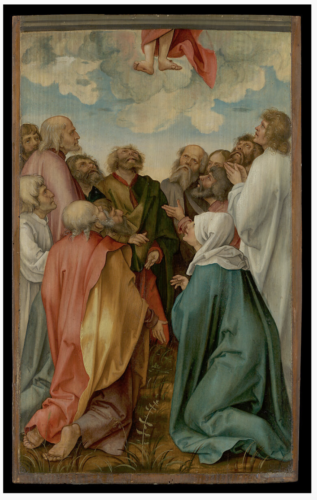
Two pieces of art have given me this incarnational and contemplative insight. The first is called The Ascension of Christ by Hans von Kulmbach (c. 1480–1522). It portrays the two human feet of Jesus at the very top of a large painting of the Ascension. Most of the canvas is taken up by the apostles, who are drawn up with Christ through their eyes, as his feet move off the top of the painting, presumably into the spiritual realms. The image had a wonderful effect on me. I too found myself looking beyond the painting toward the ceiling of the art museum. It was a mystical moment—one that simultaneously took me beyond the painting and right back into the room where I was standing.  

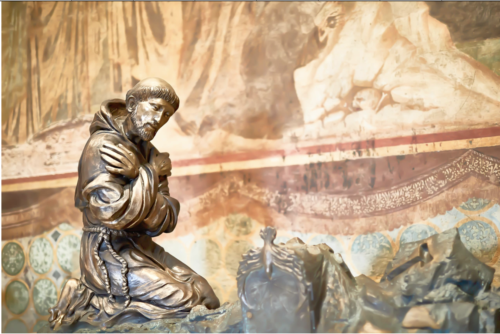
The second piece of art is a small bronze statue of St. Francis, located in the upper basilica of Assisi, Italy. Created by a sculptor whose name is hidden, the statue shows Francis gazing down into the dirt with awe and wonder, which is quite unusual and almost shocking. The Holy Spirit, who is almost always pictured as descending from above, is pictured here as coming from below—even to the point of being hidden in the dirt! God is hidden in the dirt and mud instead of descending from the clouds. This is a major transposition of place. Once we know that the miracle of “Word made flesh” has become the very nature of the universe, we cannot help but be both happy and holy. What we first of all need is here!  

Both these pieces of art put the two worlds together, but from different perspectives. Yet in both images, it is the Divine that takes the lead in changing places. Maybe artists have easier access to this Mystery than many theologians. I doubt if we can see the image of God (imago Dei) in our fellow humans if we cannot first see it in rudimentary form in stones, in plants and flowers, in strange little animals, in bread and wine, and most especially cannot honor this objective divine image in ourselves. It is a full-body tune-up, this spiritual journey. It really ends up being all or nothing, here and then everywhere.   

The Transformative Power of Art

Father Richard shares his contemplative practice of visiting art museums: 

I believe good art has the power to evoke an epiphany. Sometimes, when we can’t take our eyes off a picture or work of art, an epiphany is happening. We don’t yet know what we’re knowing while the wisdom of the unconscious is being ferried across to the conscious mind. Carl Jung said great art presents an “archetypal image.” [1] On one of my very first speaking trips away from Cincinnati, I visited the St. Louis Art Museum. They had an exhibit of Claude Monet’s water lilies; some paintings took up the whole wall. It was a quiet weekday afternoon, and as I went from room to room, I found myself getting quieter and happier, quieter and happier. When I walked out into the sunshine after the exhibit, I felt like I floated home. I wasn’t waiting for an epiphany, but I think I was granted one anyway. I don’t know that I had a new piece of doctrinal information or theological insight, but the experience connected me to something deep and true within. To this day when I’m in a city and have some time free, I go to an art museum. 

Folk artist and Living School alumna Lourdes Bernard writes:  

Art invites audiences to consider the spirituality and transformative power of images. Engaging art offers respite, contemplation, even as it shares powerful, inspiring, or difficult stories. Art images are real and alive and have the power to change us and cause change.… They can shift our perspective on what we thought we knew and understood about a subject. Too often, art is considered decorative, and it is significantly more than that. Engaging with art means we have to slow down to allow a new experience to enter which perhaps cannot be accessed in another way. It can be an expansive experience. [2] 

Richard continues: 

I believe good art, good poetry, and true mythology communicates, without our knowing it, that life is not just a series of insulated, unrelated events. The great truths—when they can be visualized in images—reveal deep patterns, and reveal that we are a part of them. That deeply heals us, and it largely happens beneath our conscious awareness. A great story pulls us inside of a cosmic story. If we’re Christian, our cosmic story is the map of the life of Jesus, the divine conception, ordinary life, betrayal, abandonment, rejection, crucifixion, resurrection, and ascension. It all comes full circle. We might not really believe it. We might not have surrendered to it or trust it, but if we can, it makes us much happier people. Our happiness is on a surface level, of course, because suffering is everywhere. We don’t close our eyes to the world’s pain, but on a deep, unconscious level, a cosmic story offers us healing and coherence. Good art gives us a sense that we belong in that story, we belong in that world.  

=================

Second-Guessing God’s Mercy
If Naaman’s story ended in verse 19, we might assume it was included in the Bible to illustrate the superiority of Israel’s God. After all, he healed Naaman’s leprosy when no foreign gods could. Or we might think the story was intended to foreshadow the day when people far beyond Israel’s borders would give the Lord their allegiance and worship. These ideas are certainly present, but it’s the conclusion of Naaman’s story (verses 20-27) that contains a surprising twist and the primary lesson of the chapter.As Naaman’s caravan heads back to Syria, we are introduced to a new character named Gehazi. He was Elisha’s servant. He disagreed with Elisha’s refusal to accept any of Naaman’s gold or silver. “My master was too easy on Naaman, this Syrian, by not accepting from him what he brought. As surely as the Lord lives, I will run after him and get something from him.”Gehazi’s words reveal that his disagreement with Elisha’s decision not to take Naaman’s wealth was all about identity. He belittles Naaman’s identity and elevates his own. Gehazi is an Israelite, one of God’s chosen, covenant people. He worships YHWH; the God who lives. Naaman, on the other hand, is dismissed as “this Syrian,” an idol-worshipping gentile. In other words, Gehazi believed his status as an Israelite entitled him to take something from this foreigner.Beyond being a gentile, Naaman was introduced at the beginning of the story as the leader of Syria’s armies. In this role, he often invaded and plundered God’s people. Gehazi may have seen Naaman’s offer of gold and silver as an opportunity to take back the wealth that rightfully belonged to Israel. It wasn’t just greed that motivated Gehazi, but vengeance. Why Elisha would pass up the chance to plunder the man who had plundered his people was inconceivable to Gehazi. So, he makes a vow, in YHWH’s name, to “get something from” this Syrian. Gehazi would self-righteously do for his people what Elisha did not.Gehazi fits a pattern we see throughout the Bible of self-righteous characters chafing against God’s mercy. Jonah is a vivid example. When the Lord extended mercy to the city of Nineveh, “it displeased Jonah exceedingly, and he was angry.” “This is why I made haste to flee to Tarshish,” Jonah complained, “for I knew that you are a gracious God and merciful, slow to anger and abounding in steadfast love.” Jonah then asked the Lord to take his life: “For it is better for me to die than to live.” The melodramatic prophet was so angry at God’s mercy that he would rather die than live in a world where his enemies are forgiven.And Jesus illustrates this attitude again in his parable about the prodigal son in Luke 15. When the rebellious younger son came home, and the father embraced him and threw a celebration, the older son was livid. “Look! All these years I’ve been slaving for you and never disobeyed your orders. Yet you never gave me even a young goat so I could celebrate with my friends. But when this son of yours who has squandered your property with prostitutes comes home, you kill the fattened calf for him!” (Luke 15:29-30).Like Jonah and the older son, Gehazi carried a sense of superiority because of his identity. I am righteous; he is a sinner. We are God’s chosen people; they are idol-worshipping pagans. Therefore, I am entitled to God’s mercy and blessings; they are not. Interestingly, the outcome of this self-righteous arrogance is not revealed by Jesus in his parable, nor is Jonah’s fate revealed. Both stories end without resolution. But not Gehazi’s. His fate serves as a clear warning to those who would second-guess God’s mercy.

DAILY SCRIPTURE
JONAH 4:1-4 
2 KINGS 5:1-27


WEEKLY PRAYERfrom Basil of Caesarea (330 – 379)

May the Father of the true light—who has adorned day with heavenly light, who has made the fire shine which illuminates us during the night, who reserves for us in the peace of a future age a spiritual and everlasting light—enlighten our hearts in the knowledge of truth, keep us from stumbling, and grant that we may walk honestly as in the day. Thus we will shine as the sun in the midst of the glory of the saints.
Amen.

A True Encounter

April 12th, 2024

True encounter with Christ liberates something in us, a power we did not know we had, a hope, a capacity for life, a resilience, an ability to bounce back when we thought we were completely defeated, a capacity to grow and change, a power of creative transformation.
—Thomas Merton, He Is Risen 

Father Richard teaches that the essence of contemplative prayer is presence and love: 

Prayer is not primarily saying words or thinking thoughts. It’s an encounter and a life stance. It’s a way of living in the Presence, with awareness of the Presence, and even enjoying the Presence. Fully contemplative people are more than aware of Divine Presence; they trust, allow, and delight in it.  

The contemplative secret is learning to live in the now, which is not as empty as it might appear to be or that we fear it may be. Try to realize that everything is right here, right now and God is in this moment in a non-blaming way. When we’re able to experience that, taste and enjoy it, we don’t need to hold on to it.  

Because most of our moments are not tasted or in the Presence, we are never full. We create artificial fullness and want to hang on to that. But there’s nothing to hold on to when we begin to taste the fullness of now. God is either in this now or God isn’t at all. If the now has never been sufficient, we’ll always be grasping. Here is a litmus test: if we’re pushing ourselves and others around, we haven’t yet found the secret of happiness. This moment is as full of the Divine Presence as it can be.  

The present moment has no competition; it’s not judged in comparison to any other. It has never happened before and will not happen again. But when I’m in competition, I’m not in love. I can’t get to love because I’m looking for a new way to dominate. The way we know this mind is not the truth is that God does not deal with us like this. Mystics, those who really pray, know this. Those who enter deeply into the great mystery do not experience a God who compares, differentiates, and judges. They experience an all-embracing receptor, a receiver who recognizes the divine image in each and every individual. 

For Jesus, prayer seems to be a matter of waiting in love. Returning to love. Trusting that love is the deepest stream of reality. That’s why prayer isn’t primarily words; it’s primarily an attitude, a stance. That’s why Paul could say, “Pray always; pray unceasingly” (1 Thessalonians 5:17). If we read that as requiring words, it’s surely impossible. We’ve got lots of other things to do. We can pray unceasingly, however, if we find the stream and know how to wade in its waters. The stream will flow through us; all we have to do is keep choosing to stay there. 

____________________________________________________________

5 For Friday: John Chaffee

1.
“I have renounced spirituality to find God.”

  • Thomas Merton, Catholic Monk and Activist
     
    Thomas Merton frequents these Friday newsletters, I know, I know.

You can’t deny it, though, this one is still just golden.  It is almost a Christian version of a Koan…

It is not that someone “gives up faith” to find God, it is more that God is larger than our concepts, frameworks, rites, and rituals.  God is willing to be experienced within them, but at some point, we butt up against the limitations of those things.

For me, there is a season in which it makes sense to “learn” religion, and then to “unlearn” it, to then “relearn” it in a larger, more mysterious sense.  (This might be similar to Brueggemann’s idea of “orientation, disorientation, reorientation”, which Rohr then calls “order, disorder, reorder.”)

It may be the wisdom of the Dark Night of the Soul that first formulated it, but there is a point at which we may need to “repent” of our own limiting understandings of God!

2.
“Individuation is the process of becoming a ‘person,’ a fully integrated and relational being… That is to say, when the individual remains undivided and does not become conscious of one’s inner opposite, the world must perforce act out the conflict and be torn into opposing halves.”

  • Sr. Ilia Delio, Franciscan Theologian
     
    This quote stopped me in my tracks.  This week I finished reading The Not-Yet God: Carl Jung, Teilhard de Chardin, and the Relational Whole.  It was not exactly an easy read, but it certainly connected some dots for me.

The possibility that all of our external conflict is the result of externalization of internal conflict is striking.  That which we cannot handle within ourselves, we seek to eliminate outside of ourselves.

Every division, every separation, every conflict, and every war is the result of an internal division, separation, conflict, or war we are dealing with.  This means that for there to be world peace that lasts, there must be the teaching of internal peace/shalom.

The book leans heavily into the idea of the Whole and how to be properly “catholic” means to be concerned (kata) with the whole (holos) of everything.

3.
For as in Adam all die, so in Christ all will be made alive.”

  • 1 Corinthians 15:22
     
    Not a few.

Not some.

Not most.

ALL.

4.
I take my cue from Jesus Christ who told me and told all of us to love each other, clothe the naked, feed the hungry, and visit those in prison. If you can’t do that, you’re not a believer—I don’t care what church you go to.”

  • James Baldwin, Civil Right Activist
     
    Any “Christianity” that does not lead toward loving one’s neighbor enough that one can’t help but do acts of compassionate justice while respecting the inherent dignity of the other… is not Christianity.

5.
“You’ve made a holy fool of me and I’ve thanked You ever since.”

  • In a Sweater, Poorly Knit by mewithoutYou
     
    I think that this singular line from mewithoutYou completely encapsulates my personal spirituality.

Spirituality as Radical Resilience

April 11th, 2024

Episcopal priest and educator Alice Updike Scannell (1938–2019) considered spirituality to be an essential element of radical resilience.  

Attending to our spirituality is an essential skill for radical resilience. The kinds of challenges and adversities in life that demand radical resilience usually cause pain and suffering. We cannot handle pain and suffering without spiritual support. Much of that spiritual support will come from people—some from those we know and some from strangers who offer a kind word or come forward to help when we need it. We might also find spiritual support through our religious tradition, twelve-step program, or a meditative practice such as tai chi, mindfulness meditation, or yoga.  

However, not all religions or spiritual belief systems are helpful for radical resilience. Any religion or spiritual belief system that is judgmental, punitive, rigid, or exclusive is a potential obstacle to resilience. The kind of spirituality that serves as a radical resilience skill respects the dignity of every human being; understands that all beings, the environment, and the universe are interconnected; views the Higher Power as loving; and holds honesty, self-awareness, compassion, forgiveness, reconciliation, openness, acceptance, and healing as core values.  

Whenever we seek to understand how we can best live our lives with meaning and purpose, through prayer, meditation, or another practice of spiritual discernment, and we pay attention with an open mind to what comes to us in response to that practice, we’re engaging with our spirituality as a radical resilience skill. Over time, engagement with spirituality in this way is transformative. It changes the way we understand ourselves. It opens our hearts to an awareness of gratitude and leads us into greater compassion and a sense of connection with others.  

Scannell names that our spirituality and faith have to mature in order to be supportive in difficult times: 

If we haven’t paid much attention to deepening our spiritual life as we’ve become adults, we’re likely to lack the spiritual resources we’ll need to be radically resilient. Our childhood understanding of spirituality is usually not adequate when we experience the kind of adversity that changes our life forever. When we search for the meaning in what has happened to us, and we search for an understanding of who we are when we can’t do what we used to do, or be who we used to be, then we need spiritual resources that go deeper….  

Yet even when we have a strong sense of spirituality and relationship with the sacred, we can experience anguish, doubt, despair, misery, and darkness. James Hollis calls these experiences “swampland visitations” and describes how they enrich our lives and help us to grow into a mature spirituality. [1] Encounters with these [painful] experiences in the spiritual framework of resilience ultimately lead to enlargement, not diminishment. “If truth be told, we wish we didn’t have to grow,” writes Hollis, “but life is asking more of us than that.” [2]  

_________________________________________________

Sarah Young Jesus Calling

This is the day that I have made. Rejoice and be glad in it. Begin the day with open hands of faith, ready to receive all that I am pouring into this brief portion of your life. Be careful not to complain about anything, even the weather, since I am the Author of your circumstances. The way to handle unwanted situations is to thank Me for them. This act of faith frees you from resentment and frees Me to work My ways into the situation, so that good emerges from it.
     To find Joy in this day, you must live within its boundaries. I knew what I was doing when I divided time into twenty-four-hour segments. I understand human frailty, and I know that you can bear the weight of only one day at a time. Do not worry about tomorrow or get stuck in the past. There is abundant Life in My Presence today.

Psalm 118:24 NLT
24 This is the day the LORD has made. We will rejoice and be glad in it.

Philippians 3:13-14 NLT
  13 No, dear brothers and sisters, I have not achieved it, but I focus on this one thing: Forgetting the past and looking forward to what lies ahead,
  14 I press on to reach the end of the race and receive the heavenly prize for which God, through Christ Jesus, is calling us.

Cultivating a New Heart

April 10th, 2024


Father Richard teaches that the inner flame of contemplation is cultivated through regular spiritual practice: 
Practice is an essential reset button that we must push many times before we can experience any genuine newness. Whether we’re aware of it or not, we are practicing all the time. When we operate by our habituated patterns, we strengthen certain neural pathways, which makes us, as the saying goes, “set in our ways.” But when we stop using old neural grooves, these pathways actually die off! Practice can literally create new responses and allow rigid ones to show themselves. 
It’s strange that we’ve come to understand the importance of practice in sports, in most therapies, in any successful business, and in creative endeavors, but for some reason most of us do not see the need for it in the world of spirituality. Yet it’s probably more important there than in any other area. “New wine demands fresh skins or otherwise we lose both the wine and the container,” as Jesus said (see Mark 2:22; Luke 5:37–38). Practices, more than anything else, create a new container for us, one that will protect the new wine we wish to take in. 
Many are convinced that rituals and “practices” like daily Eucharist, the rosary, processions and pilgrimages, repetitive chants, genuflections and prostrations, physically blessing oneself (as with the sign of the cross), singing, and silence have operated as a kind of body-based rewiring. Such practices allow us to know Reality mystically and contemplatively from a unitive consciousness. But, over time, as these practices turned into repetitive obligations, they degenerated; most people came to understand them magically as divinely required transactions. Instead of inviting people into new consciousness, such practices often froze people in their first infantile understanding of those rituals, and transactions ended up substituting for transformations. 
Mindless repetition of any practice, with no clear goal or clarity of intention, can in fact keep us quite unconscious—unless the practices keep breaking us into new insight, desire, compassion, and an ever-larger notion of God and ourselves. Automatic repetition of anything is a recipe for unconsciousness, the opposite of any genuine consciousness, intentionality, or spiritual maturity. If spirituality does not support real growth in both inner and outer freedom, it is not authentic spirituality. It is such basic unfreedom that makes so many people dislike and mistrust religious people.  
Any fear-based “rattling of beads” reflects the “magical” consciousness that dominated much of the world until it began to widely erode in the 1960s. Yet each of these practices can also be understood in a very mature way. 
It’s a paradox that God’s gifts are totally free and unearned, and yet God does not give them except to people who really want them, choose them, and say “yes” to them. This is the fully symbiotic nature of grace. Divine Loving is so pure that it never manipulates, shames, or forces itself on anyone. Love waits to be invited and desired, and only then rushes in. 

From Cancel Culture to Mercy Culture
In 2022, social psychologist Jonathan Haidt wrote a fascinating article titled, “Why the Past 10 Years of American Life Have Been Uniquely Stupid.” In the extensively researched piece, Haidt unpacks the role social media has played in the erosion of institutional and social trust. In one section, he explains the emergence of “cancel culture” and particularly the use of social media to target and silence opponents. Referring to social media posts as “dart guns,” Haidt says they “give more power and voice to the political extremes while reducing the power and voice of the moderate majority.” This is because studies show “political extremists don’t just shoot darts at their enemies; they spend a lot of their ammunition targeting dissenters or nuanced thinkers on their own team.”Haidt’s observation fits my own experience. While there are plenty of shots fired at political or cultural opponents, there is nothing like the social media fury unleashed on a member of one’s own group who is suspected of being a “squish.” Dare to question one’s side, or introduce a degree of nuance or complexity to the debate, and you’ll flee social media faster than Indiana Jones ran from the poison darts of the Hovitos. The threat of being “canceled” for being insufficiently certain and close-minded by a vocal faction of one’s own community has led wiser voices to abandon public discourse resulting in, according to Haidt, the growing stupidity of American life.The kind of certainty and inflexibility demanded by cancel culture betrays the incredible diversity and complexity of the world we now occupy. It sees only black and white and condemns those who dare admit the existence of any gray. And yet, I understand its appeal. With so many options in belief and values to choose between, and so many divergent groups to navigate, our pluralistic society can be exhausting. As Kierkegaard said, anxiety is the dizzying effect of unlimited freedom. Some try to silence the anxiety with an artificial certainty. They demand a black-and-white vision of the world and silence those who speak in shades of gray.Rather than producing more harmony, however, cancel culture only creates more fear and judgment. There is a better way—one we see extended to, and practiced by, Naaman. We can trade the cancel culture for a mercy culture.After giving his full allegiance to the Lord, Naaman recognized the difficulties that awaited him back in Syria where no one shared his new faith. He would still be required to enter pagan temples, and even assist the king with his worship of other gods. Therefore, Naaman humbly asked Elisha for understanding. In response, Elisha did not condemn or cancel Naaman. He did not rebuke him for being a “squish” or call down God’s wrath because Naaman was willing to compromise with sinners. Instead, Elisha offered him peace.Elisha’s merciful response reminds us that the world is infinitely complicated, and life is endlessly difficult. Loving God with all of our mind, heart, soul, and strength isn’t a simple paint-by-number process. It takes wisdom, nuance, discernment, and a significant amount of grace. And sometimes—perhaps many times—we will get it wrong. Elisha understood this. He recognized there were no clear black-and-white rules for following the God of Israel in a foreign, pagan country. Therefore, he extended mercy to Naaman just as the Lord had when he healed the arrogant man from Syria.This mercy from God and now extended by his prophet would also be carried by Naaman back to Syria. By his request for pardon, it’s clear that Naaman understood he could not demand that his Syrian neighbors accept or accommodate his new allegiance to Israel’s God. He would also have to extend patience and understanding to his pagan culture and his pagan king, even as he turned away from paganism himself.Elisha and Naaman display the kind of compassionate wisdom God’s people desperately need today. Of course, like Naaman, we will carry different ideas and values from others in our culture, and even among Christians, there are divergent beliefs about what faithfulness looks like today. But these challenges provide us with a choice. We may either assume the worst about our Christian sisters and brothers who think differently, condemn them as heretics, cancel them on social media, and mock them. Or, we may pursue a culture of mercy that practices patience, withholds judgment, and offers peace.

DAILY SCRIPTURE

ROMANS 14:13-19 
Romans 14:13-19
13 Therefore let us stop passing judgment on one another. Instead, make up your mind not to put any stumbling block or obstacle in the way of a brother or sister. 14 I am convinced, being fully persuaded in the Lord Jesus, that nothing is unclean in itself. But if anyone regards something as unclean, then for that person it is unclean. 15 If your brother or sister is distressed because of what you eat, you are no longer acting in love. Do not by your eating destroy someone for whom Christ died. 16 Therefore do not let what you know is good be spoken of as evil. 17 For the kingdom of God is not a matter of eating and drinking, but of righteousness, peace and joy in the Holy Spirit, 18 because anyone who serves Christ in this way is pleasing to God and receives human approval.
19 Let us therefore make every effort to do what leads to peace and to mutual edification.
2 KINGS 5:1-27


WEEKLY PRAYERfrom Thomas Aquinas (1225 -1275)

Give us, O Lord, a steadfast heart, which no selfish desires may drag downwards;
give us an unconquered heart, which no troubles can wear out;
give us an upright heart, which no unworthy ambitions may tempt aside.
Give us also, O Lord our God, understanding to know you, perseverance to seek you, wisdom to find you, and a faithfulness that may finally embrace you;
through Jesus Christ our Lord.
Amen.

Practicing Sabbath

April 9th, 2024

For many practicing Jews and Christians, Sabbath rest is an essential practice to “tend the fire within.” Biblical scholar Renita J. Weems recalls the Sabbath of her childhood: 

Once upon a time Sunday was a special day, a holy day, a day different from the other six days of the week…. This was a time when [Black] people like those I grew up with still believed that it was enough to spend six days a week trying to eke out a living, … fretting over the future, despairing over whether life would ever get better for [us]. Six days of worrying were enough. The Sabbath was the Lord’s Day, a momentary cease-fire in our ongoing struggle to survive and an opportunity to surrender ourselves to the rest only God offered. Come Sunday, we set aside our worries about the mundane and renewed our love affair with eternity….  

Our working-class hearts were ultimately fixed on one thing alone. Sunday held out to us the promise that we might enter our tiny rough-hewn sanctuary and find sanctity and blessing from a week of loss and indignities. Remembering the Sabbath where I grew up involved delighting oneself for a full twenty-four hours, ultimately in good company, with fine clothes and choice meals. The Sabbath allowed us to mend our tattered lives and restore dignity to our souls. We rested by removing ourselves from the mundane sphere of secular toil and giving ourselves over fully to the divine dimension, where in God’s presence one found “rest” (paradoxically) not in stillness and in repose but in more labor—a different kind of labor, however. We sang, waved, cried, shouted, and when we felt led to do so, danced as a way of restoring dignity to our bodies as well. We used our bodies to help celebrate God’s gift of the Sabbath. For the Sabbath meant more than withdrawal from labor and activity. It meant to consciously enter into a realm of tranquility and praise.  

After a week of the body toiling away in inane work and the spirit being assaulted with insult and loss, Sunday was set aside to recultivate the soul’s appreciation for beauty, truth, love, and eternity. 

Weems acknowledges that Sabbath is difficult to maintain, but can be a healing balm if practiced: 

The Lord’s Day allows us to bring our souls, our emotions, our senses, our vision, and even our bodies back to God so that God might remember our tattered, broken selves and put our priorities back in order. The Sabbath makes sure we have the time to do what’s really important and be with those we really care about.  

I miss the Sabbath of my childhood. I miss believing in the holiness of time. I miss believing there was a day when time stood still. There’s virtually little in this culture, and hardly anything in my adult comings and goings, to serve as a timely reminder of how precious time really is, to remind me of sacred moments. 

========================

Neither Separation Nor Domination
A significant number of our cultural and social challenges arise from a simple fact—diversity. The United States is one of the most ethnically and religiously diverse societies the world has ever seen, and despite the warped history believed by some Americans, the country’s pluralism is what its founders intended. George Washington said, “The bosom of America is open to receive not only the Opulent and Respectable Stranger, but the oppressed and persecuted of all Nations and Religions, whom we shall welcome to a participation of all our rights and privileges” (emphasis added).In many ways, America’s diversity is a great strength, but it’s not without some significant difficulties. After all, with diversity comes disagreement. Over the last 50 years, the number of Americans who attend church has declined dramatically, and only a minority of Americans remain committed to orthodox Christian doctrines about sex and marriage. Often overlooked, but perhaps more bewildering, is the plummeting biblical literacy among self-identified, churchgoing Christians, and the corresponding rise in the number of Christians who dismiss basic public virtues like honesty, humility, and mercy.Some Christians look at these changes and long for the past. They romanticize an earlier era they never experienced assuming it was more hospitable to their faith and values. Unfortunately, this sentimentality for the past can easily become antipathy toward their non-Christian neighbors. Today, we are witnessing the rise of powerful religious and political movements predicated on blaming immigrants, non-Christians, and ethnic or sexual minorities for all the country’s problems. For the Christians swept up in these movements, America’s heritage of welcoming and embracing diversity is a curse rather than a blessing. For them, tolerance is seen as the enemy of truth.The challenges of faithfully following Christ in a religiously and morally diverse society help explain the rise of two trends. First, Christian voices are calling for cultural separation. Rod Dreher’s Benedict Option is a vivid example. He calls for a “strategic withdrawal” of Christians from America’s public life and institutions to protect themselves, their children, and their churches from the corrupting influence of secularism. Second, other Christians are calling for cultural domination. Stephen Wolfe’s book, The Case for Christian Nationalism, articulates this view. He advocates for the takeover of America’s public life and institutions by Christian leaders and the imposition of Christian values upon non-believing citizens.Domination and separation represent the “fight or flight” instincts of a threatened animal. They are both born from fear and ignore our higher calling in Christ to seek a wisdom from above. As Jesus told Pilate, “My kingdom isn’t the sort that comes from here” (N.T. Wright’s translation of John 18:36). Unlike the kingdoms of the world that are rooted in fear and must use violence, coercion, or segregation to maintain their power, Christ’s kingdom is built on no such insecurity. Therefore, it is sustained by neither fear nor force. It is a kingdom that can thrive even where it is opposed.We see a glimpse of this reality in Naaman’s story. Facing the challenge of maintaining his allegiance to God upon returning to his homeland, Elisha does not tell Naaman to flee Syria to live among God’s people. Nor is he commanded to impose his religious convictions upon his pagan neighbors. Instead, Naaman is told to simply “Go in peace.” Elisha’s words reveal that Israel’s God is not threatened by the pagan deities of Syria, and therefore Naaman does not have to fight nor flee those who oppose his faith. He may, with God’s blessing, live among them.

DAILY SCRIPTURE
JOHN 18:33-37 
2 KINGS 5:1-27


WEEKLY PRAYERfrom Thomas Aquinas (1225 -1275)

Give us, O Lord, a steadfast heart, which no selfish desires may drag downwards;
give us an unconquered heart, which no troubles can wear out;
give us an upright heart, which no unworthy ambitions may tempt aside.
Give us also, O Lord our God, understanding to know you, perseverance to seek you, wisdom to find you, and a faithfulness that may finally embrace you;
through Jesus Christ our Lord.
Amen.

A Moment of Divine Fire

April 8th, 2024

In this video, CAC teacher James Finley reflects upon the theme of “tending the fire within” as a way to build capacity for radical resilience.  

I’m using the word “fire” as a metaphor for certain moments in our life where we’re graced with a heightened sense of communal presence. They have about them the feeling of that-which-never-ends.  

In our day-by-day life, most of the things we’re aware of, we’re aware of them while we’re passing by on our way to something else. But every so often, something catches our eye and gives us reason to pause. For example, we pause to see a tree. We’ve seen many trees before, we’re going to see many more, and it’s just a tree. But there’s a certain moment where we’re called to pause and ponder and be present to the tree. In that pausing, we experience ourselves undergoing a kind of a descent. It’s very subtle—a deeper, more interior dimension of the mystery of our own presence….  

We have the sense that in this deepening communal oneness with the tree, we’re dropping down together into an abyss-like depth that’s welling up and giving itself to us unexplainably as this moment of oneness with the tree. This depth of presence has no name, but we give it a name. In our tradition, it’s God. We experience the generosity of God, welling up and giving the infinity of God away as the mystery of this moment. We are being awakened to the divinity of the tree and ourselves and our communal, shared nothingness without God. There’s a sense of sacredness about this. This is the fire we want to attend to.  

We could make the same observation about every foundational dimension of our life: intimacy with another person, being in the presence of a child, a path of long-suffering patience, a moment of prayer, the quiet hour at day’s end, lying awake at night in the dark. From time to time the divine grants itself with this kind of fire, a quiet luminosity that has great depth and intimacy to it. 

These moments are quite intense sometimes, in the aftermath of which something is never quite the same. But usually it’s not that way at all. Such moments are so subtle that if we aren’t careful, we would miss them. They also tend to be very fleeting. We return to day-by-day life, go off to our next meeting, turn the TV up a little louder, or whatever it is we’re doing. 

But if we’re committed to a contemplative stance, little by little we start to see our day-by-day life from the standpoint of these moments of awakening. We notice that they have about them the feeling of effulgence or fullness or homecoming. In the light of those moments, we get this sense that in the momentum of the day’s demands, we’re skimming over the depths of our own life. We’re suffering from depth deprivation. What’s regrettable is that God’s unexplainable oneness with us is hidden in the depths over which we’re skimming. 

Choosing a Contemplative Path

James Finley continues to reflect on how, once we notice the “fire within,” we can commit to the life-changing practice of attending to it. 

Once we acknowledge this “depth deprivation,” we get an insight into life. The essential, that which is given to us in the metaphorical fire of this quiet oneness, never imposes itself on us, while the unessential is constantly imposing itself on us. We begin to wonder, “How can I learn not to get so caught up in the complexities of the day-to-day that I keep losing my sense of connectedness with this depth, this fire, which alone is ultimately real?” Thomas Merton says it beats in our very blood whether we want it to or not.  

It doesn’t lie in our power to make these insights happen, but here’s the key. We can freely choose to assume the stance that offers the least resistance to being overtaken by the fire that we cannot make happen. This is our daily rendezvous, and the key is that it’s personal. We have to find those acts, those persons, those modes of service, those moments of creative unfolding, those moments where we feel something is being asked of us….  

When I was in the monastery, the whole monastic life was carefully designed to protect us from distractions and enable us to experience what I’m talking about. But the world we live in isn’t like that, so we have to create a contemplative culture in our heart. We must vow to ourselves: I will not play the cynic. I will not break faith with my awakened heart. I know that in my most childlike hour, the cutting edge of the pain, the sweetness of the glance, the smell of the flower, I was graced by what transcends and permeates every moment of my life.  

Therefore, we want to set aside a quiet time of availability to this. We have to stay with it. We have to be patient and be calm. We have to be receptively open to this way of being. And at the end of each rendezvous with the deeper place, we ask for the grace not to break the thread of that sensitivity as we go through the rest of our day. Although the thread breaks many times from our end, it never breaks from God’s end….  

We don’t live in a monastery but out here in the world, and I think that’s what contemplative programs like the Living School are about. I think it’s what the Daily Meditations are about. It’s what centering prayer is about. We have to look for the thread of sensitivity to such insights and decide that we’re going to live this way. It’s a kind of obediential fidelity that nobody can see but it matters more than everything. We try to live out of it with integrity with people because it changes the way we see everybody. Everyone’s an infinitely loved, broken person in a fleeting, often not-so-fair, gorgeous, lovely, unexplainable world.  

Naaman’s Dilemma and Ours
The Lord had given the Israelites extensive instructions about the proper way to honor, worship, and obey him. In fact, the entire structure of Israelite culture and law was shaped by their covenant with YHWH, and foreigners from pagan lands were invited to join them in this way of life. But after giving his allegiance to YHWH alone, Naaman was not able to say in Israel. He was returning to Syria where he would be immersed in a pagan society where no one shared his devotion to Israel’s God.This is a dilemma worth exploring because it’s not unlike our situation as followers of Jesus in an increasingly post-Christian, post-religious culture. How do we navigate giving our total allegiance to Jesus Christ while living among, working with, and serving neighbors who do not share our faith, and very often celebrate values and behaviors directly opposed by Christian doctrine?First, we must recognize that Naaman’s devotion to Israel’s God was real. He even asked to take dirt from Israel back to Syria in order to build a proper altar to YHWH. But the Lord had given no instructions about how to properly worship and honor him in any context outside of Israel, and certainly not in a foreign land devoted to idols and pagan gods. Naaman feared the sincerity of his vow would be questioned, and his worship of the Lord rejected, because of his obligations to his non-Israelite neighbors and king. Therefore, Naaman explained his dilemma to Elisha and asked for understanding.Naaman said, “When my master [Syria’s king] enters the temple of Rimmon to bow down and he is leaning on my arm and I have to bow there also—when I bow down in the temple of Rimmon, may the Lord forgive your servant for this.”Biblical scholars don’t all agree on the exact meaning of the phrase “leaning on my arm.” Some argue the king of Syria was old and weak, and he would literally lean on Naaman’s arm in order to bow in worship. In this interpretation, Naaman would have no active role in the worship of a pagan god. He was just physically helping an old man kneel. Others say “leaning on my arm” is an idiom meaning Naaman was the king’s right-hand man. In this case, as a top-ranking government official, Naaman would have a role in official state functions—including the honoring of Syria’s gods alongside the king.In either case, Naaman was telling Elisha that when he returned to Syria his presence in the temple of a pagan god would be required, and in some way—either passively or actively—he would be assisting others in their worship of a god other than YHWH. Despite how this may appear, he wanted to assure Elisha that his actions should not be misunderstood as his own act of worship, because Naaman’s loyalty belonged to Israel’s God. In response, Elisha gave a simple, stunning reply: “Go in peace.”It’s difficult to imagine Elisha giving such a pardon to an Israelite, or even to a convert like Naaman who remained in Israel. God’s law was abundantly clear—idolatry and the worship of other gods was absolutely forbidden. According to God’s covenant, there was no reason for a pagan temple to ever exist anywhere in Israel, let alone for an Israelite to enter it and assist others in their worship. Therefore, for someone to request a pardon like Naaman does would have been absurd. And yet Elisha grants it anyway.Naaman represented an unprecedented case; a situation that the Torah never addressed or imagined—a foreigner, living in an unholy land, devoted to the worship of Israel’s God. Elisha’s blessing of Naaman’s request is a reminder that the Old Testament law, although God-given, good, and full of wisdom, is not comprehensive and does not anticipate every possible scenario. It speaks about how to organize an ancient, theocratic community where everyone is devoted to the Lord, and not to a modern, pluralistic community where very few are committed to God’s ways.In the coming days, we’ll look more closely at Naaman’s request, and what wisdom it may offer for how we may both give our full allegiance to Jesus Christ while loving and serving our neighbors who do not.

DAILY SCRIPTURE

JOHN 17:13-19 
2 KINGS 5:1-27


WEEKLY PRAYER from Thomas Aquinas (1225 -1275)

Give us, O Lord, a steadfast heart, which no selfish desires may drag downwards;
give us an unconquered heart, which no troubles can wear out;
give us an upright heart, which no unworthy ambitions may tempt aside.
Give us also, O Lord our God, understanding to know you, perseverance to seek you, wisdom to find you, and a faithfulness that may finally embrace you;
through Jesus Christ our Lord.
Amen.