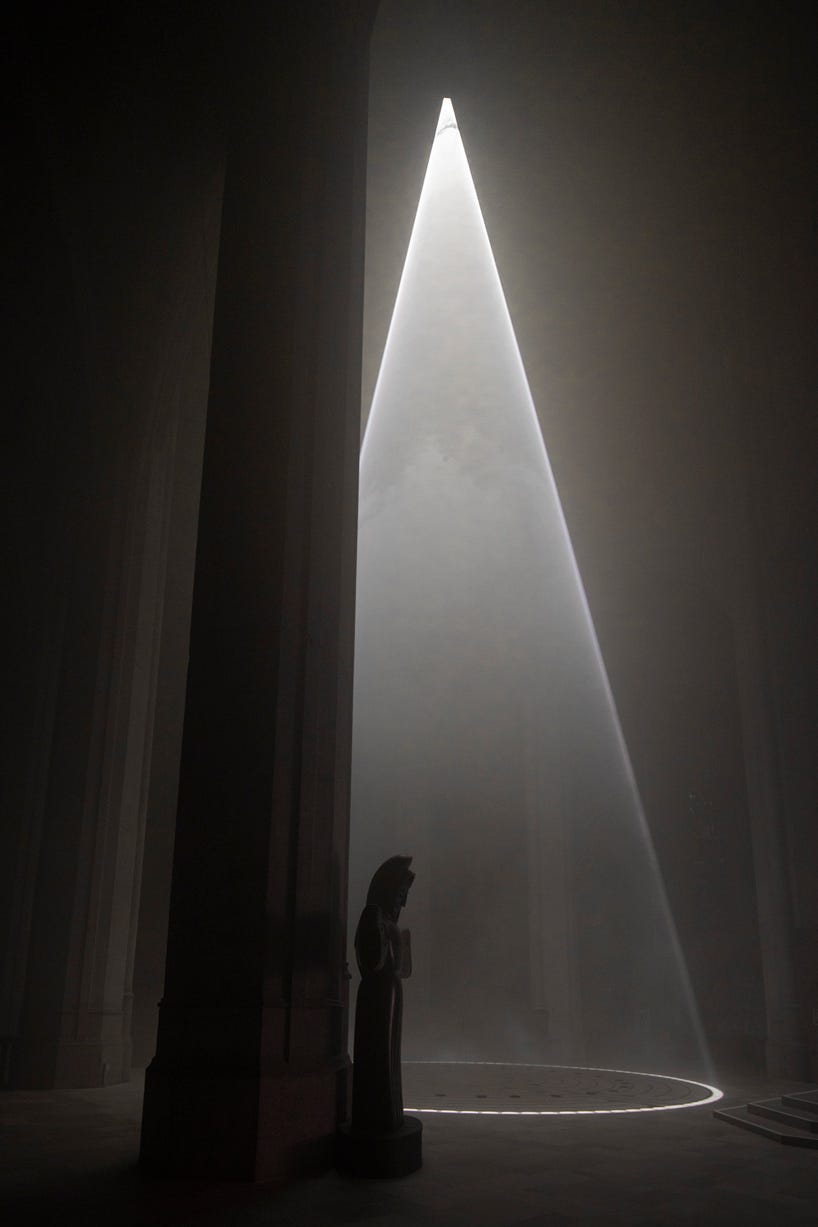
Give me a place to stand, and I will move the whole earth with a lever. —Archimedes
Father Richard Rohr uses the images of a lever and a place to stand to explain why social transformation needs both action and contemplation:
Archimedes, a third-century BCE Greek philosopher and mathematician, noticed that a lever balanced in the correct place, on the correct fulcrum, could move proportionally much greater weights than the force actually applied. He calculated that if the lever stretched far enough and the fulcrum point remained fixed close to Earth, even a small weight at one end would be able to move the world at the other.
The fixed point is our place to stand. It is a contemplative stance: steady, centered, poised, and rooted. To be contemplative, we have to have a slight distance from the world to allow time for withdrawal from business as usual, for contemplation, for going into what Jesus calls our “private room” (Matthew 6:6). However, we have to remain quite close to the world at the same time, loving it, feeling its pain and its joy as our pain and our joy. Otherwise, our distance can become a form of escapism.
True contemplation, the great teachers say, is really quite down to earth and practical, and doesn’t require life in a monastery. It is, however, an utterly different way of receiving the moment, and therefore all of life. In order to have the capacity to “move the world,” we need some distancing and detachment from the diversionary nature and delusions of mass culture and the false self. Contemplation builds on the hard bottom of reality as it is without ideology, denial, or fantasy.
Unfortunately, many of us don’t have a fixed place to stand, a fulcrum of critical distance, and thus we cannot find our levers, or true “delivery systems,” as Bill Plotkin calls them [1], by which to move our world. We do not have the steadiness of spiritual practice to keep our sight keen and alive. Those who have plenty of opportunities for spiritual practice—for example, those in monasteries—often don’t have an access point beyond religion itself from which to speak or to serve much of our world.We need a delivery system in the world to provide the capacity for building bridges and connecting the dots of life.
Some degree of inner experience is necessary for true spiritual authority, but we need some form of outer validation, too. We need to be taken seriously as competent and committed individuals and not just “inner” people. Could this perhaps be what Jesus means by being both “wise as serpents and innocent as doves” (Matthew 10:16)? God offers us quiet, contemplative eyes; God also calls us to prophetic and critical involvement in the pain and sufferings of our world—both at the same time. This is so obvious in the life and ministry of Jesus that I wonder why it has not been taught as an essential part of Christianity.
Sunday Resurrection reveals that love is stronger than death. —Richard Rohr
Monday God’s resurrecting movement has begun, and it sweeps everyone and everything up within it. —Mark Longhurst
Tuesday Easter joy is the grace of being able to say: This is hard. I am still waiting. And God is still good. —Kate Bowler
Wednesday How do we understand God-in-flesh, broken and vulnerable, and yet also resurrected and triumphant? How do we, like doubting Thomas, make meaning of Jesus with his still visible wounds? —Yolanda Pierce
Thursday Believing in the resurrection can and should transform not only how we view the world, but how we live in it. We should become people in whom others can see new life. —Paula Gooder
Friday Love is all that remains. Love and life are finally the same thing, and we know that for ourselves once we have walked through death. —Richard Rohr
Week Fourteen Practice
Resurrection: A Nonviolent Commission
Peace activist Father John Dear finds encouragement for living a nonviolent life in Jesus’s words to his disciples after his resurrection:
When he rose from the dead and appeared to his awe-struck disciples on that Easter Sunday night, [Jesus] told them repeatedly, “Peace be with you.” He showed them his wounds, and repeated his greeting, “Peace be with you.” In that resurrection moment, he offered a peace that is not of this world. It is the peace that comes about through total surrender, nonviolence, non-retaliation, and unconditional, universal love. If, like the nonviolent Jesus, we choose not to respond to violence with further violence, if we dare respond with love, surrender ourselves to God, and practice creative nonviolence, then, come what may, we will know a new kind of peace.
Life is short. We have only so many years left. Even if we eat right, lose weight, exercise daily, and take care of ourselves, our time on earth is limited. What do we want to do with the time that is given us? How can we get beyond ourselves and help relieve suffering and disarm the world? If we surrender our hearts, wills, and lives to the living God of Peace, I believe we will be given the resurrection gift of peace, and become instruments of God’s peace and universal love. Resurrection means having nothing to do with death, having not a trace of violence within us. When we live in the peaceful spirit of resurrection, we find ourselves practicing the boundless love and gentleness modeled for us in the nonviolent Jesus, who came to reconcile humanity to God, which is the ultimate act of peacemaking. This resurrection peace is ours for the asking if we dare choose it and surrender.
If we dare surrender to the God of Universal Love and Peace right now, then we can go forth into the world of violence and war, without fear, worry, anxiety, or anger, and be transforming agents of loving nonviolence like Gandhi and Dr. King, and know, with the medieval mystic Julian of Norwich, that “all will be well, all will be well, all manner of things will be well.”
Jesus Calling – Sarah Young
Do not worry about tomorrow or get stuck in the past. There is abundant Life in My Presence today.
“Brothers and sisters, I do not consider myself yet to have taken hold of it. But one thing I do: Forgetting what is behind and straining toward what is ahead, I press on toward the goal to win the prize for which God has called me heavenward in Christ Jesus.” —Philippians 3:13-14
Father Richard describes how it’s possible to experience resurrection through experiencing God’s love:
We don’t need to wait for death to experience resurrection.We can begin resurrection today by living connected to God. Resurrection happens every time we love someone even though they were not very loving to us. At that moment we have been brought to new life. Every time we decide to trust and beginagain, even after repeated failures, we are resurrected. Every time we refuse to become negative, cynical, or hopeless, we are experiencing the Risen Christ. We don’t have to wait for it later. Resurrection is always possible now.
The resurrection is not Jesus’s private miracle; it’s the new shape of reality. It’s the new shape of the world. It’s filled with grace. It’s filled with possibility. It’s filled with newness.
The resurrection is not a miracle story to prove the divinity of Christ, something that makes him the winner. It’s a storyline that allows us all to be winners. ALL! No exceptions! There’s no eternal death for anybody: All are invited to draw upon this infinite Source, this infinite Mystery, this infinite Love, this infinite Possibility. Spiritually speaking, we live in a world of abundance, of infinity, but most of us walkaround operating in a world of scarcity.
And so we hoard it—Spirit, Love, Life—to ourselves. We hoard grace and we hoard mercy. We don’t allow ourselves to be conduits through which it pours into the world. Truly, the only way we can hold onto grace, mercy, love, joy—or any spiritual gift—is to give them away consciously and intentionally. If we stop acting as a conduit, we lose them ourselves. That’s why there are so many sad, bitter, and angry people. Disconnected from God, we choose death and contribute to negativity, cynicism, anger, and even the oppression of other races and religions. [1]
I believe the meaning of the resurrection of Jesus is summed up in the climactic line from the Song of Songs: “Love is stronger than death” (8:6). In Christian art, the risen Christ often holds a blank, white banner; if that banner should say anything, it should say: “Love will win!” Love is all that remains. Love and life are finally the same thing, and we know that for ourselves once we have walked through death.
Remember, Love has you. Love is you. Love alone, and your deep need for love, recognizes love everywhere else. Remember that you already are what you are seeking. Any fear “that your lack of fidelity could cancel God’s fidelity, is absurd” (Romans 3:3), says Paul. Love has finally overcome fear, and your house is being rebuilt on a new and solid foundation. This foundation was always there, but it took you a long time to find it, for “It is love alone that lasts” (1 Corinthians 13:13). All you have loved in your life and been loved by is eternal and true. [2]
This is something I think about often. None of us can change until we have a sense that we are unconditionally loved as we are, and that includes even ourselves.
Until we accept ourselves as we are, we are still trying to change a false version of ourselves, a version of ourselves that doesn’t really exist anyway.
We have to start with reality. We have to begin with who we are in this exact moment, with all the warts, memories, scars, humors, faults, strengths, sins, and glories. That is the whole person, that is the person who actually exists.
I think this is the wisdom of grace. Grace takes us as we are. However, in religious circles, we feel as though we must change who we are to then warrant that same grace.
Fortunately, after enough failed attempts at changing ourselves, grace interrupts those attempts and tells us that even if we never change, we are still loved.
Apparently, this was written above Carl Jung’s doorway.
It is probably another way of saying the first quote from Dan Millman today.
However, the difference is that here the question is not about one’s ability to see the Spirit, but whether someone has asked God to be present. It leads me to think that whether a person is a theist or an atheist, it does not matter; God is always present.
4.
“Throughout the time of my showings, I wished to know what our Beloved meant. More than fifteen years later, the answer came in a spiritual vision. This is what I heard. “Would you like to know our Lord’s meaning in all this? Know it well: love was his meaning. Who revealed this to you? Love. What did he reveal to you? Love. Why did he reveal it to you? For love. Stay with this, and you will know more of the same. You will never know anything but love, without end.”
This might be one of the best sections from Julian’s Revelations of Divine Love. It comes at the very end of her infamous book.
I think what draws me to Julian’s insights is the absolute primacy of the Love of God.
Everything is created by, for, and through Divine Love. All that is good, beautiful, and true is an expression of that same Love. All that is wrong, ugly, and false will be made right by Love.
And, for our purposes now, Love is simply another name for God.
5.
“Spiritual maturity begins when we choose to bow before something greater than ourselves rather than to give in to self-destructive tendencies.”
– Unknown
It is when we begin to live by a standard higher than ourselves, and, dare I say, even higher than the surrounding culture, that we enter into spiritual maturity.
For many people, their highest ethic lies within themselves; for others, their morality is defined by the social majority. However, there is something even larger than the surrounding culture or social majority: the infinite mystery we call “God.”
Theologian Paula Gooder describes how Jesus’s resurrection would have been interpreted as a sign that the end times—of justice, mercy, and love—had begun:
To a lot of Jews living at the time of Jesus, believing that a resurrection had happened would have meant believing that the end times … had already started.
No wonder, then, that the earliest disciples struggled to get their heads around Jesus’ resurrection. Jesus had risen from the dead but no one else had; Jesus had risen from the dead but the world was, apparently, no different from the way it had been before: the Romans still occupied Palestine, the poor were still the poor, Israel was still downtrodden. A lot of the New Testament writers made sense of this by seeing Jesus’ resurrection as a radical and transforming event which changed the world now…. For them, Jesus’ resurrection signaled far, far more than a dead person living; it marked the start of a whole new way of being. The end times had begun, but not in their entirety. [1]
We can be encouraged by glimpses of resurrection in the here and now:
The world is as it always was with its wars, heartache, poverty, and oppressions, but … in the midst of conflict and aggression, we can, from time to time, see moments of reconciliation and of compassion. Occasions when the parent of a murdered son can forgive his killers, when a community can rise against the gangs that terrorize it and make it a better place, when we can rise above the petty arguments that spoil our human relationships are, for me, all a slice of the end times now. Some are dramatic world-changing occasions; others are small and apparently insignificant. Some affect whole nations and continents; others one or two individuals. The occasions may only be momentary and we quickly move back into the harsh reality of the everyday, but their effects linger, suggesting that new creation is possible and that transformation can happen.…
Belief in the resurrection is an act of rebellion against the evil, corruption and oppression that can so easily swamp us. Believing in the resurrection can be a refusal to accept the world as it is, that it can never change…. Believing in resurrection allows us to see the world with a long view, a perspective that looks backward to resurrection and forwards to the end times, recognizing traces of resurrection and end times in what is happening now. Believing in the resurrection can and should transform not only how we view the world, but how we live in it. We should become people in whom others can see new life, and people who introduce that new life wherever the world is stultifying and life-denying. Resurrection makes a difference not only to Jesus and the earliest disciples but also to us, as we live out our lives day by day.
Trust Me in every detail of your life. Nothing is random in My kingdom. Everything that happens fits into a pattern for good, to those who love Me. Instead of trying to analyze the intricacies of the pattern,focus your energy on trusting Me and thanking Me at all times. Nothing is wasted when you walk close to Me. Even your mistakes and sins can be recycled into something good, through My transforming grace. While you were still living in darkness, I began to shine the Light of My Presence into your sin-stained life. Finally, I lifted you up out of the mire into My marvelous Light. Having sacrificed My very Life for you, I can be trusted in every facet of your life.
RECOMMENDED BIBLE VERSES:
Joshua 10:14-15 NLT 14 There has never been a day like this one before or since, when the LORD answered such a prayer. Surely the LORD fought for Israel that day! 15 Then Joshua and the Israelite army returned to their camp at Gilgal. (Related scriptures = Exodus 14:4, Deuteronomy 1:30, Joshua 10:6, Joshua 43)
Romans 8:28 NLT 28 And we know that God causes everything to work together for the good of those who love God and are called according to his purpose for them. (Related scriptures = Ephesians 1:11 & 3:11, 2nd Timothy 1:9)
Additional insight regarding Romans 8:28: God works in “everything” – not just isolated incidents – for our good. This does not mean that all that happens to us is good. Evil is prevalent in our fallen world, but God is able to turn every circumstance around for our long-term good. Not that God is not working to make us happy but to fulfill his purpose. Note also that this promise is not for everybody. It can be claimed only by those who love God and are called by Him, that is, those whom the Holy Spirit convinces to receive Christ. Such people have a new perspective, a new mindset. They trust in God, not in worldly treasures; their security is in Heaven, not on earth. Their faith in God does not waver in pain and persecution because they know God is with them.
Psalm 40:2 NLT 2 He lifted me out of the pit of despair, out of the mud and the mire. He set my feet on solid ground and steadied me as I walked along. (Related scriptures = Psalm 27:5 & 69:1-2, Jeremiah 38:6)
Additional insight regarding Psalm 40:1-3: Waiting for God to help us is not easy, but David received four benefits from waiting: 1) God lifted him out of despair 2) God set his feet on solid ground 3) God steadies him as he walked 4) God put a new song of praise in his mouth. Often blessings cannot be received unless we go through the trial of waiting.
1st Peter 2:9 NLT 9 But you are not like that, for you are a chosen people. You are royal priests, a holy nation, God’s very own possession. As a result, you can show others the goodness of God, for he called you out of the darkness into his wonderful light. (Related scriptures = Exodus 19:5-6, Deuteronomy 7:6 & 10:15, Isaiah 43:20-21, 1st Peter 2:5, Revelation 1:6)
Additional insight regarding 1st Peter 2:9: Christians sometimes speak of “the priesthood of all believers.” In Old Testament times, people did not approach God directly. A priest acted as an intermediary between God and sinful human beings. With Christ’s victory on the cross, that pattern changed. Now we can come directly into God’s presence without fear (Hebrews 4:16), and we are given the responsibility of bringing others to him also (2nd Corinthians 5:18-21). When we are united with Christ as members of his body, we join in his priestly work of reconciling God and people.
Additional insight regarding 1st Peter 2:9-10: People often base their self-concept on their accomplishments. But our relationship with Christ is far more important than our jobs, successes, wealth, or knowledge. We have been chosen by God as his very own, and we have been called to represent him to others. Remember that your value comes from being one of God’s children, not from what you can achieve. You have worth because of what God does, not because of what you do.
Today’s Prayer:
Dear Heavenly Father,
I trust You with every aspect of my life. I know nothing is random in Your kingdom, and You work all things for good for those who love You. Instead of analyzing out of a desire to be in control, I choose to focus on trusting and thanking You always in all circumstances.
Thank You for lifting me out of darkness and transforming my mistakes into something good. Help me to live out Your purpose for me and to show Your goodness to others.
Womanist theologian Yolanda Pierce reminds us that the resurrection and its promise of new life doesn’t erase the pain of what has been lost:
You cannot read the stories of the resurrected Jesus as accounts of life triumphing over death without contending with layers of grief, mourning, and pain. A beloved mother has lost her first-born child; students and disciples are grieving the death of a teacher, confidant, and friend. Everyone has borne witness to the excruciating pain of the cross, the consequences of daring to defy empire, and the cost of declaring Jesus as Messiah. Some believers go into hiding, and others are confused about who they should now follow.
In the chaos of this time, the risen Savior shows up again, and again, and again—not as a ghostly, ethereal being but as wounded flesh. “Look at my hands and my feet,” he says to some of the frightened folks to whom he appears. “It is I myself! Touch me and see; a ghost does not have flesh and bones, as you see I have” (Luke 24:39)….
How do we understand God-in-flesh, broken and vulnerable, and yet also resurrected and triumphant? How do we, like [doubting] Thomas, make meaning of Jesus with his still visible wounds? To Thomas, Jesus speaks the words, “Put your finger here; see my hands. Reach out your hand and put it into my side” (John 20:27)….
There is an intimacy to Jesus’s command to Thomas, a closeness that we cannot overlook. Christ invites him to touch the unhealed wounds—to feel the places where nails and spear had pierced his body. It is a proclamation that the physical body still matters…. Wounds, too, are a part of the divine story.
By sharing his wounds, Jesus reveals that our wounds are places for God’s healing presence and love:
This is a theology for the wounded, for those who are still healing, and even for those who aren’t quite ready for healing. The risen Savior insistently welcomes the doubting, the uncertain, and the grieving to touch and see that he is real and present and here with us. The risen Savior, who had been abandoned, denied, betrayed, and crucified, doesn’t hide his wounds or rush their healing. As wounded people encased in the frailties of human flesh, can we, too, summon enough grace and kindness to acknowledge that our own very human wounds need time to heal?…
This is an embodied theology. In these stories, the physical body and the tangible world are consistently presented as ways of intimately knowing God. Some saw and believed; others have not seen and still believed. At the center of both experiences is God-in-flesh, loving us in our own wounded places.
================
APR 7, 2026 Right-ness. Skye Jethani
Amid a stunning array of beliefs, religions, philosophies, and cultures, there are two things that all people agree on. First, this world is not what it ought to be. Second, we do not behave as we ought. Both the Hindu and the humanist will lament when an earthquake razes a village or a disease kills a child. Likewise, both the believer and the atheist can agree that the powerful should not abuse the weak and the rich should not cheat the poor.An inherent sense of ought–ness is universal in our species. As C.S. Lewis observed, “Whenever you find a man who says he does not believe in a real Right and Wrong, you will find the same man going back on this a moment later. He may break his promise to you, but if you try breaking one to him he will be complaining ‘It’s not fair’ before you can say Jack Robinson.”
While the particulars of what constitutes right and wrong vary somewhat across cultures, the existence of the categories “right” and “wrong” does not. We have yet to discover a society that is truly and consistently relativistic in its morality, where right and wrong are defined by each individual and never imposed upon another. This is because such a society cannot endure. To be a society, people must agree upon a sense of order—they must share a framework for how the world ought to be and uphold it when it is violated. Anything less is not a culture; it’s chaos.
Modern American culture speaks a lot about “justice,” but the common biblical word for this universal instinct is “righteousness.” We often focus on the word’s spiritual or moral dimensions, but righteousness simply means “rightly ordered relationships.” A righteous person, for example, fulfills all their relational obligations in a way that allows everyone within their network to flourish. Of course, this also applies to a properly ordered relationship between God and his people. Violating this relationship makes one “unrighteous,” while keeping the covenant with God results in a declaration of one’s “righteousness.
”Whether it is the shout for justice by a protestor or the call to live in union with God by a preacher, Jesus affirms this longing for righteousness. “Blessed are those who hunger and thirst for righteousness, for they shall be satisfied.” He equates the soul’s desire for justice with the unrelenting physical desire for food and water. It is an inescapable aspect of our human condition, and he promises that it will be quenched. We can be assured that in time God will put everything back into its proper order so that all he has made will flourish. As Martin Luther King Jr. said, “The arc of the moral universe is long, but it bends towards justice.”
DAILY SCRIPTURE MATTHEW 5:3–12 LUKE 18:1–8 WEEKLY PRAYER. From the Liturgy of St. Basil (329 -379) Remember, O Lord, those who are poor and in need, the widows, the orphans, the strangers, those in captivity and those in exile, the sick and the suffering. Remember, O Lord, those who love us and those who hate us; those who have asked us to pray for them, and those whom we have not remembered through ignorance. Remember all Your people, O Lord, and pour out Your rich mercy upon all. Amen.
Group Discussion — choose one:
What does it mean to you that the risen Jesus still carries his wounds? Does that comfort you, disturb you, or both?
Jethani defines righteousness as “rightly ordered relationships.” Which relationship in your life feels most out of order right now — and what would it look like if it were made right?
Both readings suggest God meets us in the broken, longing places rather than past them. Where have you experienced that — and where do you find it hardest to believe?
Theologian and podcaster Kate Bowler frames Easter as a feast of joy that doesn’t erase the pain that has come before it:
Easter is the season of joy.
The alleluias return. The story reaches its turning point. Death does not get the last word.
Easter is that gorgeous, sweet, closing note of the salvation hymn we believe with all our hearts: Christ has conquered death, and we will someday be with God forever. Hallelujah. Hallelujah.
Joy brings us incredible, brief, soul-filling moments when we feel the overwhelming love of God and our place in this world. Our soul cries: Yes. I am grateful. It is so good to be alive.
Joy is a gift from God and a feeling that bubbles up from wherever the soul lives (probably close to the intestines. This is my working theory after realizing I will never love anything as much as I love Old Dutch Ketchup Potato Chips).
But that is not the only way joy shows up.
There is an aspect of joy we often miss around Easter, and it appears precisely when Easter comes and goes and life remains … unfinished. We wake up the next morning and discover that we are still carrying the same griefs, the same unanswered prayers, the same ache we carried throughout Lent.
This can feel confusing. Shouldn’t we feel better? Was Easter not enough?
But Easter joy is not the feeling that everything has been fixed. It is not happiness, resolution, or emotional closure. Easter joy is the ability to live in Christian anticipation and trust—patiently and imperfectly—even while we remain here in the long middle.
Joy is one of the most powerful experiences we can have because it is an emotion that can co-exist with our actual lives. Unlike happiness, joy can live alongside sadness, boredom, fear, or despair. It expands our capacity to hold contradictory truths at the same time—and because we know joy, we recover a strange, steady confidence that life is still worth loving, even when it hurts.
Scripture is honest about this. Jesus weeps at Lazarus’s tomb, even knowing resurrection is coming. Paul speaks of being “sorrowful, yet always rejoicing” [2 Corinthians 6:10]. Revelation [21:4] promises a future where God will wipe away every tear—but that promise is not the same thing as pretending we are not crying now.
This is where Easter joy lives.
It is not joy instead of grief. It is joy with grief. Not joy that rushes us forward, but joy that allows us to remain human in the meantime.… This joy is more totalizing than optimism. It is truer than plain happiness. It is the deep assurance that the story is not finished, even when our lives feel painfully incomplete.
Easter joy is the grace of being able to say: This is hard. I am still waiting. And God is still good.
Not because everything has changed—but because, one day—poof—God promises everything will.
Father Richard Rohr explains how the resurrection offers us hope, especially in challenging times:
I often wonder why so much of human life seems so futile, so tragic, so short, and so sad. If Christ is risen, why do people die before they begin to truly live? Why has there been nonstop war? Why are so many people imprisoned unjustly? Why are the poor oppressed? Why do we destroy so many of our relationships? If Christ is risen, why is there so much suffering? What is God up to? It really doesn’t make any logical sense. Is the resurrection something that just happened once, in his body, but not in ours?
I believe the resurrection of Christ is saying that the final judgment has already happened. It’s nothing we need to fear. It’s nothing we need to avoid or deny. God’s final judgment is that God will have the last word! Easter reveals that there are no dead ends; ultimately, nothing is going to end in tragedy and crucifixion. Of course we look around us, at history and at life in its daily moments and it seems, “No, that isn’t true.” And yet, ever and again, here and there, more than we suspect, new life breaks through for those who are willing to see and to cooperate with this universal mystery of resurrection.
We’re so lucky in my part of the world that Easter coincides with springtime. If this applies to you, I hope you’re going out and seeing the leaves and the flowers being reborn after months of winter. I went out early this morning to see the Easter sunrise. Sure enough, the sun rose as it always does and peeked over the horizon, just between two mountains. It appeared not so much like a sunrise but as a groundswell. The light was coming from the earth. It was coming from the world we live in. It was coming not from the top, but from the bottom. It seemed to say that even all of this, which looks muddy and material, even all of this, which looks so ordinary and dying, will be reborn.
Easter is the feast of hope. This is the feast that says God will have the last word and that God’s final judgment is resurrection. God will turn all that we maim and destroy and hurt and punish into life and beauty.
What the resurrection reveals more than anything else is that love is stronger than death. Jesus walks the way of death with love, and what it becomes is not death but life. Surprise of surprises! It doesn’t fit any logical explanation. Yet this is the mystery: that nothing dies forever, and that all that has died will be reborn in love.
So, to be a Christian is to be inevitably and forever a person of hope. God in Christ is saying this is what will last: My life and my love will always and forever have the final word.
The Easter Story
We Are All Rising
Monday, April 6, 2026
CAC staff member Mark Longhurst recounts the Easter story which revealed the good news of Jesus’s resurrection—and our own:
Each year Easter is, for Christians, a celebration of the rising of Christ, but this rising is far more than one person’s death-defying divine act. The resurrection of Christ is expansive: Jesus the person rises and launches God’s resurrection movement that brings everyone and everything along with it.
It starts with a body or, rather, a body’s absence. Mary Magdalene and other women are at the tomb before sunrise to preserve Jesus’s body with spices (Luke 24:1). A rolled-away stone ensures they can enter the tomb easily, but the body is missing. Two men—angels—stand near them wearing clothes that dazzle like the very lightning of the sky. They point out the befuddled obvious: “He is not here” and the more shocking, “He has risen” (24:5).
Jesus Christ rises first on Easter morning to the women. [In Luke’s Gospel] shortly after, he will make appearances to two disciples on the road to Emmaus (24:13–35) and to disciples gathered in Jerusalem (24:36–49), but it’s the women who first see the empty tomb and believe. Jesus Christ rises to Mary Magdalene, the devoted disciple extraordinaire, to Mary the mother of James, to Joanna, who—Luke chapter eight tells us—is married to the manager of Herod’s household himself, and to the other women who were with them at the tomb (24:10). You could even say that the women are rising with Jesus. They are the first to witness the empty tomb, the first to herald a new message of hope, the first to glimpse a renewed world where love is stronger than death….
The implications of the empty tomb are not seen by those looking for an eyewitness investigative account of what did or did not happen. Only those whose hearts bear the capacity to love can see the resurrection and dream a new way out of no way. The men lack this consciousness—Luke says they “did not believe them” [See 24:10–11]. It’s to Peter’s credit that he follows his awakening heart, still bruised from his threefold betrayal of Jesus, and runs to check the tomb himself. Perhaps he hopes for a last-ditch chance to demonstrate his faithfulness. Perhaps out of aching desperation, Peter is rising, too….
Jesus rising, however, is only the beginning or “first fruits” of resurrection (1 Corinthians 15:20). In Jesus Christ, God’s resurrecting movement has begun, and it sweeps everyone and everything up within it. Dying and rising are a central pattern and truth of reality—and so to talk about Jesus’s rising is somehow to approach the weighty paradox of death and life evolving together at the center of the universe. Mary, Joanna, and the other women are rising, Peter is rising, I’m rising, you’re rising, and the universe itself is rising.
=======================
Individual Reflection: Where in your life right now does resurrection feel more like something you believe than something you’re experiencing?
Group Discussion — choose one:
What in you is still waiting to rise?
Where have you seen love outlast death?
What would it mean to cooperate with resurrection rather than just hope for it?
Father Richard offers a guided meditation, inviting listeners to be present with Jesus at the crucifixion:
Picture yourself before the crucified Jesus; recognize that he became what you fear: nakedness, exposure, vulnerability, and failure. He became sin to free you from sin (see 2 Corinthians 5:21). He became what we do to one another in order to free us from the lie of punishing and scapegoating each other. He became the crucified so we would stop crucifying. He refused to transmit his pain onto others.
Richard imagines Jesus speaking these words to us, offering God’s love and forgiveness:
My beloved, I am your self. I am your beauty. I am your goodness, which you are destroying. I am what you do to what you should love. I am what you are afraid of: your deepest and best and most naked self—your soul. Your sin largely consists in what you do to harm goodness—your own and others’. You are afraid of the good; you are afraid of me. You kill what you should love; you hate what could transform you. I am Jesus crucified. I am yourself, and I am all of humanity.
We are invited to respond to Jesus on the cross:
Jesus, Crucified, you are my life and you are also my death. You are my beauty, you are my possibility, and you are my full self. You are everything I want, and you are everything I am afraid of. You are everything I desire, and you are everything I deny. You are my outrageously ignored and neglected soul.
Jesus, your love is what I most fear. I can’t let anybody love me for nothing. Intimacy with you or anyone terrifies me.
I am beginning to see that I, in my own body, am an image of what is happening everywhere, and I want it to stop today. I want to stop the violence toward myself, toward the world, toward you. I don’t need to ever again create any victim, even in my mind.
You alone, Jesus, refused to be crucifier, even at the cost of being crucified. You never asked for sympathy. You never played the victim or asked for vengeance. You breathed forgiveness.
We humans mistrust, murder, and attack. Now I see that it is not you that humanity hates. We hate ourselves, but we mistakenly kill you. I must stop crucifying your blessed flesh on this earth and in my brothers and sisters.
Now I see that you live in me and I live in you. You are inviting me out of this endless cycle of illusion andviolence. You are Jesus crucified. You are saving me. In your perfect love, you have chosen to enter into union with me, and I am slowly learning to trust that this could be true.
_______________________________________________
John Chaffee 5 On Friday
1.
“We ought not to be weary of doing little things for the love of God, who regards not the greatness of the work, but the love with which it is performed.”
At one point this past week, we were out to dinner, and one of the people from our group said that Practicing the Presence of God had utterly changed the way she thought about work around the house.
Doing dishes.
Walking the dog.
Folding laundry.
Taking the trash out.
Restocking toilet paper.
Mopping the floor.
Making the bed.
Sort the mail.
Do some emails.
Modern culture tells us we must always be doing something grand, explosive, or extreme, but aspirituality of presence and depth is actually more interesting in the little things... Because, after all, our lives are chock full of the little things.
2.
“For it is God’s will that by doing good you should silence the ignorant talk of foolish people.”
The letter of 1 Peter, which tradition holds was written by the actual Apostle Peter, is hitting me differently after being at the Tomb of St. Peter.
Just before Peter was crucified on an inverted cross, he was clearly trying to help the Christians live while under Roman occupation. During the time of the first century, there were many rumors swirling about the Christians being “atheists” who did not have a temple of their own and who practiced cannibalism (it was actually the Eucharist).
In 64 AD, Rome caught on fire, and Nero did nothing to stop it. It ended up burning down a massive section (which he then rebuilt for himself), and he blamed it on the Christians.
So, of course, Peter encouraged the Christians to be of the utmost moral quality, to help “silence the ignorant talk of foolish people” who kept feeding the gossip and rumors that Christians were ruining Rome.
3.
“As surely as I live,’ says the Lord, ‘Every knee will bow before me; Every tongue will εχομολογησεται God.”
Εχομολογησεται (exomologesetai) is the Greek word that is often translated as “confess” in most English translations.
However…
The word “confess” often carries a negative connotation.
If we take a moment to look up other meanings of the word, they are all positive! The word can also be translated to mean “openly and joyfully profess without reservation.”
This is why I believe that it is vitally important to read the Bible in the original languages, if possible. There are so many nuances that are missed, such as this one!
This past week, a fellow traveler did a great job of convincing me to read Therese of Lisieux next. Although her writings can be seen as a bit “saccharine” by some, others find them quite beautiful.
I love this quote about love. It challenges me. I often calculate the cost/risk/worth of loving others, and it has not served me.
Fortunately, the whole of the Christian faith is built around love, and it keeps pointing me back to its primacy. I am beyond certain that I would be a miserable wreck without my faith.
5.
“We are convinced that believing in God is worthwhile. We thereby want to express the conviction that it is not death that has the last word but life; it is not the absurd but the full meaning in life that wins the day.”
Dr. Yolanda Pierce finds both comfort and challenge in the spiritual “Were You There?,” which invites listeners to reflect on how they are present to Jesus’s death on the cross:
In that small Baptist church where I was invited the invited preacher for Palm Sunday, the choir sang, “Were You There (When They Crucified My Lord)?” That beloved spiritual caused me to reflect theologically on the power of showing up and on the experience of the radical presence of God the song embodies….
More than two thousand years removed from the reality of Jesus’s crucifixion, this spiritual … stresses the reality of the current moment by daring to ask the listener, “Were you there?” With this emphasis on “you”—on those of us who could not have been physically present—it reminds us that the believer still needs to show up at the foot of the cross and to identify with the radical act of Jesus’s death andresurrection.
Pierce names examples of suffering where we are called to bring our presence and seek justice:
There is fullness of life when you show up, fully present, when people are suffering and where people are bearing the burdens of their own crosses. “Were You There?” is a reminder that to be fully present with the whole of humanity does not require us to enter the sanctuary or walk across the threshold of a church. The cross, Calvary, is a site of public spectacle. The rhetorical question “Were you there?” signifies the real pressing question about whether you will be present for lost and hurting generations.
To be present is to be wherever there is need. Were you there when the levees broke during Hurricane Katrina or when the earthquake shook Haiti?
Will you be there when the next natural disaster strikes and the most vulnerable cannot find shelter? …
To be present is to be where people are suffering. Were you there among the hungry and the homeless, those in search of both their spiritual and physical daily bread?… Or will you cross to the other side of the street?
To be present is to be at the front lines of the fight for justice. Were you there in Selma and Birmingham, risking the dogs and the water hoses? Will you be there on Capitol Hill to fight for health care for the uninsured? Will you be there at your senator’s office to protest the cuts to educational funding even as another several billion dollars are appropriated to fight unjust wars?
The lyrics of “Were You There?” continue with the words “Oh, sometimes it causes me to tremble! Tremble! Tremble!” I wonder whether we have lost our ability to tremble—to be deeply affected —in the face of injustice. I wonder whether we no longer tremble in the presence of a holy God who requires us to do the work of justice.
________________________________________________
Jesus Calling – April 2nd, 2026, Sarah Young
I have promised to meet all your needs according to My glorious riches. Your deepest, most constant need is for My Peace. I have planted Peace in the garden of your heart, where I live; but there are weeds growing there too: pride, worry, selfishness, unbelief. I am the Gardener, and I am working to rid your heart of those weeds. I do My work in various ways. When you sit quietly with Me, I shine the Light of My Presence directly into your heart. In this heavenly Light, Peace grows abundantly and weeds shrivelup. I also send trials into your life. When you trust Me in the midst of trouble, Peace flourishes and weeds die away. Thank Me for troublesome situations; the Peace they can produce far outweighs the trials you endure.
RELATED SCRIPTURE:
Philippians 4:19 (NLT) 19 And this same God who takes care of me will supply all your needs from his glorious riches, which have been given to us in Christ Jesus.
Additional insight regarding Philippians 4:19: We can trust that God will always meet our needs. Whatever we need on earth he will always supply, even if it is the courage to face death as Paul did. Whatever we need in Heaven he will supply. We must remember, however, the difference between our wants and our needs. Most people want to feel good and avoid discomfort or pain. We may not get all that we want. By trusting in Christ, our attitudes and appetites can change from wanting everything to accepting his provision and power to live for him.
2nd Corinthians 4:17 (NIV) 17 For our light and momentary troubles are achieving for us an eternal glory that far outweighs them all.
Additional insight regarding 2nd Corinthians 4:17: Our troubles should not diminish our faith or disillusion us. We should realize that there is a purpose in our suffering. Problems and human limitations have several benefits: 1) they remind us of Christ’s suffering for us; 2) they keep us from pride; 3) they cause us to look beyond this brief life; 4) they give us opportunities to prove our faith to others; and 5) they give God the opportunity to demonstrate his power. See your troubles as opportunities!
Today’s Prayer:
Dear Heavenly Father,
You promise to meet all my needs with Your abundant riches. Yet, weeds of pride, worry, and unbelief often choke the peace You offer to me unconditionally. As the true and wonderful gardener, You work to remove these obstacles and distractions.
Your presence brings abundant peace in quiet moments with You, and trials, when faced with trust, yield even more. Thank You for these assurances that give me comfort.
Help me to see troublesome situations as opportunities for growth and to witness Your extreme power.
In Jesus’ name, amen.
Comments Off on Jesus and the End of Scapegoating »
Karen González, an immigrant advocate, points to the story of Joseph in Genesis 37 as an example of God’s love and protection for foreigners:
[Joseph] suffers a series of misfortunes as a vulnerable foreigner. Joseph’s story is powerful and effective because it raises questions about the goodness of God in the midst of suffering. It also depicts the human tendency to alternate between loving and fearing strangers. In his story we see the Egyptian society’s movement from fear to love and then back to fear again….
Without recourse, as an enslaved person in a foreign land, Joseph does not receive due process. Instead, he is thrown into jail for a crime he didn’t commit. The unknown narrator of Genesis states that God always sees Joseph and remains with him. Twice within the span of three verses we are told that “the Lord was with” Joseph, blessing his work and giving him favor with those in authority over him (Genesis 39:21–23)…. Nonetheless, he spends years unjustly imprisoned, largely forgotten by his foreign captors….
For many immigrants and others on the underside of history, God’s presence in suffering isn’t about complex theological arguments about theodicy or sovereignty or how bad things can happen to good people. For them, God’s presence in suffering is what enables them to live. Indeed, for many who suffer, Christ on the cross offers the comfort of knowing that they serve a God who himself has known great sorrow and suffering. [1]
Fear leads to scapegoating while friendship leads us to welcome Christ in our midst:
Fear has become the default in the current immigration conversation in North America, even for followers of Jesus, who are called to love our neighbors as ourselves. The Bible speaks to the need for philoxenia [love of foreigners] repeatedly, from Exodus all the way to Hebrews: “Keep loving each other like family. Don’t neglect to open up your homes to guests [strangers or foreigners], because by doing this some have been hosts to angels without knowing it” (Hebrews 13:1–2)….
When we open ourselves up to friendships with immigrants and take intentional steps to know and be known in mutuality, we widen the circle of our affections. Suddenly, immigrants are no longer a burden or a drain on our economy, but a Ruth, a Hagar, or a Joseph to be loved. They become multidimensional people to us—friends who enrich our lives with their very selves. We welcome them and simultaneously welcome Christ and his joy. Indeed, when the Egyptians welcomed the Israelites, they welcomed God and God’s blessing into their midst. And when they rejected the Israelites and oppressed them, they rejected God’s very self, even without realizing it.
Jesus often comes to us in disguise, as he himself says in Matthew 25: he is sometimes a prisoner, a sick person, a naked person, a hungry person, a thirsty person, or an immigrant (verses 35–36). If we learn anything from Joseph and his suffering, it is to welcome and embrace Jesus in disguise.
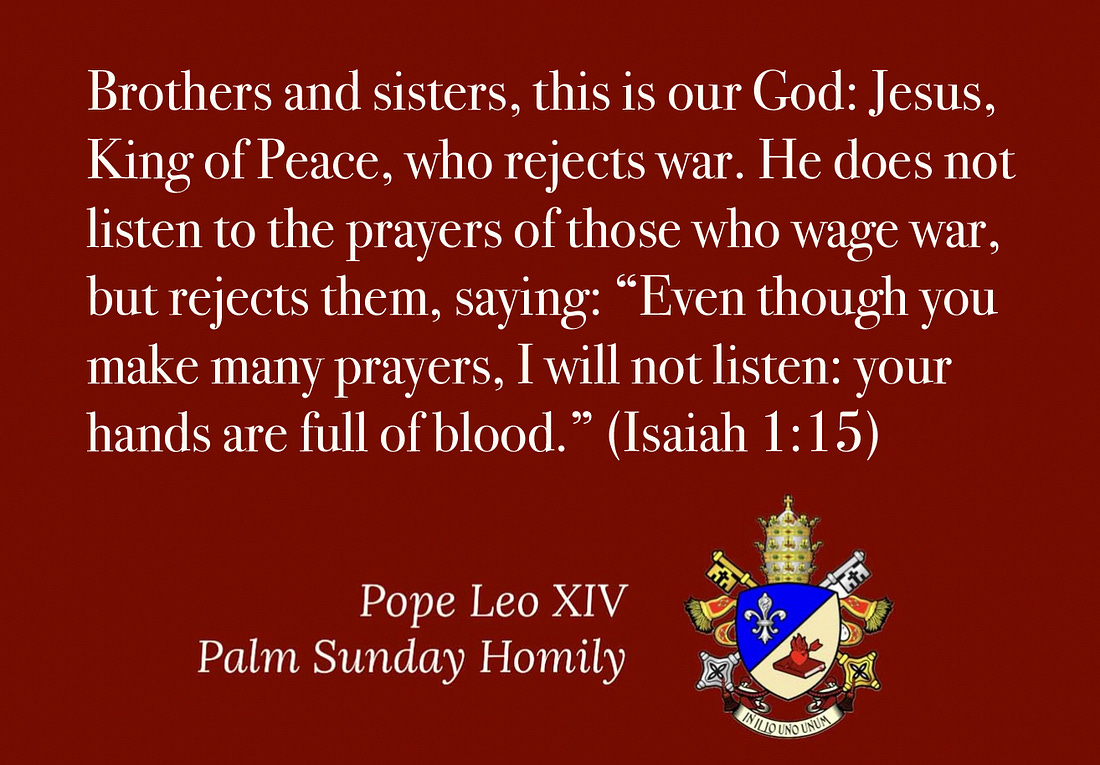
“Why did the Pope tell people Jesus doesn’t listen to some people’s prayers? We are all sinners. We all have blood on our hands. Doesn’t God promise to hear everyone?”
Response
Thank you for your thoughtful question.
For those wary of hearing a few lines out of context, I recommend reading the full text of Pope Leo’s short homily by clicking HERE. But it is also important to read it in it’s biblical and immediate context.
I. Biblical Context
The occasion of the homily was the Feast of the Triumphal Entry. In its biblical context, we see his message was permeated with Scripture. In the order that he referred to them:
Ephesians 2:14 – “He is our peace.”
Zechariah 9:9-10 –“Lo, your king comes to you; triumphant and victorious is he, humble and riding on a donkey, on a colt, the foal of a donkey. He will cut off the chariot from Ephraim and the war-horse from Jerusalem; and the battle bow shall be cut off, and he shall command peace to the nations.”
Matthew 26:52 – “Put your sword back into its place, for all who take the sword will perish by the sword.”
Isaiah 53:7 – [Jesus] “did not open his mouth, like a lamb that is led to the slaughter, and like a sheep that before its shearers is silent.”
Isaiah 1:15 – “Even though you make many prayers, I will not listen: your hands are full of blood.”
And since the last statement drew so much ire, let’s remember that the Pope was quoting the prophet Isaiah, who we should also here in his context—visions from God concerning Judah and specifically Jerusalem. Here is Isaiah 1:15 in its context [with emphases and in notes from me]:
10 Hear the word of the Lord, you rulers of Sodom! Listen to the teaching of our God, you people of Gomorrah!
[Ouch. God is addressing Jerusalem!]
11 What to me is the multitude of your sacrifices? says the Lord; I have had enough of burnt offerings of rams and the fat of fed beasts; I do not delight in the blood of bulls or of lambs or of goats. 12 When you come to appear before me, who asked this from your hand? Trample my courts no more! 13 Bringing offerings is futile; incense is an abomination to me. New moon and Sabbath and calling of convocation— I cannot endure solemn assemblies with iniquity. 14 Your new moons and your appointed festivals my soul hates; they have become a burden to me; I am weary of bearing them.
[God is rejecting their worship]
15 When you stretch out your hands, I will hide my eyes from you; even though you make many prayers, I will not listen; [Why not?] your hands are full of blood.
[But restoration is possible… How?]
16 Wash yourselves; make yourselves clean; remove your evil deeds from before my eyes; cease to do evil; 17 learn to do good; seek justice; rescue the oppressed; defend the orphan; plead for the widow.
[A fresh start awaits… if only…]
18 Come now, let us argue it out, says the Lord: If your sins are like scarlet, will they become like snow? If they are red like crimson, will they become like wool? 19 If you are willing and obedient, you shall eat the good of the land, 20 but if you refuse and rebel, you shall be devoured by the sword, for the mouth of the Lord has spoken.
Side note: Notice the formatting. This is a song. I’ve noticed that those who deliver poetic indictments seem to get away with more than those who write the same truths in prose or speak them directly. It’s not as though Isaiah was telling it slant, but the prophet whose words are recorded in chapter 1 may have “got published” rather than cancelled in part because the words were delivered in verse. Then again, there is the tradition that he was “sawn asunder” under King Manasseh (Hebrews 11:37), so there’s that.
Anyway, the real point is that while God is everywhere present and always attentive, what has caught God’s attention in this passage was the gross incongruity around blending worship and cruelty… perpetrating national injustice while weaponizing worship has put God off worship (similar to Micah and Amos and Jeremiah).
This was what came up in the Pope’s mind and heart and from his mouth when he spoke.
II. Immediate Context: Feb 28, Mar 26, Mar 29, 2026
The immediate context of the homily:
February 28 – the Minab Massacre: on the first morning of the Iran War, missile attacks destroyed the Shajareh Tayyebeh Elementary School in Minab, Iran. Over 170 people were killed, at least 100 of them primary-age girls were killed.
March 26 – the Secretary of War’s Pentagon Prayer: Pete Hegseth’s prayer invoking the name of Jesus Christ, calling for overwhelming violence without mercy.
March 29 – the Papal Homily, condemning war and rejecting prayers used to justify war, incite violence, and glorify death.
The Pope’s homily was, without a doubt, a response to a prayer offered at the Pentagon service just three days earlier. One cannot understand the Pope’s severity without reading Secretary Hegseth’s prayer in its entirety, HERE.
The prayer is a composite of imprecations from various Psalms, an invocation from a chaplain ahead of the Venezuelan incursion in January, and specific calls to violence for the war in Iran. “Imprecation” refers to calling down a curse or invoking harm upon someone—especially by appealing to God to bring judgment, punishment, or justice. The prayer included the following paragraphs (emphases in bold are mine):
Almighty God, who trains our hands for war and our fingers for battle, you who stirred the nations from the north against Babylon of old, making her land a desolation where none dwell, behold now the wicked who rise against your justice and the peace of the righteous. Snap the rod of the oppressor, frustrate the wicked plans, and break the teeth of the ungodly. By the blast of your anger, let the evil perish. Let their bulls go down to slaughter for their day has come, the time of their punishment. Pour out your wrath upon those who plot vain things and blow them away like chaff before the wind.
Grant this task force clear and righteous targets for violence. Surround them as a shield, protect the innocent and blameless in their midst. Make their arrows like those of a skilled warrior who returned not empty-handed. Let every round find its mark against the enemies of righteousness and our great nation.
Give them wisdom in every decision, endurance for the trial ahead, unbreakable unity, and overwhelming violence of action against those who deserve no mercy.Preserve their lives, sharpen their resolve, and let justice be executed swiftly and without remorse that evil may be driven back and wicked souls delivered to the eternal damnationprepared for them. For the wicked flee when no one pursues, but the righteous are as bold as a lion. We ask these things with bold confidencein the mighty and powerful name of Jesus Christ, King over all kingsand amen.
Not because of partisan politics or which party holds the keys to power, or which nation is to blame, but because we hate the destructive power of everywar and grieve the loss of all lives—children, civilians, and military. We are heartbroken when missiles fly in any direction for any reason. We know it is never the way of Jesus, who wept over Jerusalem, “If you, even you, had only recognized on this day the things that make for peace! But now they are hidden from your eyes” (Luke 19:42).
Every time nations go to war, grieving with Jesus and joining his lament is the righteous response. But when we (included the Pope) heard that prayer from Central Command in Arlington, many of us felt deeply sickened. Death-dealing was once again being baptized in Jesus’ name.
Pope Leo’s homily, offered just three days later, is now widely regarded as Rome’s obvious and immediate response. Some would say ‘prophetic.’
Yet many have since questioned Leo’s wording . . .
What does he mean God doesn’t listen? What does Isaiah mean by that?
III. The Language of “Listening”
This question is much simpler to understand if we think about the language of “listening” in the context of normal conversation.
For example, when someone says in exasperation, “You are notlisteningto me,” we’re not literally saying they can’t audiblyhear us. We’re often upset because what we’re saying is not getting an affirmative response of obedience. “You’re not obeying me! You’re not doing what I want!” And from the one “not listening,” the response comes, “No, I am not going to do that.”
The particular prayer that Pope Leo was referring to—the prayers God doesnotlisten to are precisely those prayers telling God to bless our extreme violence, show no mercy, and send the wicked to hell. That was the prayer. And the Pope is saying, “No, Jesus will not do that. Jesus will never do that.” Jesus told us to bless our enemies and pray for them, but if instead, we pray curses on them, then no, “God will not listen.” God is not the agent of violence, war, and death. In other words, “God doesn’t listen” = “Don’t expect a yes.”
And lucky for us. Because God is also not listening to prayers for violence of the Mullahs in Iran. Or of the Rabbis in Jerusalem. Like, what if God did listen and answer? What would that look like? Mutual annihilation. It’s true, “There is blood on all our hands.” My complicity in my nation’s death-dealing and evil-doing paints a target on my own back. Better if I don’t add to the body count.
Here’s what we know from Jesus’ Sermon on the Mount:
Blessed are the peacemakers. They get to be called the “children of God.” What does Jesus say to our claims of “Lord, Lord, … did we not _____ in your name?” but do not listen to what he said?
The measure with which we judge will be used on us. Prayers for violence sound like perilous projections. I don’t want God to listen to pastors, imams, or rabbis who ask God to align with their wrath. Why not? Because (1) some of them have me in mind and (2) according to Jesus, the judgments they make inevitably boomerang. As one of my friends used to say, when the lawnmower of judgment comes over, be the lowest blade of grass. Get low.
IV. The Function of Imprecatory Prayers
“Break the teeth of the wicked.
Snap the rod of the oppressor.
Frustrate wicked plans.”
Amen.
Even as a firm believer in the non-violent victory of Christ, I pray (actually, chant) the imprecatory Psalms. I don’t avoid reading them. I don’t avoid praying them. Including the most angry tunes:
Psalm 7
Psalm 31
Psalm 35
Psalm 55
Psalm 58
Psalm 59
Psalm 69
Psalm 83
Psalm 109
If you include every Psalm that includes imprecatory elements, the list gets longer: Psalm 3, 5, 6, 7, 9, 10, 12, 17, 28, 31, 35, 36, 40, 41, 52, 54, 55, 56, 58, 59, 64, 69, 70, 71, 79, 83, 94, 109, 129, 137, 139, 140, 141, 143.
V. How they work
How do imprecatory prayers work when Jesus has forbidden his disciples to curse their enemies or strike back in retaliation? How do we sing them authentically when Paul says, “Bless those who persecute you; bless and do not curse them” (Romans 12:14)?
Yes, we should read them Christologically as prefiguring Jesus’ conquest of death itself, where not one more person needs to die for the world to be made right. Death is the enemy and you don’t defeat death by killing.
But not quite so fast.
I remember Dr. Walter Brueggemann’s words, reminding us that somewhere in this word right now, there is someone for whom these prayers are the authentic cries of their heart… the parents of those little girls massacred in Minab, for example.
As those called to mourn with those who mourn (Romans 12:15), how do we pray these prayers without sounding like warmongers?
First, we pray them as lament. They are expressions to God about our anxieties, frustrations, and yes, our rage. When I pray them, I can authentically say, “Part of me feels this angry! God, why don’t you just throat-punch that guy!?” If I don’t let my self-righteous guard down and honestly confess those feelings to God, the repressed emotion rots into bitterness, resentment, vengeance, and violence. Better not to stuff it down where it can morph from a feeling into something that infects me and hardens my heart.
Second, we pray them as confession. Imprecation is admitting that I have these feelings, but also, that I’m increasingly attached to them in a way the condemns the other and wishes them harm. The dopamine pull I get by entertain it becomes a sin, a turning away from love. But if I confess my sins to God and to others, I can be healed of violence and malice can be expunged from my soul. “If your sins are like scarlet, will they become like snow?” It’s possible.
Third, I pray them to the Prince of Peace, NOT over others as a chest-pounding battle cry. Yes, God hears our cries for vengeance, but instead of directing God to “listen to them” as curses we expect God to bless, we pray our most toxic desires directly toJesus as Prince of Peace, who bears every curse we utter in himself. When I release those I regard as enemies over to Christ, I can be transformed into his likeness—his radical forgiveness and mercy. Jesus cried out, “Father forgive them!” not “Avenge me!” And we too can pray, “Forgive them as you forgive me. Show them the mercy I need for myself—including the gift of repentance.”
The mercy I need. That’s when we begin to see that our bloodlust exposes the blood on our own hands and the violence done our our behalf. Jesus directs us to forgive, reminding us that the measure with which we judge will be applied to us. That is not Jesus threatening to unleash violence on us when we ask for violence on others. But if our post-prayer intention is to say “Amen” and then go kill someone, Jesus wants us to know how a life given to violence actually works. He says, “Peter (or Pete), put away your sword. Now. For those who take up the sword will perish by the sword.” Gratefully, that’s a proverb, not a promise, and repentance is possible.
Imprecation is for deescalation. Gathering up these points, we can see how identical words and phrases can be used as a motivational monologue for militarism OR to bring broken hearts, tormented by injustice, to the throne of grace, aka the Cross of peace. In my case, these prayers can become repetitive because my anger runs deep when it comes to the suffering and death of children.
Pray them with gratitude. Thank God that Jesus hears our hearts without “listening”—i.e., without acting on our deranged prayers for violence. Question: Has God listened to the Pentagon prayer—has he answered it? No. Question: If God is listen to and answer the Pentagon prayer, whose side would God take? Would we still be alive?
Summary
When we employ imprecatory prayers, they can be therapeutic.Christ is well able to clean up whatever toxins we’re willing to vomit up—like when my Mom used to rub my back as I retched into the toilet.
But the same words, when used to justify war and glorify killing, cause death to spread like a plague—that’s when their utterance becomes a blasphemy of bravado. Then, mercifully, No. God will not not listen.
Far better to align with Leo’s beautiful words of empathy and love:
As we set our gaze upon him who was crucified for us, we can see a crucified humanity. In his wounds, we see the hurts of so many women and men today. In his last cry to the Father, we hear the weeping of those who are crushed, who have no hope, who are sick and who are alone. Above all, we hear the painful groans of all those who are oppressed by violence and are victims of war.
Christ, King of Peace, cries out again from his cross: God is love! Have mercy! Lay down your weapons! Remember that you are brothers and sisters!
I may need some new subscribers after this! Two posts per week, always free. Thanks to paid subscribers who make this possible.
This CO2- (Church Of 2) is where two guys meet each day to tighten up our Connections with Jesus. We start by placing the daily “My Utmost For His Highest” in this WordPress blog. Then we prayerfully select some matching worship music and usually pick out a few lyrics that fit especially well. Then we just start praying and editing and Bolding and adding comments and see where the Spirit takes us.
It’s been a blessing for both of us.
If you’d like to start a CO2, we’d be glad to help you and your partner get started. Also click the link below to see how others are doing CO2.Odds Monkey
Steve Harvey Introduces Jesus To A Secular Audience
About
Change this text in the admin section of WordPress
You are currently browsing the archives for the Uncategorized category.

 Amid a stunning array of beliefs, religions, philosophies, and cultures, there are two things that all people agree on. First, this world is not what it ought to be. Second, we do not behave as we ought. Both the Hindu and the humanist will lament when an earthquake razes a village or a disease kills a child. Likewise, both the believer and the atheist can agree that the powerful should not abuse the weak and the rich should not cheat the poor.An inherent sense of ought–ness is universal in our species. As C.S. Lewis observed, “Whenever you find a man who says he does not believe in a real Right and Wrong, you will find the same man going back on this a moment later. He may break his promise to you, but if you try breaking one to him he will be complaining ‘It’s not fair’ before you can say Jack Robinson.”