Archive for the ‘Uncategorized’ category

August 26th, 2025

Overcoming an Exclusionary Faith

Sikh activist and author Valarie Kaur recalls an experience of a childhood friendship ending because of a difference in faith:  

I was in eighth grade, sitting in the library with my very best friend in the whole world. Her name was Lisa. We were working …, but we were really giggling and passing notes to each other and messing around, when Lisa gets really quiet for a moment. She has this far-away look in her eyes and she says, “Valarie, I just can’t wait until judgment day.”… 

I said, “What do you mean?” She said, “Well, then it’ll just be us. It’ll just be us. I can’t wait until it’s just us who are left.” I said, “Well, where will everyone else go?” Then she looked at me, very uncomfortable. She said, “Well, you know, down there.” It was that moment that I had to break to my very best friend the fact that I was not Christian…. I could see the blood drain from her face…. How could her very best friend not be saved? Not be good? Not be Christian?…

She had inherited a theology that divided the world into good and bad, right and wrong, saved and unsaved. Her theology severed her from her own deep knowing that her best friend was good and beloved. It’s like her theology stole me from home. She was trying to make it all make sense, try to hold both, but she couldn’t hold both. She had to let me go. [1] 

In the wake of that loss, Kaur visits a church where she can confront a Christian about the belief in a God who discriminates against people of other faiths. There, she meets a church organist and recalls saying,  

“I just can’t believe that there could be a God who would send me to hell,” I said. There was a pause as she looked at me. I was ready to fight.  

“I can’t either,” she said. She saw my shock and explained. “I think that there are many paths. It just doesn’t make sense otherwise….” Her name was Faye and she was the first Christian I had ever met who did not believe I was going to hell. I would go on to meet many more people like her and learn that there are many ways to be Christian, just as there are many ways to be Sikh. Our traditions are like treasure chests filled with scriptures, songs, and stories—some empower us to cast judgment and others shimmer with the call to love above all…. 

Fifteen years after I thought our friendship was over, Lisa would reach out with an apology. She would still be Christian and I would still be Sikh, but she would have long abandoned the particular theology that had tried to sever us from one another. She had gone on her own journey … and had eventually come back to our friendship. In the end, we learned that love was the way, the truth, and the life. 


An Excerpt from Here Comes the Sun by Bill McKibben

The central role of the sun in the religious life of humans has faded in most places over the millennia. Look to the Middle East, for example, the place we sometimes think of as the cradle of civilization. The sun was pre-eminent for the Sumerian civilization; Utu, the sun god, and his Akkadian successor Shamash could see, as they traversed the sky, all that happened on earth, making them the arbiters of justice and equity (Shamash gave Hammurabi the famous law code that served as the model for so much that came after). Sun worship may have reached its apogee next door in Egypt, where Ra, with his sun disk on his head, was numbered the king of the gods, sailing the sky in his solar boat. Pharaohs were considered his sons; the great temples at Karnak and Luxor captured the sunrise at the solstices, and many of the tombs in the Valley of the Kings were aligned toward the setting sun. The shape of the pyramids themselves is likely symbolic of the rays of the sun as they spread down from the heavens.

This region no longer belongs to these gods, of course. Instead it’s firmly in the grip of the various religions of the book — Judaism, Christianity, Islam — which frown on anything even resembling sun worship. And yet, as Freud argues in Moses and Monotheism, there’s a sense in which “modern” religion comes in a direct line from that earlier era — that monotheism really originated in Egypt and that Judaism just dropped the sun. Moses, he insisted, was not Hebrew but an Egyptian follower of a monotheism based on the sun, “who chose the Jewish people to keep alive an advanced ethical and religious belief which the Egyptians were abandoning.” 

Scholars don’t accept this version as historical truth, but those of us who grew up with the Bible understand Freud’s deeper reasoning — the sense of light as a metaphor for the divine, the idea that God, like the sun, is a source of life and energy. Yes, the Bible is harsh on idolators: “beware lest you lift up your eyes to heaven, and when you see the sun and the moon and the stars, all the host of heaven, you be drawn away and worship them and serve them.” And yet “Sun of Righteousness” is the name that the Hebrew prophets used to forecast the Messiah. 

Though I’m not a preacher, I lead the Christmas Eve services in our tiny Vermont church, and I always make sure we sing “Hark the Herald Angels Sing,” in part for those lyrics:

“Hail the Sun of Righteousness! Light and life to all He brings, Risen with healing in His wings.”

Christmas, in fact, is the reminder that none of our meaningful traditions are ever pure or disconnected from the past. Was Jesus born on the 25th of December? The Bible doesn’t say, and early accounts — Clement of Alexandria, say — suggest April or May; but there was an existing Roman solstice feast (Saturnalia) and as Constantine was baptized into the new religion customs began to be absorbed. (Cultural appropriation!). In 354 Liberius, bishop of Rome, picked December 25, and for many centuries Christmas continued pretty much as the drunken feast around the darkest days of the year that it always had been (even in the new world the Puritans frowned on Christmas, which they called Foolstide.) It’s taken two thousand years to wring most of the old sunlight out of the day.

But hey, what do you know, the Roman Sun Day became the Christian day of worship. There’s no escaping it. I’m a Christian — a Methodist, the least excitable of all denominations. That means I worship the Son, not the sun: the radical code that Jesus laid out, with its insistence above all on caring for the poor and vulnerable, works for me. But my form of the faith (increasingly remnant in modern America where a cultish and brutal Christianity is now the norm) is perfectly compatible with some low-key reverence for the sun. I am reminded constantly of Francis of Assisi and his Canticle of the Sun.

Praised be You, my Lord, with all your creatures;
especially Brother Sun, who is the day, and through whom You give us light.

And he is beautiful and radiant with great splendor,
and bears a likeness to You, Most High One.

It’s worth noting, in fact, that the last Bishop of Rome took his papal name from that earlier Francis. And when he wrote his overpoweringly radical 2015 encyclical on climate change, Laudato Si, he took that phrase (Praised be You) straight from the Canticle.

As the author of Ecclesiastes (Solomon, at least by legend) put it:

“What has been will be again
What has been done will be done again.
There is nothing new under the sun.”

August 25th, 2025

An Open Christianity

If something is true, no matter who said it, it is always from the Holy Spirit.  
—Thomas Aquinas, De Veritate 

Father Richard Rohr reflects on how his commitment to Christ and the inspiration of the Holy Spirit have continually helped him recognize God in other religious traditions: 

In my own life, going deep in the Christian religion of my birth has enabled me to see the same Spirit and love in other religions as well. It’s been quite a journey from growing up in a Catholic “ghetto” in Kansas, and hardly even knowing any Protestants. And yet, at age fourteen, I was sent to study with the Franciscans in Cincinnati, Ohio, and they gave me an expansive theological education. 

One of the best courses I had was on the Hebrew Scriptures, which gave me a great love for Judaism. It’s probably why I emphasize the prophets so much, because I realized the prophets really weren’t about what we call today retributive justice. They were about restorative justice. When we stay with their message, there are these magnificent passages toward the end of their books that invariably point toward love. God eventually says through the prophets: “I’m going to love you anyway. I’m going to redeem you by my perfect love. I’m going to love you into wholeness” (see Isaiah 29:13–24; Hosea 6:1–6). 

In 1969, when I was sent as a deacon to the Acoma Pueblo in New Mexico, I had only a basic introduction to Indigenous religions. I observed how mothers in the pueblo would show their children how to silently wave the morning sunshine toward their faces, just as many Christians learn to bless themselves with the sign of the cross. I realized that Indigenous peoples had contemplative prayer long before we Franciscans ever appeared. 

The rediscovery of Christian contemplation opened my eyes to Buddhists and Sufis—their teachings and practitioners. Buddhism taught me the phenomenology of perception—what’s going on in our brains. Every world religion at its mature level discovers some forms of practice to free us from our addictive mind, which we take as normal. Starting in the 1960s, our increased interaction with Eastern religions in general, and Buddhism in particular, helped us recognize and rediscover our own very ancient Christian contemplative tradition. The Sufis’ deep love of mysticism, especially as expressed by their poets Rumi and Hafiz, often captures the stirrings of my own heart. 

My latest discovery was Hinduism, which is considered the oldest world religion. In the early 1980s, I gave a retreat in Nepal. Between talks I would just walk the old streets, go into temples, and try to remain invisible. I remember these lovely Indian women coming in so gracefully, wearing saris, and paying no attention to anything else except perhaps the flame or the oil they were holding. With what reverence they would bow! What do we think they’re bowing to except God, the Mystery? Like the wind, the Spirit blows where it will (John 3:8). 

Learning from Thomas Merton

In the CAC’s Essentials of Engaged Contemplation course, James Finley reflects on what he learned about interfaith friendships from Thomas Merton:  

Thomas Merton had a sense of depth and integrity to the search for God and how it interfaces the world. He had a deep love for his own mystical, contemplative Christian tradition, down through the ages. He wrote two books on Zen Buddhism, Zen and the Birds of Appetite and Mystics and Zen Masters. In his letter to D. T. Suzuki, who was a Buddhist scholar, he wrote: “When I read your teachings about these talks between the master and the teacher, where the student is enlightened in the presence of the teacher, something leaps off the page at me and says, ‘This is true.’” [1] He said in essence, “I would like to know if I, as a Christian, could dialogue with you as a Buddhist about our common ground.” And Suzuki accepted the invitation. Merton approached everyone that way, and they came to talk with him.  

What Merton saw was that the world will not survive religion based on in-group consciousness. It’ll bring the whole world down. But if those who have been awakened within their tradition to the Divine Mystery which also transcends their tradition, when they all come in toward that all-encompassing center, they recognize each other. And if they would speak up, religion’s awakening could be a source of world unity and peace. Merton was trying to be someone who spoke out of this unified clarity. He saw that each religion is like a different language of the universality of awakening.  

Finley recalls how he sought Merton’s guidance in developing his own curiosity about Buddhism: 

Merton would talk about the beauty of these religions, their analogies and similarities. When I would go see him for spiritual direction, I’d ask him to help me to go further. He never pushed it or anything, but I asked. He introduced me to the Dharma or Buddhist teaching, and it had a deep effect on me. The same with yoga. He practiced yoga and introduced me to it. A yoga monk came from India and we all went up to the front porch of Merton’s hermitage to practice asana—the postures—together. People were drawn to Merton, because they sensed the depth of awareness that he carried.  

Thomas Merton once said that if we want to study Buddhism, the answer is not to read a lot of books on Buddhism; it’s to meet a holy Buddhist instead. There’s an unmistakable quality of presence. And if someone tries to understand Christianity, they don’t need to read a lot of books on Christian theology. Philosopher Jacques Maritain, who came to visit Merton at the monastery once, said, “If there’s a place where Christ isn’t present, you go there. Christ will be present this way.” I think it is this transformative place of living from presence that allows us to resonate with others—meeting them in their presence, rather than through our ideas about them, or their ideas of us.  


Learning from the Mystics:
George MacDonald
Quote of the Week:  
“Sad, indeed, would the whole matter be, if the Bible had told us everything God meant us to believe.  But herein the Bible itself greatly wronged.  It nowhere lays claim to be regarded as the Word, the Way, theTruth.  The Bible leads us to Jesus, the inexhaustible, the ever unfolding Revelation of God.  It is Christ ‘in whom are hid all the treasures of wisdom and knowledge, not the Bible, save as leading to him.” – from the Unspoken Sermon “The Higher Faith.”

Reflection 
The Bible is indispensable in the life and practice of Christianity.  It is rightfully the first conversation partner and influence for Christian spiritual formation. However, It is not the cornerstone upon which everything should stand or fall. That title, the Cornerstone, is reserved for Christ alone.  To make the Christian Scriptures the main thing in one’s life is actually to make an idol of the Bible.  Idolatry is so sneaky, it will even take something pious and make it primary. MacDonald is making a sharp distinction:

The Bible exists to point toward Christ.  Any interpretation of the Scriptures that esteems them more than Christ is faulty and misguided. The fervor and the intensity to which some of us defend, quote, and uphold the Scriptures might be communicating something else.  Is it possible that our fanatic devotion to the Bible is a wall, a distraction, a means by which we hold God at a distance? Take a moment to consider these questions…What is more important to you, being “biblical” or “Christlike”?What does a Christian do, follow the Bible or follow Jesus?Is the Bible the “way, truth and life” or is the Carpenter from Galilee?Can quoting the Bible become a shallow replacement for instead doing what Christ would do?Jesus himself encountered this problem of pious people making an idolatrous god of the Bible… “You study the Scriptures diligently because you think that in them is eternal life.  These are the very Scriptures that testify about me, yet you refuse to come to me to have life.” – John 5:39-40 Theologians of Church history have taken to understanding the Bible, not as the Word of God per se, but as the echo or the testimony that Jesus is the Word of God.  This may sound striking, but it is only because we have confused the testimony about Jesus with the person of Jesus himself. 

MacDonald, through rather direct wording, is doing the pastoral thing of reminding his people to keep Christ at the center of their faith and practice rather than the Scriptures.  Again, this does not negate that the Scriptures can rightfully be the first and primary conversation partner and influence in the life of faith, but the Scriptures serve a function… The Scriptures are not the Christ, they unwaveringly point toward Him as the self-revelation of God.

Prayer 
Heavenly Father, we acknowledge that we often take secondary things and make them primary.  Often, we do this with pious things but we recognize that to do so is still idolatry.  Help us to understand the Scriptures for what they are, as a guide pointing us back to you.  Do not allow us to be tempted to love anything more than we should you.  Amen and amen.
Life Overview of George MacDonald

When and Where: Born on December 10th, 1824.  Died on September 18th, 1905.  He spent most of his life in England and Scotland. 

Why He is Important: The Cloud of Unknowing is considered a spiritual classic, that in some ways, worked against the logic and the rhetoric common in that day.  What is understood about God is deemed less important compared to what can be experienced with God. 

Most Known For: His poetry, fantastical stories, and unspoken sermons on God as Father, God as Refiner, and the salvation of all people.

Notable Works to Check Out:Unspoken Sermons Phantastes Lillith

Emotional Equilibrium

August 22nd, 2025

Purifying the Heart

Friday, August 22, 2025

Blessed are the pure of heart; for they shall see God. —Matthew 5:8  

Cynthia Bourgeault explains how understanding the ancient meaning of the word passion can help us gain emotional equilibrium:   

The tradition from about the 4th century on has been unanimous with what gets in the way of becoming pure of heart. I will quote directly from the Philokalia: “The problem with the passions is that they divide the heart.” The passions are the culprit that sucks the heart out of its capacity to see with equanimity and clarity, with luminosity and radiance, and makes it the slave of your personal drama.    

Nowadays, we think of passion as a good thing, as authenticity, and joie de vivre, the energy of our being coming through. Passion is the capacity to relate to life and get some juice out of it. We keep running this map: that if you can only find what you’re passionate about, you’ll become authentic. I’m not going to say that meaning is wrong, but I will say that that meaning is modern. In ancient texts it has a different meaning: “Passio” is the first-person singular passive of the word which means “I suffer. I am acted upon.” What passion always refers to in the ancient texts is this peculiar, compulsive nature of stuck emotion. The passions are really stuck emotions, revolving around themselves to generate drama.   

There’s a great teaching from the 4th-century spiritual teacher, Evagrius, the first real spiritual psychologist of the Christian West. He did an interesting analysis of how when you’re in a deep field of gathered stillness something will rise up as a thought and quickly become a thought chain. At first it doesn’t have any energy in it but as soon as it hooks onto a sense of myself, as soon as it becomes an “I-story,” it becomes a passion. It’s usually at this point, if you’re not terribly self-aware, that it comes to the surface in the form of rage, anger, hurt or fear, or all of those.   

Once it becomes a passion and it’s stuck to your story, it can do nothing else but churn up more emotion, which then goes down into your physical body and steals your energy of being. Evagrius’ advice is that you have to learn to nip the thought in the bud before it becomes a passion. It’s a kind of wonderful combination of what we might call witnessing presence or practice, developing the capacity to see, combined with kenosis, the willingness to let go of the satisfaction you get from your drama. That is what clears the radar screen.   

The core practice for cleansing and restoring the heart to its organ of spiritual seeing, becomes supremely, in Christianity, the path of kenosis, of letting go. The seeing will come, but the real heart of working with emotion is the willingness to let go, to sacrifice your personal drama, letting go at that level, so that you can begin to see with a pure heart.    

________________________________________________________

John Chaffee 5 on Friday August 22, 2025

1.

“Love that does not know of suffering is not worthy of the name.”

– Clare of Assisi, Italian Saint

Years ago, I was out to lunch with a high school student who had to write a paper on a topic of their choosing.  They chose suffering.

Seeing as I was their youth pastor at the time, and had recently finished my Master’s of Divinity, I had the honor of being one of the people interviewed for their paper.

Halfway through our lunch, I said, “I do not believe it is possible to love someone if you are not willing to suffer with or for them.”  It flowed out of me at that time, but I completely believe it was the result of my recent reading on the lives of St. Francis and St. Clare of Assisi.

To love others is no easy task.  Not in the slightest.  Especially if it is to the point of being willing to suffer.

2.

“Come, let us give a little time to folly… and even in a melancholy day let us find time for an hour of pleasure.”

– Bonaventure of Bagnoregio, Doctor of the Church

Bonaventure is one of my favorite theologians.  He was a professor of theology at the University of Paris as a contemporary of St. Thomas Aquinas.

What is so lovely about this quote is how it validates levity and humor.  The spiritual life is not supposed to be one of somber faces and boring ways of being.  As the French say, “L’amour de Dieu est folie”/”The love of God is folly/foolishness.”  The willingness to be a fool, an idiot, the laughingstock of others is proof of a particular type of humility that can only be found by resting in the infinite and intimate love of God for each and all.

3.

“Through a tree we became debtors to God; so through a tree we have our debt cancelled.”

– Irenaeus of Lyons, Early Church Father

Irenaeus was a student of Polycarp, who was a student of the Apostle John, who was a student of Jesus of Nazareth.

I say that to infer that we can trust his theological pedigree.

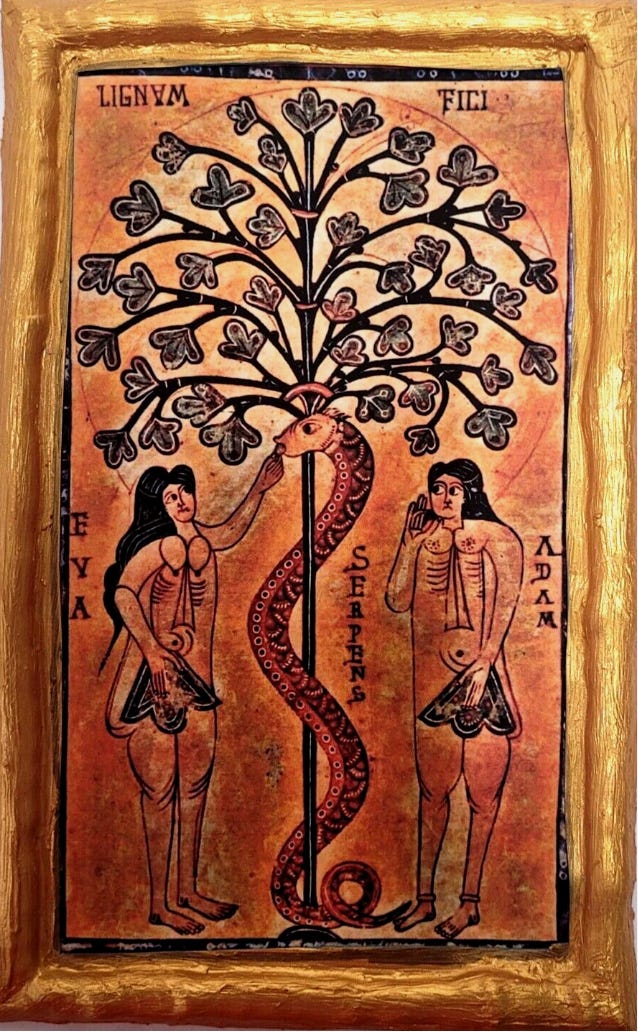
In the Garden of Eden, humanity became debtors to God.  Not in the sense that we stole money, but in that there was an offense that needed to be rectified.  In the Garden of Eden, humanity took the forbidden fruit from a tree, and then many years later, the Son of Man was hung like rotten fruit on a twisted tree outside of Jerusalem.

Here is the brilliance of Christianity: Humanity did not offer something to appease God; God sacrificed himself to prove to humanity that God is infinite, outpouring, co-suffering love (Thank you, Brad Jersak).

4.

“Keep in mind God’s precept that states, ‘Judge not, and you will not be judged’ (Lk. 6:37), and in no way meddle in the lives of others.”

– Symeon the New Theologian, 10th Century Monk

I struggle with this one.

I struggle with this because I can be a judgmental son of a gun.

There is one side of my personality that wants to say some people need to have their lives “meddled with” because the way their lives do violence to others.  On a macro-scale, we could easily point to the Israel-Gaza conflict or the Russian occupation of Ukraine.  On a micro-scale, we could point to abusers, thieves, and the like.

But perhaps all that is my roundabout way of justifying my own unhealthy need to judge others and tell them how to live their lives.  Who knows?  Rather than point my fingers at others, I should stop rationalizing things and reiterate that I am a judgmental son of a gun, and I do not want to give it up.

“Wretched person that I am! Who will rescue me from this body of death?” – Romans 7:24

5.

“The Bible was composed in such a way that as beginners mature, its meaning grows with them.”

– Augustine of Hippo, Early Church Father

If you are immature, you will read the Bible in an immature way.

If you are mature, you will read the Bible in a mature way.

As someone who majored in Biblical Studies in college, and never slowed that personal study of the Scriptures since, I can say for myself that my understanding of the Scriptures has consistently blossomed.  There were some readings of the Scriptures that I needed to let go of, allowing the Scriptures to breathe, grow, and teach me in new ways.

Emotional Equilibrium

August 21st, 2025

Releasing Our Passions

Thursday, August 21, 2025

Richard Rohr explores the emotional energy of anger and how we can allow it to both inform us and move through us:   

In Greek mythology, three female goddesses, the Furies, were the deities of retribution and vengeance. They were horrible to look at, with snakes for hair, black wings, and blood dripping from their eyes. Though they were supposedly pursuing and punishing evildoers, their righteous need for vengeance brought about little lasting good, because they needed to punish evil too much and thus became evil themselves. Does this not sound like what practitioners of modern nonviolent theory tell us—violence begets violence? Our words “furious” and “infuriated” come from these goddesses. Their main problem was that their righteous anger consumed them, and their blind fury became an end in itself—and the lasting message.  

It has taken us centuries to fully recognize this pattern is operating in human beings too. It is common for the psyche to put its hope in a retributive notion of justice even though it never works long term. That reveals the classic pattern of all addiction: We keep doing something even when it is not working.  

The preoccupations of the Furies were what the later Desert Fathers and Mothers would call “passions” or what we might call addictive emotions. Whenever we recognize an outsized emotional response, we can be pretty certain that we are over-identified with something or our shadow self has just been activated and exposed. If we are ultimately incapable of detaching from an emotion, we are far too attached!  

There is much evil and injustice in the world that deserves righteous anger, but a good practice is to watch that emotion a bit—to see where that anger is actually coming from. This will take humility and patience. If it is truly God’s anger, we can also trust God to lead and resolve it to some degree, but when it is mostly our anger—if we are using God as our justification—it will have too much urgency, too much of “me,” too much righteousness, too much impatience, too much need to humiliate the opponent. We almost always start there, but good therapy, a wise friend, or spiritual direction can help us distinguish between our personal anger and God’s pure anger. This might take some time to learn, but, unless we do this, we will not have healthy or helpful emotional responses—the unhealthy ones will have us! This is surely what the Bible was pointing to in using the psychologically astute phrase of “being possessed by a demon”!  

If we don’t want to let go of our anger and keep justifying why we deserve to hold on to it, we’re probably operating out of our own offended ego. When we can let go of it—after properly acknowledging it—we will probably be able to retrieve its wisdom—without its excessive charge and use it effectively.  

______________________________________________________

Sarah Young Jesus Calling

Wait with Me for a while. I have much to tell you. You are walking along the path I have chosen for you. It is both a privileged and a perilous way: experiencing My glorious Presence and heralding that reality to others. Sometimes you feel presumptuous to be carrying out such an assignment.
     Do not worry about what other people think of you. The work I am doing in you is hidden at first. But eventually blossoms will burst forth, and abundant fruit will be borne. Stay on the path of Life with Me. Trust Me wholeheartedly, letting My Spirit fill you with Joy and Peace.

RELATED SCRIPTURE:

1st Kings 8:23 (NLT)
23 and he prayed,
“O Lord, God of Israel, there is no God like you in all of heaven above or on the earth below. You keep your covenant and show unfailing love to all who walk before you in wholehearted devotion.

Galatians 5:22-23 (NLT)
22 But the Holy Spirit produces this kind of fruit in our lives: love, joy, peace, patience, kindness, goodness, faithfulness, 23 gentleness, and self-control. There is no law against these things!

Additional insight regarding Galatians 5:22-23: The fruit of the Spirit is the spontaneous work of the Holy Spirit in us. The Spirit produces these character traits that are found in the nature of Christ. They are the by-products of Christ’s control – we can’t obtain them by trying to get them without his help. If we want the fruit of the Spirit to grow in us, we must join our life to his (discussed in John 15:4-5). We must know him, love him, remember him, and imitate him. As a result, we will fulfill the intended purpose of the law – to love God and our neighbors. Which of these qualities do you want the Spirit to produce in you?

Mind Your Mind

August 20th, 2025

Brian McLaren describes how contemplative practices allow us to “mind our mind,” making space for thoughts, emotions, and physical sensations without getting caught up in them.  

When you learn to mind your mind, you begin by allowing your thoughts and feelings to shout or cry, to throw a tantrum and have a meltdown. It’s fruitless and ultimately quite harmful to perpetually beat down those feelings. So for some period of time, you let your inner committees express their distress and negotiate, firing up the subway for a frantic rush hour.  

And then, at some point, you have to get off the train and exit the subway station and find a quiet place. Perhaps you’ll meet with a circle of trust, processing with some friends what you’re struggling with. Perhaps you’ll find some solitude to practice private contemplation.  

One of the most time-tested approaches to private contemplation could be called the focus/release method…. I might focus on a single, simple word. I might focus on a phrase or mantra…. Sometimes, when simple breath, heartbeat, words or phrases aren’t working, I might listen to music, dance, cook, or simply walk mindfully and focus on what I see around me…. I may go running, practice yoga, or play a game, so I have to shift my focus from inner turmoil to physical endurance and prowess.  

McLaren names the freedom and creativity that arises from contemplative practice:  

Contemplation liberates me from being a perpetual prisoner of my trains of thoughts and feelings; it helps me realize that I am not my thoughts and feelings. It helps me see that these inner reactions and negotiations happen to me and within me without my consent, like digestion, like sleep, like fatigue or laughter.  

In the stillness, new insights, comfort, and ways of being often arise. If stepping off the train is letting go, and if dwelling in the stillness is letting be, receiving these gifts is letting come. When these new gifts come, I experience a kind of liberation, a setting free. All of my best creative work seems to flow from this deep place of restful, receptive awareness beneath my mental subway system…

What we experience in the letting-come phase some people describe as intuition. Many would call it the gentle voice of God speaking within them. Seasoned contemplatives like Thomas Merton describe letting go, letting be, letting come, and setting free as discovering the true self. Others call it becoming the best self. I tend to think of it as becoming the integrated, unitive, or connected self…. 

This connected self seeks to bring together smaller competing parts into larger harmonious wholes. It seeks to integrate the known and the unknown. It wants to help the parts of [me] to live intentionally in relation to each other and to the reality outside of me. It seeks harmony and interdependence among parts, not domination, manipulation, exclusion, and oppression. It holds the both/and of part and whole.  


Hey CO Few, Andrew Lang here,
This past week, I facilitated my nonprofit’s annual training for local educators: a 3-day intensive on how to build relevant, hands-on projects so students feel seen and are engaged in real-world problem solving while at school.It’s one of my favorite events each year because we work on really hard stuff: developing curriculum kids actually care about, integrating anti-racist teaching practices into our lesson planning, co-creating our classrooms with students rather than simply for them, or, in some case, for ourselves.It’s beautiful – but it’s also absolutely exhausting.
And you can probably guess:Many teachers for whom this is new struggle with shifting from thinking about potential changes to actually making them.It can be scary to try new things; challenging to do the self-examination needed to think in new ways; emotionally draining to work those muscles of creativity; absolutely paralyzing to face the possibility of public failure. (Plus the event is in the middle of a teacher’s summer break, so…there’s that.)
For some, the gathering each year is like a breath of fresh air amidst a stale stream of district-led events; for others, just getting there and getting started was crushingly difficult.We all have something like this in our lives – where getting started, no matter how much we want to, is the hardest step.

So here’s a framework I like to use as a gut-check when I’m considering starting something new: (I think I heard this first in a podcast with James Clear.)Is this a hat, a haircut, or a tattoo?
Most decisions are like hats: things we can easily try on and see how they fit; and if they don’t, we can just move onto another one; they are easily reversible and try-again-able.
Some are more like haircuts: a bit more of a commitment and sacrifice, but still changeable and short-term-ish; if it doesn’t work great or feel right, we’ll think about it for awhile – others might let us know – but we’ll be okay.
And then there are the tattoos: the big, permanent-for-the-most-part decisions; the long-haul commitments; the decisions that come with real, embodied sacrifice.I realized on the second day of our event that the teachers who were struggling most were mistaking hats and haircuts for tattoos: every small change felt like a mountain that had to be moved.Sound relatable?Especially when it comes to making changes in our personal lives or taking a deeper step into activism, it’s easy to conflate hats with haircuts…and sometimes even tattoos.The decision to call a representative, attend a local Indivisible meeting, speak up against harmful policies or behavior at work: for many of us, if we’ve never done anything like this before, it can feel huge, difficult, and emotionally exhausting just to consider taking action.But, the truth is – most of these decisions are hats and haircuts: doable actions that are flexible, changeable, and require very little real commitment of us.

So an invitation:This week, try on a few hats and maybe even get a haircut. Choose to take action, no matter how small, and pay attention to its impact and how it feels in your body. Then, when you find something you can do sustainably to meaningfully impact an issue you care about, go and get yourself that big back tattoo.

Feeling for Collective Healing

August 19th, 2025

Somatic therapist and healer Prentis Hemphill explores how curiosity and openness to emotions allows us to access their wisdom: 

To feel an emotion is to allow it and let it run through, to learn from what it is telling you about you, about your relationships. Feeling is a self-acceptance of your own emotions and the wisdom of your body….  

A significant part of feeling is not allowing ourselves to fall too quickly into naming or categorizing what we feel, but to allow and witness. Simply asking what an area of the body might say if it were held … most always elicits stories and more sensations. It can be tricky, though. Just as our avoidance of feeling can become our normal, we can try to live in emotions, or rather perpetually revisit them. Sometimes we can get stuck in a way of emoting, or focusing on emoting as evidence of feeling, and that can be its own means of hiding or avoiding another feeling buried even further underground. Authentic feeling is not performed nor is it summoned. Feeling is allowed. It is emergent. It is a listening that aligns us with our real indicators. Feeling grounds us. It is proof that we are alive…. Feeling itself needn’t turn into an obsession or another kind of supremacy. It is offered as a counterbalance to a worldview that denies its wisdom.  

Hemphill explores how strong feelings are brought forward with support and in turn offer collective support and healing to others. 

It takes resource to feel. But what we think of as resource can be expansive. Human and animal relationships often provide resource for us to face what was previously unfaceable. If we are open to it, trees can help us feel; their steady strength can be an ally, a way to ease our fear. Feeling needs resource and gives us resource in return….  

Feeling and connection bring us into the world and into relationship with one another. Some things seem too big to be felt alone because they are. They require the collective to hold the space for big feeling, for it to move through, and to remind us that we’re not alone…. This is why we meet in the streets. As much as mass protests and direct action are about putting strategic pressure on opposition, they are often a gathering space for our grief and pain because they are too big to feel alone. Protests don’t get reported on this way, as an eruption of collective grief; on the news they are riots, and we begin the cycle of minimizing the feelings that bring people to the streets, and ultimately we miss the message. We need those spaces and others, too, where our grief can swell, where feeling for feeling’s sake can reconstitute us, where our empathy for one another can build. A community, a society, becomes one, remains one, I think, through sharing feeling.  


The Wrong Story Entirely

a couple more thoughts on fear for my very good looking subscribers

NADIA BOLZ-WEBERAUG 18

The Jesus Pillow

In the Gospel of Mark, Jesus and his disciples left with some other boats to go to the far side of the Galilean sea…there was a great storm and they were afraid and to top it all off Jesus was being sorta useless.  I mean, in the middle of the storm he was napping . . .on a cushion. (For you Bible nerds: this story appears in varying forms in all 4 of the gospels, but God bless him, Mark is the only one of his fellow gospel writers who mentions that there was a pillow involved) Anyhow, the disciples are freaking out thinking they are going to die.  They look at their situation and see that the cast isn’t acting how they are supposed to and the script isn’t unfolding the way they think it should if Jesus really loved them.  So they wake him up and say, “don’t you care we are perishing?”.   

The disciples had some feelings about their situation, which is totally understandable – If I were in a sketchy first-century boat, water up to my ankles, thunder cracking overhead, and Jesus was just snuggled up with his little boat-pillow? Yeah. I’d be like,  Jesus why don’t you care that we are, you know…dying here?

The issue isn’t that they found a scary storm to be scary, the issue is that the disciples assume that since Jesus isn’t acting the way he “should” that Jesus therefore doesn’t care that they are in peril. Which is a little thing we call: projection. 

Projection is how fear finds its business partner: resentment

I mean, Jesus never actually left them, he just didn’t act the way they thought he should in a crisis

More often than not I am afraid because I think I am not going to get something I want or because I think that something I have will be taken away.  Fear shrinks me down into the starring role in a tiny, self-centered story where I’m both the hero and the narrator. And in that story, every storm is about me.

Other Boats

Here’s why I mention that: I’m not sure how many times I’ve read this storm at sea story from Mark but it’s a lot. And I’ve read tons of commentaries on it and I can’t remember seeing anything about this one little detail in verse 26:  And leaving the crowd behind, they took him with them in the boat, just as he was. Other boats were with him and a great storm arose and the waves beat the boat.  

I get that they were afraid and all that, but what about the other boats?  

I mean, the text says that there were other boats with them, which means that the people in those boats were experiencing the storm too. And yet I can’t remember ever noticing this part of the story. So maybe one cost of their fear was that the disciples forgot about anyone but themselves.  I know that is usually my move. Fear can make me think only of myself and my needs. When the storms of life overtake me, my world becomes only about me. 

         What I mean is this: sometimes when we get so wrapped up in how we think the story of our lives should look: the cast and setting and plot, we forget about the other boats.  Maybe we think God’s faithfulness to us has to look a certain way.  But sometimes God’s faithfulness looks like the fact that there is actually a better story than the way we want things to be.  And that better story is ALWAYS a bigger story.  A story with a lot of boats other than ours.

And here’s the paradox: the very stuff I wish God had protected me from—my screwups, my addiction, my body falling apart, the griefs I would have given anything to skip—those are the exact things that allow us to show up for other people in their own shit storms. 

         Don’t mistake me, this is not the same as saying that your fear and crises and loss are not painful in a totally real way.  I just think that maybe God’s love shows up in ways we don’t script. 

And honestly, thank God for that. Because left to my own devices, I’d settle for a God who just fixes things on cue. But the God who commands the wind and the waves? That is the God of all the boats.

Which is inconvenient, honestly. Because sometimes I really want Jesus to be my own personal boat-buddy, smoothing my own personal waters, fixing my own personal life. But God’s story is bigger. 

Bigger and better. I believe that, but it isn’t always easy.

In this storm with you,

Nadia

Welcoming but Not Clinging

August 18th, 2025

Father Richard Rohr describes the necessity of attending to our emotions while not clinging to them:  

Emotions are necessary weathervanes, in great part body-based, that help us read situations quickly and perhaps in depth. But they are also learned and practiced neural responses, often ego-based, which have little to do with objective reality and much more to do with the storylines that we have learned and created. Our separate self loves to hold onto such emotions to justify and defend itself and assert its power. 

Much of the work of emotional maturity is learning to distinguish between emotions that give us a helpful message about ourselves or situations and emotions that are merely narcissistic reactions to the moment. I dare to say that, until we have found our spiritual center and ground, most of our emotional responses are usually too self-referential to be helpful or truthful. They read the moment as if the “I,” with its immediate needs and hurts, is a reference point for objective truth. It isn’t. The small, defensive “I” cannot hold that space. Only Reality/God/Creation holds that space.  

Naming any emotion, even if it is negative, as a “sin” is not useful, because guilt and shame, or any sense that “God is upset” with us, usually only increases our negativity and fear—which causes us to close down all the more. In other words, when we try to shut them down, our emotions become more complex, more conflicted, more repressed—and thus less honest “reflections” of reality. If an emotion does not help us read the situation better and more truthfully, we must release it, let it move through us—for our own advantage.  

Most of us are naturally good at attachment, but few of us have training in detachment or letting go. Practicing detachment is one of the great tasks of any healthy spirituality, but, when carried to extreme, it’s counterproductive. (It almost took over in much of early Christianity, which was not helpful.) We must take the risk of legitimate attachment (fully feeling the emotion), learn its important message, and then have the presence and purpose to detach from that fascinating emotion after it has done its work. This is the gift and power of an emotionally mature person. [1] 

To be truly conscious, we must step back from our compulsive identification with our unquestioned attachment to our isolated selves—the primary illusion. Pure consciousness is never just me, trapped inside my self. Rather, it is an observing of “me” from a distance—from the viewing platform kindly offered by God (see Romans 8:16), which we call the Indwelling Spirit. Then we see with eyes much larger and other than our own.  

Most of us do not understand this awareness because we are totally identified with our passing thoughts, feelings, and compulsive patterns of perception. We have no proper distance from ourselves, which ironically would allow us to see our radical connectedness with everything else. Such radical connectedness is holiness. 

A Gift for Experiencing Reality

Father Richard suggests how we might honor our emotions without overly attaching to them:  

When it comes to honoring our emotions, we have to say both a strong “yes” and a strong “no.” We must begin with “yes” because so many of us were trained, by family and religion, to not feel our feelings. They thought they were doing us a favor, because they didn’t want emotions to rule our life. Unfortunately, that gave a moral connotation to even having feelings, not just the “negative” ones like anger, resentment, or fear, but the positive ones too, like pleasure, happiness, and even desire. The overt or subliminal messaging “That’s wrong. That’s bad” stunted our capacity to appreciate, and to suffer or to allow the full meaning of reality. Emotions are, first of all, a gift from God so that we can touch reality by a way other than our brain.   

Pastor Peter Scazzero affirms that our emotions are central to our humanity and to our relationships with God and people:   

Like most Christians, I was taught that almost all feelings are unreliable and not to be trusted. They go up and down and are the last thing we should be attending to in our spiritual lives. It is true that some Christians live in the extreme of following their feelings…. It is more common, however, to encounter Christians who do not believe they have permission to admit their feelings or express them openly. This applies especially to such “difficult” feelings as fear, sadness, shame, anger, hurt, and pain. And yet, how can we listen to what God is saying and evaluate what is going on inside when we cut ourselves off from our emotions?   

To feel is to be human. To minimize or deny what we feel is a distortion of what it means to be image bearers of God. To the degree that we are unable to express our emotions, we remain impaired in our ability to love God, others, and ourselves well. Why? Because our feelings are a component of what it means to be made in the image of God. To cut them out of our spirituality is to slice off an essential part of our humanity. [1] 

Richard considers the risk of overemphasizing the importance of our feelings:  

Because emotions were so repressed and denied and thought to be always faulty, it’s probably one of the major reasons we moved into overly heady Christianity. We’re rediscovering the value of emotions now, but this has the danger of swinging the pendulum to the other side—assuming that emotions are always right, always good. But when taken at face value, emotions don’t have any cognitive balancing. We aren’t asking “Is that a sensible response? Is that a reasonable response? So, we have a lot of sentimentality and drama, the pumping up of emotions about nothing. We spend hours creating outer dramas, particularly when there’s no inner drama, no inner aliveness or contentment. Inside the frame of the smaller self, we tend to make everything a big deal.


The Rich Young Ruler’s Second Chance: A John Mark Conspiracy Theory
By Anthony Parrott
 
  I’ve long been fascinated by the rich young ruler—not because of what he did, but because of what we assume he didn’t do next.Picture him walking away from Jesus in Mark 10, shoulders heavy with the weight of unmet expectations. The text says he went away “grieving, for he had many possessions.” But what if grieving was just the beginning? What if walking away sad wasn’t the end of his story, but the necessary prelude to understanding what it actually costs to follow love? Here’s my favorite biblical conspiracy theory: the rich young ruler came back. And his name was John Mark.
The Case for John Mark
John Mark first appears in Acts 12, where we learn his mother Mary owns a house in Jerusalem—not just any house, but the house where the early church gathers. Prime real estate: big enough to host the Last Supper, spacious enough for Pentecost when the Holy Spirit shows up like wind and fire, central enough to serve as headquarters for the early Jesus movement.In Acts 13, John Mark joins Paul and Barnabas on their first missionary journey. Then, in Acts 15, he abandons them halfway through. Paul gets so pissy he refuses to work with John Mark again.But years later something shifts. Later, in Colossians 4 and 2 Timothy 4, Paul calls John Mark “like a son to me” and “useful in ministry.”The earliest church tradition about Mark comes from Papias of Hierapolis (around 125 CE), who wrote that Mark “became Peter’s interpreter and wrote accurately all that he remembered of the things said or done by the Lord.” This tradition—that Mark’s Gospel is essentially Peter’s memoirs of following Jesus—was picked up by later church fathers like Irenaeus and Clement of Alexandria. So we have this wealthy young man with serious family money and connections to the Jesus movement, who has a documented pattern of saying yes to following Jesus, then walking away, then coming back again.The Rich Young Ruler’s QuestionIn Mark 10, an unnamed wealthy young man approaches Jesus with a question that sounds spiritually mature but reveals something desperate underneath: “Good Teacher, what must I do to inherit eternal life?”Jesus’ response cuts through the performance. After the young man claims he’s kept all the commandments since his youth, Mark tells us Jesus “looked at him and loved him.” Then comes the challenge: “You lack one thing; go, sell what you own, and give the money to the poor, and you will have treasure in heaven; then come, follow me.”The young man walks away grieving “for he had many possessions.”
Many sermons end there, with the rich young ruler as a cautionary tale about the seductive power of wealth. Which, you know, we need those sermons. But what if that’s not where his story ends? What if the grief was the beginning of transformation?Hidden Signatures in Mark’s GospelMark’s Gospel contains these strange little details that feel like signatures by the author—moments where the writer seems to insert himself into the narrative.In Mark 14, during Jesus’ arrest in Gethsemane, most of the disciples have fled, but there’s this random detail found only in Mark’s account: “A certain young man was following him, wearing nothing but a linen cloth. They caught hold of him, but he left the linen cloth and ran off naked.”Why include this seemingly irrelevant detail? What if it’s not irrelevant at all?You have two unnamed young men in Mark’s Gospel: one who owns expensive possessions and walks away from Jesus sad, another who follows Jesus wearing expensive linen and literally leaves his costly garment behind when he flees. Both are wealthy. Both are young. Both are unnamed. Both walk away.What if they’re the same person? What if John Mark is writing his own origin story into his Gospel—not as the hero, but as the one who kept getting it wrong before he finally got it right?This reading reframes John Mark’s later story. His abandonment of Paul and Barnabas during their missionary journey isn’t just youthful irresponsibility—it’s part of a larger pattern of walking away when the cost gets too high, then finding his way back to saying yes.Think about the psychological weight Mark might have carried. If he was the rich young ruler, he’d lived with the memory of walking away from Jesus when directly challenged. He’d experienced the grief of choosing security over transformation. But then Jesus uses his family’s house for the Last Supper. The Holy Spirit shows up at Pentecost in the same space. The early church makes its headquarters in his mother’s home.That’s what conversion looks like—not a single moment of decision, but a series of choices to keep showing up even after you’ve failed. Faith isn’t about getting it right the first time, but about learning that love keeps offering second chances.

Why This Matters
I love this theory not because it’s provable (it’s not), but because it reframes failure as part of the journey rather than the end of it.The traditional reading of the rich young ruler story often feels like condemnation—see what happens when you choose money over Jesus? But if John Mark is our rich young ruler, the story becomes about redemption. It becomes about a God who doesn’t give up on us when we walk away sad.Jesus told his disciples, who were astounded by the difficulty of wealthy people entering God’s kingdom, “For mortals it is impossible, but not for God; for God all things are possible.”All things. Even rich young rulers who need multiple chances to learn what it costs to follow love. Even those of us who keep walking away and coming back, saying no and then yes, abandoning and returning.If John Mark really was the rich young ruler, then his Gospel becomes something beautiful and subversive—a testimony written by someone who knew intimately what it felt like to fail Jesus, and also what it felt like to be welcomed back. No wonder Mark’s account feels particularly human, so willing to showcase the disciples’ failures and fears.It also means our stories can be read differently. The times we’ve walked away grieving aren’t the end of our spiritual narratives—they’re the necessary prelude to understanding grace.Following Jesus can’t be about getting it right the first time. It’s about learning that love keeps calling our names even after we’ve walked away sad, keeps setting tables even after we’ve abandoned ship, keeps writing us into the story even when we’re convinced we’ve edited ourselves out.

Paul: A Christ Mystic

August 15th, 2025

United in Our Need for Grace

Friday, August 15, 2025

Brian McLaren reflects on Paul’s challenging task of implementing Jesus’ inclusive message in a growing spiritual community:  

Paul wasn’t trying to define or explain the gospel at all; rather, he was trying to clean up a mess that Jesus had created through his gospel. By mess I mean Jesus had quite effectively ruined the tidy conventional categories of his religious community. In his mind, some prostitutes and tax collectors were closer to God than some Pharisees and priests—and the greatest faith Jesus could find in all Israel was found in the heart of a political enemy who belonged to another religion (Matthew 8:10). Similarly, Jesus broke the rules about clean and unclean, and he kept raising wild and revolutionary new proposals—about the Sabbath, about what’s kosher…. How do you work out a deep shift like this in a community of faithful people who have always defined themselves in exclusive ways?  

McLaren highlights Paul’s Letter to the Romans as an example of Paul’s unifying message: 

Romans aimed to address a more immediate, practical question in the early Christian movement…: How could Jews and gentiles in all their untamed diversity come and remain together as peers in the kingdom of God without having first- and second-class Christians?…

Paul, like Jesus, is not a modern Western linear-argument type of guy. He’s Middle Eastern. He thinks in circles and speaks in parables. Paul is … the kind [of poet] who understands the power of imagination and has a way with words. His letter (contrary to dominant readings) is no more of a well-reasoned, linear, logical, analytical argument than Jesus’s sermons were. And that’s not a bad thing….  

What we have is not a premeditated work of scholarly theology, edited and reedited, complete with footnotes. Rather, Paul is dictating a letter to some people he loves on a subject he loves, expressing the honest, unedited, natural flow of his thoughts and feelings…. If we read Romans keeping these realities in mind, I think we will become more sensitive than ever to the wonderful dance of the Spirit of God and the mind of a man in the context of a community in crisis. Together, the Holy Spirit and Paul make move after move toward the single goal of justifying the gospel as good news for gentiles and Jews alike…. 

Paul asserts that God doesn’t play favorites. All human beings are on the same level, whatever their religious background. All violate their own conscience, all fall short of God’s glory, all break God’s laws. None can claim an inside track with God just because they have mastered a body of religious knowledge, avoided a list of proscribed behaviors, or identified themselves with a certain label. In this way, Paul renders every mouth silent and everyone accountable to God (Romans 3:19). There is no us versus them, no elite insiders and excluded outsiders. There’s just all of us—Jews and gentiles—and we’re all … united in our need of grace.   

_________________________________________________

John Chaffee 5 On Friday

1.

“We have all our beliefs, but we don’t want our beliefs.
God of peace, we want You.”

– Four Word Letter (pt.2) by mewithoutYou

mewithoutYou has been in my top 3 bands for most of my life.  I am hard-pressed to say it, but I think they might be my favorite band of all time. 

Sonically, they are all over the place.  There are elements of post-punk, but also orchestral pieces with ranting poetry over them.  Lyrically, they are mystical and experiential, and I love it.

2.

“There is nothing to writing.  All you do is sit down at a typewriter and bleed.”

– Earnest Hemingway, American Author

Yes, I have written five books now.

However, I rarely consider myself a writer or author.

Why?

Call it imposter syndrome?  I have no idea.

That said, there is serious truth to this idea that to write is a matter of bleeding.  My first attempts at writing lacked my voice.  They were my attempts to teach something about life, but it was an attempt to do that without bleeding, without sharing myself, without being vulnerable.

However, the best writers are the ones who are ruthlessly honest about their own experience of life.  Yes, they may have an impressive vocabulary, but the real je ne sais quoi is the life they pour out of their veins and onto the piece of paper in front of them.

Ironically, writing is the easiest and most challenging thing.

3.

The spiritual journey is like an archaeological dig through various stages of our lives, from where we are back through the midlife crisis, adult life, adolescence, puberty, early childhood, infancy. What happens if we allow that archaeological dig to continue? We feel that we are getting worse. But we are really not getting worse; we are just finding out how bad off we always were. That is an enormous grace.”

– Fr. Thomas Keating, Trappist Monk

An archaeological dig, huh?

I like that.

For Keating, healthy spirituality is a matter of Divine Reparenting.  It is allowing God to heal the life wounds we inherited at different times throughout our lives. 

Of course, it is all well and good to think that the Christian life is about service to others and living a moral life, but what if we are doing those things out of a distorted need to prove something?  What if wounds and trauma taint our motivations for living out the Christ-life?

It is for this reason that many of us are terrified of doing legitimate work in the spiritual life.  Understandably, we might be averse to doing an “archaeological dig” back through different seasons of our lives to figure out and heal what needs healing.

4.

“Follow your dreams.  Unless they are stupid.”

– David Lynch, Movie Director

This one just made me chuckle.

I just had to pass it forward to you. 

5.

“You have only one master now…But with this ‘yes’ to God belongs just as clear a ‘no.’ Your ‘yes’ to God requires your ‘no’ to all injustice, to all evil, to all lies, to all oppression and violation of the weak and poor, to all ungodliness, and to all mockery of what is holy. Your ‘yes’ to God requires a ‘no’ to everything that tries to interfere with your serving God alone, even if that is your job, your possessions, your home, or your honour in the world.”

– Dietrich Bonhoeffer, German Lutheran Pastor and Martyr

Bonhoeffer was the first Christian theologian I ever read.

I can distinctly remember the summer after graduating college, sitting in the backyard by the lagoon with a Heineken in one hand and The Cost of Discipleship in the other. 

And so, it is fair to say that Bonhoeffer’s approach to ethics is firmly set within me.  With Bonhoeffer, there is no middle ground between loyalty to Christ and loyalty to anything else.  No nation, political party, figure, or ideology can or should ever stand equal to that of Christ.  If anything, loyalty to Christ demands an inevitable disruption of all other loyalties and ultimately a dismissal of them.

Bonhoeffer teaches us that anything that rivals our loyalty to Christ is an idol that deserves to be smashed.

In our day and age, some people have conflated loyalty to the nation, political party, figure, and/or ideology with being the same thing as being loyal to Christ, which is an insidious and misleading heresy.

In the words of Bonhoeffer, our “yes” to God demands a solid “no” to everything else.

Paul: A Christ Mystic

August 14th, 2025

The Mystery of the Cross

Thursday, August 14, 2025

Richard Rohr describes how Paul’s understanding of Jesus’ death critiques both the conservatives and liberals of his day:  

One of the dialectics that Paul presents is the perennial conflict between “conservative” and “liberal”, to use today’s terms. In his writings, Paul’s own people, the Jews, are the stand in for pious, law-abiding traditionalists; the Greeks provided his model for liberal intellectuals and cultural critics. Paul sees the Jews trying to create order in the world by obedience to law, tradition, and kinship ties. The Greeks attempt order through reason, understanding, logic, and education. Paul has a unique vantage point, with a foot in each world—as both a Jew and a Roman citizen.  

Paul insists that strict adherence to neither worldview can finally succeed because they don’t have the ability to “incorporate the negative,” which will always be present. He recognizes that the greatest enemy of ordinary daily goodness and joy is not imperfection, but the demand for some supposed perfection or order. There seems to be a shadow side to almost everything; all things are subject to “the principalities and powers” (Ephesians 6:12). Only the unitive or nondual mind can accept this and not panic; in fact, it will grow because of it, and even grow beyond it. 

Neither a liberal pattern nor a conservative pattern can deal with disorder and misery. Paul believes that Jesus has revealed the only response that works. The revelation of the cross makes us indestructible, Paul says, because it reveals there is a way through all absurdity and tragedy. That way is precisely through accepting absurdity and tragedy, trusting that God can somehow use it for good. If we can internalize the mystery of the cross, we won’t fall into cynicism, failure, bitterness, or skepticism. The cross gives us a precise and profound way through the shadow side of life and through all disappointments. 

Paul allows both conservatives and liberals to define wisdom in their own ways, yet he dares to call both inadequate and finally wrong. He believes that such worldviews will eventually fail people. He writes, “God has shown up human wisdom as folly” on the cross, and this is “an obstacle that the Jews cannot get over,” and which the gentiles or pagans think is simple “foolishness” (1 Corinthians 1:21–23). 

For Paul, the code words for nondual thinking, or true wisdom, are “foolishness” and “folly.” He says, in effect, “My thinking is foolishness to you, isn’t it?” Admittedly, it does not make sense unless we have confronted the mystery of the cross. Suffering, the “folly of the cross,” breaks down the dualistic mind. Why? Because on the cross, God took the worst thing, the killing of the God-human, and made it into the best thing, the very redemption of the world. The compassionate holding of essential meaninglessness or tragedy, as Jesus does on the cross, is the final and triumphant resolution of all the dualisms and dichotomies that we face in our own lives. We are thus “saved by the cross”! Does that now make ultimate sense?   

_____________________________________________

Sarah Young

Jesus Calling: August 14th

I am yours for all eternity. I am the Alpha and the Omega: the One who is and was and is to come. The world you inhabit is a place of constant changes--more than your mind can absorb without going into shock. Even the body you inhabit is changing relentlessly, in spite of modern science’s attempts to prolong youth and life indefinitely. I, however, am the same yesterday and today and forever.
     Because I never change, your relationship with Me provides a rock-solid foundation for your life. I will never leave your side. When you move on from this life to the next. My Presence beside you will shine brighter with each step. You have nothing to fear because I am with you for all time and throughout eternity.

RELATED SCRIPTURE:

Revelation 1:8 (NLT)
8 “I am the Alpha and the Omega—the beginning and the end,” says the Lord God. “I am the one who is, who always was, and who is still to come—the Almighty One.”

Additional insight regarding Revelation 1:8: Alpha and omega are the first and last letters of the Greek alphabet. The Lord God is the beginning and the end. God the Father is the eternal Lord and Ruler of the past, present, and future (see also Revelation 4:8; Isaiah 44:6 and 48:12-15). Without him, you have nothing that is eternal, nothing that can change your life, nothing that can save you from sin. Is the Lord your reason for living, “the Alpha and the Omega” of your life? Honor the one who is the beginning and the end of all existence, wisdom, and power.

Hebrews 13:8 (NLT)
8 Jesus Christ is the same yesterday, today, and forever.

Additional insight regarding Hebrews 13:8: Though human leaders have much to offer, we must keep our eyes on Christ, our ultimate leader. Unlike any human leaders, he will never change. Christ has been and will be the same forever. In a changing world, we can trust our unchanging Lord.

Psalm 102:25-27 (NLT)
25 Long ago you laid the foundation of the earth
    and made the heavens with your hands.
26 They will perish, but you remain forever;
    they will wear out like old clothing.
You will change them like a garment
    and discard them.
27 But you are always the same;
    you will live forever.

Additional insight regarding Psalm 102:25-27: The writer of this psalm felt rejected and tossed aside because of his great troubles (Psalm 102:9-10). Problems and heartaches can overwhelm us and cause us to feel that God has rejected us. But God our Creator is eternally with us and will keep all his promises, even though we may feel alone. The world will perish, but God will remain.

Psalm 48:14 (NLT)
14 For that is what God is like.
    He is our God forever and ever,
    and he will guide us until we die.

Additional insight regarding Psalm 48:14: We often pray for God’s guidance as we struggle with decisions. What we need is both a map that gives us directions and a constant companion who has an intimate knowledge of the way and will make sure we interpret the map correctly. The Bible is such a map, and the Holy Spirit is our constant companion and guide. As you make your way through life, use both the map and your guide – the Holy Spirit.

August 13th, 2025

Enabled to Do All Things

What is a Mystic? From the Canadian Anglican Church Newsletter

The earliest documentary witness to Jesus Christ which we possess is the witness of mysticism; and it tells us, not about His earthly life, but about the intense and transfiguring experience of His continued presence, enjoyed by one who had never known Him in the flesh.  
—Evelyn Underhill  

Something missing in my heart tonight
Has made my eyes so soft,
My voice so tender
My need for God absolutely clear. (Hafiz)

Can you recall a time when you knew you needed God, and nobody else, nothing else, could fill that need? These are the words of Hafiz, a Mystic, describing the heart of every mystic.

How do you respond to this need? Do you push it back and try to ignore it, or do you spend some time trying to connect with the one who can fill that need? Do you try and clear space in your busy inner world and invite God to fill that need?

If you make the time to connect with God, you are a mystic. I define mystics as all who seek a deeper connection with God and live into that deeper connection. The church recognizes some people as mystics, for example, Hildegard of Bingen, and Julian of Norwich. Many others have not been officially identified as Mystics, just as the church recognizes some people as Saints. The number of saints is not limited to those formally recognized by the church. The Apostles Creed refers to the Communion of Saints: a large number.

___________________

We can read the stories about Mystics, Theologians, and others in two ways. We can read to learn the details of their lives and to gain knowledge about their teaching. We become scholars. Or we can read their stories with the eyes of our hearts – asking: “What is God wanting me to hear, to see, to feel, through what I am reading?” As we ponder what God is saying to us, we are mystics.

Anglican mystic and author Evelyn Underhill (1875–1941) is convinced that the apostle Paul’s writings are often misunderstood because we weren’t taught that he is a mystic:  

To obtain a true idea of St. Paul’s personality … we must correct the view which sees him mainly as a theologian and organizer by that which recognizes in him a great contemplative. For here we have not only a sense of vivid contact with the Risen Jesus, translated into visionary terms—“I fell into a trance and saw him saying to me” [Acts 22:17]—but an immediate apprehension of the Being of God…. 

We misunderstand St. Paul’s mysticism if we confuse it with its more sensational expressions. As his spiritual life matured his conviction of union with the Spirit of Christ became deeper and more stable. It disclosed itself … as a source of more than natural power. Its keynote is struck in the great saying of his last authentic letter: “I can do all things through Christ which strengtheneth me” (Philippians 4:13). This statement has long ago been diluted to the pious level, and we have ceased to realize how startling it was and is. But St. Paul used it in the most practical sense, in a letter written from prison after twelve years of superhuman toil, privation, and ill-usage, accompanied by chronic ill-health; years which had included scourgings, stonings, shipwreck, imprisonments, “on frequent journeys, in danger from rivers, danger from bandits, danger from my own people, danger from gentiles, danger in the city, danger in the wilderness, danger at sea, … in toil and hardship, through many a sleepless night, hungry and thirsty, often without food, cold and naked” (2 Corinthians 11:26–27). [1] 

These, and not his spiritual activities and successes alone, are among the memories which would be present in St. Paul’s consciousness when he declared his ability “to do all things.” 

Underhill emphasizes Paul’s sense of himself as a mystic:  

Much of the difficulty of St. Paul’s “doctrine” comes from the fact that he is not trying to invent a theology, but simply to find words which shall represent to others this vivid truth—“I live, yet not I … to live is Christ … Christ in me…” [Galatians 2:20].  

[His] letter [to the Romans] is the work of a man who has fully emerged into a new sphere of consciousness, has been “made free by the Spirit of Life,” “a new creature,” and enjoys that sense of boundless possibility which he calls “the glorious liberty of the children of God.” He knows the mysterious truth, which only direct experience can bring home to us, that somehow even in this determined world “all things work together for good to them that love God” [Romans 8:2, 21, 28].  

______________________

AUG 13, 2025
The Problem with Applying Scripture. (Skye Jethani)
Studying and applying scripture is difficult. As a result, some traditions discourage Christians from engaging the Bible, fearing its misapplication, and instead reserve the study of scripture for those trained to handle it correctly. Of course, this doesn’t guarantee the correct use of scripture either, as there is no shortage of bad biblical scholarship throughout church history. Other, more populist traditions do the opposite by encouraging everyone to read the Bible, interpret it, and apply it for themselves. While this may lead to some wackadoodle interpretations—and frequently does—the belief is that broad biblical engagement ultimately does far more good than harm.
One of the interpretive challenges for both Bible scholars and Bible populists is determining which of Jesus’ statements are universally applicable and which are not. For example, I have heard many sermons in which Jesus’ call to Peter, James, and John to become “fishers of men” (Luke 5:10) has been broadly applied to all believers. On the other hand, I’ve yet to hear a sermon in which Jesus’ command to a rich man to “sell all that you have and give it to the poor” (Luke 18:22) is imposed on every Christian. Why do we universalize Peter’s specific calling and not the rich young ruler’s?

Sometimes the application of Jesus’ commands has changed over time. For most of Christian history, for example, the Great Commission passage at the end of Matthew’s gospel was seen as a specific calling to the remaining eleven Apostles to whom Jesus said, “Go and make disciples of all nations…” (Matthew 28:18). Only later, with the modern missionary movement, was this passage broadly reapplied as a commission given to the whole church. In my life, I’ve never heard it taught any other way but go back just a few hundred years and the interpretation assumed by nearly all modern evangelicals would have been unknown in most churches.

This same interpretive challenge applies to many parts of Jesus’ farewell discourse. It’s clear from John’s gospel that Jesus was addressing his closest disciples concerning his death, resurrection, and return to the Father, but how do we know which of Jesus’ promises apply only to those gathered with him that night and which apply to us as well? For example, in John 14:26, Jesus says the Holy Spirit will “bring to your remembrance all that I have said to you.” Some have taken this verse to mean the Spirit’s role in every believer’s life is to recall and illuminate Jesus’ words. Throughout history, some have even used this verse to claim they’ve received new revelations from God and new commands from Jesus himself.But what if Jesus intended this promise only for those with him in the upper room? Those affirming this view believe the Spirit, while promised to all believers, was also given to Jesus’ first disciples for a special purpose. Specifically, so they could remember all he said and did and record it for future generations. In other words, some believe John 14:26 anticipates the writing of the gospels and the rest of the New Testament. When understood this way, our job isn’t to seek the Spirit for new revelations from Christ, but to engage the words given by the Spirit to his Apostles as authoritative scripture (see 2 Timothy 3:16). In the context of the farewell discourse, I find this interpretation far more convincing.Still, the ambiguities of Bible interpretation remain real, and we should all be more self-aware of the biases and interpretive traditions we carry with us when we open the scriptures. Our tendency to universalize the promises and commands we like, while dismissing the ones we don’t as not applying to us, is very real. Minimizing this error requires learning from both the Bible scholars and the Bible populists. The scholars can teach us history, context, and language so we read the Bible as its authors intended, while the populists remind us that even with education and training, we still need the Spirit’s guidance to lead us into all truth. And I would beware of any Bible teacher who insists only one or the other is necessary.

DAILY SCRIPTURE

JOHN 14:25-31
2 TIMOTHY 3:10-17


WEEKLY PRAYER. From Robert Leighton (1611 – 1684)

Grant, O Lord, that I may be so ravished in the wonder of your love that I may forget myself and all things; may feel neither prosperity nor adversity; may not fear to suffer all the pain in the world rather than be parted from you. O let me feel you more inwardly, and truly present with me than I am with myself, and make me most circumspect in your presence, my holy Lord.
Amen.