Father Richard considers what we can learn from the first Bible of nature:
The first act of divine revelation is creation itself. The first Bible is the Bible of nature. It was written at least 13.8 billion years ago, at the moment that we call the Big Bang, long before the Bible of words. “Ever since God created the world, God’s everlasting power and divinity—however invisible—are there for the mind to see in the things that God has made” (Romans 1:20). One really wonders how we missed that. Words gave us something to argue about, I guess, while nature can only be experienced, and hopefully enjoyed and respected with admiration and awe. Don’t dare put the second Bible in the hands of people who have not sat lovingly at the feet of the first Bible. They will invariably manipulate, mangle, and murder the written text.
The biblical account tells us God creates the world developmentally over six days, almost as if there was an ancient intuition of what we would eventually call evolution. Clearly creation happened over time. The only strict theological assertion of the Genesis story is that God started it all. The exact how, when, and where is not the author’s concern. This creation story, perhaps written five hundred years before Jesus Christ, has no intention or ability to be a scientific account. It is a truly inspired account of the source, meaning, and original goodness of creation. Thus, it is indeed “true.” Both Western rationalists and religious fundamentalists must stop confusing true with that which is literal, chronological, or visible to the narrow spectrum of the human eye. Many assume the Bible is an exact snapshot—as if caught on camera—of God’s involvement on Earth. But if God needed such literalism, God would have waited for the 19th century of the Common Era to start talking and revealing through “infallible” technology. [1]
Science often affirms what were for centuries the highly suspect intuitions of the mystics. We now take it for granted that everything in the universe is deeply connected and linked, even light itself, which interestingly is the first act of creation (Genesis 1:3). Objects—even galaxies!—throughout the entire known universe are in orbits and cycle around something else. There’s no such thing in the whole universe as autonomy. It doesn’t exist. That’s the illusion of the modern, individualistic West, which imagines the autonomous self to be the basic building block and the true Seer. [2]
Yet all holy ones seem to say that the independent self sees everything incorrectly. Parts can only recognize parts and so split things even further. Whole people see things in their wholeness and thus create wholeness (“holiness”) wherever they go and wherever they gaze. Holy people will find God in nature and everywhere else too. Heady people will only find God in books and words, and finally not even there.
==================
Contemplation in the Desert
| MARK LONGHURST OCT 6 |
I’m no desert dweller. I love New Mexico’s dry dirt, short trees, and adobe houses, but I wouldn’t dare journey for days in the actual desert. When my wife and I first discussed moving to western Massachusetts, I asked, “Is there an independent movie theater? Where’s the nearest craft brewery?”
The desert, however, is a rich and longstanding image in the Jewish and Christian traditions. Ancient Christian monks wandered to the most remote and craggy outposts they could find and set up camp. The barren landscape became a spiritual metaphor for the interior purification or “letting go” process needed to meet God.
The ancient Israelites were a wilderness, nomadic people. They contemplated God in deserts, on mountaintops, on the margins, and on the move. Of course, the image of the promised land looms large in the Jewish imagination, but the desert persistently haunts the people as a symbol and harsh reality.
It’s the wilderness—in Hebrew, the same word for desert, midbar—that wields transformative, liberating power. The dramatic, mountain-quaking revelation at Sinai that Moses experiences is preceded by the people’s escape from Egyptian slavery and time spent wandering in the desert. But before Moses leads the people in the archetypal freedom flight from Empire, he goes out to the desert.
He has fled Egypt, having murdered an Egyptian and taken refuge in a land called Midian. One day, Moses is keeping the flocks of his father-in-law, Jethro (Exodus 3:1). He leads his flock into the wilderness-desert and arrives at a mountain, where he stumbles across a burning bush and receives Yahweh’s liberating call.
His own divine desert encounter galvanizes his leadership.
Before the people arrive at Sinai, they, too, trek through the desert. But the desert is tough and impersonal. It does not care about people. It has its own identity and will. It does not bend easily to our desires, if at all. The desert is not only a stop on the way to the mountain or an unfortunate detour on the way to the promised land but also a destination itself.
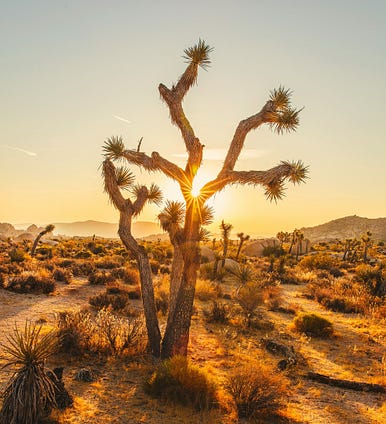
The ancient Israelites learn this lesson with great complaint. They cross the Red Sea, fleeing Pharaoh’s chariots while divine power holds waves at bay. Once in the wilderness-desert, the people face hunger, thirst, and armed enemies. Newly liberated, they nevertheless romanticize their oppression. They start to pine for Egypt’s full meals. They become thirsty. They protest Moses’s leadership. “Why did you bring us out into the desert, to kill us?” they ask (Exodus 16:3). God sends food from heaven for sustenance. God gives water that flows out of a rock struck by Moses. They run into other desert nomads, called Amalek, and are forced to fight to protect themselves.
The desert is the in-between space of testing, divine revelation, and transformation. It’s the job loss and search, the dissolution of a marriage, the grief after a beloved’s death. It’s also the place to discover God’s freedom and presence, from which a voice cries out, “Prepare the way of the Lord” (Mark 1:3). The story of Israel in the desert is also the story of the gospels, the way retread by Jesus. Once baptized and immersed in water, Jesus, too, is thrust into the wilderness-desert. Moses lingers at Mount Sinai for forty days and forty nights while, generations later, Jesus endures the desert and Satan’s cross-examination for forty days and forty nights.
Once tested and proven true in the desert, Jesus returns to the desert. It’s as if Jesus chooses the uncertain liminality of the desert to frame his life. Mark’s gospel includes rich, brief lines that suggest Jesus’s dedication to contemplation. They often simply read, “Jesus withdrew to a quiet place.” Writers on silent prayer have often turned to these verses hoping that Jesus, too, values silence. But Jesus’s embrace of silence is tied to landscape: the Greek word eremos means both a solitary and desert place (see Mark 6:31). When Jesus goes off to pray, he is not only stealing solitude, he is going to the desert.
The desert is the archetypal and literal place where we meet God, the place of fierce love. Deserts of loss, grief, pain, and literal sand strip down our pretensions, as if to say that preparing for God’s way requires abandonment of all our prior ways. The ways that we are in the world are all too often directed by addiction and a desire for more. The desert demands us to be emptied rather than filled, to show up and be tested, for divine fire to refine our desire, to face inner barrenness head-on, just as Jesus faces down the devil in the wilderness.
We are confronted with our naked self in the desert. There’s no place for our pride, lust, anger, resentment, or need for approval to hide. No amount of posturing will shield us from the desert sun’s unremitting glare. Its clarity may even stir us to long once again for the seemingly safe oppression of Egypt.
Or the truth that the desert peels away may cause us to plunge headlong in love with God, to say with the poet of the Song of Songs, “Who is that coming up from the wilderness, leaning upon her beloved?” (8:5)
The desert is a pliable metaphor for spaces of contemplation. While barren landscapes still hold transformative power, deserts are more populated these days. In a technological age, deserts are contested sites for cities, nuclear tests, oil drilling, and pipeline development. As Thomas Merton once wrote, “When man and his money and machines move out in the desert and dwell there, not fighting the devil as Christ did, but believing in his promises of power and wealth . . . then the desert moves everywhere.” Deserts symbolize the inner work of purgation and reality confrontation that would-be contemplatives must undergo wherever we find ourselves.
