Work Hard, Rest Well
Friday, October 10, 2025
To overwork—that is, to spend time working for what one does not need—means that one’s life is out of balance, and it breaks the circle of harmony.
—Randy and Edith Woodley, Journey to Eloheh
Randy and Edith Woodley co-founded the Eloheh Indigenous Center for Earth Justice and Eloheh Farm and Seeds. They explore Indigenous values in relation to materialism and life balance:
Materialistic values of Euro-American modernity are very different from our own Indigenous values…. Generally speaking, Indians are not materialistic. Materialism and consumerism are values imposed on Native Americans. The differences between Native North American values and those of the dominant society have been noted throughout our mutual history. Ronald Wright, author of Stolen Continents, writes of this conflict between settler and Native American understandings of wealth:
The problems were those which arise wherever a stable, collective system and one based on expansion and individual profits collide. It was, for instance, impossible to run a store or plantation profitably without violating the [way] of reciprocity fundamental to most Amerindian societies. To obtain respect in the Native world, people had to redistribute wealth; for esteem in the white world, they had to hoard it. To a Cherokee, sufficient was enough; to a white, more was everything. [1]
“More was everything”: what an apt description of the culture that surrounds us. And “sufficient was enough” gives us a window into Indigenous perspectives on consumption. The Cherokee concept of redistribution of wealth was at direct odds with the individualism of settlers. Until the nineteenth century, the Cherokees were able to retain their communal values. Remember: this was even after removal from their homelands. For a people to hold on to cultural values during times of extreme oppression, including forced relocation, is remarkable.
After touring Indian Territory in 1887, Senator Henry Dawes described the Cherokees in this way:
The head chief told us that there was not a family in the whole nation that had not a home of its own. There is not a pauper in that nation, and the nation does not owe a dollar. It built its own capitol … and built its schools and hospitals. Yet the defect of the system was apparent. They have got as far as they can go, because they hold their land in common…. There is no selfishness, which is at the bottom of civilization. Till these people will consent to give up their lands, and divide them among their citizens so that each can own the land he cultivates, they will not make much progress. [2]
“Progress,” according to Senator Dawes, meant individualism, materialism, and even selfishness. None of these ideals are Cherokee values, nor do they represent the values of other Native Americans….
Native Americans are not immune to hard work. In fact, some of the hardest-working people we have known are Indigenous. But in order to maintain a life of harmony, there must be a balance between work and rest, or recreation.
Work hard and rest well.
_____________________________________________
John Chaffee 5 on Friday
1.
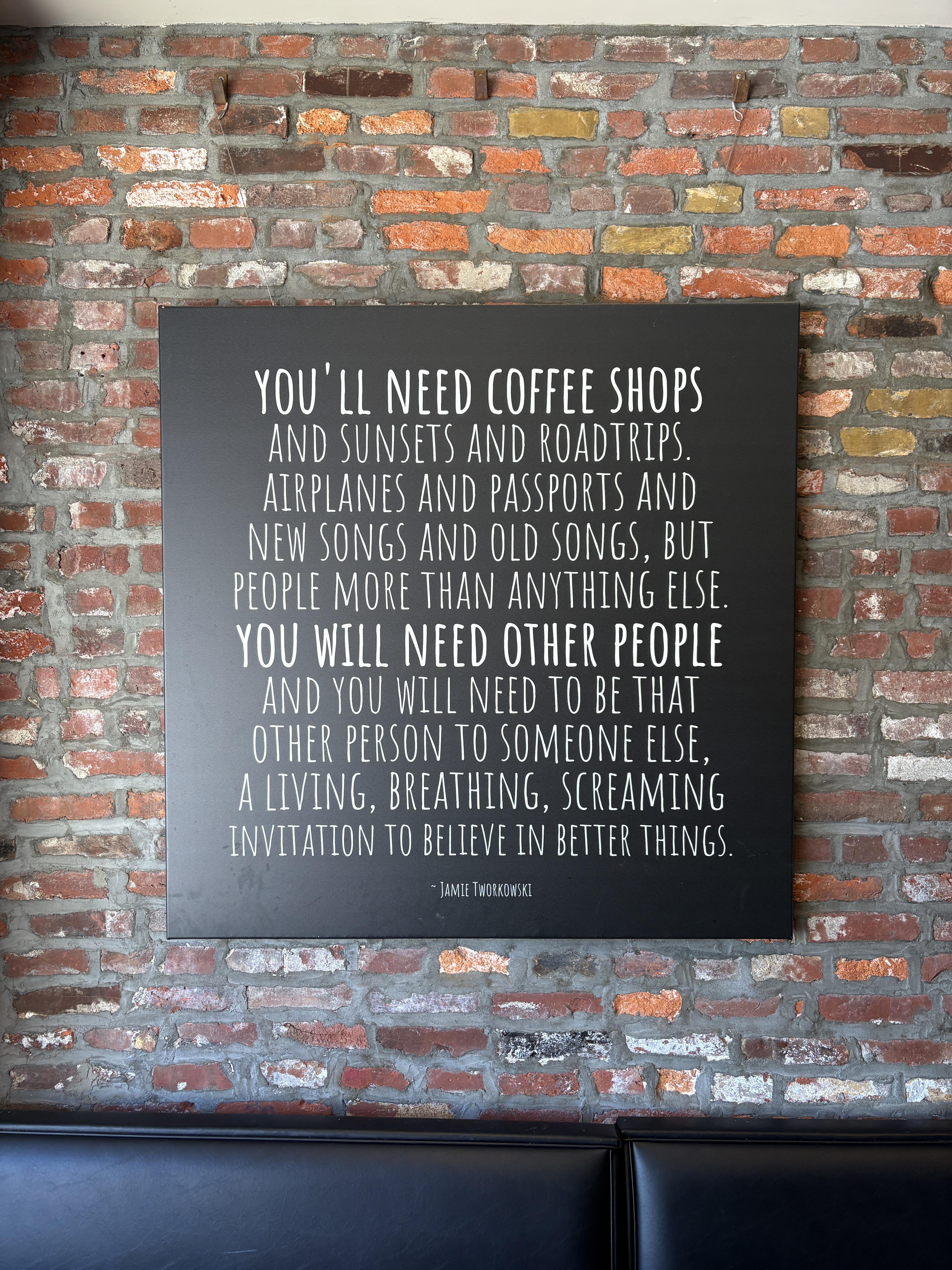
This quote is in on the left as soon as you enter House Cup, a coffee shop near me in Havertown, PA.
Jamie Tworkowski is the founder of To Write Love on Her Arms, an organization devoted to giving hope to those dealing with depression and suicidal ideation.
2.
“Good teaching cannot be reduced to technique; good teaching comes from the identity and integrity of the teacher.”
– Parker Palmer in The Courage to Teach
The Courage to Teach is a fantastic book.
I’ve been slowly reading it over the past month or so, and I’ve been underlining whole paragraphs.
To anyone who has the vocation of being an educator (of any sort), this is a potentially life-changing book. To me, it highlights some of the tensions and struggles of being an educator who wants their teaching to be a direct expression of their personhood. Too many teaching modes emphasize information sharing but lack the dynamism of the intersubjective and mutual transformation that can occur between a teacher and a student, THROUGH whatever field of study is being taught.
Education is for formation and transformation, not just the passing of information.
3.
“Christ was never in a hurry.”
– Mary Slessor, Scottish Missionary
Richard Foster writes that the three most significant obstacles to spiritual formation in modern society are “hurry, noise, and crowds.” As long as those things dominate our lives, and we do not intentionally choose a rhythm of stillness, silence, and solitude, then we should never expect to make much progress on the spiritual path.
Hurry is not something for which I am physically at fault. I despise running.
However, I admit that my mind is almost always racing toward the next event, task, deadline, etc. That type of hurried thinking leads me to sometimes fail at being joyfully present in the moment. Unfortunately, I must admit that I gave in to this type of hurried thinking quite a bit this week, and it came at the cost of my own joy, and perhaps at the cost of some of those around me.
So, if Christ was never in a hurry, that is quite convicting. I would guess that he had many of the same stressors, including deadlines, people clamoring, and dealing with incomplete people.
Fortunately, I believe Jesus lived the “perfect” life not to shame us for not doing it, but to reveal to us that it is possible for human beings not to be dominated by “hurry, noise, and crowds.”
4.
“We can know only that we know nothing. And that is the highest degree of human wisdom.”
– Leo Tolstoy in War and Peace
The older I get, the more I realize that I barely know anything.
It is youthful hubris that kickstarts that misguided belief that I know better than others, and then life comes along and dismantles that entire belief structure right in front of us.
I am absolutely guilty of being arrogant, brash, and a know-it-all. Looking back, I can see at least one decade where my hubris prevented me from cultivating humility. What kind of foolishness is that?
If I could sit down a younger version of myself, I would tell them to stop talking so much and do at least ten years more of listening to authentic people around me and that tiny, inescapable, authentic voice inside myself. I would tell a younger version of myself that no amount of knowledge will ever protect you from the pain of living a life, and that the most important lessons to learn are the ones that lead to personal transformation and vulnerable maturity.
5.
“To say that God turns away from the sinful is like saying the sun turns away from the blind.“
– St. Anthony the Great, Desert Monastic
The early desert mothers and fathers of the Church were so incredibly wise. I love this one from St Anthony the Great.
5. (Again)
“Gradually it was disclosed to me that the line separating good and evil passes not through states, nor between classes, nor between political parties either—but right through every human heart—and through all human hearts.
This line shifts. Inside us, it oscillates with the years. And even within hearts overwhelmed by evil, one small bridgehead of good is retained. And even in the best of all hearts, there remains … an unuprooted small corner of evil.“
– Aleksandr Solzhenitsyn, The Gulag Archipelago
(Embarrassingly, last week I sent out the weekly email with this last quote, but it did not have a commentary/brief word of reflection on it. I must have been tired or just out of it to let that mistake slip by.
So, here it is again.
But this time with said commentary/brief word of reflection.)
The best writers are not only those with impressive vocabularies or a precise command of grammar.
The best writers are those who best name what it means to be human. It can be either through poetry or prose, and it can rhyme or not. Those things do not matter. What matters is that when the reader comes to a new sort of clarity about themselves and the world.
And guess what?
That clarity does not always have to create warm and fuzzy feelings. Sometimes, clarity about ourselves or the world involves facing the hard truths that reveal there is good and evil within all of us, and that the responsibility rests with us to confront that evil and cultivate the good. In a sense, Solzhenitsyn reminds us here that the stakes are as high as they are personal.
And that is a big pill to swallow.
