Tuesday, March 10, 2026
Author Barbara Brown Taylor describes the suffering we experience when we live from a sense of disconnection:
Deep down in human existence, there is an experience of being cut off from life. There is some memory of having been treated cruelly, and—a little deeper, perhaps—the memory of having treated someone else cruelly as well…. Deep down in human existence there is an experience of reaching for forbidden fruit, of pushing away loving arms, of breaking something on purpose just to prove that you can. Deep down in human existence there is an experience of doing whatever is necessary to feed and comfort the self, because there is no one else to trust, no other purpose to serve, no other god to follow.
For ages and ages, this experience has been called sin—deadly alienation from the source of all life. By some definitions, it implies willful turning away from God. By others, it is an unavoidable feature of being human. Either way, it is a name for the experience of being cut off from air, light, sustenance, community, hope, meaning, life. It is less concerned with specific behaviors than with the aftermath of those behaviors. There are a thousand ways to turn away from the light, after all, with variations according to culture, century, class, and gender. The point is to know the difference between light and darkness, and to recognize the pull when it comes.
Though we may make choices out of a sense of disconnection, we can also choose to return to the original blessing of God’s love:
Repentance begins with the decision to return to relationship: to accept our God-given place in community, and to choose a way of life that increases life for all members of that community. Needless to say, this often involves painful changes, which is why most of us prefer remorse to repentance. We would rather say, “I’m sorry, I’m so sorry, I feel really, really awful about what I have done” than actually start doing things differently.…
“All sins are attempts to fill voids,” wrote the French philosopher Simone Weil. Because we cannot stand the God-shaped hole inside of us, we try stuffing it full of all sorts of things, but it refuses to be filled. It rejects all substitutes…. It is the holy of holies inside of us, which only God may fill….
I do not believe that sin is the enemy we often make it out to be, at least not when we recognize it and name it as such. When we see how we have turned away from God, then and only then do we have what we need to begin turning back. Sin is our only hope, the fire alarm that wakes us up to the possibility of true repentance.
================
Is it Sin or a Style of Coping?
How Doing The Deep Work of the Heart Requires Both
| CHUCK DEGROAT. MAR 8 |
“Is it sin or is it survival?” a student of mine asked not long ago. It’s a question I’ve heard repeatedly as I’ve taught called The Christian Interior Life at WTSover the years.
“All this talk of coping sounds as if we need to have empathy for abusers,” a reader asked, after a recent article.
Indeed, after When Narcissism Comes to Church was released, I heard some critiques that I didn’t use the particular word sin enough. The common hesitation—when we begin to use psychological words, it seems as if we’re veering away from theological ones, and when we veer away from robust words like sin, we’re prone to minimize it.
What’s lost in this, however, is that much of what I and others have written on narcissism, abuse, and trauma describe contexts where strong doctrines of sin were present. And yet, in these very places, there is too often 1) a real minimization of actual sin—hurt, harm, and abuse and 2) a denial of systemic sin, most often impacting women, the socially/racially/economically marginalized, and more, often hidden behind proclamations of a Gospel of grace and freedom.
As I’ve often said about my own writing—sin isn’t a word count. You reveal your actual doctrine of sin through the ways in which you courageously engage not just one-off misdeeds but actual and embedded patterns of harm. And psychology serves us by deepening our understanding of how our patterns develop, how our character forms, even about how the power of sin—in people, in family systems, in communities—can be undone, not through what I’ve called “bandaid theology” (quick fixes) but through the deep work of disentangling a heart from whatever binds it.
Sin and Styles of Coping
“When you talk about the nervous system,” someone says, “it sounds as if you’re just saying we learn to cope and adapt, not that we might actually be engaging sinfully.”
Those of us who are engaged in asking how God-designed physiological and neurobiological processes are involved in human action are profoundly interested in what’s bubbling beneath the surface of our behaviors. And we’ve tapped the well of psychology to affirm and deepen what wise theologians have long taught about what’s happening within.
Like the desert fathers and mothers of the third and fourth centuries, as former archbishop of Canterbury Rowan Williams notes, cartographers of the soul who were not just interested in bad behaviors but in the internal dynamics motivating sin—what they called the “passions.” Williams says that they named a “whole realm of instinct, reaction, coping mechanisms” that drive our outward behaviors, and a “compound of anxiety, defensiveness and acquisitiveness,” all driving us into inner and outer turmoil, robbing us of what God designed us for—connection and communion.
That’s nervous system language. And that’s theological language!
In other words, they sensed that the story of our patterns and habits is inextricably tied to a churning anxiety within—evidence of the kind of self-protection and survival we experience east of Eden, not the safety and security of Eden.
But here’s a physiological fact: the nervous system does not operate according to a moral code. It does not pause to ask, Is this right or wrong? It asks something much more immediate: Am I safe? And it reflexively responds by adapting and coping in a way that facilitates safety, at all costs.
That’s important.
Here, we lean in with wonder, asking what might actually be going on beneath the surface. Here, our hearts are widened beyond moral judgment and into compassion.
Our hearts grow in compassion for the child raised by a volatile parent who eventually learned to scan every room for subtle shifts in mood. Or the girl who became fiercely self-reliant because no one else was reliable. Or the boy who endured violence only to develop a powerful fight response that now keeps him from being crushed.
All bodies habituated to terror, adapting to survive.
And from the vantage point of survival, these responses make perfect sense. They worked. They helped us endure what might otherwise have been unbearable.
But hear this: survival strategies do not automatically become healthy ways of living. Survival strategies are not merely nervous systems in search of safety—they also become morally consequential.
The fight response that once protected a child may show up decades later as anger or intimidation toward a spouse or colleague. A flight response may turn into anxious perfectionism that keeps an entire household walking on eggshells—everyone bracing for the next sigh of disappointment or the quiet pressure of impossible standards. A fawn response may lead someone to chronically abandon their own voice while quietly resenting the people they work so hard to please. A freeze response may become emotional withdrawal that leaves loved ones feeling shut out.
What once helped us survive can eventually wound us—and the people around us.
Trauma therapist Diane Langberg has spent decades sitting with the aftermath of human harm, and she puts it starkly: “Abuse does terrible damage to the soul. It distorts how we see ourselves, how we see others, and how we see God.” When the soul is distorted in this way, our strategies for survival begin to shape the way we move through the world.
And the cycle can continue. As Langberg observes elsewhere, “The misuse of power devastates people, and those who have been devastated by power are often tempted to wield it in the same destructive ways.”
In other words, wounded people sometimes wound others—not because they intend to, but because survival patterns become ways of living.
“How do we hold people accountable for wrongdoing and yet at the same time remain in touch with their humanity enough to believe in their capacity to be transformed?” wrote Bell Hooks.
This is where the conversation between psychology and theology becomes especially important.
Psychology has helped us see the wisdom of our coping. But theology reminds us that human life is not merely about survival.
It is about love.
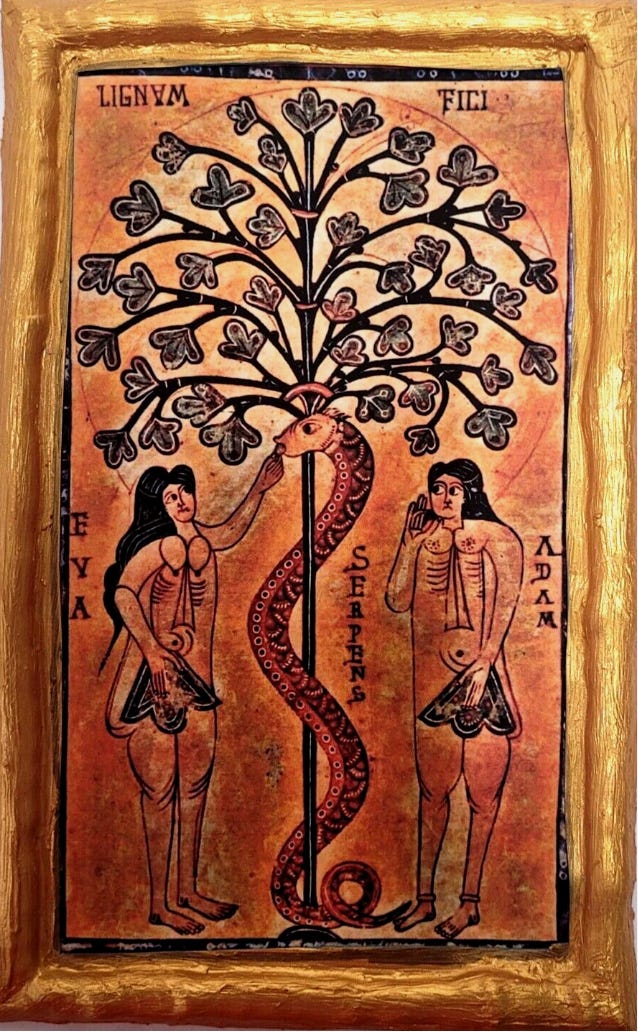
Our Stories, Our Sins
Rowan Williams writes that “sin is what happens when we refuse the reality of God’s love and try to construct a life for ourselves on other foundations.”
Seen this way, sin is not merely rule-breaking. It is a life lived in disconnection, east of Eden, and organized around substitutes for love.
And this is where trauma and sin intersect in a deeply human way.
Consider life in these 1,185 chapters between Genesis 3 and Revelation 20. Born into a broken world and wounded by imperfect human beings, we begin constructing lives around strategies that promise safety—control, perfection, power, withdrawal, approval. But the strategies that once protected us can, over time, become the very foundations on which we build our lives.
What began as adaptation slowly becomes orientation.
Centuries before trauma theory, Augustine described this dynamic as disordered love—loving something in the wrong way or giving ultimate weight to things that cannot sustain us.
Modern neuroscience might describe the same process as the nervous system organizing around survival rather than connection.
Different language. Same human story.
For me, what brings it all together is this: trauma is a story about disconnection—disconnection from ourselves, from others, and from God.
And sin is life lived in the tragic reality of disconnection—the trauma of everyday life in these 1,185 chapters filled with heartache as we eagerly await One who will wipe away every tear.
The reality of life lived in disconnection is seen, too often, among those of us who purport to use the right words and do the right things for God.
It’s the pastor who talks of grace and kingdom and sin, but isn’t aware of his own lifelong fight response. His own disordered love hurts and harms those he pastors, a confusing dynamic for the ones harmed because he is supposed to be their shepherd, their pastor. Empathy stretches to his early story of pain and the little boy who still resides fearfully within him, while accountability requires that he face his sin—and its relational devastation.
It’s the activist who burns with a righteous passion for justice, who can name the sins of systems with clarity and courage, but who has never slowed long enough to tend to the unhealed wounds that fuel the fire. The cause becomes the place where pain finds expression, and opponents become enemies rather than neighbors. The fight for justice is good and necessary, but when fight is the only gear available, relationships fracture and the very community the work requires begins to thin and fray.
It’s the professor who speaks eloquently about love, formation, and the life of the mind, whose lectures on virtue and humility draw nods from attentive students, but whose interior life is quietly governed by flight—anxious productivity, relentless achievement, the pressure to always prove her worth. Students feel the subtle tension in the room, the sense that nothing less than excellence will do. The very wisdom she teaches about rest, grace, and belonging struggles to find a home within her.
So, while it’s tempting to get entangled in abstract debates about sin and styles of coping, the real work for each of us is to look courageously at ourselves, at the both/and that includes our stories and our self-centered patterns. In the end, psychology—as I see it—doesn’t minimize or evade sin, it deepens and widens the scope. It asks how we’re coping this side of Eden.
And, as I’ve written in Healing What’s Within, the remedy—psychologically and theologically—is introduced right there in Genesis 3, smack dab in a moment of fear and fig leaves, an invitation to reconnection amidst the disconnection, as God’s kind hand extends to us and his words soften our self-protected hearts: “Where are you?”
=============
Individual Contemplation Prompt
Both readings describe a spectrum — from the wounds we’ve carried, to the coping patterns that formed around them, to the moments we’ve turned away from the light or hurt someone else. Where do you find yourself on that spectrum today? Is there a place in your own story where survival became orientation — where a strategy that once protected you is now distancing you from love?
Group Discussion Prompt
DeGroat writes that “what began as adaptation slowly becomes orientation” — our survival patterns quietly becoming the foundations we build our lives on. Where have you seen this dynamic at work — in your own life, in communities you’ve been part of, or in the people DeGroat describes (the pastor, the activist, the professor)? And where have you experienced — even glimpsed — what it feels like when God’s “Where are you?” reaches through the hiding?
