Wednesday, March 25, 2026
How we read the Bible—as the literal word of God or as an expression of God’s people and their experience of God—makes a significant difference in who we think God is. Brian McLaren uses a psalm of Exile as an example:
The best known psalm of Exile is Psalm 137. While the beautiful poetry of the first part of the psalm is often read—and even became a popular hit in the musical Godspell—the ending of the psalm is often regarded as one of the ugliest passages of the whole Bible. It is seldom read aloud in most church settings because of its horrific content.
When lovers of the Bible glibly refer to the Bible as “The Word of God,” without also taking seriously the reality that the Bible is also the testimony of human beings in great pain, they can find themselves unintentionally rendering God a monster.
For example, read these closing lines of Psalm 137:7–9 in two different ways. First, read them as an expression of the agony and fury felt by displaced, dispossessed, oppressed people who are repeatedly dehumanized by their enemies and oppressors:
Remember, O Lord, against the Edomites
the day of Jerusalem’s fall,
how they said, “Tear it down! Tear it down!
Down to its foundations!”
O daughter Babylon, you devastator!
Happy shall they be who pay you back
what you have done to us!
Happy shall they be who take your little ones
and dash them against the rock!
Read in this way, this desire for horrific vengeance cannot be excused, nor can it be justified and attributed to God … but it can be understood. Of course, they would dream of and pray for revenge against the Babylonians who ransacked their country, kidnapped them, and now ask them to perform their native music for their captors’ entertainment. Again, when we understand their outrage, we feel their pain, but that doesn’t mean we justify it.
Now read the passage again, assuming that every word in the Bible should be read as God’s true opinion of a matter. Can you see why people who are taught to read the Bible in this way would get an idea of God as a heartless, vengeful, cruel monster?
Can you see how a wise and careful reading of Psalm 137 can help us read the whole Bible more wisely and carefully?
No, of course God does not take delight in the suffering and death of babies or the heartbreak of their bereaved parents. No! Of course not! If we see God as taking such perverse delight in violence, soon we will make ourselves in that God’s image.
Yes, reject that awful reading. But please, don’t stop there.
Ask this question: How can we stand with God and share divine loving kindness in the midst of all-too-real and all-too-often-repeated human cruelty?
We certainly do not tell the oppressed to shut up and submit to their ongoing dehumanization. Nor do we give them encouragement to act upon their revenge fantasies.
Instead, we dare to listen deeply, to understand and empathize, to put ourselves in the shoes of those who suffer and feel their fury and despair.
And we don’t stop there either: then we see how oppression and revenge, if we let them take over, create vicious cycles that grow uglier and more catastrophic. We imagine how in our future, we could repeat the worst mistakes of our past.
Then we are ready to take our stand: If we want to break out of the vicious, violent cycles of our history, we must develop a new way of reading the Bible, a new way of seeing, a new way of being.
That’s why, in a sense, Psalm 137 is like an eye exam: What we see there tells us how well we see.
==================
Grief in a Culture of Fast-Forwarding
Part 6 of the Lenten Series: The Season We’d Rather Skip
| BEAU STRINGERMAR 24 |
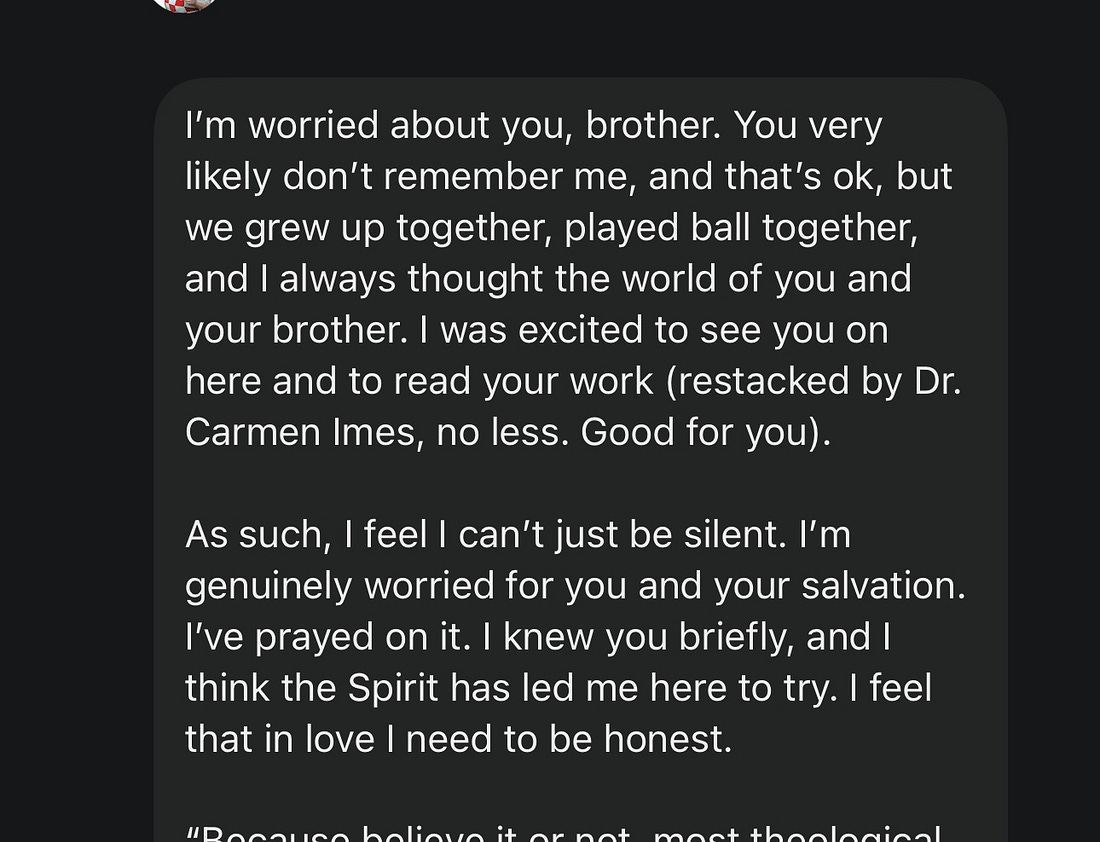
A few months ago a guy I grew up with sent me a message here on Substack. We played baseball together as kids. He said he used to think the world of me and my brother. He said he’d been praying about it and felt like he couldn’t stay silent. And then he told me he was genuinely worried about my salvation.
He wasn’t mean about it. That’s the part that made it so hard. He wasn’t trolling or picking a fight. He was a guy from my hometown who remembered me as a kid and believed with every fiber of his being that I was in spiritual danger. He told me my writing was misleading and manipulative. He told me I was bending scripture to fit the world. He quoted 1 Timothy and begged me to reconsider the path I was on. And then he signed off by saying he prayed for me to have the peace and love of Jesus.
I sat with that message for a long time, and I wasn’t angry. I was just sad. Because that message represents something that doesn’t get talked about nearly enough in deconstruction spaces. It represents grief. The slow, quiet kind of grief that settles in when you realize that people you love and respect are never going to be able to follow you to where you’ve landed. And that some of them will interpret the most honest season of your faith as evidence that you’ve lost it entirely.
The Death Nobody Sends Flowers For
When someone you love dies, the world makes space for your grief, at least for a little while. People bring food, they send cards, and your employer usually gives you a few days off. There kind of a cultural script for mourning the loss of a person and even though that script is inadequate in about a hundred ways, at least it exists.
But when you leave a faith tradition, there is no script. No casseroles show up at your door. Nobody sends a sympathy card that says “sorry you lost your entire theological framework and half your friendships in the process.” There is no bereavement leave for the death of your old belief system. And yet the grief is still very real. It is heavy and disorienting and it can last for years.
I trust me, I know, because I’ve lived it. Leaving evangelicalism cost me relationships I thought were permanent. It changed the way certain family members look at me. It has rearranged my social world in ways I’m still sorting out. And the hardest part wasn’t the people who got angry, it was the people who got sad. The people who looked at me with genuine concern and said they were praying for me (not to be passive aggressive) but because they sincerely believed I was walking away from God. That kind of love, the kind that comes wrapped in the theological certainty that you’re headed straight for destruction, is one of the most painful things I’ve ever experienced. Because you can’t argue with it and you can’t fix it. You can only grieve it.
The Bounce-Back Problem
And our culture has a very specific expectation about grief. You’re allowed to be sad for a little while. A few weeks, maybe a month. And then you should be getting back to normal. Moving on. Finding your new church. Rebuilding your community. Getting over it. The timeline varies depending on who you ask but the underlying message is always the same. Grief is just a phase. It has an expiration date. And if you’re still in it past that date then something is wrong with you.
The church is often even worse about this than the broader culture. There is an unspoken expectation in many Christian communities that grief should resolve quickly into worship. Or that sadness should transform into praise. That the appropriate Christian response to loss is to fast-forward to the part where God works it all together for good and to skip the long, messy, formless middle where nothing makes sense and the only honest prayer is “how long, O Lord?”
Nicholas Wolterstorff lost his twenty-five-year-old son in a mountain climbing accident. In his book Lament for a Son, he wrote something that stopped me cold. He said “every lament is a love song.” I think about that constantly now, because it reframes everything. Grief is not the absence of faith, or some kind of spiritual failure…
Grief is what love looks like when it has lost the thing it loves.
And we have to stop rushing people through that process.
Letting Grief Be Grief
Jesus never rushed anyone through their pain. When Mary and Martha were grieving Lazarus, he didn’t show up and immediately fix it. He wept with them first. He entered the grief before he entered the miracle, and I think the order matters more than we realize. Because it tells us something about the heart of God that all of our bounce-back theology misses entirely. God is not in a hurry to get past your pain. God is not standing at the end of your grief with a stopwatch, tapping his foot, wondering when you’re going to pull it together. God is sitting in it with you. For as long as it takes.
That message from my old baseball teammate still sits in my inbox. I haven’t deleted it. I probably won’t. It represents something I lost that I’m still learning to grieve. A version of belonging that doesn’t exist for me anymore. A world where everyone I grew up with was on the same page and the answers were simple and the people who loved you never had to worry about your salvation because you all believed the same things.
That world is gone for me, and I’m okay. But okay and grieving are not mutually exclusive. You can be further along than you’ve ever been in your faith and still feel the ache of what it cost to get there. Both things can be true at the same time. Lent makes space for that. The whole season is an invitation to stop fast-forwarding through the hard parts and just let them be hard for a while.
Try This
This week, give yourself permission to grieve something you haven’t fully grieved yet. Maybe it’s a relationship that didn’t survive your deconstruction. Maybe it’s a community you had to leave. Maybe it’s a version of God you used to believe in that you can’t believe in anymore. Whatever it is, don’t rush past it. Don’t slap a Bible verse on it. Don’t skip to the resurrection. (It’s not even Holy Week yet.) Just sit in the loss and let it be what it is. A love song for something that mattered to you. That’s one of the most faithful things you can do this Lent.
=======
Individual Reflection
What is one loss from your faith journey you haven’t fully grieved — and what has kept you from letting it just be what it is?
Group Discussion — choose one:
- When you encounter the violent ending of Psalm 137, what does your gut reaction tell you about how you’ve been taught to read the Bible?
- Who in your life looks at where you’ve landed spiritually with genuine concern — and what does it cost you to receive that kind of love?
- Where have you felt the pressure — from others or yourself — to skip the hard middle and get to the part where it all works together for good?
