Scapegoating the “Foreigner”
Wednesday, April 1, 2026
Karen González, an immigrant advocate, points to the story of Joseph in Genesis 37 as an example of God’s love and protection for foreigners:
[Joseph] suffers a series of misfortunes as a vulnerable foreigner. Joseph’s story is powerful and effective because it raises questions about the goodness of God in the midst of suffering. It also depicts the human tendency to alternate between loving and fearing strangers. In his story we see the Egyptian society’s movement from fear to love and then back to fear again….
Without recourse, as an enslaved person in a foreign land, Joseph does not receive due process. Instead, he is thrown into jail for a crime he didn’t commit. The unknown narrator of Genesis states that God always sees Joseph and remains with him. Twice within the span of three verses we are told that “the Lord was with” Joseph, blessing his work and giving him favor with those in authority over him (Genesis 39:21–23)…. Nonetheless, he spends years unjustly imprisoned, largely forgotten by his foreign captors….
For many immigrants and others on the underside of history, God’s presence in suffering isn’t about complex theological arguments about theodicy or sovereignty or how bad things can happen to good people. For them, God’s presence in suffering is what enables them to live. Indeed, for many who suffer, Christ on the cross offers the comfort of knowing that they serve a God who himself has known great sorrow and suffering. [1]
Fear leads to scapegoating while friendship leads us to welcome Christ in our midst:
Fear has become the default in the current immigration conversation in North America, even for followers of Jesus, who are called to love our neighbors as ourselves. The Bible speaks to the need for philoxenia [love of foreigners] repeatedly, from Exodus all the way to Hebrews: “Keep loving each other like family. Don’t neglect to open up your homes to guests [strangers or foreigners], because by doing this some have been hosts to angels without knowing it” (Hebrews 13:1–2)….
When we open ourselves up to friendships with immigrants and take intentional steps to know and be known in mutuality, we widen the circle of our affections. Suddenly, immigrants are no longer a burden or a drain on our economy, but a Ruth, a Hagar, or a Joseph to be loved. They become multidimensional people to us—friends who enrich our lives with their very selves. We welcome them and simultaneously welcome Christ and his joy. Indeed, when the Egyptians welcomed the Israelites, they welcomed God and God’s blessing into their midst. And when they rejected the Israelites and oppressed them, they rejected God’s very self, even without realizing it.
Jesus often comes to us in disguise, as he himself says in Matthew 25: he is sometimes a prisoner, a sick person, a naked person, a hungry person, a thirsty person, or an immigrant (verses 35–36). If we learn anything from Joseph and his suffering, it is to welcome and embrace Jesus in disguise.
========================
Q&R: What did Leo mean God doesn’t listen?
How Imprecation Works (and Doesn’t)
| BRADLEY JERSAK. APR 1 |
Question
“Why did the Pope tell people Jesus doesn’t listen to some people’s prayers?
We are all sinners. We all have blood on our hands.
Doesn’t God promise to hear everyone?”
Response
Thank you for your thoughtful question.
For those wary of hearing a few lines out of context, I recommend reading the full text of Pope Leo’s short homily by clicking HERE. But it is also important to read it in it’s biblical and immediate context.
I. Biblical Context
The occasion of the homily was the Feast of the Triumphal Entry. In its biblical context, we see his message was permeated with Scripture. In the order that he referred to them:
- Ephesians 2:14 – “He is our peace.”
- Zechariah 9:9-10 – “Lo, your king comes to you; triumphant and victorious is he, humble and riding on a donkey, on a colt, the foal of a donkey. He will cut off the chariot from Ephraim and the war-horse from Jerusalem; and the battle bow shall be cut off, and he shall command peace to the nations.”
- Matthew 26:52 – “Put your sword back into its place, for all who take the sword will perish by the sword.”
- Isaiah 53:7 – [Jesus] “did not open his mouth, like a lamb that is led to the slaughter, and like a sheep that before its shearers is silent.”
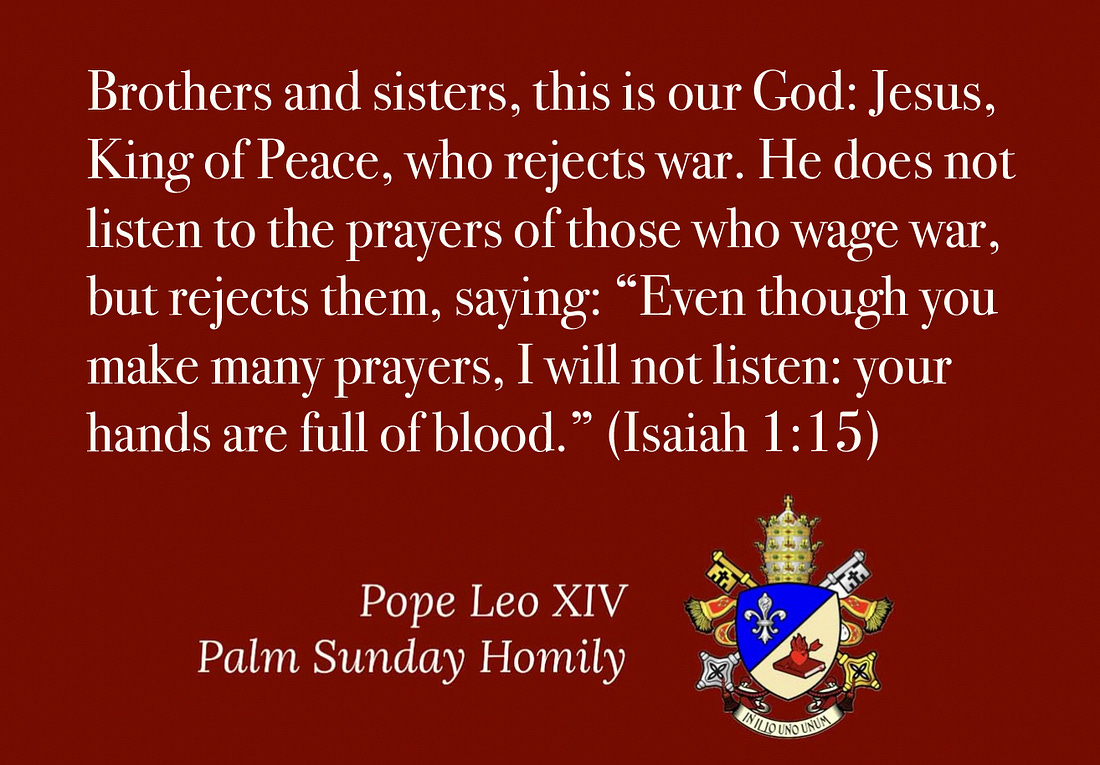
- Isaiah 1:15 – “Even though you make many prayers, I will not listen: your hands are full of blood.”
And since the last statement drew so much ire, let’s remember that the Pope was quoting the prophet Isaiah, who we should also here in his context—visions from God concerning Judah and specifically Jerusalem. Here is Isaiah 1:15 in its context [with emphases and in notes from me]:
10 Hear the word of the Lord,
you rulers of Sodom!
Listen to the teaching of our God,
you people of Gomorrah!
[Ouch. God is addressing Jerusalem!]
11 What to me is the multitude of your sacrifices?
says the Lord;
I have had enough of burnt offerings of rams
and the fat of fed beasts;
I do not delight in the blood of bulls
or of lambs or of goats.
12 When you come to appear before me,
who asked this from your hand?
Trample my courts no more!
13 Bringing offerings is futile;
incense is an abomination to me.
New moon and Sabbath and calling of convocation—
I cannot endure solemn assemblies with iniquity.
14 Your new moons and your appointed festivals
my soul hates;
they have become a burden to me;
I am weary of bearing them.
[God is rejecting their worship]
15 When you stretch out your hands,
I will hide my eyes from you;
even though you make many prayers,
I will not listen;
[Why not?]
your hands are full of blood.[But restoration is possible… How?]
16 Wash yourselves; make yourselves clean;
remove your evil deeds
from before my eyes;
cease to do evil;
17 learn to do good;
seek justice;
rescue the oppressed;
defend the orphan;
plead for the widow.
[A fresh start awaits… if only…]18 Come now, let us argue it out,
says the Lord:
If your sins are like scarlet,
will they become like snow?
If they are red like crimson,
will they become like wool?
19 If you are willing and obedient,
you shall eat the good of the land,
20 but if you refuse and rebel,
you shall be devoured by the sword,
for the mouth of the Lord has spoken.
Side note: Notice the formatting. This is a song. I’ve noticed that those who deliver poetic indictments seem to get away with more than those who write the same truths in prose or speak them directly. It’s not as though Isaiah was telling it slant, but the prophet whose words are recorded in chapter 1 may have “got published” rather than cancelled in part because the words were delivered in verse. Then again, there is the tradition that he was “sawn asunder” under King Manasseh (Hebrews 11:37), so there’s that.
Anyway, the real point is that while God is everywhere present and always attentive, what has caught God’s attention in this passage was the gross incongruity around blending worship and cruelty… perpetrating national injustice while weaponizing worship has put God off worship (similar to Micah and Amos and Jeremiah).
This was what came up in the Pope’s mind and heart and from his mouth when he spoke.
II. Immediate Context: Feb 28, Mar 26, Mar 29, 2026
The immediate context of the homily:
- February 28 – the Minab Massacre: on the first morning of the Iran War, missile attacks destroyed the Shajareh Tayyebeh Elementary School in Minab, Iran. Over 170 people were killed, at least 100 of them primary-age girls were killed.
- March 26 – the Secretary of War’s Pentagon Prayer: Pete Hegseth’s prayer invoking the name of Jesus Christ, calling for overwhelming violence without mercy.
- March 29 – the Papal Homily, condemning war and rejecting prayers used to justify war, incite violence, and glorify death.
The Pope’s homily was, without a doubt, a response to a prayer offered at the Pentagon service just three days earlier. One cannot understand the Pope’s severity without reading Secretary Hegseth’s prayer in its entirety, HERE.
The prayer is a composite of imprecations from various Psalms, an invocation from a chaplain ahead of the Venezuelan incursion in January, and specific calls to violence for the war in Iran. “Imprecation” refers to calling down a curse or invoking harm upon someone—especially by appealing to God to bring judgment, punishment, or justice. The prayer included the following paragraphs (emphases in bold are mine):
Almighty God, who trains our hands for war and our fingers for battle, you who stirred the nations from the north against Babylon of old, making her land a desolation where none dwell, behold now the wicked who rise against your justice and the peace of the righteous. Snap the rod of the oppressor, frustrate the wicked plans, and break the teeth of the ungodly. By the blast of your anger, let the evil perish. Let their bulls go down to slaughter for their day has come, the time of their punishment. Pour out your wrath upon those who plot vain things and blow them away like chaff before the wind.
Grant this task force clear and righteous targets for violence. Surround them as a shield, protect the innocent and blameless in their midst. Make their arrows like those of a skilled warrior who returned not empty-handed. Let every round find its mark against the enemies of righteousness and our great nation.Give them wisdom in every decision, endurance for the trial ahead, unbreakable unity, and overwhelming violence of action against those who deserve no mercy. Preserve their lives, sharpen their resolve, and let justice be executed swiftly and without remorse that evil may be driven back and wicked souls delivered to the eternal damnationprepared for them. For the wicked flee when no one pursues, but the righteous are as bold as a lion. We ask these things with bold confidencein the mighty and powerful name of Jesus Christ, King over all kingsand amen.
Not because of partisan politics or which party holds the keys to power, or which nation is to blame, but because we hate the destructive power of everywar and grieve the loss of all lives—children, civilians, and military. We are heartbroken when missiles fly in any direction for any reason. We know it is never the way of Jesus, who wept over Jerusalem, “If you, even you, had only recognized on this day the things that make for peace! But now they are hidden from your eyes” (Luke 19:42).
Every time nations go to war, grieving with Jesus and joining his lament is the righteous response. But when we (included the Pope) heard that prayer from Central Command in Arlington, many of us felt deeply sickened. Death-dealing was once again being baptized in Jesus’ name.
Pope Leo’s homily, offered just three days later, is now widely regarded as Rome’s obvious and immediate response. Some would say ‘prophetic.’
Yet many have since questioned Leo’s wording . . .
What does he mean God doesn’t listen?
What does Isaiah mean by that?
III. The Language of “Listening”
This question is much simpler to understand if we think about the language of “listening” in the context of normal conversation.
For example, when someone says in exasperation, “You are not listeningto me,” we’re not literally saying they can’t audibly hear us. We’re often upset because what we’re saying is not getting an affirmative response of obedience. “You’re not obeying me! You’re not doing what I want!” And from the one “not listening,” the response comes, “No, I am not going to do that.”
The particular prayer that Pope Leo was referring to—the prayers God doesnot listen to are precisely those prayers telling God to bless our extreme violence, show no mercy, and send the wicked to hell. That was the prayer. And the Pope is saying, “No, Jesus will not do that. Jesus will never do that.” Jesus told us to bless our enemies and pray for them, but if instead, we pray curses on them, then no, “God will not listen.” God is not the agent of violence, war, and death. In other words, “God doesn’t listen” = “Don’t expect a yes.”
And lucky for us. Because God is also not listening to prayers for violence of the Mullahs in Iran. Or of the Rabbis in Jerusalem. Like, what if God did listen and answer? What would that look like? Mutual annihilation. It’s true, “There is blood on all our hands.” My complicity in my nation’s death-dealing and evil-doing paints a target on my own back. Better if I don’t add to the body count.
Here’s what we know from Jesus’ Sermon on the Mount:
- Blessed are the peacemakers. They get to be called the “children of God.” What does Jesus say to our claims of “Lord, Lord, … did we not _____ in your name?” but do not listen to what he said?
- The measure with which we judge will be used on us. Prayers for violence sound like perilous projections. I don’t want God to listen to pastors, imams, or rabbis who ask God to align with their wrath. Why not? Because (1) some of them have me in mind and (2) according to Jesus, the judgments they make inevitably boomerang. As one of my friends used to say, when the lawnmower of judgment comes over, be the lowest blade of grass. Get low.
IV. The Function of Imprecatory Prayers
“Break the teeth of the wicked.
Snap the rod of the oppressor.
Frustrate wicked plans.”
Amen.
Even as a firm believer in the non-violent victory of Christ, I pray (actually, chant) the imprecatory Psalms. I don’t avoid reading them. I don’t avoid praying them. Including the most angry tunes:
- Psalm 7
- Psalm 31
- Psalm 35
- Psalm 55
- Psalm 58
- Psalm 59
- Psalm 69
- Psalm 83
- Psalm 109
If you include every Psalm that includes imprecatory elements, the list gets longer: Psalm 3, 5, 6, 7, 9, 10, 12, 17, 28, 31, 35, 36, 40, 41, 52, 54, 55, 56, 58, 59, 64, 69, 70, 71, 79, 83, 94, 109, 129, 137, 139, 140, 141, 143.
V. How they work
How do imprecatory prayers work when Jesus has forbidden his disciples to curse their enemies or strike back in retaliation? How do we sing them authentically when Paul says, “Bless those who persecute you; bless and do not curse them” (Romans 12:14)?
Yes, we should read them Christologically as prefiguring Jesus’ conquest of death itself, where not one more person needs to die for the world to be made right. Death is the enemy and you don’t defeat death by killing.
But not quite so fast.
I remember Dr. Walter Brueggemann’s words, reminding us that somewhere in this word right now, there is someone for whom these prayers are the authentic cries of their heart… the parents of those little girls massacred in Minab, for example.
As those called to mourn with those who mourn (Romans 12:15), how do we pray these prayers without sounding like warmongers?
- First, we pray them as lament. They are expressions to God about our anxieties, frustrations, and yes, our rage. When I pray them, I can authentically say, “Part of me feels this angry! God, why don’t you just throat-punch that guy!?” If I don’t let my self-righteous guard down and honestly confess those feelings to God, the repressed emotion rots into bitterness, resentment, vengeance, and violence. Better not to stuff it down where it can morph from a feeling into something that infects me and hardens my heart.
- Second, we pray them as confession. Imprecation is admitting that I have these feelings, but also, that I’m increasingly attached to them in a way the condemns the other and wishes them harm. The dopamine pull I get by entertain it becomes a sin, a turning away from love. But if I confess my sins to God and to others, I can be healed of violence and malice can be expunged from my soul. “If your sins are like scarlet, will they become like snow?” It’s possible.
- Third, I pray them to the Prince of Peace, NOT over others as a chest-pounding battle cry. Yes, God hears our cries for vengeance, but instead of directing God to “listen to them” as curses we expect God to bless, we pray our most toxic desires directly to Jesus as Prince of Peace, who bears every curse we utter in himself. When I release those I regard as enemies over to Christ, I can be transformed into his likeness—his radical forgiveness and mercy. Jesus cried out, “Father forgive them!” not “Avenge me!” And we too can pray, “Forgive them as you forgive me. Show them the mercy I need for myself—including the gift of repentance.”
- The mercy I need. That’s when we begin to see that our bloodlust exposes the blood on our own hands and the violence done our our behalf. Jesus directs us to forgive, reminding us that the measure with which we judge will be applied to us. That is not Jesus threatening to unleash violence on us when we ask for violence on others. But if our post-prayer intention is to say “Amen” and then go kill someone, Jesus wants us to know how a life given to violence actually works. He says, “Peter (or Pete), put away your sword. Now. For those who take up the sword will perish by the sword.” Gratefully, that’s a proverb, not a promise, and repentance is possible.
- Imprecation is for deescalation. Gathering up these points, we can see how identical words and phrases can be used as a motivational monologue for militarism OR to bring broken hearts, tormented by injustice, to the throne of grace, aka the Cross of peace. In my case, these prayers can become repetitive because my anger runs deep when it comes to the suffering and death of children.
- Pray them with gratitude. Thank God that Jesus hears our hearts without “listening”—i.e., without acting on our deranged prayers for violence.
Question: Has God listened to the Pentagon prayer—has he answered it? No.
Question: If God is listen to and answer the Pentagon prayer, whose side would God take? Would we still be alive?
Summary
When we employ imprecatory prayers, they can be therapeutic. Christ is well able to clean up whatever toxins we’re willing to vomit up—like when my Mom used to rub my back as I retched into the toilet.
But the same words, when used to justify war and glorify killing, cause death to spread like a plague—that’s when their utterance becomes a blasphemy of bravado. Then, mercifully, No. God will not not listen.
Far better to align with Leo’s beautiful words of empathy and love:
As we set our gaze upon him who was crucified for us, we can see a crucified humanity. In his wounds, we see the hurts of so many women and men today. In his last cry to the Father, we hear the weeping of those who are crushed, who have no hope, who are sick and who are alone. Above all, we hear the painful groans of all those who are oppressed by violence and are victims of war.
Christ, King of Peace, cries out again from his cross: God is love! Have mercy! Lay down your weapons! Remember that you are brothers and sisters!
I may need some new subscribers after this! Two posts per week, always free. Thanks to paid subscribers who make this possible.
