A Book of Devotion
Wednesday, May 6, 2025
The theologian Stephanie Paulsell considers how praying with the Song of Songs can help us discover “good news”:
What would we find if we turned to this poem listening for God’s voice, as countless readers before us have done? What would we hear if, as Origen long ago urged, we made the words of the Song our own?
One thing we find when we pray with the Song is good news: good news about the glory of the human body, the joy of mutuality in love, the responsiveness of a world that is cherished and loved, and the longing to know and to be known. These are the Song’s own concerns, the Song’s own preoccupations. Bringing the Song into our prayer brings our bodies, our relationships, the earth, and our longings into our prayer as well. This is precisely where these concerns belong: at the intersection of our life and God’s life, at the place where we turn toward God with all we are. [1]
Paulsell encourages us to linger in our reading with the Song of Songs:
The Song offers us a way of reading that is also a way of receiving the world, a way that leads to prayer. By inviting us into the dialogue of the two lovers, we are encouraged to read as they love—lingering in the presence of the beloved, admiring the beloved’s beauty and grace, and adoring both what can be seen and known and spoken of, and what is beyond our sight, beyond our ability to know or describe. In a world marked by speed and overwhelmed by information, the Song offers us a space beneath the pine branches and cedar boughs to read slowly, admiringly, meditatively….
The Song does not rush us…. Rather, it invites us to read and reread and read again, listening for unexpected resonances, allowing multiple meanings to accumulate. It is a banqueting house, a garden, a vineyard, a field: a place to be explored in every season, a place that discloses something new each time we move through it….
Hidden like a jewel at the heart of the Bible, the Song of Songs waits for us to take it up again and so enter with other faithful people in a song that never ends. [2]
Paulsell invites us to encounter the Song of Songs as an opening to prayer and life:
Think and pray with the Song about the life of the body, our life with one another, our life in creation, and our life with God. It is just one life, after all.… One life that opens onto depths that are spiritual, erotic, compassionate, and, on some level, not entirely knowable. One life touched and blessed by the kiss that has been sung about over centuries in language unutterably beautiful.
================
Sermon for the 4th Sunday of Easter
Preached at Trinity Episcopal Church, Santa Barbara, on April 26, 2026
by The Rev. Sarah D. Thomas
“Awe came upon everyone” – these people were experiencing a spiritual high. They were becoming a new kind of community in those post-Easter days. They called themselves “the Way.” A Greek word used to describe their life together is koinonia, which means fellowship, communion, shared life. To our ears their new way might sound simple, quaint, or idealistic. But to Jesus’ early followers, it was electric. Risky. Brave. Awe had come upon them and they were reoriented to living differently.
We have all just lived through something like this, something electric, brave, and risky.
During Holy Week this year, four humans left Earth, launched into space at 25,000 miles per hour to achieve a first for humanity: a mission around the back side of the moon. Some of you followed it closely. Some of you may have missed it in the flood of everything else. I’ll admit, I was captivated. I marveled that I was able to watch live video footage inside a space capsule floating 250,000 miles away from Earth.
The first thing that really hit me wasn’t the technology, but the conversations that took place between the astronauts in space and the scientists on the ground. The way they spoke to each other was respectful. Attuned. Intelligent. Kind. Even though I didn’t understand any of the scientific language they were using, I was riveted to the live feed because the way they were all speaking to each other was so different from what I’ve become accustomed to hearing in public discourse. Apparently, I have become accustomed to snark. Mistrust. Disrespect. Competition. But now I was hearing something different. There was humor. Competence. Supportive, clear communication. Real teamwork. The mere words “copy that” made me tear up a little. (They said it a lot.) “Copy that”: “I hear you. I believe you. I will address that.” The Artemis II mission didn’t just show us space, it showed us our better selves.
And then there was a moment I can’t forget: As the crew passed the farthest point from Earth any humans have traveled (a record set by Apollo 13 over 50 years ago), they paused to mark it – not with data or achievement, but with love. They wanted to name two craters on the moon. One they named “Integrity,” after the spirit of their mission. And the other they named “Carroll,” after the late wife of one of their crewmates, who had died a few years ago. “Copy that,” said mission control. At the moment they were the farthest yet from Earth, their first instinct was to care for one another.
I pulled my car over and watched them. Their voices wavered and there were some tears. They formed an unplanned group hug and their legs drifted upward in zero gravity, forming a web of connection. This moment spread quickly on social media. Suddenly the whole world was paying attention. Because when humans act like this, it draws us in. Their survival depended on it. They needed each other. They shared everything: tight quarters, weird space food, exhaustion, wonder. Together, they looked back at Earth, just a small blue crescent as they drifted behind the moon. It did something to them. And by extension, it did something to us.
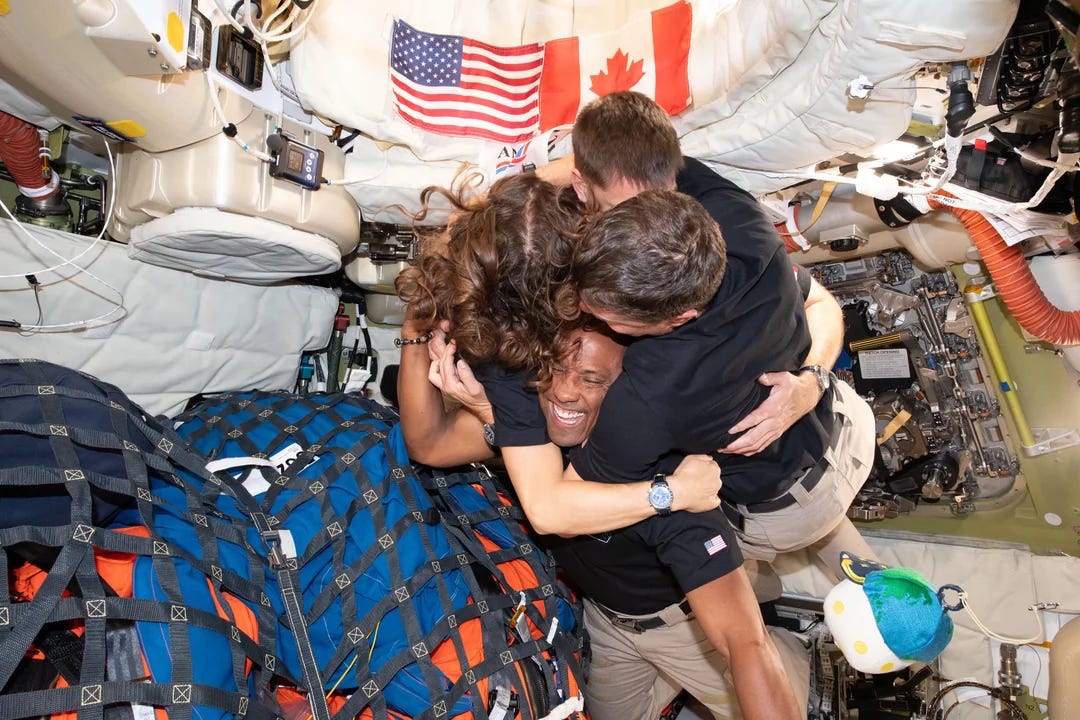
When they returned and spoke at a press conference one day after “splashdown,” their words were unpolished and emotional. Astronaut Christina Koch said this: “What struck me wasn’t necessarily just tiny Earth, it was all the blackness around it. Earth was just this life boat hanging undisturbingly in the universe.”
And then she said something that sounds remarkably like our reading from the Book of Acts.
She said, “A crew is a group of people that is in it all the time no matter what, that is stroking together every minute with the same purpose, that is willing to sacrifice silently for each other, that gives grace, that holds accountable. A crew has the same cares and the same needs, and a crew is inescapably, beautifully, dutifully linked. I know I haven’t learned everything that this journey has yet to teach me, but there is one new thing I know. And that is: Planet Earth, you are a crew.”
Listen again to Acts: “Awe came upon everyone, because many wonders and signs were being done by the apostles. All who believed were together and had all things in common; they would sell their possessions and goods and distribute the proceeds to all, as any had need. Day by day, as they spent much time together in the temple, they broke bread at home and ate their food with glad and generous hearts, praising God and having the goodwill of all the people. And day by day the Lord added to their number those who were being saved.”
Awe came upon everyone. And it made them see life differently. Jesus’ followers experienced his risen presence in the days following that first Easter morning. It was shocking and surprising. And it changed them. It made them want to be together, to share all they had; to care for each other, to care for those in need. They had glad and generous hearts and had the goodwill of all the people. They became a crew.
This is what it means to be saved – not saved for some kind of afterlife, but to experience something in this life that leaves us in awe; to have our hearts opened to realities we often don’t see; to be filled with gladness and generosity; to let that spill over into the world. This is what being saved means.
Those four astronauts experienced a kind of salvation, too. Awe came upon them. They were shaken into what is real: Earth is tiny, we need each other, and there is great love when we bear witness to that together.
On this Earth Day Sunday, could there be any better message for us to hear? We are here on this tiny lifeboat floating in space, together. One small fragile crew. And yet, we have a hard time living that way. Every day we see division, greed, violence, and systems that pull us apart.
But we’ve also seen something else: a mirror held up to us, reminding us of what is also true.
Bill McKibben, a famous environmentalist, spoke at UCSB a few days ago. While his talk was full of sobering and alarming science regarding climate change, his message was also hopeful. Solar and wind energy are accelerating at a very fast pace. He said that the past 36 months have made all the difference in ways many of us don’t really see. The earth is producing roughly a third more power from the sun this spring than it was last spring. China is at warp-speed-ahead on solar energy. We are almost too late, but if we can continue to speed this up, we have the ability to make a difference for the future. The problem is, the progress is being slowed by those invested in fossil fuels.
A journalist summed up McKibben’s main point: “Time is short. The technology is here. The obstacle is power. Fortunately, sunlight is much harder to hoard – or to wage war over.”[1] A student in the audience asked, “What can I do?” And McKibben replied, “We need to stop thinking of ourselves as individuals, as an ‘I,’ and join others. Join a movement.”
In other words, become a crew!
Astronaut Jeremy Hansen, in his little speech right after splashdown, asked his fellow astronauts to stand up there next to him. They put their arms around each other as he said, “What you saw is a group of people who loved having meaningful contribution, and extracting joy out of that, and what we’ve been hearing is … that was something special for you to witness. If you look up here, you’re not looking at us. We are a mirror reflecting you. And if you like what you see, then just look a little deeper. This is you.”
The Artemis II mission became a mirror reflecting ourselves back to us in a way we needed to see. We saw teamwork, we saw sacrifice, we saw humble intelligence put to use for a greater good, we saw humans trembling with awe and wonder at the mystery of our universe, and we saw deep love. When I looked into that mirror, something in me shifted, and I haven’t been able to shake it for days.
We must take care as we look into the mirrors that are around us. There are plenty that distort, magnifying fear, division, and scarcity. But there are other mirrors that remind us who we are at our best, and mirrors that connect us to awe and the wonder of life itself.
When the church is at its best, it gets to be one of those mirrors – a people of koinonia: a community of joy and shared life, with glad and generous hearts, sharing presence and resources with those in need, and reminding the people of the world that it is a crew, held together in the love of Christ.
“Awe came upon everyone” and reoriented them to becoming a new kind of community.
Awe is a renewable resource! And one that we can easily harness if we cultivate it, if we become a crew. Our salvation depends on it.
Copy that?
============
Individual Reflection
Where is awe trying to reach you?
Group Discussion — choose one:
- Where are you being invited to linger and behold rather than rush past?
- When have you experienced shared life that reoriented you toward awe?
- What would it mean for you to live as if “Planet Earth, you are a crew”?
