Tuesday, May 19, 2026
CAC Dean of Faculty Carmen Acevedo Butcher translated The Cloud of Unknowing, the foundational text for Centering Prayer. Contemplative practice creates space for us to be with God, after which we return to our daily lives and commitments. The anonymous author of The Cloud encourages beginners to enter contemplation with these simple instructions:
Lift up your heart to God with a gentle stirring of love. Focus on him alone. Want him, and not anything he’s made. Think on nothing but him. Don’t let anything else run through your mind and will. Here’s how. Forget what you know. Forget everything God made and everybody who exists and everything that’s going on in the world, until your thoughts and emotions aren’t focused on reaching toward anything…. Let them be. For a moment don’t care about anything…
Everyone on earth has been helped by contemplation in wonderful ways. You can’t know how much…. So stop hesitating. Do this work until you feel the delight of it. [1]
The author urges beginner contemplatives to welcome the temporary experience of “unknowing” that takes place in this type of prayer:
The first time you practice contemplation, you’ll only experience a darkness, like a cloud of unknowing. You won’t know what this is. You’ll only know that in your will you feel a simple reaching out to God. You must also know that this darkness and this cloud will always be between you and your God, whatever you do. They will always keep you from seeing him clearly by the light of understanding in your intellect and will block you from feeling him in the sweetness of love in your emotions. So be sure you make your home in this darkness. Stay there as long as you can…. It’s the closest you can get to God here on earth, by waiting in this darkness and in this cloud. [2]
For Acevedo Butcher, contemplation is an essential practice of our time, enabling us to meet the challenging conditions of our lives with greater wisdom and compassion:
We need contemplation because, as our globe gets more crowded by the hour, more and more we act like elbow-to-elbow passengers in cheap coach seats on a commuter flight…. Who doesn’t rush through the day? Who never feels the pressure to produce? How often are you in cyberspace? Our new frantic pace is like poison to our holding hands with those we love. That is where contemplation comes in. It reconnects us to ourselves, to God, and to others. It helps us learn to forgive and heal our souls….
For the first sixteen centuries of the Christian church, contemplative prayer was the goal of Christian spirituality, and now in our own time of transition and upheaval, … we are returning to our roots. Contemplative prayer is more relevant than ever before. More and more of us are practicing this ancient form of prayer and finding peace in a world of war, extreme political divide, epidemics, terrorism, technology, overcrowding, noise, inequality, and a Church in need of humility.
============================
From Diana Butler Bass’ Sunday Musings
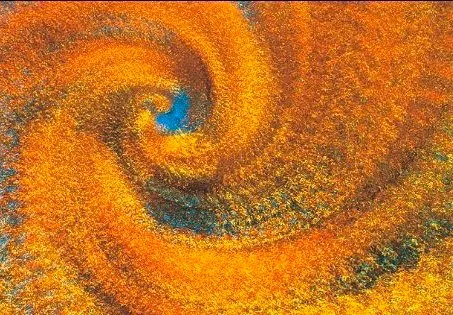
“Maple Spiral” by Freeman Patterson. Please visit the photographer’s website to view his prints, workshops, and books. You can also discover more about his work in this short film.
On a recent trip to New Brunswick, my host arranged for me to meet Freeman Patterson, a world-renown Canadian photographer.
I confess that I hadn’t heard of him. But my friend knew how I love art, gardens, and theology — and that Freeman’s interests combine all three. And so I did what any decent person would do in advance of such a meeting. I looked him up on the internet.
Richard was also on this trip. As we pursued Freeman’s website, the photograph above caught his attention. “This looks like an illustration of your work,” Richard said. “You could have used it in your powerpoint in last night’s lecture!”
He passed me his phone. On the screen was a breathtaking image of a spiral, whirling oranges, yellows, and greens with a single cobalt blue crescent at its center. “You’re right,” I said. “It is stunning. What do you think it is?”
We didn’t know. We couldn’t figure it out.
The next day, we had the privilege of spending an afternoon at his home and garden in rural New Brunswick. The conversation was delightful and wide-ranging, and, as often happens, we discovered threads that connected our seemingly very distant lives. I finally asked him about the spiral photograph we’d seen online. “What it is? Something like a fiddlehead fern?”
He laughed. “No. It is a maple tree!”
“A maple tree — one maple tree?” I asked incredulously. “Yes. A maple tree in the autumn, taken in a series of exposures, moving the camera slightly in each frame. The blue is the sky above.”
He shared with us a little bit about how he creates his photographs, with double and multiple exposures, slight camera movements, and widened apertures. We looked at the prints he had displayed in his home, thumbed through his books, and walked in his woodland garden. Inwardly, I marveled. This wasn’t about just making photographs or creating a garden. This was his vision of both everything and himself. It wasn’t just about a camera. It was about his open aperture. He could see deeper and further and differently. The spiral was far more than a cleverly exposed maple tree — it was his journey, wisdom and wonder, and an image of the oneness of all things.
That maple tree was a living spiral, an entirely different vision of the Tree of Life. There, in the garden.
We didn’t really want to leave.
*****
Does the Gospel of John ever drive you crazy?
It probably should because today is one of those days. This is not the work of a linear thinker. The text whirls about with words, pulling ideas from here and there, weaving them together to create an effect, an experience, an uncommunicable vision. The Jesus in John’s story doesn’t tell parables. He doesn’t offer sermons or moral lessons. Instead, he roams about in mystical experiences and waxes poetic. Some scholars refer to John’s style as paroimia (παροιμία), a Greek term for “sideways” truths usually expressed in allegory, riddles, or metaphors.
What is this? All these words about glory and the world and oneness?
I mean honestly: What is this?
“All mine are yours, and yours are mine; and I have been glorified in them.
And now I am no longer in the world, but they are in the world, and I am coming to you. Holy Father, protect them in your name that you have given me, so that they may be one, as we are one.”
You could try to explain that in a thousand ways and probably never come close to what it is. Who is this Jesus? Who is going where? What, truly, is his relationship with “Holy Father”? And who is one with whom?
I’ve heard genuinely tortured sermons on this text over the years. Some poor pastor trying to make sense of this as narrative, a story with a beginning, middle, and end, with an arc and plot lines, and clearly drawn characters. But it is not that.
It is, instead, a sideways truth.
More like a spiral.
That recent visit, surrounded by photographs and woodlands, books and water vistas, opened my soul-aperture a bit wider. I wasn’t just meeting a well-known photographer; I was encountering a gifted teacher, a seer the world. As we talked about all manner of things and walked in the garden, he was showing me how to appreciate small movements, to see differently, to layer multiple views, and to let more light in. It wasn’t narrative; it wasn’t didactic; it wasn’t polemic. It was sideways.
A spiral.
I think that is the Gospel of John. Like “Maple Spiral,” the whole thing is a series of multiple exposures by modest repositioning to create a single image. From John’s magisterial opening:
In the beginning was the Word, and the Word was with God, and the Word was God. He was in the beginning with God. All things came into being through him, and without him not one thing came into being. What has come into being in him was life, and the life was the light of all people. The light shines in the darkness, and the darkness did not overcome it.
To the moment when a grief-stricken Mary tries to embrace her dearest friend:
Jesus said to her, ‘Woman, why are you weeping? For whom are you looking?’ Supposing him to be the gardener, she said to him, ‘Sir, if you have carried him away, tell me where you have laid him, and I will take him away.’ Jesus said to her, ‘Mary!’ She turned and said to him in Hebrew,*‘Rabbouni!’ (which means Teacher).
And the blue clearing in the sky? The central point of the image:
Love.
As the Father has loved me, so I have loved you; abide in my love. If you keep my commandments, you will abide in my love, just as I have kept my Father’s commandments and abide in his love.
Love is the oneness, the still center of the spiral. The blue dot. Love, love, love. Love is the origin point of creation; love is Mary reaching to hold the body of Jesus. For God so loved the cosmos that he gave his only Son…. Love is the Alpha and Omega. The “I am” and the “You are.”
Do you see it? Tilt your gaze sideways, open your eyes just a little wider. One maple tree, spiraling through time and space. One whirl of love sweeping every frame toward the same focal point, the heart of it all.
One. Love is the center. Love winds to the One.
=============
Individual Reflection
Where are you being invited to abide rather than to understand?
Group Discussion — choose one:
- Where do you notice love as the still center in your life — or where do you long for it to be?
- What does it stir in you to be told to “make your home in this darkness”?
- What would change if you tilted your gaze sideways at your own life today?
