The Spirit Is Always with Us
Wednesday, May 27, 2026
Father Richard envisions the Holy Spirit as the loving immensity of God’s presence within us:
On one level, soul, consciousness, love, and the Holy Spirit can all be thought of as one and the same. Each of these points to something that is eternal, larger than the self, and shared with God. That’s what Jesus means when he speaks of “giving” us the Spirit or sharing his consciousness with us. One whose soul is thus awakened actually has “the mind of Christ” (see 1 Corinthians 2:10–16). That does not mean the person is psychologically or morally perfect, but such a transformed person does see things in a much more expansive and compassionate way. St. Paul calls it “a spiritual revolution of the mind” (Ephesians 4:23)—and it is!
Jesus calls this implanted Spirit the “Advocate,” who is “with you and in you,” makes you live with the same life that he lives, and unites you to everything else (John 14:16–20). He goes on to say that this “Spirit of truth” will “teach you everything” and “remind you of all things” (John 14:26) as if we already knew this somehow. Talk about being well-equipped from a secret Inner Source! It really is too good to believe—so we didn’t believe it. [1]
Consciousness, the soul, love, the Holy Spirit, on both the individual and shared levels, have sadly become largely unconscious! No wonder some call the Holy Spirit the “missing person” of the Blessed Trinity. No wonder we try to fill this radical disconnectedness through various addictions.
There is an Inner Reminder, an Inner Rememberer, (see John 14:26, 16:4) who holds together all the disparate and fragmented parts of our lives, fills in all the gaps, owns all the mistakes, forgives all the failures, and loves us into an ever-deeper life. This is the job description of the Holy Spirit, who is the spring that wells up within us (John 7:38–39)—and unto eternal time. This is the breath that warms and renews everything (John 20:22). These are the eyes that see beyond the momentary shadow and disguise of things (John 9); these are the tears that wash and cleanse the past (Matthew 5:4). And better yet, they are not only our tears but are actually the very presence and consolation of God within us (2 Corinthians 1:3–5).
You must contact this Immensity! You must look back at your life from the place of this Immensity. You must know that this Immensity is already within you. The only thing separating you from such Immensity is the ego’s unwillingness to trust such an utterly free grace, such a completely unmerited gift.
=====================
Interview with our friend, Brad Jersak
Q&A: On Surrender / Letting Go
I was recently interviewed for a forthcoming book for which some of my responses may be selected and distilled into a larger collection. But for now, I’d like to share my raw responses word-for-word.
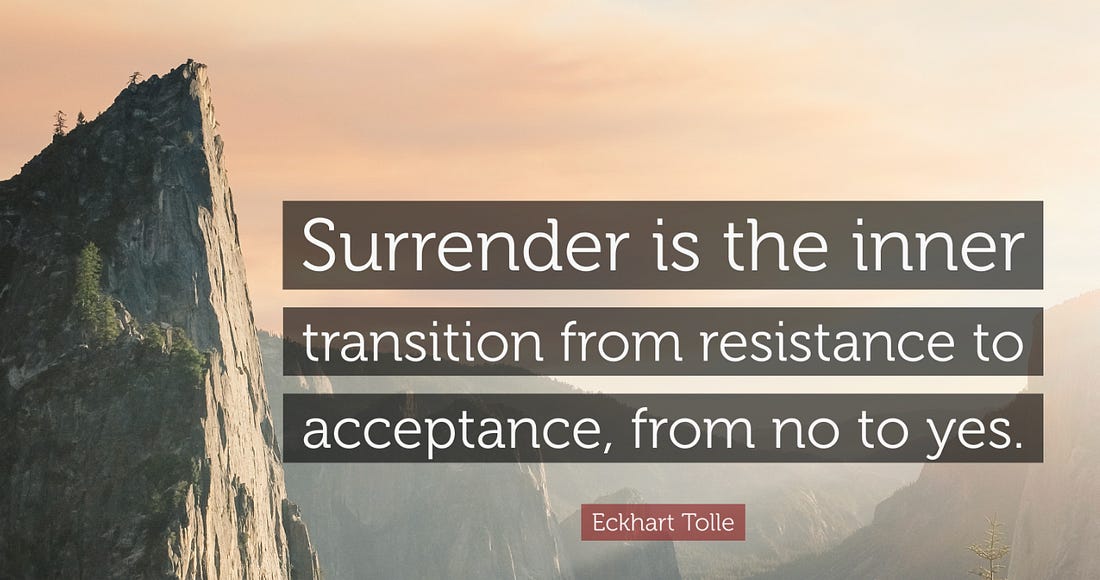
Q1. How would you define surrender? Who or what is one surrendering to, in your opinion? God, Universe, Self, Soul, present moment…?
Surrender has been a key word in my spiritual vocabulary for decades and as a result, has become layered. My definition is drawn from my experiences in prayer, from the influence of Simone Weil in my life, my interactions in spiritual direction, and from the twelve-step recovery movement.
I typically define surrender as “letting go,” which applies to how I try to let go of control (self-will), of agendas, of “my will be done.” In recovery language, I make a decision to surrender my life and will to the care (not the control) of a loving God. In Weil’s terms, I consent to the divine will as Christ did in Gethsemane. In prayer, I actually picture standing or kneeling before Christ and offering him whatever he asks for—releasing attitudes, emotions, intentions, worries, resentments, regrets, etc., over to him. Most of all, I surrender people. Those I’ve harmed, those who’ve harmed me, those I love most, worry about most, obsess over most. I picture delivering them into the hands or arms of God. I picture him taking responsibility for their care or correction or healing because it’s too much for me. I am no one’s saviour.
This is how I process my anxieties when I lay awake thinking about my children or grandchildren. It’s how I process forgiveness for those who my resentments chain me to. It’s how I deal with my own self-pity, self-loathing, and self-centeredness.
But I also think about surrender in terms of acceptance. Dr. Walter Thiessen calls this “compassionate consent to reality.” Surrender here is connected to the distinction in the Serenity Prayer between accepting what I cannot change versus the courage to change what I can (including my reorientation back toward love and life).
An elderly sage once said to me, “Your biggest struggle is that you struggle,”or in the kind rebuke of one massage therapist, “Stop fighting me!” My wife tells me that in her contractions through labour, she learned how even in pushing, she could surf the pain rather than fighting against it. All these analogies are a kind of surrender, so we might also say “rolling with” along with “letting go.” That is, we learn to take life on life’s terms.
Q2. Is there a practice to surrender that does not cause more suffering?
I’ve already suggested one method in terms of a visual exercise of handing over. Along those lines, I also use other pictures when I need to be most gentle with myself. Sometimes, I simply enter a state where I lay my head on Jesus’ lap and gaze into a small campfire in front of us. Silent surrender. At other times, when there’s a lot of grief, I kneel beside him in Gethsemane. This helps me because I sync up with Jesus’ own experience and notice that he doesn’t get stuck. His surrender leads mine from grief to comfort to hope.
But when I’m on the verge of a panic attack, I resort to pre-established prayers that begin on their own in my heart… the Jesus Prayer (“Lord Jesus Christ, have mercy on me”) or the Serenity Prayer—either of which I use in conjunction with deep breathing, where the surrender is expressed as an exhale or a sigh.
I also do surrender work in the presence of non-judgmental listening with a spiritual director, a sponsor, or my godfather. I confess all that causes me anxiety (not just my sins) in a kind of surrender where I unpack and offload my most authentic feelings with a safe person who is not inclined to fix or rescue, but can sit with me as a peace-centered companion.
Q3. What happens when you surrender?
Any range of outcomes can happen when I surrender, but I’ve learned not to attach myself to outcomes—which is itself another important layer of surrender. Let’s not overlook that!
When I surrender, I may feel a great burden lift from my shoulders, or the easing of my queasy stomach, or a blessed stillness settles in. These can be quite visceral since body and soul are so connected. I may feel the well-being of realizing it will be okay or I will be okay, no matter what. I can then resist the demands of the ego to take over (control) or take back (what I let go)—to cling or to grasp.
I think about these practices and their results a lot precisely because I need to. Today, I need to let go again. Another disappointment, another burden… I’m a chronic worrier and I’ve even had to surrender the delusion that I’ll overcome that. I regress. I relapse. But I see a path, and for this moment, open my hands once again.
Q4. What is the ego or mind? What’s holding on?
“Ego” is a tricky term because it gets defined in a variety of ways. It’s literally just the Greek word for “I.” At one time, I spoke in terms of “the death of the ego.” But I was corrected by those who reminded me that ego is essential for a sense of self (or even is our sense of self). As tiny children, we gradually begin to differentiate from others and form our own sense of “me” as object, then “I” as subject.
Further, therapists tell me that many of their clients need their ego to be strengthened, especially in order to escape the demoralizing imprisonment of domestic abuse. So we should never tell a battered partner to crucify their ego!
However, when we use the word ego negatively, what we typically mean is egoism—the enthronement of the ego in self-will, self-centredness, self-importance. When ego is king, I don’t surrender. I don’t follow the wisdom of my higher power. I don’t live in the Jesus Way of self-giving, others-centered love. “I” becomes Lord. It may even develop an insidious, bullying voice increasingly devoid of conscience.
In a previous post, I mentioned pesky voices that, for me, include self-pity, self-loathing, and self-centeredness. In some models, these self-voices are all variations of the ego that, when disordered, share an incorrigible resistance to surrender—to letting go.
But when Jesus said, “Blessed are the poor in spirit,” we might paraphrase that, “Blessed are those who’ve learned to say no to the demands of the ego”or “Blessed are those who’ve bankrupted the ego” [Ron S. Dart]. In that sense, ego can be shorthand for willfulness and surrender is willingness. But again, beware of how you process this with those who’ve been belittled. If they have internalized the voice of an oppressor, the “surrender” message may be a form of gaslighting. Someone more qualified than me can help distinguish whether the ego-voice is reinforcing the bully’s control or helping us resist it.
Q5. Is there a practice/methodology you follow that would create surrender?
For me, it’s more of a recognition that self-will has not worked. “I admitted that I was powerless [in my own strength] over my addiction/circumstances/crazy thoughts/self-destructive and others-harming behaviors, and that my life had become unmanageable.”
“Bottoming out” does not mean you go as low as you can go. It describes any point at which (1) you admit that self-will is not working , (2) you come to believe only Someone greater than yourself is able to restore your sanity, and (3) you decide to surrender to the care of that Someone. “Bottoming out” is a grace—a spiritual awakening that leads to a daily reprieve.
But I didn’t wake myself up. I needed God to wake me up. I didn’t create surrender… I suppose life did that, or grace, or both.
There are also times when advising someone to “let go” can be harmful. A friend of mine had a stillbirth child seven months through her pregnancy. To feel the child stop moving but carry it through to delivery was traumatic. Worse, she discovered that the medical staff had discarded the tiny body rather than allowing a burial. My friend retreated for recovery outside the city and connected with some caring Buddhist women for comfort. But when they began saying, “It’s okay. Just let go. The baby’s soul has left and will find its way to a new reincarnation,” she tells me that she erupted in rage. “Let go” was not the message she needed. Better to sit in silent pain with her until she discovered for herself what she needed… Instead of “letting go” of the pain, she says she needed to face it head on, enter it, and she there she discovered she could create something beautiful with it.
The idea was not to get rid of the grief—she couldn’t—but she was able to use everything at her disposal to weave something beautiful. Even there, I would caution against co-opting her words as new platitudes but instead, learn how to companion people through affliction until they emerge on the beautiful side of grief.
====================
Individual Reflection
Where in your life right now are you still running the show — and what would it feel like to actually step back?
Group Discussion — choose one
- Jersak describes surrender as an exhale, an open hand, a laying of the head — what’s your body’s experience of it?
- Rohr says the Immensity is already within you; what makes that so hard to believe?
- Jersak says “I regress, I relapse, but I see a path” — what keeps you returning to the path?
