Giving Is Receiving
Wednesday, June 10, 2026
In CAC’s online course The Divine Exchange, Cynthia Bourgeault considers one of Jesus’s parables through the lens of interconnection and abundance.
For Jesus, oneness is not a matter of a static return to a source. It’s a dance of continual “giving is receiving.” We become one because we’re all changing places within a greater whole. We can’t pull a single straw out without the whole thing toppling. Everything is wedged in this great relational field that’s living, giving, receiving, breathing. The depth and breadth and force of the exchange between the parts is the measure of its health. Anything that increases the field of relationality, interactivity, and flow is going in the right direction. Anything that works in the direction of isolation, cooping things up into disconnected, separate particles is decreasing the abundance of divine mercy flowing through the system.
That’s what Jesus is pointing to in his wonderful teaching in Luke 12. The parable goes like this: “The land of a rich man produced abundantly. And he thought to himself, ‘What should I do for I have no place to store my crops?’ Then he said, ‘I will pull down my barns and build larger ones and there I will store all my grain and my goods, and I will say to my soul, “Soul, you have ample goods laid up for many years. Relax, drink, and be merry.”’ But God said to him, ‘You fool, this very night, your life is being demanded of you. And the things you have prepared, whose will they be?’”
Jesus continues to heap on metaphor after metaphor: Behold the lilies of the field, behold the sparrow, behold the hairs of your head. He creates a picture of a kingdom where every single piece, no matter how humble, is known and supported. He ends the whole thing with a favorite line from Scripture: “Do not be afraid, little flock. It is my Father’s good pleasure to give you the kingdom” (Luke 12:32).
If there’s one thing Jesus is opposed to, it’s hoarding—and it’s not just about physical possessions. The ego is the ultimate hoarder. It hangs on to everything. We hoard our entitlements: I am rich, I am educated, I am a person of authority. We hoard our principles and ideologies; we hoard our self-justifications and our resentments. We use all these things to line the nest of our fragile sense of selfhood.
But Jesus sets himself against any kind of hoarding. He teaches a path of radical non-clinging. He says in effect, “Don’t clench your fist. Open your hands.” The world is abundant and provident beyond belief, and what flows through it is a coherence, a beauty, a life force that is a direct expression of the heart of God.
For Jesus, the world is suffused with the glory of divine tenderness and providence. That’s reason he was so implacably opposed to hoarding. Whenever we go into any kind of braced position—clinging, defending, self-justifying, insisting—it immediately makes us spiritually blind. They cut us off from the whole and we can no longer see the abundance that’s flowing right there.
==================
from Dianna Butler Bass…. Summer Series.
THE STORY
The parable itself is found only in Luke 15:22-32:
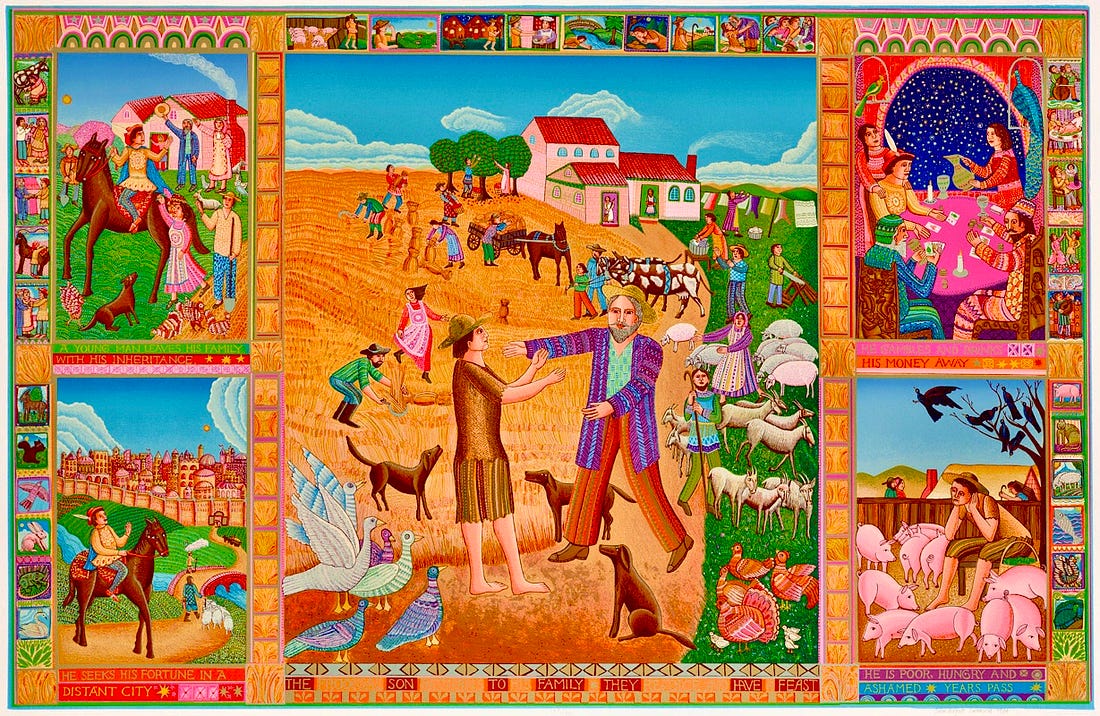
Then Jesus said, ‘There was a man who had two sons. The younger of them said to his father, “Father, give me the share of the property that will belong to me.” So he divided his property between them. A few days later the younger son gathered all he had and travelled to a distant country, and there he squandered his property in dissolute living.
When he had spent everything, a severe famine took place throughout that country, and he began to be in need. So he went and hired himself out to one of the citizens of that country, who sent him to his fields to feed the pigs. He would gladly have filled himself with the pods that the pigs were eating; and no one gave him anything. But when he came to himself he said, “How many of my father’s hired hands have bread enough and to spare, but here I am dying of hunger! I will get up and go to my father, and I will say to him, ‘Father, I have sinned against heaven and before you; I am no longer worthy to be called your son; treat me like one of your hired hands.’”
So he set off and went to his father. But while he was still far off, his father saw him and was filled with compassion; he ran and put his arms around him and kissed him. Then the son said to him, “Father, I have sinned against heaven and before you; I am no longer worthy to be called your son.”
But the father said to his slaves, “Quickly, bring out a robe—the best one—and put it on him; put a ring on his finger and sandals on his feet. And get the fatted calf and kill it, and let us eat and celebrate; for this son of mine was dead and is alive again; he was lost and is found!” And they began to celebrate.
‘Now his elder son was in the field; and when he came and approached the house, he heard music and dancing. He called one of the slaves and asked what was going on. He replied, “Your brother has come, and your father has killed the fatted calf, because he has got him back safe and sound.”
Then he became angry and refused to go in. His father came out and began to plead with him. But he answered his father, “Listen! For all these years I have been working like a slave for you, and I have never disobeyed your command; yet you have never given me even a young goat so that I might celebrate with my friends. But when this son of yours came back, who has devoured your property with prostitutes, you killed the fatted calf for him!”
Then the father said to him, “Son, you are always with me, and all that is mine is yours. But we had to celebrate and rejoice, because this brother of yours was dead and has come to life; he was lost and has been found.” ’
WHAT IS THIS STORY ABOUT?
How would you explain this story to someone who had never heard it before? What’s the point? Is there more than one point to this parable?
Do you like the story? Do you not like it? Does it puzzle you? Anger you? Make you resentful? What emotions does it stir? Be honest!
Do you think it is better described as a moral parable, an example parable, or a challenge parable? It is tempting to say “all three,” but which of these styles is most prominent?
THE STORY AND YOUR STORY
WHAT DOES THIS STORY MEAN TO YOU NOW?
When did you first hear this story? How many times do you think you’ve heard it? Have you heard it in other forms (film, novel, poetry, art, music) in addition to the biblical story?
Have you ever had an experience of being lost then found? Of returning home or being welcomed?
To which character do you most relate? Who garners your sympathy? Who is the hero of this story? The villain? Who do you like the most?
Where’s the mother? What do you think she was thinking?
How has your understanding of this story changed over the years? What stands out for you differently today than at other times in your life? As you re-read it or listen to my reflections on it, what surprised you? Is there something you’ve never noticed before?
THE STORY AND OUR STORY
During the first week of this series, John Dominic Crossan joined with the paid subscriber community in an online conversation about the parables.
We focused on how the parables challenged empire, how they present an alternative to Christian nationalism, and how they widen our vision toward evolutionary — and revolutionary — possibilities for a sustainable, peaceable future for humankind.
In his book, The Power of Parable, Crossan pointed out that the Prodigal Son is one of three parables in Luke 15 about things that are lost and found. He also suggested that this story is an “example parable” of an episode found in Luke 5:
Levi gave a great banquet for Jesus in his house, and there was a large crowd of tax collectors and others sitting at the table with them. The Pharisees and their scribes were complaining to his disciples, saying, “Why do you eat and drink with tax collectors and sinners?” Jesus answered, “Those who are well have no need of a physician, but those who are sick: I have come to call not the righteous but sinners to repentance.” (Luke 5:29-32)
If you read Sunday Musings, you surely will recognize this context as being very similar to last weekend’s reading from Matthew! Indeed, “Levi” is another name for “Matthew.”
Like Sunday’s Matthew text about an offensive dinner and two women being healed, the Prodigal Son makes a similar point — that which has been lost will receive mercy and invited to the feast.
The parable isn’t only about one person — or personal repentance. The one stands for many. In my essay, I wrote,
“Perhaps this story is less about personal forgiveness and more about the feast. A precursor of the supper that lies ahead? A foreshadowing of the revolutionary meal Jesus instituted at his last supper? A meal structured on mutuality and equality, based in humble service to one another and unconditional forgiveness? … The Jesus supper overcomes social divides, heals brokenness with reconciliation, and treats everyone at the table with dignity. The Prodigal Son rehearses this theological possibility in story.…”
HOW DOES THIS PARABLE CHALLENGE YOU — AND US — AT THIS SPECIFIC MOMENT IN HISTORY?
What do you think about Crossan’s suggestion that the Prodigal Son is an “example parable” of the dinner with “tax collectors and sinners”? Does its example of “lost and found” resonate with my reflection? With your experience?
I hadn’t read Crossan’s interpretation of the Prodigal Son when I wrote my essay about all the food in the parable. Do you see the similarities between his framing and mine? I primarily saw the Prodigal Son feast as prefiguring the Last Supper, but Dom drew on a different dinner example. How are these feasts all related?
The parable is more of an “example parable” than was the Good Samaritan. Yet it held a challenge for the older brother! And it does challenge us as well. What is most challenging for you? For our communities? What’s the challenge for NOW?
What does this parable say to the global rise of authoritarianism and Christian nationalism?
An example parable may be good, a challenge parable is a far more importantly subversive operation. Why? Because challenge parables humble our prejudicial absolutes, but without proposing counter-absolutes in their place. They are tiny pins dangerously close to big balloons. They push or pull us into pondering whatever is taken totally for granted in our world.
— John Dominic Crossan
