Jim Finley, my friend and fellow
teacher at the CAC, began studying the mystics at the Abbey of Gethsemani at
age eighteen, with Thomas Merton as his novice master. He remembers when he
first read this excerpt from the Prologue to the Ascent of Mount
Carmel by St. John of the
Cross:
A deeper
enlightenment and wider experience than mine is necessary to explain the dark
night through which a soul journeys toward that divine light of perfect union
with God that is achieved, insofar as possible in this life, through love. The
darknesses and trials, spiritual and temporal, that fortunate souls ordinarily
undergo on their way to the high state of perfection are so numerous and
profound that human science cannot understand them adequately. Nor does
experience of them equip one to explain them. Only those who suffer them will
know what this experience is like, but they won’t be able to describe it. [1]
Jim describes the effect John’s writing had on him:
Now, I could tell in the first paragraph, I was in deep
water, and I could also tell as I kept reading that just a lot of it was going
right over my head. But in John’s poetry, and from the very first paragraph of
his prose, I sensed that his words were coming from some very deep place inside
of him, or really coming from some deep place and [going] through him, and then
intimately accessing that deep place in me. There was a certain resonance in
realizing he was talking about something that I didn’t understand; but I knew
mattered very, very much. And, as I kept reading on in that way, it got clearer
and clearer to me. I am now over 76 years old, and I am still reading John of
the Cross. He is one of my teachers. . . .
John’s core intuition is that the Infinite Love that is
the architect of our hearts has made our hearts in such a way that nothing less
than an infinite union with Infinite Love will do. It’s the setup in the
beginning. For Infinite Love to create us in the image of itself is for
Infinite Love to create us as a capacity to receive the forms of Infinite Love
as our destiny. That love is our origin, love is our ground. That Infinite
Love creates us as a capacity for love, for love’s sake alone. Love is the
fabric of the true nature of everything that’s happening. This is the love
nature of life.
[Richard again: Throughout these
weeks, I have been praying, trying to understand how, as Jim puts it, “love is
the fabric of the true nature of everything that’s happening.” How can it be
that God’s love is at work and present in the tragedies around the globe right
now? But knowing what harrowing circumstances John of the Cross was in when he
came to experience the infinite love of God gives me hope and perseverance.]
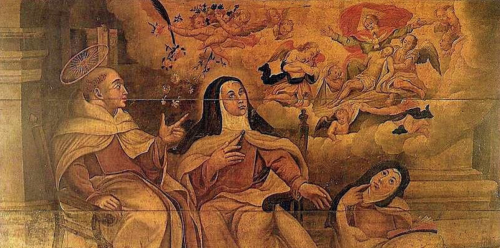
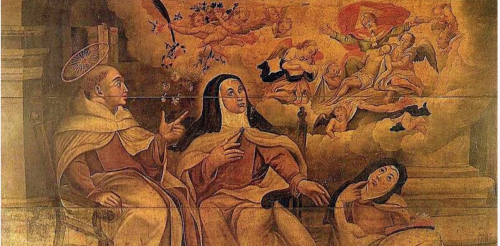
In 1567, when Teresa of Ávila was 52 and deeply involved in her attempts to reform the Carmelite Order and create the Discalced (or “barefoot”) Carmelites, she met the newly ordained John of the Cross. Though he was only 25 years old, Teresa persuaded him to join her cause. In her book St.John of the Cross: Devotions, Prayers, and Living Wisdom, spiritual teacher Mirabai Starr,who has translated many works by both John and Teresa, tells the story of John’s loyalty to their shared mission of reformation:
Juan de la Cruz was twenty-nine years old and madly in love with God.The great living saint Teresa of Ávila had recognized a rare sanctity and brilliance in this humble young friar and placed him in charge of her first reform convent [in 1572].
Then late one night [when John was thirty-five], threatened by this movement to return the order to the contemplative path embodied by the Desert Fathers and Mothers, the mainstream Carmelites whisked him away and imprisoned him in Toledo.
His cell was a tiny closet that had formerly served as a latrine. There was not enough room to lie down, and the only window was far above his head. . . .
Twice a day the friars took him out and flogged him. [Hard to imagine, isn’t it? But the church was still trapped in retributive justice, which has lasted until our time among a high percentage of Christians, because that is the way the entire world operates. –RR]
“Denounce Teresa!” they demanded. “Renounce the heresy of this so-called reform!”
But he would not betray the dream. The dream of a life of voluntary simplicity, solitude, and silence. A contemplative life based on the Gospel teachings of poverty of spirit and charity of heart. A life of stripping away rather than accumulating. Of relinquishing power and seeking nothing. Of nothing but loving friendship with the divine and loving service to [God’s] creation. . . .
As the months ground by, [John] began to fear that he had been abandoned by the Holy One. For the first time in his life, he questioned the existence of a God he could no longer feel or remember. And, as his soul dried up, he found he could no longer even conceive of this God to whom he had dedicated everything. When he tried to pray, all he encountered was a cavernous emptiness.
He cried out, “Where have you hidden, my Beloved?”
Echoing from this cry came an outpouring of love poetry to God. He committed each poem to memory and recited them all again and again until they were etched on his heart. His poems became simultaneously a call to and a response from his Beloved. . . .
At last [after nine long months], one dark night, a sympathetic guard turned the other way as the frail friar made his escape. Taking refuge among the sisters in a nearby convent, he fell into an ecstatic state [of love for God], from which he never recovered.
This
is a great favor for those to whom the Lord grants it; the active and the
contemplative lives are joined. . . . The will is occupied in its work and
contemplation without knowing how. –Teresa of Ávila
Author Tessa
Bielecki writes about Teresa of Ávila as an extraordinary example of action and
contemplation. In addition to her physical suffering, Teresa also suffered from
difficult life circumstances, including the suspicion of church authorities who
disapproved of her visions, her Carmelite reforms, and her status as a converso, a member of a Jewish family that had converted to
Catholicism (likely under duress). In her book Holy Daring, Bielecki shows us that it was the deeply mutual and
loving nature of the “spousal” prayer Teresa entered into with God that led to
such bold and faithful action:
Teresa
. . . is not only one of the greatest contemplatives in the Western spiritual
tradition, but also one of its greatest activists. Tremendously involved with
people and projects, constantly on the go, Teresa still found time to make
prayer a priority.
She
founded new convents at the rate of one and sometimes two per year. . . . She
was an ingenious administrator with a flair for organization, an astute
diplomat, and wise in the world of finance, litigation, and contract
negotiation. Her financial worries, business deals, and personnel problems
certainly challenged her life of prayer, but never spoiled it. . . .
Contemplation
and mysticism . . . both mean loving
experiential awareness of God: not ideas in the head or on the lips, but personal living
experience. In the Teresian tradition, this experience takes a special form
which spiritual writer William McNamara calls “spousal prayer”. . . . [It is sometimes called bridal mysticism and is found in
the Bible in the Song of Songs.]
Teresa
uses the various stages in human courtship to describe the stages of prayer.
First we meet [with God], exchange gifts and get acquainted. Eventually we are
betrothed, and then finally we marry. True love deepens and grows gradually,
over a lifetime. . . .
But
the matter does not end here. Another consequence of prayer is far more
demanding: generous, self-spending, and exhausting service. . . . The proper relationship between these two
consequences is clear in the teachings of Jesus. First, he says, “Love
the Lord your God with all your mind and heart and soul and body.” Espousal. Second, “Love your neighbor as yourself.” Service. [see Mark 12:30–31] . . .
As
our prayer grows deeper and more authentic, we want to spend ourselves serving
God and the world created out of divine love.
To be clear, this type of “spousal”
or unitive prayer is not just for single or celibate people; it is available to
all of us who are willing to risk surrendering our hearts and lives fully to
God.
As of today, like many of you, I have been in self-isolation for several weeks. Honestly, it is a bit like when I sometimes go on a hermitage during Lent; except now, of course, my prayers are with the innumerable people who are ill with COVID-19 and so many who are grieving loved ones who have died. My heart is heavy for the health care workers, first responders, and other essential workers who continue to put themselves at risk every day. I’m also concerned about the many people now facing financial challenges, or whose marginalization has only been made worse by the virus. This type of prayer leads us to experience solidarity with the suffering.
For all the helpers, including people like yourselves who are doing what you can to meet the needs of loved ones and those who are suffering, I offer this excerpt of a prayer from my friend Mirabai Starr, who is a translator of Teresa of Ávila’s works:
You [Teresa] lived that beautiful balance Between active service And quiet contemplation. Teach us to be of use in this troubled world At the same time that we cultivate Joyous intimacy With the Beloved who lives inside us. [1]
I am truly grateful for the people who are living this truth out through their actions in this time of crisis. And there is more we can do, even as most of us stay at home. A few years ago, I wrote, somewhat facetiously, that the Church should close all programs for a year and simply teach people to pray. It seems to me we may unintentionally have just such an opportunity right now, although I sincerely hope it won’t last a year!
In this week’s Daily Meditations, we will meet with two great teachers of prayer, Teresa of Ávila (1515-1582) and John of the Cross (1542–1591). Teresa was canonized (declared a saint) in 1622 and named the first woman Doctor of the Church in 1970. A Doctor of the Church is someone whose teaching can be trusted. Teresa is recognized as the Doctor of Prayer. John, known as the Mystical Doctor, was canonized in 1726 and named a Doctor in 1926.
I like to say that Teresa and John were part of the “final supernova” of nondual, mystical consciousness in 16th-century Spain, before it all but disappeared in Europe for five hundred years in the wake of the Protestant Reformation, the Enlightenment, and the invention of the printing press. Both Teresa and John wrote detailed accounts of their lives and experiences with God, which makes them very accessible guides.
One of Teresa’s most famous teachings is a poem known as “Teresa’s Bookmark” that was found in her own prayer book after her death:
Let nothing disturb you. Let nothing upset you. Everything changes. God alone is unchanging. With patience all things are possible. Whoever has God lacks nothing. God alone is enough.[2]
I hope Teresa’s words will bring you some comfort in this challenging time.
Gateway to Action & Contemplation: What word or phrase resonates with or challenges me? What sensations do I notice in my body? What is mine to do?
Prayer for Our Community: O Great Love, thank you for living and loving in us and through us. May all that we do flow from our deep connection with you and all beings. Help us become a community that vulnerably shares each other’s burdens and the weight of glory. Listen to our hearts’ longings for the healing of our world. [Please add your own intentions.] . . . Knowing you are hearing us better than we are speaking, we offer these prayers in all the holy names of God, amen.
Matthew 11:28-30 The Message (MSG)
28-30 “Are you tired? Worn out? Burned out on religion? Come to me. Get away with me and you’ll recover your life. I’ll show you how to take a real rest. Walk with me and work with me—watch how I do it. Learn the unforced rhythms of grace. I won’t lay anything heavy or ill-fitting on you. Keep company with me and you’ll learn to live freely and lightly.”
Courage in Times of Trouble Monday, April 20, 2020
TessaBieleckiis a Christian hermit in the tradition of the Desert Mothers and Fathers. Co-founder of the Spiritual Life Institute, she was a Carmelite monk and Mother Abbess for almost 40 years, establishing experimental monastic communities of men and women in Arizona, Colorado, Nova Scotia, and Ireland. She has written extensively on the life, spirituality, and enduring legacy of Teresa of Ávila. Bielecki writes that Teresa has much to teach us about suffering:
For over forty years, [Teresa] never spent a single day without physical pain. For most of her life she suffered such nausea that she vomited daily and couldn’t eat until noon. She suffered the little illnesses that afflict us all—colds, headaches, stomachaches, toothaches, and flus. But she also suffered from high fevers, fainting spells, heart trouble, neuritis, tinnitus, her maimed left arm, a three-year paralysis, severe convulsions, a four-day coma, and the influenza that almost killed her in 1580, aged her terribly, and left her palsied for the last two years of her life. . . .
As a result of her experience, Teresa teaches us that poor health is not an obstacle to spiritual growth but actually enhances it. Why? We learn patience and surrender. We learn how to transcend the body and rise above both sickness and health altogether. . . .
Through this, as in all else, Teresa learned how to let go of her own will and trust in God. She vehemently asserts that we must “determine once and for all to swallow death and the lack of health,” or there will be no hope for us. [Italics mine.] [1]
In a letter to the convent at Seville that she had founded, Teresa writes:
Courage, courage, my daughters. Remember, God gives no one more troubles than [she] is able to bear, and [God] is with those who are in tribulation. [2]
And in a letter to one of her spiritual directors, the Dominican Father Gracián, she reflects:
One must not think that a person who is suffering is not praying. He is offering up his sufferings to God, and many a time he is praying much more truly than one who goes away by himself and meditates his head off, and, if he has squeezed out a few tears, thinks that is prayer. [3]
Richard again: Suffering, of course, can lead us in one of two directions. It can make us very bitter and close us down, or it can make us wise, compassionate, and utterly open. Our hearts open either because they have been softened, or perhaps because suffering makes us feel like we have nothing more to lose. It often takes us to the edge of our inner resources where we “fall into the hands of the living God” (Hebrews 10:31).
Let us all pray for the grace of this second path of softening and opening.
When we try to live in solidarity with the pain of the world—and do not spend our lives running from it—we will encounter various forms of “crucifixion.” Pain is physical or emotional discomfort, but suffering often comes from our resistance to that pain.
The soul must walk through such suffering to go higher, further, deeper, or longer. The saints variously called such suffering deaths, nights, darkness, unknowing, spiritual trials, or just doubt itself.
Necessary suffering allows us to grow, but “in secret” (Mark 4:26–29), which is an amazingly common concept, both in the teachings of Jesus and of many of the mystics. Such growth must largely be hidden because God alone can see it and steer it for our good. If we try too hard to understand it, we will stop the process or steer it in the wrong direction.
It seems there is a cruciform shape to reality with cross purposes, paradoxes, and conflicting intentions everywhere. Jesus hangs right there amid them, not even perfectly balancing them, but just holding them (see Ephesians 2:13–22). This deserves a major “Wow!” because mere philosophy or even proper theology would never have come to this conclusion.
The virtue of hope, with great irony, is the fruit of a learned capacity to suffer wisely, calmly, and generously. The ego demands successes to survive; the soul needs only meaning to thrive. Somehow hope provides its own kind of meaning, in a most mysterious way.
The Gospel gives our suffering both personal and cosmic meaning by connecting our pain to the pain of others and, finally, by connecting us to the very pain of God. Did you ever think of God as suffering? Most people don’t—but Jesus came to change all of that.
Any form of contemplation is a gradual sinking into this divine fullness where hope lives. Contemplation is living in a unified field that produces in people a deep, largely non-rational, and yet calmly certain hope, which is always a surprise.
A life of inner union, a contemplative life, is practicing for heaven now. God allows us to bring “on earth what is in heaven” (Matthew 6:10) every time we can allow, receive, and forgive the conflicts of the moment. Such acceptance allows us to sit in some degree of contentment—despite all the warring evidence.
God alone, it seems to me, can hold together all the seeming opposites and contradictions of life. In and with God, we can do the same. But we are not the Doer.
Hope is the main impulse of life. —Ilia Delio, OSF
[1]
Because we are so quickly led to despair, most of us
cannot endure suffering for long without some sliver of hope or meaning.
However, it is worth asking ourselves about where our hope lies. My friend and
colleague Cynthia Bourgeault makes a powerful distinction between what she
calls ordinary hope, “tied to outcome . . . . an optimistic feeling . . .
because we sense that things will get better in the future” and mystical hope
“that is a complete reversal of our usual way of looking at things. Beneath the
‘upbeat’ kind of hope that parts the seas and pulls rabbits out of hats, this
other hope weaves its way as a quiet, even ironic counterpoint.” She writes,
We might make the following observations about this other
kind of hope, which we will call mystical
hope. In contrast to our usual notions of hope:
Mystical hope is not tied to a good outcome,
to the future. It lives a life of its own, seemingly without reference to
external circumstances and conditions.
It has something to do with presence—not a future good
outcome, but the immediate experience of being met, held in communion, by
something intimately at hand.
It bears fruit within us at the psychological
level in the sensations of strength, joy, and satisfaction: an “unbearable
lightness of being.” But mysteriously, rather than deriving these gifts from
outward expectations being met, it seems to produce them from within. . .
[It] is all too easy to understate and miss that hope is
not intended to be an extraordinary infusion, but an abiding state of being. We lose sight of
the invitation—and in fact, our responsibility,
as stewards of creation—to develop a conscious and permanent connection to this
wellspring. We miss the call to become a vessel, to become a chalice into which
this divine energy can pour; a lamp through which it can shine. . . .
We ourselves are not the source of that hope; we do not manufacture it.
But the source dwells deeply within us and flows to us with an unstinting
abundance, so much so that in fact it might be more accurate to say we dwell
within it. . . .
The good news is that this deeper current does exist and
you actually can find
it. . . . For me the journey to the source of hope is ultimately a theological journey: up and
over the mountain to the sources of hope in the headwaters of the Christian
Mystery. This journey to the wellsprings of hope is not something that will
change your life in the short range, in the externals. Rather, it is something
that will change your innermost way of seeing. From there, inevitably, the
externals will rearrange. . . .
The journey to
the wellsprings of hope is really a journey toward the center, toward the
innermost ground of our being where we meet and are met by God.
The Prayer of Francis and Clare Wednesday, April 15, 2020
Both St. Francis of Assisi (1182–1226) and St. Clare (1194–1253) let go of their fear of suffering; any need for power, prestige, and possessions; and any need for their small self to be important. By doing so they came to know who they really were in God—and thus who they objectively were.
Such a profound ability to change is often the fruit of suffering and various forms of poverty. The small self does not surrender without a fight to its death. If we understand suffering to be whenever we are not in control, then we see why some form of suffering is absolutely necessary to teach us how to live beyond the illusion of control and to give that control back to God and the flow of reality.
This counterintuitive insight surely explains why these two medieval dropouts—Francis and Clare—tried to invite us all into their happy run downward, to that place of “poverty” and powerlessness where all of humanity finally dwells anyway. They voluntarily leapt into the very fire from which most of us are trying to escape, with total trust that Jesus’ way of the cross could not, and would not, be the wrong path.
By God’s grace, they believed that they could trust the eventual passing of all things, and where they were passing to. They did not wait for liberation later—after death—but grasped it here and now.
Franciscan Sister Ilia Delio writes:
[Francis’] life indicates to us that if we persevere in prayer we will find God in the center of our lives and the bitter will become sweet [as when Francis kissed the leper]; however, if we stay on the plain of mediocrity then the bitter may remain bitter. To trust in the power of God’s grace through darkness, isolation, bitterness, and rejection is to be on the way to becoming prayer because it is the way to freedom in God. For prayer, that deep relationship of God breathing in us, requires change and conversion. And where there is change, there is the letting go of the old and the giving birth to the new. To pray is to be open to the new, to the future in God. The way to life passes through change and ultimately the change from death to life. Prayer is the way to life because in prayer we are invited to change and to grow in love. [1]
I find myself in prayer much of the time right now, not simply because of the limitations of our current circumstances, but because I want to be a witness to such divine freedom. I believe it is this kind of prayer that may keep us from simply hoping things quickly return to “normal” (though that is a comforting thought to many) and instead praying for the courage to “change and grow in love.” Such courage is surely what we and the world truly need.
Sooner or later, the heart of everybody’s spiritual problem is “What we do with our pain? Why is there evil? Why is there suffering?” Job begs God for an answer to this mystery, and he can’t get one. He only begins to trust when he no longer feels ignored, when he knows that God is taking him seriously and that he is “part of the conversation” (see Job 42). When Jesus later becomes the answer in his own passion, death, and resurrection, he discovers what Job finally experienced: in the midst of suffering, God can be trusted. The world is still safe, coherent, and even blessed.
We are “saved” by being addressed and included in a cosmic conversation. We do not really need answers; we need only to be taken seriously as part of the
dialogue. But we usually only know this in hindsight after the suffering and the struggle. It cannot be known beforehand, not theoretically or theologically. Our knowledge of God is participatory. God refuses to be intellectually “thought,” and is only known in the passion and pain of it all, when the issues become soul-sized and worthy of us.
Jesus says, “There’s only one sign I’m going to give you: the sign of the prophet Jonah” (see Luke 11:29, Matthew 12:39, 16:4). Sooner or later, life is going to lead us (as it did Jesus) into the belly of the beast, into a situation that we can’t fix, can’t control, and can’t explain or understand. That’s where transformation most easily happens. That’s when we’re uniquely in the hands of God. Right now, it seems the whole world
is in the belly of the beast together. But we are also safely held in the loving hands of God, even if we do not yet fully realize it.
All of us experience the absurd, the tragic, the nonsensical, the unjust, but we do not all experience pain in the same way, so try not to judge others too harshly for their reactions. We don’t know what has brought them to this point. However, if we could see all our wounds as the way through to their transformative effect, as Jesus did, then they would become “sacred wounds” and not something to deny, disguise, or export to others.
The genius of Jesus’ teaching is that he reveals that God uses tragedy, suffering, pain, betrayal, and death itself, not to wound or punish us, but to bring us to a Larger Identity:
“Unless the single grain of wheat loses its shell, it remains just a single grain” (see John 12:24). The shell must first crack for the expanded growth to happen. In such a divine economy, everything can be transmuted, everything can be used, and nothing is wasted.
Gateway to Action & Contemplation: What word or phrase resonates with or challenges me? What sensations do I notice in my body? What is mine to do?
Prayer for Our Community: O Great Love, thank you for living and loving in us and through us. May all that we do flow from our deep connection with you and all beings. Help us become a community that vulnerably shares each other’s burdens and the weight of glory. Listen to our hearts’ longings for the healing of our world. [Please add your own intentions.] . . . Knowing you are hearing us better than we are speaking, we offer these prayers in all the holy names of God, amen.
[Rise up] O sleeper, awake! Rise from the dead, for I am the life of the dead. Rise up, work of my hands, for you were created in my image. Rise, let us leave this place, for you are in me and I am in you. Together . . . we cannot be separated! [1]
I believe the Christian faith is saying that the pattern of transformation is always death transformed, not death avoided. The universal spiritual pattern is death and resurrection, or loss and renewal, if you prefer. That is always a disappointment to humans, because we want one without the other—transformation without cost or surrender.
We ordinarily learn to submit and surrender to this scary pattern only when reality demands it of us, as it is doing now. Christians are helped by the fact that Jesus literally submitted to it and came out more than okay. Jesus is our guide, the “pioneer and perfecter of our faith,” as the Letter to the Hebrews puts it (12:2).
Each time we surrender, each time we trust the dying, we are led to a deeper level. We are grounded for a while, like an electric wire, so there is less resistance and more available energy to trust it the next time. Yet it is still invariably a leap of faith, a walk through some degree of darkness.
There is something essential that we only know by dying. We really don’t know what life is until we know what death is. Divine Life is so big, so deep, and so indestructible, that it is able to include death.
In her March Newsletter from The Omega Center, entitled “Hope in a Time of Crisis,” Franciscan sister and scientist Ilia Delio wrote:
Christianity can help us realize that death and resurrection are part of the evolutionary path toward wholeness; letting go of isolated existence for the sake of deeper union. Something dies but something new is born—which is why the chaos of our times is, in a strange way, a sign of hope; something new is being born within. Out of chaos, a star is born. Breakdown can be break through if we recognize a new pattern of life struggling to emerge.
We may find Ilia’s words challenging but I hope we also find them encouraging—reminding us to look for new signs of life and new ways of being, today and in the days to come.
The “Backside” of God Monday, April 13, 2020
I feel a deep solidarity with individuals throughout the world who are wrestling with health issues. In 2016, I was diagnosed with prostate cancer and underwent a complete prostatectomy. The wisdom lessons that God offered me before, during, and after the surgery were pretty much constant. The experiences were initially disempowering, sometimes scary in their immediacy, and only in hindsight were they in any way empowering. Prayer was both constant and impossible for much of this period.
About ten days after the surgery, during my attempt at some spiritual reading, I opened the Bible to an obscure passage in the Book of Exodus. Moses asks YHWH to “Show me your glory” (33:18), and YHWH shows it in a most unusual way: “I shall place you in the cleft of the rock and shield you with my hand until I have passed by. Then I shall take my hand away, and you will see my backside, but my face will not be seen” (33:22–23). In several sermons, I have used that verse to teach that our knowledge of God is indirect at best, and none of our knowledge is fully face-to-face. God is always and forever Mystery. All we see is the “backside” of God.
During that time, it was not the indirectness that hit me in this passage, but the directness! My best spiritual knowing almost always occurs after the fact, in the remembering—not seen “until God has passed by.” I realized that in the moments of diagnosis, doctor’s warnings, waiting, delays, and the surgery itself, I was as fragile, scared, and insecure as anybody would be. If I could stay with the full narrative all the way into and through, only afterward could I invariably see, trust, and enjoy the wonderful works of God (mirabilia Dei).
The foundation of faith is the ability to look at our entire salvation history and then trust that this pattern would never—could never—change! It is largely after the fact that faith is formed—and gloriously transmuted into hope for the future. Only after the fact can you see that you were being held and led duringthe fact. During the fact, you do not enjoy or trust your own strength at all, in fact, quite the opposite. You just cry out in various ways. Then God, for some wonderful reason, is able to fill the gap.
Lesson Five: Nothing Can Come Between Us Friday, April 10, 2020 Good Friday
Click here to watch a special video or listen to the audio of Richard Rohr introducing Holy Week and this week’s Daily Meditation theme on “Reality Initiating Us,” addressing our current global crisis as a collective initiation experience which we are all undergoing.
It is true that you are going to die, and yet “I am certain of this, neither death nor life, nothing that exists, nothing still to come, not any power, not any height nor depth, nor any created thing can ever come between us and the love of God” (Romans 8:38-39).
On Good Friday, we lament Jesus’ death while living in hope that death does not have the last word on our destiny. We are born with a longing, desire, and deep hope that this thing called life could somehow last forever. It is a premonition from something eternal that is already within us. Some would call it the soul. Christians would call it the indwelling presence of God. It is God within us that makes us desire and seek God.
Yes, we are going to die, but we have already been given a kind of inner guarantee and promise right now that death is not final—and it takes the form of love. Deep in the heart and psyche, love, both human and divine, connotes something eternal and gratuitous, and it does so in a deeply mysterious and compelling way. We are seeing this now in simple acts of love in this time of crisis, such as people volunteering to make masks and deliver food, or people cheering hospital workers arriving for their shift. Isn’t it amazing how a small act of love or gratitude can imprint a deeper knowing on our soul?
The crucifixion of Jesus is the preeminent example of God’s love reaching out to us. It is at the same moment the worst and best thing in human history. The Franciscans, led by John Duns Scotus (1266-1308), even claimed that instead of a “necessary sacrifice,” the cross was a freely chosen revelation of Total Love on God’s part.
In so doing, they reversed the engines of almost all world religion up to that point, which assumed that we had to spill blood to get to a distant and demanding God. On the cross, the Franciscans believed, God was “spilling blood” to reach out to us! This is a sea change in consciousness. The cross, instead of being a transaction, was seen as a dramatic demonstration of God’s outpouring love, meant to utterly shock the heart and turn it back toward trust and love of the Creator.
I believe that the cross is an image for our own time, and every time: we are invited to gaze upon the image of the crucified Jesus to soften our hearts toward all suffering. Amidst the devastating spread of COVID-19, the cross beckons us to what we would call “grief work,” holding the mystery of pain, looking right at it, and learning from it. With softened hearts, God leads us to an uncanny and newfound compassion and understanding.
Gateway to Action & Contemplation: What word or phrase resonates with or challenges me? What sensations do I notice in my body? What is mine to do?
Prayer for Our Community: O Great Love, thank you for living and loving in us and through us. May all that we do flow from our deep connection with you and all beings. Help us become a community that vulnerably shares each other’s burdens and the weight of glory. Listen to our hearts’ longings for the healing of our world. [Please add your own intentions.] . . . Knowing you are hearing us better than we are speaking, we offer these prayers in all the holy names of God, amen.
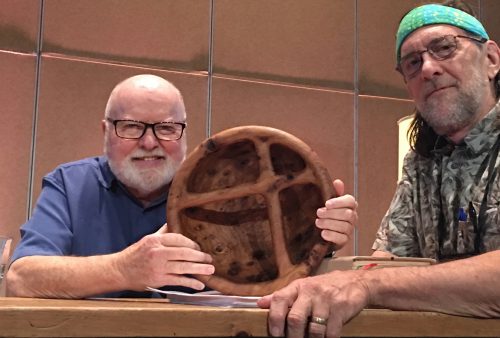
This CO2- (Church Of 2) is where two guys meet each day to tighten up our Connections with Jesus. We start by placing the daily “My Utmost For His Highest” in this WordPress blog. Then we prayerfully select some matching worship music and usually pick out a few lyrics that fit especially well. Then we just start praying and editing and Bolding and adding comments and see where the Spirit takes us.
It’s been a blessing for both of us.
If you’d like to start a CO2, we’d be glad to help you and your partner get started. Also click the link below to see how others are doing CO2.Odds Monkey
Steve Harvey Introduces Jesus To A Secular Audience
About
Change this text in the admin section of WordPress
You are currently browsing the CO2MannaToday blog archives.