Open Heart, Mind, and Body

December 10th, 2018 by Dave No comments »

Open Heart, Mind, and Body
Sunday, December 9, 2018

We may think of prayer as thoughts or feelings expressed in words. But this is only one expression. . . . Prayer is the opening of mind and heart—our whole being—to God, the Ultimate Mystery, beyond thoughts, words, and emotions. Through grace we open our awareness to God whom we know by faith is within us, closer than breathing, closer than thinking, closer than choosing—closer than consciousness itself. —Thomas Keating [1]

Whenever your heart space, your mind space, and your body space are all present and accounted for at the same time, you can experience pure presence, a moment of deep inner connection with the pure, gratuitous Being of anything and everything. It will often be experienced as a quiet leap of joy in the heart.

Contemplation is an exercise in openness, in keeping all three spaces open long enough for you to notice other hidden material. When you can do that, you are content with the present moment and can then wait upon futures you know will be given by grace. This is “full-access knowing”—not irrational, but intuitive, rational, and trans-rational all at once.

The supreme work of spirituality, which makes presence possible, is keeping the heart space open (which is the result of conscious love), keeping a “right mind” (which is the work of contemplation or meditation), and keeping the body alive with contentment and without attachment to its past woundings (which is often the work of healing). In that state, you are neither resisting nor clinging, and you can experience something genuinely new.

Those who can keep all three spaces open at the same time will know the Presence they need to know. That’s the only prerequisite for true prayer. People who can simply be present will know what they need to know—the Presence that connects everything to everything. This way of knowing has little to do with belonging to any particular denomination or religion.

———————–

Knowing Our Source
Monday, December 10, 2018
Thomas Merton Day

Within Christianity, contemplation was not systematically taught for the last 400 or 500 years. Thankfully, Trappist monk Thomas Merton (1915–1968)—who died fifty years ago today—helped reintroduce contemplation to Western Christianity. Here’s just a taste of what Merton had to say about contemplation:

Contemplation is the highest expression of [human] intellectual and spiritual life. It is that life itself, fully awake, fully active, fully aware that it is alive. It is spiritual wonder. It is spontaneous awe at the sacredness of life, of being. It is gratitude for life, for awareness and for being. It is a vivid realization of the fact that life and being in us proceed from an invisible, transcendent and infinitely abundant Source. Contemplation is above all, awareness of the reality of that Source. It knows the Source, obscurely, inexplicably, but with a certitude that goes both beyond reason and beyond simple faith. . . . [1]

Contemplation reaches out to the knowledge and even to the experience of the transcendent and inexpressible God. It knows God by seeming to touch Him [sic]. Or rather it knows Him as if it had been invisibly touched by Him. . . . Touched by Him Who has no hands, but Who is pure Reality and the source of all that is real! Hence contemplation is a sudden gift of awareness, an awakening to the Real within all that is real. A vivid awareness of infinite Being at the roots of our own limited being. An awareness of our contingent reality as received as a present from God, as a free gift of love. This is the existential contact of which we speak when we use the metaphor of being “touched by God.”

Contemplation is also the response to a call: a call from Him who has no voice, and yet Who speaks in everything that is, and Who, most of all, speaks in the depths of our own being: for we ourselves are words of His. But we are words that are meant to respond to Him, to answer to Him, to echo Him, and even in some way to contain Him and signify Him. Contemplation is this echo. It is a deep resonance in the inmost center of our spirit in which our very life loses its separate voice and re-sounds with the majesty and mercy of the Hidden and Living One. [2]

The only true joy on earth is to escape from the prison of our own false self, and enter by love into union with the Life Who dwells and sings within the essence of every creature and in the core of our own souls. In His love we possess all things and enjoy fruition of them, finding Him in them all. And thus as we go about the world, everything we meet and everything we see and hear and touch, far from defiling, purifies us and plants in us something more of contemplation and heaven. [3]
The Universal Christ; Growing in Christ

December 7th, 2018 by JDVaughn No comments »

The Universal Christ
Growing in Christ
Friday, December 7, 2018

[The cosmos] is fundamentally and primarily living. [1] Christ, through his Incarnation, is interior to the world, rooted in the world even in the very heart of the tiniest atom. [2] —Pierre Teilhard de Chardin
As Paul saw Christ as a single “New Human” (see Ephesians 2:15), as Duns Scotus saw Christ as the Alpha point of history, so Teilhard saw the same Divine Icon as the Omega point of cosmic history—both the archetypal starting point and the alluring final goal. The end was therefore already contained in the beginning. History is both emanating from and also seduced by the same force: Divine Love. Do not confuse this with any sentimental notion of love. Teilhard uses the word “love” to describe the cosmic allurement of everything toward everything, a structural, metaphysical shape to the universe, most visible in the basic laws of gravity, the inherent structure of every atom, electro-magnetic fields, and sexual reproduction.
And yet everything is also fragmented and fighting this very process of reunification. For Christians, this resistance is symbolized by the cross. There is a cruciform shape to reality, it seems. Loss precedes all renewal; emptiness makes way for every new infilling; every transformation in the universe requires the surrendering of a previous “form.” This is the big fly in the cosmic ointment!
It may take us hundreds of years more to move beyond the old cosmology that viewed matter and spirit, light and dark, you and me, as separate entities and life and death as total opposites. Christ is the Living Icon of all Reality and all Reconciliation. His very being says that matter and Spirit are one! Life and death are one! The Christ Mystery is the code-breaker for the human dilemma.
Collectively, we’re moving toward the Omega point; but every time you and I hate, fear, compete, attack, judge, separate—thus avoiding the necessary letting go—we are resisting the full flow of Love, the energy which is driving the universe forward. The “Three Persons” of the Trinity—the template for all of reality (see Genesis 1:26-27)—can only pour themselves out because they have agreed to let go, and they can only receive because they have made space for the other. Self-emptying and infilling in equal measure is the only sustainable meaning of Love, growth, and Life Itself.
Let me end with a prayer from Teilhard:
Since, by virtue of my consent, I shall have become a living particle of the Body of Christ, all that affects me must in the end help on the growth of the total Christ. Christ will flood into and over me, me and my cosmos.
. . . May my acceptance be ever more complete, more comprehensive, more intense!
May my being, in its self-offering to you, become ever more open and more transparent to your influence!
And may I thus feel your activity coming ever closer, your presence growing ever more intense, everywhere around me. [3]

The Universal Christ; Christ Is Everywhere

December 6th, 2018 by JDVaughn No comments »

The Universal Christ
Christ Is Everywhere
Thursday, December 6, 2018

Christ is the eternal amalgam of matter and spirit as one as they hold and reveal one another. Wherever the human and the divine coexist, we have the Christ. Wherever the material and the spiritual coincide, we have the Christ. That includes the material world, the natural world, the animal world (including humans), and moves all the way to the elemental world, symbolized by bread and wine. The Eucharist offers Christians the message in condensed form so we can struggle with it in a very concrete way. We cannot think about such a universal truth logically; we can only slowly digest it! “Eat it and know who you are,” St. Augustine said. [1] We are what we drink and eat, as any good nutritionist will say.
Only slowly does the truth become believable. Finally, the Body of Christ is not out there or over there; it’s in you—it’s here and now and everywhere. The goal is then to move beyond yourself and recognize that what’s true in you is true in all others too. The Universal Christ permeates all creation including us. We are all the image and likeness of God!
This recognition was supposed to be a political and social revolution. But Christians wasted centuries arguing about whether it was true at all! The orthodox insistence on the “Real Presence” in the Eucharist is merely taking the Mystery of Incarnation to its natural and full and very good conclusion. Here I am quite happy to be fully Catholic. “There is only Christ, he is everything, and he is in everything,” Paul shouts (see Colossians 3:11). This is not pantheism; it is the much more subtle and subversive panentheism, or God in all things.
You and I are living here in this ever-expanding universe. You and I are a part of this Christ Mystery without any choice on our part. We just are, whether we like it or not. It’s nothing we have to consciously believe. It’s first of all announcing an objective truth. But if we consciously take this mystery as our worldview, it will create immense joy and peace. It gives us significance and a sense of belonging as part of God’s Great Work. We are no longer alienated from God, others, or the universe. Everything belongs. And it is pure, undeserved gift from the very beginning.
Participating in Christ allows each of us to know that “I don’t matter at all, and yet I matter intensely—at the same time!” That’s the ultimate therapeutic healing. I’m just a little grain of sand in this giant, giant universe. I’m going to pass in a little while like everyone else will. But I’m also a child of God. I’m connected radically, inherently, intrinsically to the Center and to everything else.

Outpouring Love

December 5th, 2018 by Dave No comments »

Outpouring Love
Wednesday, December 5, 2018

Francis of Assisi understood that the entire circle of life had a Great Lover at the center. For Franciscan John Duns Scotus, before God is the divine Logos (rational pattern), God is Infinite and Absolute Friendship (Trinity), that is, Eternal Outpouring (Love). Love is the very nature of Being itself. God is not a being who occasionally decides to love. God is “the one in whom we live, move, and have our being” (Acts 17:28). God is Being Itself, and by reason of the Trinity, Being operates as Infinite Love, emptying and out-pouring like an eternal water wheel—in one positive direction.

For us, the Trinity must be the absolute beginning point—and ending point, too. Outpouring Love is the inherent shape of the universe, and only when we love do we fully and truthfully exist in this universe and move toward our full purpose. The Christ who comes forth from the Trinity is both the Alpha and the Omega point of all history (Revelation 1:8, 21:6, 22:13). This metaphysical and cosmic statement gives the whole universe meaning, direction, and goal! God’s purposes are social, cosmic, and universal, not just to hold together a small group of so-called insiders.

Love is the very meaning of Creation. Many of the Fathers and Mothers of the Church, along with saints and mystics throughout history, said that God created because, frankly, God needed something to love and something that could love God freely in return. Parents’ fondest desire, perhaps unconsciously, is to love their little ones in every way. Hidden behind that is the hope that someday their children will love them back. The very way we love our children becomes their empowerment to love us.

Franciscan Philippe Yates puts this in cosmic terms:

At the heart of Scotus’ theology was the doctrine of the primacy of Christ. God is absolutely free and therefore if he [sic] creates it is because he wants to create. He wants to create in order to reveal and communicate his goodness and love to another. Because God loves, he wills that his creation should also be infused by love.

St. Paul tells us that Christ was the “first-born of all creation” [see Colossians 1:15], and Scotus’ theology makes sense of this affirmation. The incarnation in Scotus’ theology is the whole purpose of creation. Christ is the masterpiece of love in the midst of a creation designed for love, not a divine plumber come to fix the mess of original sin. [1]

In other words, many of us Christians settled for Plan B, or Jesus as a mere problem solver after we messed up. The Good News is that the Christ is Plan A from the very beginning, and Jesus came along much later to make it all visible, lovable, and attractive. Salvation is a historical, social, and universal notion, which is made very clear already by the Jewish prophets. But when we make Jesus very small, then the good news of salvation becomes very small too.

The Universal Christ; The Inner Blueprint

December 4th, 2018 by JDVaughn No comments »

The Universal Christ
The Inner Blueprint
Tuesday, December 4, 2018

Let’s begin in the beginning with the prologue to John’s Gospel (John 1:1-11). John is not talking about Jesus; he’s referring to Christ. I’m going to give you my own translation, which I think is a fair one. Instead of “Word,” which is taken from Greek philosophy’s Logos, I’m going to substitute the word “Blueprint,” because it’s really the same meaning. Logos is the inner blueprint.
In the beginning was the Blueprint, and the Blueprint was with God, and the Blueprint was God. . . . And all things came to be through this inner plan. The inner reality of God became manifest in the outer world as the Cosmic or Eternal Christ.
No one thing came to be except through this Blueprint and plan. All that came to be had life in him. Now it’s become personalized. This great Universal Christ Mystery since the beginning of time now becomes specific in the body and the person of Jesus of Nazareth. The Blueprint has become personified and visible as a human being. (The particular gender is not significant here.)
And that Life was the Light of humanity. John is describing a bigger life, a bigger light, from which we all draw. This is Consciousness—a pre-existent form that is the Eternal or One Light. This great Light or Consciousness is the source of our little piece of light, as it were. You can also substitute the word Love. The Blueprint is a cosmic act of Love.
This Light/Life/Love shines in the darkness, and the darkness cannot overcome it. “The visible galaxies we see strewn across space are nothing more than strings of luminous flotsam drifting on an invisible sea of dark matter,” writes astrophysicist Adam Frank. [1] Franciscan Sister Ilia Delio explains: “Scientists speculate that dark energy comprises about 73 percent of the total mass-energy of the universe and accelerates expansion of the universe.” [2] Somehow the universe is an interplay between light and darkness.
This Blueprint was the true light that enlightens all human beings who have come into the world. So, the true light, Consciousness, or Love itself precedes and connects and feeds all of our smaller lights and attractions.
He was in the world that had its very being through him. But the world did not know him. In the same way, for the last 2,000 years, we have not understood the Cosmic Christ. We fell in love with the symbol instead of what Jesus fully represented. To love “Jesus, the Christ” is to love both the symbol and everything that he stands for—which is precisely everything. This lays a wonderful foundation for a new consciousness and a new cosmology—and a very different notion of religion itself.

Who Is Christ

December 3rd, 2018 by Dave No comments »

Who Is Christ
Sunday, December 2, 2018
First Sunday of Advent

What if we’ve missed the point of who Christ is, what Christ is, and where Christ is? I believe that a Christian is simply one who has learned to see Christ everywhere. Understanding the Universal or Cosmic Christ can change the way we relate to creation, to other religions, to other people, to ourselves, and to God. Knowing and experiencing this Christ can bring about a major shift in consciousness. Like Saul’s experience on the road to Damascus (see Acts 9), we won’t be the same after encountering the Risen Christ.

The Universal Christ is present in both Scripture and Tradition, and the concept has been understood by many mystics, though not as a focus of mainline Christianity. (See John 1:1-5, Colossians 1:15-20, Ephesians 1:9-12 if you think this is some new idea.) We just didn’t have the eyes to see it.

The Universal Christ is Divine Presence pervading all of creation since the very beginning. My father Francis of Assisi (1181–1226) intuited this presence and lived his life in awareness of it. Later, John Duns Scotus (1266–1308) put this intuition into philosophical form. For Duns Scotus, the Christ Mystery was the blueprint of reality from the very start (John 1:1). Teilhard de Chardin (1881–1955) brought this insight into our modern world.

God’s first “idea” was to become manifest—to pour out divine, infinite love into finite, visible forms. The “Big Bang” is now our scientific name for that first idea; and “Christ” is our Christian theological name. Both are about love and beauty exploding outward in all directions. Creation is indeed the Body of God!

In Jesus, this eternal omnipresence had a precise, concrete, and personal referent. God’s presence became more obvious and believable in the world. The formless took on form in someone we could “hear, see, and touch” (1 John 1:1), making God easier to love.

But it seems we so fell in love with this personal interface in Jesus that we forgot about the eternal Christ, the Body of God, which is all of creation, which is really the “First Bible.” Jesus and Christ are not exactly the same. In the early Christian era, only a few Eastern Fathers (such as Origen of Alexandria and Maximus the Confessor) noticed that the Christ was clearly historically older, larger, and different than Jesus himself. They mystically saw that Jesus is the union of human and divine in space and time; Christ is the eternal union of matter and Spirit from the beginning of time.

When we believe in Jesus Christ, we’re believing in something much bigger than the historical incarnation that we call Jesus. Jesus is the visible map. The entire sweep of the meaning of the Anointed One, the Christ, includes us and includes all of creation since the beginning of time (see Romans 1:20). This Advent, let us wait in anticipation for the eternally coming Christ.

—————————-

From the Beginning of Time
Monday, December 3, 2018

Christ is the radiant light of God’s glory and the perfect copy of God’s nature, sustaining the universe by God’s powerful command. —Hebrews 1:3, Jerusalem Bible

Christ is not Jesus’ last name. The word Christ is a title, meaning the Anointed One, which many Christians so consistently applied to Jesus that to us it became like a name. But a study of Scripture, Tradition, and the experience of many mystics reveals a much larger, broader, and deeper meaning to “the Christ.”

The above passage from Hebrews says that Christ “sustains the universe.” The concept of Christ can be used to describe reality in an archetypal, symbolic, and profound way. But it names the shape of the universe before it names the individual who typifies that shape, the one we call Jesus Christ. All of creation first holds God’s anointing (“beloved” status), and then Jesus brings the message home in a personal way over thirteen billion years later!

This is a different way of thinking for so many Christians. The three synoptic Gospels are largely talking about Jesus, the historical figure who healed and taught and lived in human history. John’s Gospel presents the trans-historical “Christ” (which is why so very few stories in John coincide with Matthew, Mark, and Luke). This Christ frequently makes universal “I AM” statements and claims (see John 6:35, 48; 8:12, 24, 58; 10:9, 11; 11:25; 14:6; 15:1), mirroring the unspeakable name of the Holy One (Exodus 3:14).

Many people don’t realize that the Apostle Paul never met the historical Jesus and hardly ever quotes Jesus directly. In almost all of Paul’s preaching and writing, he refers to the Eternal Christ Mystery or the Risen Christ rather than Jesus of Nazareth before his death and resurrection. The Risen Christ is the only Jesus that Paul ever knew! This makes Paul a fitting mediator for the rest of us, since the Omnipresent Risen Christ is the only Jesus we will ever know as well (see 2 Corinthians 5:16-17).

Jesus’ historical transformation (“resurrected flesh”) allows us to more easily experience the Presence that has always been available since the beginning of time, a Presence unlimited by space or time, the promise and “guarantee” of our own transformation (see 1 Corinthians 15:1-58). In Jesus, the Timeless Christ became time bound so we could enjoy the personal divine gaze (see 1 John 1-2).

Whenever the material and the spiritual coincide, there is the Christ. Jesus fully accepted that human-divine identity and walked it into history. Henceforth, the Christ “comes again” whenever we are able to see the spiritual and the material coexisting, in any moment, in any event, and in any person. All matter reveals Spirit, and Spirit needs matter to “show itself”! I believe “the Second Coming of Christ” happens whenever and wherever we allow this to be utterly true for us. This is how God continually breaks into history—even before the first homo sapiens stood in awe and wonder, gazing at the stars.

Mystical Hope

November 30th, 2018 by Dave No comments »

Mystical Hope
Friday, November 30, 2018

Cynthia Bourgeault, one of our core faculty members at the Center for Action and Contemplation, writes about the unshakable depths of hope:

Must we be whiplashed incessantly between joy and sorrow, expectation and disappointment? Is it not possible to live from a place of greater equilibrium, to find a deeper and steadier current?

The good news is that this deeper current does exist and you actually can find it. . . . For me the journey to the source of hope is ultimately a theological journey: up and over the mountain to the sources of hope in the headwaters of the Christian Mystery. This journey to the wellsprings of hope is not something that will change your life in the short range, in the externals. Rather, it is something that will change your innermost way of seeing. From there, inevitably, the externals will rearrange.

The journey to the wellsprings of hope is really a journey toward the center, toward the innermost ground of our being where we meet and are met by God.

Meditation, more than any other spiritual practice, nurtures the latent capacities within us that can perceive and respond to divine hope. In the classic language of our tradition, these capacities are known as the “spiritual senses.”

Deeper than our sense of separateness and isolation is another level of awareness in us, another whole way of knowing. Thomas Keating, in his teachings on centering prayer, calls this our “spiritual awareness” and contrasts it with the “ordinary awareness” of our usual, egoic thinking. The simplest way of describing this other kind of awareness is that while the self-reflexive ego thinks by means of noting differences and drawing distinctions, spiritual awareness “thinks” by an innate perception of kinship, of belonging to the whole.

The only thing blocking the emergence of this whole and wondrous other way of knowing is your over-reliance on your ordinary thinking. If you can just turn that off for a while, then the other will begin to take shape in you, become a reality you can actually experience. And as it does, you will know . . . your absolute belonging and place in the heart of God, and that you are a part of this heart forever and cannot possibly fall out of it, no matter what may happen.

[I]n the contemplative journey, as we swim down into those deeper waters toward the wellsprings of hope, we begin to experience and trust what it means to lay down self, to let go of ordinary awareness and surrender ourselves to the mercy of God. And as hope . . . flows out from the center, filling us with the fullness of God’s own purpose living itself into action, then we discover within ourselves the mysterious plenitude to live into action what our ordinary hearts and minds could not possibly sustain.

Joy and Hope; Mystical Hope

November 30th, 2018 by JDVaughn No comments »

Richard Rohr
Joy and Hope
Mystical Hope
Friday, November 30, 2018

Cynthia Bourgeault, one of our core faculty members at the Center for Action and Contemplation, writes about the unshakable depths of hope:
Must we be whiplashed incessantly between joy and sorrow, expectation and disappointment? Is it not possible to live from a place of greater equilibrium, to find a deeper and steadier current?
The good news is that this deeper current does exist and you actually can find it. . . . For me the journey to the source of hope is ultimately a theological journey: up and over the mountain to the sources of hope in the headwaters of the Christian Mystery. This journey to the wellsprings of hope is not something that will change your life in the short range, in the externals. Rather, it is something that will change your innermost way of seeing. From there, inevitably, the externals will rearrange.
The journey to the wellsprings of hope is really a journey toward the center, toward the innermost ground of our being where we meet and are met by God.
Meditation, more than any other spiritual practice, nurtures the latent capacities within us that can perceive and respond to divine hope. In the classic language of our tradition, these capacities are known as the “spiritual senses.”
Deeper than our sense of separateness and isolation is another level of awareness in us, another whole way of knowing. Thomas Keating, in his teachings on centering prayer, calls this our “spiritual awareness” and contrasts it with the “ordinary awareness” of our usual, egoic thinking. The simplest way of describing this other kind of awareness is that while the self-reflexive ego thinks by means of noting differences and drawing distinctions, spiritual awareness “thinks” by an innate perception of kinship, of belonging to the whole.
The only thing blocking the emergence of this whole and wondrous other way of knowing is your over-reliance on your ordinary thinking. If you can just turn that off for a while, then the other will begin to take shape in you, become a reality you can actually experience. And as it does, you will know . . . your absolute belonging and place in the heart of God, and that you are a part of this heart forever and cannot possibly fall out of it, no matter what may happen.
[I]n the contemplative journey, as we swim down into those deeper waters toward the wellsprings of hope, we begin to experience and trust what it means to lay down self, to let go of ordinary awareness and surrender ourselves to the mercy of God. And as hope . . . flows out from the center, filling us with the fullness of God’s own purpose living itself into action, then we discover within ourselves the mysterious plenitude to live into action what our ordinary hearts and minds could not possibly sustain.

______________________________________________________

Sarah Young

Jesus Calling

November 30, 2018

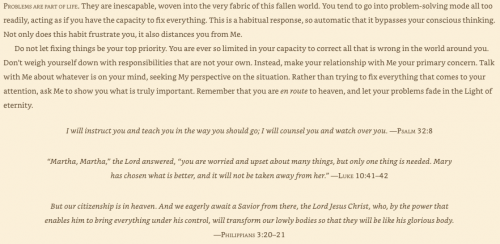
Psalms 32:8; I will instruct you and teach you in the way you should go; I will counsel you with my loving eye on you.

Luke 10:41-42; Martha, Martha,” the LORD answered, “you are worried and upset about many things, 42but few things are needed-or indeed only one. Mary has chosen what is better, and it will not be taken away from her.”

Philippians 3:20-21; But our citizenship is in heaven. And we eagerly await a Savior from there, the LORD Jesus Christ, 21who, by the power that enables him to bring everything under his control, will transform our lowly bodies so that they will be like his glorious body.

Joy and Hope: Generosity of Spirit

November 29th, 2018 by JDVaughn No comments »

Richard Rohr

Joy and Hope
Generosity of Spirit
Thursday, November 29, 2018

For a week in April 2015, Archbishop Desmond Tutu visited His Holiness the Dalai Lama at his residence in exile in India. Their dialogue and interactions, facilitated by Douglas Abrams, became The Book of Joy. I’d like to share some of their hard-won wisdom with you today.
Suffering is inevitable, they said, but how we respond to that suffering is our choice. Not even oppression or occupation can take away this freedom to choose our response.
As our dialogue progressed, we converged on eight pillars of joy. Four were qualities of the mind: perspective, humility, humor, and acceptance. Four were qualities of the heart: forgiveness, gratitude, compassion, and generosity.
[Archbishop Tutu said:] “Our human nature has been distorted, . . . I mean, we are actually quite remarkable creatures. In our religions I am created in the image of God. I am a God carrier. It’s fantastic. I have to be growing in godlikeness, in caring for the other. I know that each time I have acted compassionately, I have experienced a joy in me that I find in nothing else.”
When we practice a generosity of spirit, we are in many ways practicing all the other pillars of joy. In generosity, there is a wider perspective [italics mine], in which we see our connection to all others. There is a humility that recognizes our place in the world and acknowledges that at another time we could be the one in need, whether that need is material, emotional, or spiritual. There is a sense of humor and an ability to laugh at ourselves so that we do not take ourselves too seriously. There is an acceptance of life, in which we do not force life to be other than what it is. There is a forgiveness of others and a release of what otherwise might have been. There is a gratitude for all that we have been given. Finally, we see others with a deep compassion and a desire to help those who are in need. And from this comes a generosity that is “wise selfish,” a generosity that recognizes helping others as helping ourselves. As the Dalai Lama put it, “In fact, taking care of others, helping others, ultimately is the way to discover your own joy and to have a happy life.”
[Near the end of their time together, Archbishop Tutu offered this blessing:]
“Dear Child of God, you are loved with a love that nothing can shake, a love that loved you long before you were created, a love that will be there long after everything has disappeared. You are precious, with a preciousness that is totally quite immeasurable. And God wants you to be like God. Filled with life and goodness and laughter—and joy.
“God, who is forever pouring out God’s whole being from all eternity, wants you to flourish. God wants you to be filled with joy and excitement and ever longing to be able to find what is so beautiful in God’s creation: the compassion of so many, the caring, the sharing. And God says, Please, my child, help me. Help me to spread love and laughter and joy and compassion. And you know what, my child? As you do this—hey, presto—you discover joy. Joy, which you had not sought, comes as the gift, as almost the reward for this non-self-regarding caring for others.”

____________________________________________

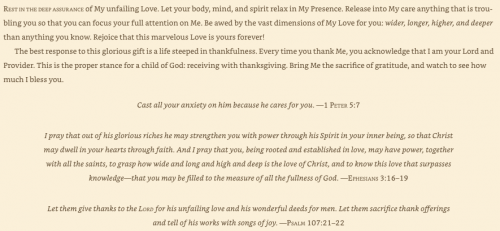
John 14:27; Peace I leave with you; my peace I give you. I do not give to you as the world gives. Do not let your hearts be troubled and do not be afraid.

Isaiah 58:11; The Lord will guide you always; he will satisfy your needs in a sun-scorched land and will strengthen your frame. You will be like a well-watered garden,

Isaiah 40:11; He tends his flock like a shepherd: He gathers the lambs in his arms and carries them close to his heart; he gently leads those that have young.

PEACE

Young, Sarah. Jesus Calling Morning and Evening Devotional (Jesus Calling®) (Kindle Location 8057). Thomas Nelson. Kindle Edition.

Joy in Contemplation

November 28th, 2018 by Dave No comments »

Joy in Contemplation
Wednesday, November 28, 2018

Joy proceeds from the inner realization of union with God, which descends upon us at ever deeper levels as we walk our faith journey. This deepening is the goal of Christian contemplation and is the heart of perennial wisdom from every faith. This is how contemplatives “know” things: The soul itself is an image of God, to which God is so present that the soul can actually grasp God, and, as Bonaventure wrote, “is capable of possessing [God] and of being a partaker in [God].” [1] Ironically, it is in letting go that we most truly “possess” God and participate in God’s fullness.

Jesus modeled and taught contemplative prayer. He invited us to “go to your inner room, close the door, and pray to your Father in secret” (Matthew 6:6). Our beloved Father Thomas Keating (1923–2018), who recently passed away, explained how such prayer helps us access the joy of experiential union with God:

In Jesus’ formula for waking up to who we are, he suggests entering this inner room. Then he says shut the door, meaning stop the interior dialogue. Get free or detached from our over-identifications with our thoughts, experiences, past life, future hopes. It doesn’t mean leaving anything behind, but changing your attitude to everything, so it’s a non-possessive attitude, which is the nature of [God] or the Beloved, or the Ultimate Reality. . . .

[We are] in the process of awakening to the divine image within us, the supernatural organism where faith, hope, and charity, the divine indwelling, and the fruits and the gifts of the Spirit are sitting, so to speak, in our ontological unconscious, gathering dust, waiting to be used. And they can’t come into full action until our over-identification with the false self and its programs for happiness that can’t possibly work have been reduced.

So life, then, is constant death and resurrection at every moment. We die to our own will and enter the present moment by consenting to whatever it is, either by accepting it or doing something that the Spirit suggests to improve the situation. This divine enlightening process sometimes gives us an Aha! experience. It’s still on the egoic level, so it’s penetrated with some misunderstandings, but nonetheless, this is what Alleluia means. “Aahh”—this is the primordial sound that that you hear in Allah or in Alleluia or in Aum [Om] as the Hindus put it. It’s waking up!

. . . Everybody has personal, unique relationship with God and capacity to manifest something of that infinite goodness that is a torrent that simply moves from relationship to relationship in the Trinity in a kind of moving ocean of infinite love that is reaching out and drawing everybody back through the unspeakable groanings of the Spirit that dwells even in matter [see Romans 8:22-23], but especially in our inmost being and conscience, calling us into freedom, into peace, into joy, which we already possess at the hidden level. That’s why we need to find out who we are!

We are already all these things. We just think we aren’t. Stop thinking, and you’ll find out. [2]