Etty Hillesum: A Commitment to Life
Thursday, July 23, 2026
Why is there a war?… Because I and my neighbor and everyone else do not have enough love. Yet we could fight war and all its excrescences by releasing, each day, the love that is shackled inside us, and giving it a chance to live.
—Etty Hillesum, An Interrupted Life
Father Richard has long drawn comfort and wisdom from the writings of the young Jewish woman Etty Hillesum (1914–1943), believing her to be someone whose contemplative practice and mystical experience led to greater compassion and action in a hurting world. Shortly before her departure for internment at the Westerbork transit camp, Hillesum wrote in her journal:
One thing is becoming increasingly clear to me: that You cannot help us, that we must help You to help ourselves. And that is all we can manage these days and also all that really matters: that we safeguard that little piece of You, God, in ourselves. And perhaps in others as well….You cannot help us, but we must help You and defend Your dwelling place inside us to the last. [1]
Hillesum fully accepted the brokenness of reality and chose to love ever more consciously:
Something has crystallised. I have looked our destruction, our miserable end which has already begun in so many small ways in our daily life, straight in the eye and accepted it into my life, and my love of life has not been diminished. I am not bitter or rebellious, or in any way discouraged. I continue to grow from day to day, even with the likelihood of destruction staring me in the face. I shall no longer flirt with words, for words merely evoke misunderstandings: I have come to terms with life.…
By “coming to terms with life” I mean: the reality of death has become a definite part of my life; my life has, so to speak, been extended by death, by my looking death in the eye and accepting it, by accepting destruction as part of life and no longer wasting my energies on fear of death or the refusal to acknowledge its inevitability. It sounds paradoxical: by excluding death from our life we cannot live a full life, and by admitting death into our life we enlarge and enrich [life]. [2]
Reflecting on Jesus’s words in Matthew 6:34 not to worry about tomorrow, Hillesum writes:
We have to fight them daily … those many small worries about the morrow, for they sap our energies.… The things that have to be done must be done, and for the rest we must not allow ourselves to become infested with thousands of petty fears and worries, so many motions of no confidence in God.… Ultimately, we have just one moral duty: to reclaim large areas of peace in ourselves, more and more peace, and to reflect it towards others. And the more peace there is in us, the more peace there will also be in our troubled world. [3]
References:
[1] An Interrupted Life: The Diaries of Etty Hillesum, 1941–1943, trans. Arno Pomerans (Pantheon Books, 1984), 151.
[2] Hillesum, Interrupted Life, 131–132.
[3] Hillesum, Interrupted Life, 185.
=============================================================================
On January 27, 2010 by Brian Zahnd
Humiliation and Dignity
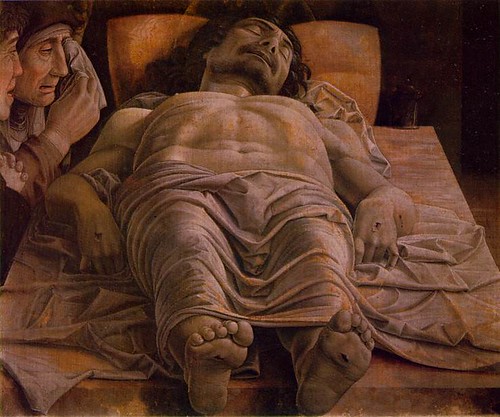
In his humiliation justice was denied him.
Who can describe his generation?
For his life is taken away from the earth.
-Acts 8:33
Someone showed me a picture and I just laughed
Dignity never been photographed
I went into the red, went into the black
Into the valley of dry bone dreams
-Bob Dylan, Dignity
Life is a struggle. A struggle against humiliation. A struggle to gain dignity. And in the battle against humiliation in the hope of gaining dignity we may experience some triumphs. The dignity of courage. The dignity of wisdom. The dignity of noble gesture. The dignity of rising above base animal instinct and becoming fully human. But in the end its a war we all lose. Death sees to that. Death is the final and ultimate humiliation. In death we are laid low. In death we return to dust. In death we are humiliated. In death we return to the humus. Humiliation and humus are related. We strive for the stars, but we return to the soil. Humus. Humiliation.
Some will say, “All the better for being done with this mortal shell.” But I will have none of it. Neither will the Hebrew prophets. Neither will the Christian apostles. The human body is not a mere “mortal shell” and much less is it a “vile prison of the spirit.” Let the Manichaens talk that way, I won’t go along for the ride. The human body is integral to the human being. And the decay of the human body is a decay of humanity itself. The return of the human body to the humus is the ultimate humiliation of the human. It stinks. Literally.
And this is why the gospel is the Christian belief in the resurrection of the body and not the Gnostic belief of an eternal disembodied soul. In the inaugural sermon of the Christian era the Apostle Peter said this:
“David spoke of the resurrection of Messiah, saying,
He was not abandoned to Hades
Nor did his flesh experience corruption.
This Jesus God raised up, and of that all of us are witnesses.”
-Acts 2:31, 32
Jesus overcame the humiliation of death and decay, not by becoming an eternal, disembodied spirit existing in a non-spacial, non-temporal Platonic heaven, but by resurrection from the dead!
The humiliation of death is conquered by the dignity of resurrection.
In the Greek Orthodox icons of the resurrection, Jesus is never depicted as risen alone, but as bringing Adam and Eve out of the grave with him. Jesus conquered death, not as an individual, but as a representative of the human race. Jesus took death into himself that death itself might be destroyed and that the human race might be liberated from the humiliation of death and brought into the dignity of resurrection.

The eternal life the New Testament speaks of is not the immortality of the soul dreamt of by Plato and it is not the “harps and clouds” angelic existence of popular imagination. When Jesus and the Apostles speak of eternal life they are speaking of a resurrected life — a fully embodied, physical life that has achieved immortality through resurrection. This is the Christian hope. The hope of dignity that rises (literally!) above humiliation.
And so we who believe in the resurrection of Jesus Christ labor with the assurance that our labor is not in vain. We are assured that every good thing we do now will somehow carry over into the resurrection. The interruption of death and our interim period of “absent from the body, present with the Lord” will not prevent our good works from carrying over into the new creation.
This makes me happy.
I was never going to be a very good Platonist. And I was certainly never going to be a very happy Platonist. Plato may pine away for the realm of perfect forms, but I want to feel…I want to feel the sun on my face, the wind in my hair and the sand between my toes. I want to be a human, not an angel. I don’t want to be “liberated” by death. It’s not liberation, it’s humiliation. But Jesus Christ has taken the humiliation out of death by his resurrection. The Apostle Paul says it like this:
“When this perishable body puts on imperishablity, and this mortal body puts on immortality,
then the saying that is written will be fulfilled:
Death is swallowed up in victory,
Where, O death, is your victory?
Where, O death, is your sting?
The sting of death is sin, and the power of sin is the law.
But thanks be to God who gives us the victory through our Lord Jesus Christ!”
1 Corinthians 15:53-57
And how is death defeated? Not by going to heaven — that is simply death. Death is defeated by resurrection! That is the whole point of 1 Corinthians chapter 15. It’s amazing (and tragic) that so many have missed this and settled for Plato’s paltry substitute. A Christianity where resurrection is not the central hope and the primary focus of the good news is either a paganized Christianity or a Christianized paganism. Either way it’s not the Christianity of the Apostle Paul.
My faith is founded on bodily resurrection.
(There is no other kind of resurrection.)
My faith is guaranteed by the resurrection of Jesus Christ.
My hope is that I too will be raised to immortality.
Call me crazy.
But call me a Christian.
For this is what Christians believe.
The dignity of resurrection triumphing over the humiliation of death.
Amen.
BZ
(The painting is The Lamentation of the Dead Christ by Mantegna.)
