Tuesday, August 11, 2026
Feast Day of Clare of Assisi
Sister Margaret Carney tells of the radical trajectory of Clare of Assisi’s life, who left behind wealth and social standing under cover of night in exchange for a simple life devoted to God:
The year was 1212. On Palm Sunday morning she attended the Mass in the cathedral…. Late that same night, Clare left her home on the piazza of San Rufino…. The gate by which she could leave the city after curfew was in a section owned by the bishop—the palm branch [he went out of his way to give to her that morning at Mass] might also have served as an “all clear” relative to the route she must take…. Once on the other side of this gate and Assisi’s protective walls, she would become a citizen of another “commune” of Gospel striving….
Finally, she arrived at the tiny church of Santa Maria degli Angeli. Once there, she was formally received by Francis in a carefully orchestrated ritual. Her beautiful clothing was exchanged for a penitent’s robe. Francis himself cut her hair—the time-honored tradition for women seeking to leave the world to live by religious vows…. In the presence of the brothers, Clare professed her dedication to Jesus, and, like them, to poverty and their simple rule. All that she once claimed as a member of a noble family was put aside. [1]
In one of Clare’s letters, we sense the depth of her contemplative life:
Place your mind before the mirror of eternity! Place your soul in the brilliance of glory! Place your heart in the figure of the divine substance, and through contemplation, allow your entire being to be transformed into the image of the Godhead itself, so that you may feel what friends feel, and taste the hidden sweetness that God has reserved for His lovers. [2]
Richard Rohr reflects:
This profound quote, that could only emerge as a fruit of contemplation, along with her very frequent use of the mirror metaphor in her writings, communicates to me that Clare experientially understood prayer as an actual transformation of the self, a reflected glory, even daring to speak of “allowing your entire being to be transformed into the image of the Godhead itself.” This was surely not common Catholic language in the Western Church at that time and would have seemed presumptuous or even heretical to many (as it may even seem today).
Clare directly expresses what the Eastern Church held onto under the name of divinization (theosis). Theosis was understood as a true, objective sharing and growing in our divine nature, which was then reflected and received in humans as in a mirror. All we can really do is polish our own mirror to reflect the gift of this Godself more perfectly. Thus the objectively given “image” at our conception becomes subjective “likeness” over time, building on the foundational metaphors that we were created in both the image and the likeness of God
================
The Man Who Ran
Back to Maturity, Part Two
| JASON TWOMBLY AUG 10 |
It was Mother’s Day.
I’d taken the kids to Walmart after church to grab a tablecloth for David’s sixth-grade project. Simple errand. Twenty minutes, in and out.
But church had already been its own weight. Mother’s Day as a widowed single dad is a particular kind of hard. You sit in the pew, you sing the songs, you watch other families move through it intact, and you carry something nobody in the room can quite see. By the time we walked out into that parking lot, I was already running on fumes (not the tired kind, the grief kind). The kind that sits just below the surface and waits for something small to tip it.
Someone had left the stereo running while we were inside Walmart. By the time we came back out to the parking lot, the battery was dead.
I want to be honest about what happened next.
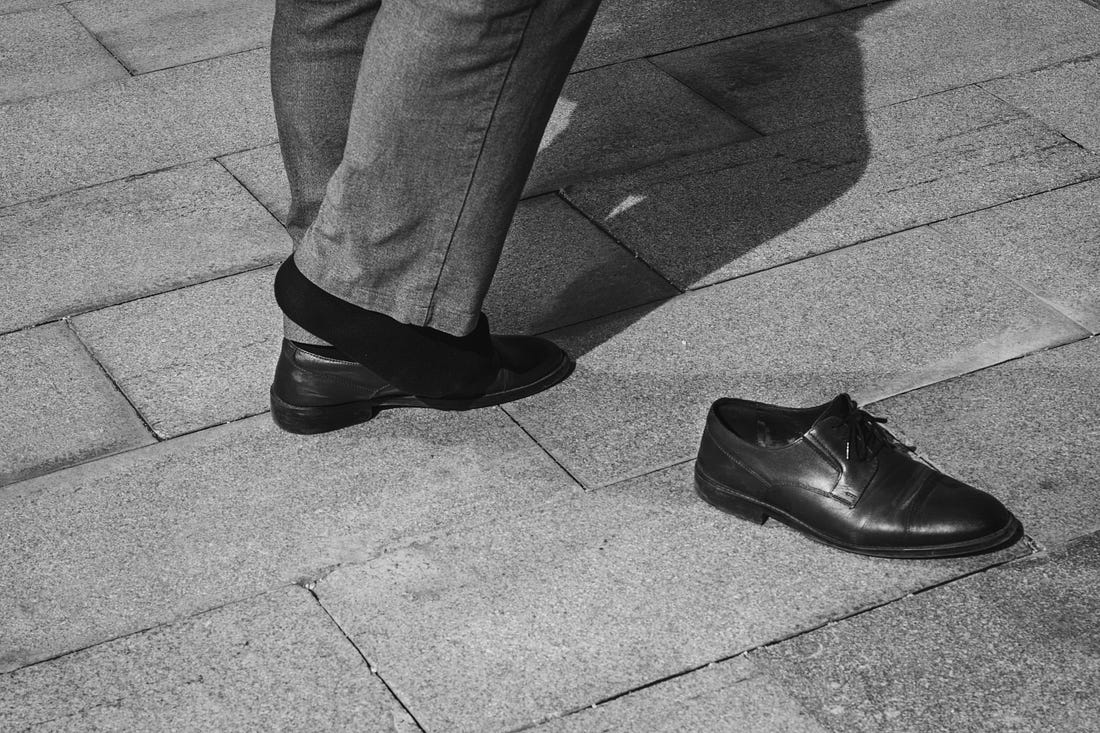
When that battery died, something in me flipped. And instead of staying with my kids and solving the problem from where we stood, I ran. Five miles home, in my church shoes, to get another car and jumper cables. Leaving my three kids alone in that Walmart parking lot.
Here’s the thing: I was training for a marathon at the time. Five miles was nothing. My body didn’t even register it as a decision. And I told myself the kids would be fine, which they were. But that’s exactly what makes overwhelm so disorienting, it doesn’t feel like panic. It feels like logic. It feels like you’re handling something. What I couldn’t see, sprinting down the road in my dress shoes, was the image I was leaving behind. And what my kids were watching their dad do instead of stay.
In the moment it felt like decisive action.
Looking back, my overwhelm had taken the wheel. And my children paid the fare.
Years later I came across a short video by Dr. Dan Siegel, the neuropsychiatrist and author who developed the concept he calls “flipping your lid.” In it, he uses his hand as a model of the brain to explain what happens when the prefrontal cortex (the part responsible for judgment, empathy, and regulated response) goes offline under stress. The lid flips. The rational brain disconnects. And what takes over isn’t evil or weak. It’s just the oldest part of your brain doing what it was built to do: survive.
I watched that video and I could smell that parking lot again.
For the first time, I understood what had actually happened that day. Not an excuse. Not a pass. But an explanation that quietly removed the shame and replaced it with something more useful: understanding. Because you can’t grow what you can’t see clearly, and shame makes everything blurry.
(I’ve linked the video below. If you’ve ever wondered why you said what you said, did what you did, or left when you should have stayed, watch it. It might do for you what it did for me.)
That story surfaced in a men’s gathering I lead called MANCAVE. We were practicing something in this month’s coaching practice called “Back to Maturity Stories” (moments that quietly reveal where we stopped growing, usually in the most ordinary-looking scenes of our lives). When I told that Walmart story out loud, to a room full of men, something shifted in the telling. Not because it was dramatic. Because it was true.
And because the men in that room recognized it.
Not that exact story. But the shape of it, the man who, under pressure, disappears. Who mistakes movement for leadership. Who handles his own overwhelm by leaving the people who needed him to stay.
That shape has a name. And it lives inside a framework I’ve been training in MANCAVE, drawn from decades of maturity research and practice, the work of Dr. Jim Wilder in relational neuroscience, the Life Model carried forward by the team at LK10, and Marcus Warner’s work in Rare Leadership. These voices don’t all say exactly the same thing, but they’re mapping the same territory.
That territory looks like this. Human maturity moves across five stages, each with a core task:
Infant — the task is learning to receive. Not earning, not performing. Simply letting someone give you what you need before you know how to ask.
Child — the task is learning to ask for what you need. To do hard things on purpose. To discover what actually satisfies, not just what distracts.
Adult — the task is learning to take care of two people at once. Yourself and another, simultaneously. Taking responsibility for how your actions land on the people around you (including protecting them from your own unregulated self).
Parent — the task is giving without keeping score. Pouring into others without needing it returned.
Elder — the task is carrying the whole community. Staying yourself under fire. Being steady when everyone around you needs someone to hold the room.
Here’s what matters: your body doesn’t graduate a stage just because you had a birthday. Most of us are a mix (solid in one area of life, still working through something unfinished in another). That’s not a flaw. That’s just where growth still has room to go.
The Walmart parking lot? That was an Adult-stage task I hadn’t finished. I failed at the precise thing the Adult stage asks of us: taking responsibility for how my actions land on the people I love, and protecting them from my own overwhelm rather than leaving them to weather it alone.
When a task at any stage doesn’t get finished, the researchers and practitioners in this space are consistent: the gap doesn’t stay invisible. It surfaces. It shows up as:
Avoidance — the world quietly gets smaller. We fill it with noise, or with work, anything to avoid what’s waiting at home.
Addiction — almost always a sign something is unfinished underneath. Not a moral failure. A developmental gap looking for relief.
Anxiety — a lower capacity means it takes less to overwhelm us. And overwhelm, over time, turns into fear about everything ahead.
Anger — a short fuse is one of the clearest signs of an unfinished task. Returning to calm from anger is a skill. If nobody taught it to you, of course you don’t have it yet.
None of these mean something is wrong with you as a man. They mean there’s work still to be done. And that work can be done.
Here’s what I’ve learned to do with a moment like the Walmart battery: the redo.
Not to shame the man who ran. He was doing the best his nervous system could do that day. The grief was real. The overwhelm was real. But naming what I’d do differently is how I actually build the muscle for next time.
If I could walk back into that parking lot today, I’d stay. I’d ask the nearest person walking by for jumper cables, or I’d walk back into the store with my kids and ask an associate for help. My children would watch their dad handle a hard moment without disappearing (solving the problem while staying present with the people it most affected).
That’s the redo. Not just fixing the car. Staying with my children while I fixed it. Protecting them from my own flipped lid instead of leaving them to weather it alone.
The man who ran was doing his best. The man learning to stay is doing the work.
This is what Back to Maturity stories are built for, not to catalog your failures, but to find the ordinary moments that are still quietly shaping you, name what task they’re pointing to, and practice what it would look like to finish what wasn’t finished.
We do this work inside MANCAVE every session. If you’re a man who recognizes the shape of that parking lot (the moment where you moved instead of stayed, handled instead of held) you’re not alone. And it’s not too late to learn what you were never shown.
You can’t go back. But you can grow forward into someone who stays. What you practice now shapes who shows up next time.
