
THE MYSTICISM OF FRANCIS AND CLARE
Incarnation: The Humility of God
Thursday, August 13, 2026
Franciscan mysticism is at heart incarnational mysticism. Theologian Ilia Delio highlights how Francis of Assisi was transformed by the radical implications of the Incarnation, including his powerful experience meeting a leper:
Francis lived in the spirit of humility and poverty by following the poor and humble Christ…. Just as God reached out to embrace Francis in the compassionate love of the cross, so, too, that same God was now present in the distorted figure of the leper…. The leper became a source of God’s loving embrace and thus someone to whom Francis realized he was intimately related….
The leper experience was a turning point in Francis’ life. As his life deepened in God, he made a constant effort to spend himself in love by giving himself to the other…. Following the footprints of Jesus, Francis found the God of humble love not among the popular and the proud, the arrogant and the rich or those who “stand out” in society, but among the ordinary, the forgotten, the poor and sick and marginalized….
The simplest way to describe God’s poverty and humility is in terms of love. Love gives itself away—this is God’s poverty. Love turns toward the other so it can give itself to the other—this is God’s humility. In the Incarnation, God turns toward us through the Son/Word and gives [God’s] self to us as love. We call this gift of God’s love to us, this gift of total self-emptying love, “kenosis.” The poverty of God is the kenosis or self-emptying of the Word, the descent of the Word, from the riches of divine glory into our fragile human nature. [1]
Delio invites us, like Francis, to experience the poverty and humility of God:
What would the world be like if Christians actually believed in a humble God? If following a God of poverty and humility led them to abandon their opinions, prejudices and judgments so they could be more open to love others where they are, like God? Francis went about the world following the footprints of Christ, not so he could look like Christ, but because they were the footprints of divine humility. He discovered that God descends in love to meet us where we are, and he found God in the most unexpected forms…. The humility of God means acceptance—God accepts ordinary, fragile human flesh to reveal [God’s] glory so that we in turn may accept others as the revelation of God. Christ discloses the beauty of the world as the radiance of God. That is why every person and creature merits utmost respect and attention because in that living being, God dwells. We may be confounded by the mystery of God’s humility if we try to understand it through reason alone. The humility of God is not an abstract concept. It is how God expresses [Godself] in concrete reality. [2]
References:
[1] Ilia Delio, The Humility of God: A Franciscan Perspective (St. Anthony Messenger Press, 2005), 19–20, 25.
[2] Delio, Humility of God, 31–32.
Image Credit and Inspiration: Pouya Hajiebrahimi, untitled, 2025, photo. Unsplash. Click here to enlarge image. Alone in the mist, we stand quietly before the mirror Saint Clare speaks of, waiting to be transformed.
Healing Prophetic Abuse & Hearing God Again
Bradley Jersak foreword excerpt to Eric H. Janzen’s “Ponder: Valuing & Evaluating the Gift of Prophecy”
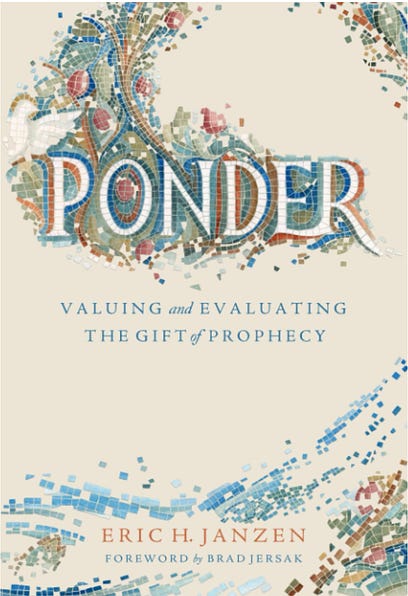
Click here to order Eric Janzen, Ponder: Valuing and Evaluating the Gift of Prophecy here.
Foreword
I believe in and have been the grateful beneficiary of what Paul describes in 1 Corinthians 14 as the New Testament “gift of prophecy.” He describes it there as a function of the Holy Spirit in the Body of Christ gathered, whereby we build each other up in love. For thirty years, I have been committed to and taught the same criteria the apostle lays out there. He says that prophetic ministry serves to “strengthen, comfort and encourage” one another. By adhering to these parameters as our basic protocol, the churches and ministries where I’ve served have seen remarkably little prophetic abuse to the degree that we submitted to those love-centered guidelines.
Even before I first became conscious of this gift, I witnessed Spirit-filled encouragement at work in the life of my parents, who, as Baptists, would never dare say, “Thus says the Lord,” or “God is saying,” yet flowed in that ministry using phrases like, “I sensed the Lord prompting me” or “I felt led.” That approach called for bold action but humble terminology.
Unfortunately, in the decades since I first began to see authentic prophetic phenomenon, I’ve also witnessed profound examples of misuse, ranging from condemnation and accusation, flattery and manipulation, consumeristic confessions, and perhaps worst of all grotesque politicization. For all the bad press the self-proclaimed prophets have faced, I can say that I’ve been in the conference green rooms and it’s probably worse than you can imagine.
But that’s nothing new. One needs to ask why Paul was compelled (by the Spirit) to exhort the Thessalonians, “Do not despise prophetic utterances. Test everything; retain what is good. Refrain from every kind of evil.” I would propose that Paul needed to warn this family of faith not to hold prophecy in contempt precisely because they had been disillusioned by its misuse… so much so that, like many of us, they developed a cynical eye roll when the latest ‘prophet’ would show up. And who wouldn’t?
But to allow the counterfeits to incite you to ditch the authentic seems like an odd sort of concession to the thief. Paul’s wise advice is a doubling down on testing. Test everything. Boldly. Unapologetically. Even if the prophets claim to be exempt (“because I’m the Lord’s anointed). That claim is immediately self-disqualifying. Rather, the true prophetic spokesperson not only welcomes an examination of their message and their character but exhorts the listener to go listen for themselves to the same Spirit they believe is at work in them.
At one time, I believed this testing involved confirmation and alignment with the Scriptures, the Body of Christ and the voice of the Spirit. But it wasn’t long before I saw how quickly someone could produce a Bible verse, a yes-man and a warm fuzzy feeling to meet the criteria. I began to recognize the need to sharpen our focus onto the person of Jesus Christ—the threefold witness of his person, his ministry and his teaching, as laid out in the four Gospels and especially the Sermon on the Mount. At the end of that sermon, Jesus says, “Here’s the wise person who builds their house upon the rock—the one who hears these words of mine and puts them into practice.”
With that, I began to pray the Beatitudes every day, and I saw how many so-called prophetic words could not pass through the purifying fire of even the first beatitude: “Bless are the poor in Spirit,” much less the second, “Blessed are those who mourn,” and by the time we got to the third, “Blessed are the meek,” every grandiose word that appealed to our fleshly egoism was consumed. It’s an incredibly reliable furnace of discernment.
Having tested everything, Paul adds, “And hold fast to that which is good.” We used to say, “Chew on the meat, spit out the bones.” And what is good? Who is good? Jesus alone. And this is why, first and foremost, John the Revelator announces that “the testimony of Jesus is the Spirit of prophecy.” That is, the gift of prophecy points us back to Jesus, over and over. It’s not about my success or my ministry or all the things that make me feel great. It’s a constant invitation to look into the eyes of our gentle Shepherd and to listen to his kind words—even the stern ones.
If those who receive the prophetic word regard it as, in some sense, the voice of Jesus Christ through the Holy Spirit, then I believe its greatest value is in how it makes God real to us. We see how many of those who’ve left the faith and abandoned Jesus himself do so as if they had never met him or known him as more than an idea or doctrine or remote figure… or if they had an experience of his voice, the birds of disillusionment and cynicism have stolen the seed from their hearts (because of rogue prophetic claims that sullied the whole experience).
But if we can somehow retrieve this gift, I believe we will find they invite us to deeper intimacy with Christ and into a greater wonder in following him… and his messages of hope then empower us to overcome inertia and opposition because we know God has our backs in a deeply personal way.
I will be frank here… I still have an anxious tick when folks begin to speak about the prophetic gift. The bizarre and blasphemous words given in the name of Jesus have left me jaded (which is a harsh way to say weary and untrusting). BUT if we’ll exercise a deep and consistent commitment to testing prophets and prophecies by their fruit, we’ll begin to see the powerful positive fruit of transformation in those who represent the “real deal.”
