A Prophetic Dream of Peace
Wednesday, August 19, 2026
Brian McLaren considers how the Hebrew prophets dreamed of peace in the midst of war and oppression:
Prophets in the Bible have a fascinating role as custodians of the best hopes, desires, and dreams of their society…. And when they see people behaving in harmful ways, they warn them by picturing the future to which that harmful behavior will lead.
One of the most important prophetic compositions was the book of Isaiah. Most scholars today agree that at least three people contributed to the book over a long period of time, but their combined work has traditionally been attributed to one author. The first thirty-nine chapters of Isaiah were situated in the southern kingdom of Judah…. The prophet saw deep spiritual corruption and complacency among his people and warned them that this kind of behavior would lead to decline and defeat.
That defeat came in 587 BC at the hand of the Babylonians. After the invasion, many survivors were taken as exiles to Babylon. Chapters 40–55, often called Second Isaiah, addressed those Judean exiles, inspiring hope that they would someday return to their homeland and rebuild it. That soon happened, beginning in 538 BCE under the leadership of Ezra and Nehemiah. That era of rebuilding was the setting for Third Isaiah, chapters 56–66.
For readers in later generations, ingredients from these three different settings blend into one rich recipe for hope, full of imagery that still energizes our imagination today….
They shall beat their swords into plowshares,
and their spears into pruning-hooks.
Nation shall not lift up sword against nation,
Neither shall they learn war any more (2:4)….The wolf shall live with the lamb,
the leopard shall lie down with the kid,
the calf and the lion will feed together,
and a little child shall lead them (11:6)….
Isaiah’s descriptions of that better day were so inspiring that Jesus and his early followers quoted Isaiah more than any other writer. But many other prophets added their own colors to this beautiful vision of hope. In Ezekiel’s vision, people’s hearts of stone will be replaced with hearts of flesh. For Malachi, the hearts of parents would turn to their children, and children to their parents. Joel describes the Spirit of God being poured out on all humanity—young and old, men and women, Jew and Gentile. Amos paints the vivid scene of justice rolling down like a river, filling all the lowest places….
In the centuries between the time of the prophets and the birth of Jesus, these prophetic dreams never completely died. But they were never completely fulfilled, either…. It remained alive in people like Elizabeth and Zechariah, Mary and Joseph, and Anna and Simeon, and even among humble shepherds who lived at the margins of society.
To be alive in the adventure of Jesus is to have a desire, a dream, a hope for the future. It is to translate that hope for the future into action in the present and to keep acting in light of it.
============
Jesus, Etc.
A Foreword to a Vulnerable God
| BRIAN ZAHNDAUG 18 |
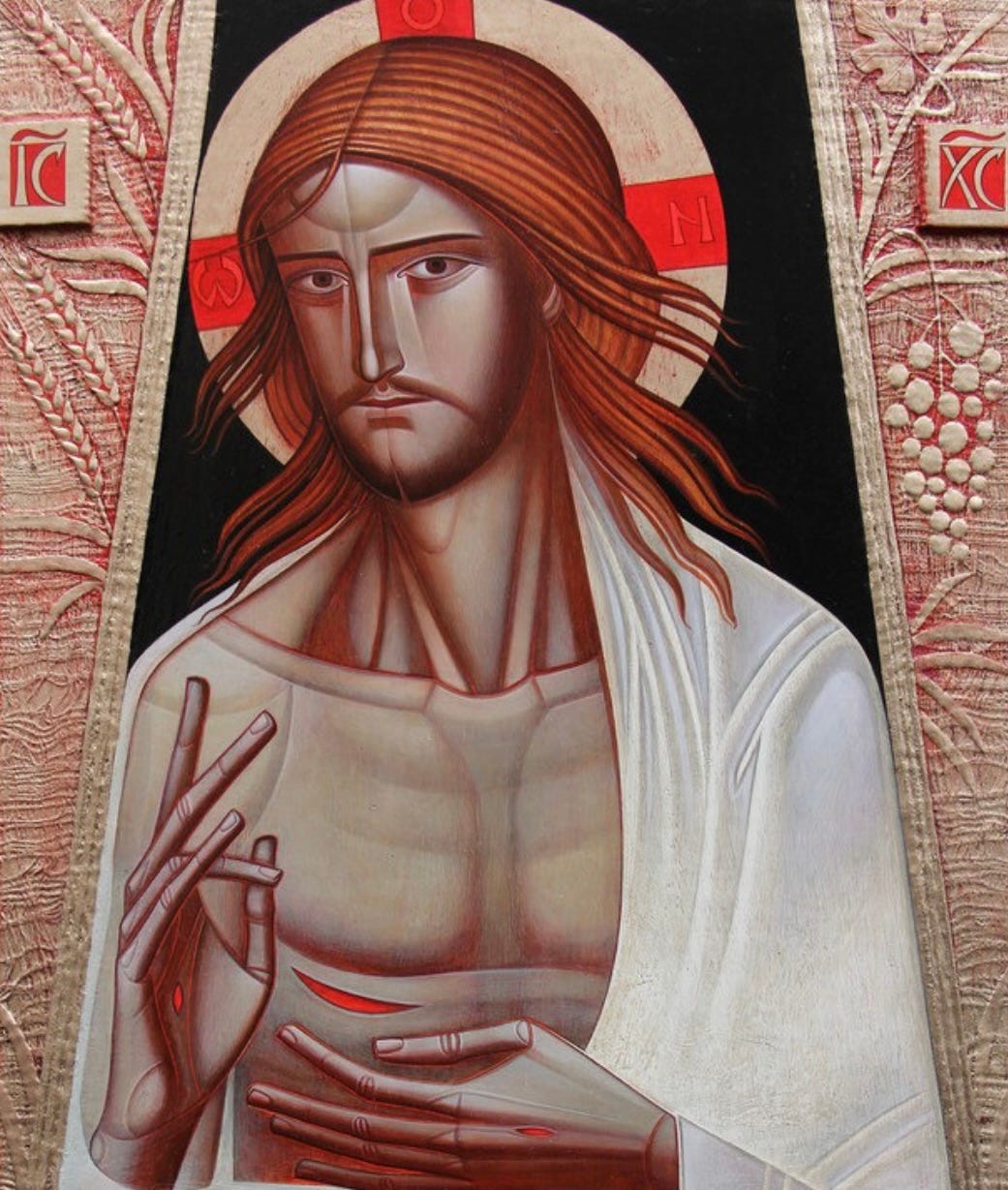
“Christ of the Eucharist” ~ Lyuba Yatskiv
Jesus is God. Nothing is more central to the Christian faith than this confession. Christianity orbits around the audacious claim that the Galilean Jew known to history as Jesus of Nazareth was and is uniquely and fully divine. We insist that no matter how incongruent it may seem, the carpenter of Nazareth is also the Creator of the Cosmos. In the most important of the ancient Christian creeds we confess that Jesus Christ is “God from God, Light from Light, true God from true God.” But I suspect that most Christians misunderstand why this is so important.
In confessing the divinity of Christ we do not mean that we already know what God is like—omnipotent, omniscient, omnipresent, omni-benevolent, all the theistic omnis put together—and Jesus is that. No. We do not know what God is like. We don’t begin with an abstract philosophical concept of God and then project it on Jesus. Instead we begin with Christ himself as the only way to know what God is truly like. In seeking to understand the transcendent Creator who dwells in unapproachable light, we cannot begin with “God” in abstraction or we will mostly end up with a divinized projection of our own aspirations, fears, values, and concepts of violent power. Which is to say we have fashioned an idol.
At the end of the poetic prologue to his Gospel, John the Evangelist makes this daring assertion: “No one has ever seen God. It is God the only Son, who is close to the Father’s heart, who has made him known.” (Jn 1:18) Think about what John has said. No one has ever seen God? We might protest. Didn’t Abraham see God under the oaks of Mamre? Didn’t Jacob see God at Bethel as the angels trafficked the ladder between heaven and earth? Didn’t Moses see God on Mount Sinai so that his face shone? Aren’t we told that Moses took the seventy elders of Israel up the mountain that they too might see God? Didn’t Isaiah see God in the Temple in the year King Uzziah died? Didn’t Ezekiel have visions of God by the river Chebar? Yes, the Bible tells all of these stories and more. And yet John is adamant—“No one has ever seen God.” Why? Because no matter what dreams, visions, revelations, epiphanies, theophanies, or Christophanies people have had in times past, compared to the revelation of God in Christ no one has ever seen God! Thus the reason Christians confess the full deity of Christ is so that at last we might know what God is like. God is like Jesus! Or in the language of the New Testament, Jesus is “the exact imprint of God’s very being.” (Heb 1:3) To see Jesus is once and for all to behold God and finally know what God is like. At the Last Supper Jesus told his disciples requesting to see the Father, “whoever has seen me has seen the Father.” (Jn 14:9)
I know of nothing more central to Christian theology and Christian spiritual formation than a sustained meditation on Jesus Christ as the Word of God. The incarnation is the boundless mystery that should eternally fascinate our theological imagination. All Christian theology begins with wonder—and the greatest wonder of all is the Eternal Logos assuming human flesh. Why does the Word of God enter the world through a human birth? “In order that the world might be saved through him.” (Jn 3:17) The world will not be saved by political movements or various activisms. This is the folly of the culture wars—or of all wars for that matter. The crucified and risen Word of God may, at times, inspire movements and activism, but we must not imagine that Christ is a mere accessory to our political or social agendas. Christ is not an addendum; Christ is the Alpha and Omega. All things have been created by and for Christ. He is the origin and telos of all creation. In pronouncing that all things are created by and for Christ, and that all things in heaven and on earth are reconciled in Christ, the Apostle Paul begins his lofty Christological hymn by first telling us that, “He is the image [icon] of the invisible God.” (Col 1:15) Jesus is the perfect icon of the invisible God. We are no longer guessing in abstraction concerning what God is like—we now gaze upon the icon who is Christ and move toward the beatific vision.
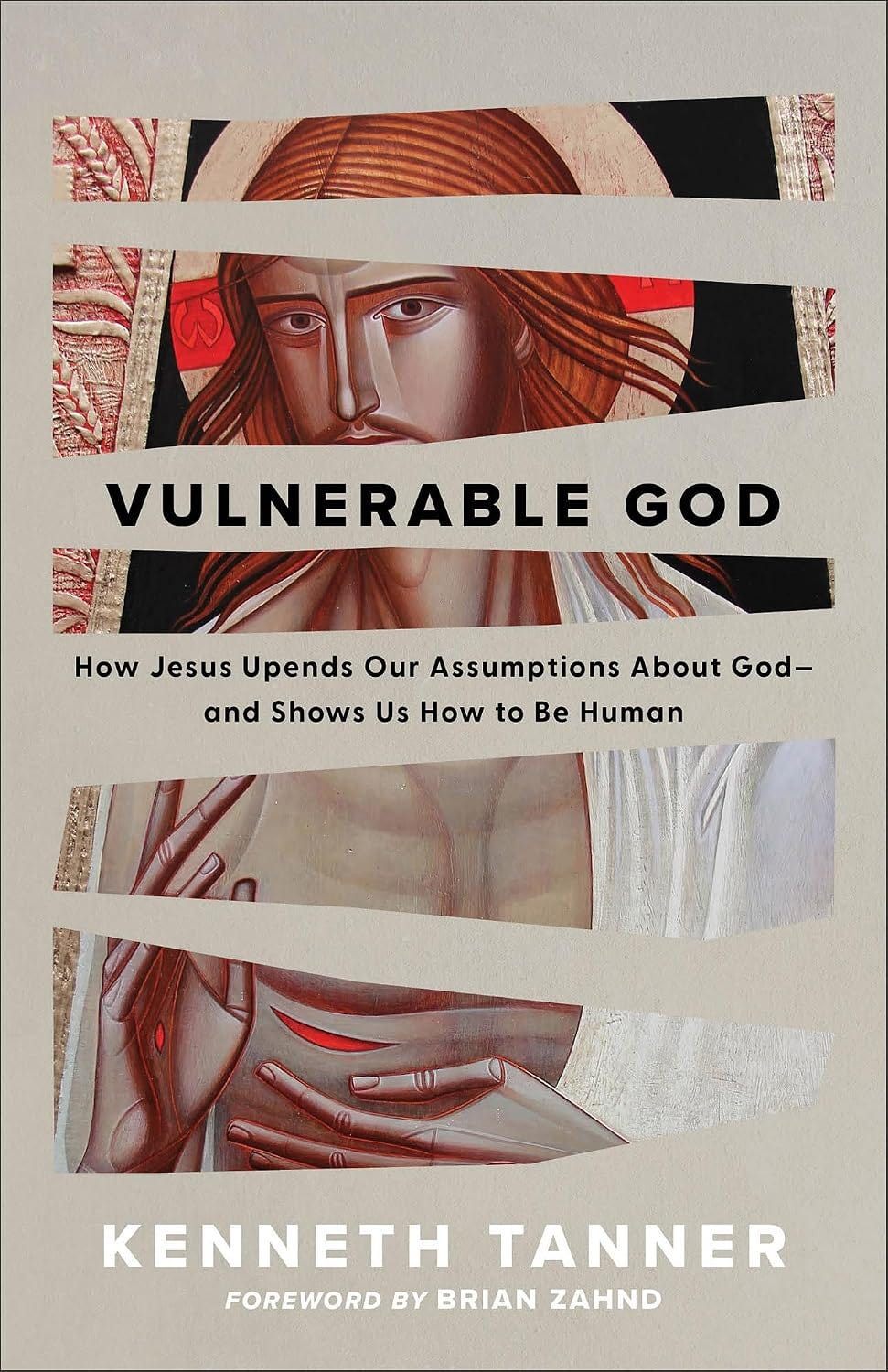
I know Kenneth Tanner, and I know he loves icons. You will find icons in his domestic and ecclesial habitats. He speaks frequently of icons and has given small replicas of the famous Sinai Pantocrator to many a soul. I am a grateful recipient of one of these gifts. And Kenneth Tanner is an iconographer himself. No, he doesn’t work with egg tempera and goldleaf on wooden panels, but he is an iconographer, nonetheless. Tanner is a pastor-theologian who works with the medium of words. In Vulnerable God we find a valuable and beautiful sustained meditation on Jesus Christ. This book does not read like a dry academic theological tome—it is far more like a poetic portrait. Thankfully, this book does not join the ranks of the ubiquitous catalogs of Christian pragmatism where we are told “how to” do this or that. This book simply invites us to gaze upon the face of Christ until the miracle of inner transformation begins to occur. Christ does the saving, all we have to do is look upon him. “Look to me and be saved.” (Is 45:22) This book is not angry—we have far too many of those. This book is gracious. It doesn’t strike as lightning, it falls as a gentle rain. Vulnerable God as a sustained meditation on the implications of the incarnation draws regularly upon ancient Christian theologians and pastors, but Tanner does it in such a way that Origen, Athanasius and others feel bracingly contemporary.
What I love most about this book is that every single page is about Jesus. Yes, every single page! This is why I describe Vulnerable God as an icon, and Kenneth Tanner as a theological iconographer. Page after page we are invited to look upon Christ—as a helpless infant, as a curious adolescent, as a young carpenter, as an itinerate healer, as a humble servant, as one crucified and buried, as one risen and ascended. Through this literary icon we are invited to look upon the vulnerable God who sustains the Cosmos with his word and fills all things everywhere with himself. Read this icon and behold the beauty of the Lord.
BZ
