Releasing Our False Self
Tuesday, August 25, 2026
Richard Rohr appreciates the purpose the false or egoic self serves, while encouraging us not over-identify with it.
Our false self is not our bad self, our inherently deceitful self, the self that God does not like or we should not like. Actually, our false self is quite good and necessary as far as it goes. It just does not go far enough, and it often poses and substitutes for the real thing. That is its only problem, and that is why we call it “false.” Various false selves (temporary costumes) are necessary to get us all started, but they show their limitations when they stay around too long. If a person keeps growing, their various false selves usually die in exposure to greater light.
Our false self, which we might also call our small or separate self, is our launching pad: our body image, our job, our education, our clothes, our money, our success, and so on. These are the functional trappings of ego that we all use to get us through an ordinary day. However, they are largely projections of our self-image and our attachment to it.
When we are able to move beyond our false self—as we are invited to do over the course of our lives—it will feel precisely as if we have lost nothing. While this “moving beyond” almost always entails some suffering, it ultimately feels like freedom and liberation. When we are connected to the Whole, it lessens our need to protect or defend the mere parts. We no longer need to compare and compete. We are now connected to something inexhaustible.
To not let go of our false self at the right time and in the right way is precisely what it means to be stuck, trapped, and addicted to our self. (The traditional word for that was sin, the result of being separate from the Whole.) Discovering the true self is not just a matter of chronological age. Some spiritually precocious young people see through the false self rather early, while some old men and old women are still dressing it up. If all we have at the end of our life is our separate or false self, there will not be much to eternalize. These costumes are transitory and impermanent, useful to us in our development, but also largely created by the mental ego. The false self is what changes, passes, and dies when we die. Only our true self lives forever.
Before we have encountered our true self, our false self is who we think we are. But our thinking does not make it true. The false self is primarily a social construct to get us started on life’s journey. It is a set of agreements made during childhood with our parents, family, neighbors, school friends, partner or spouse, and religion. Jesus might call it an “old wineskin,” which he points out cannot hold any new wine (Mark 2:22).
====================
The Song of Songs and Exegetical Mysticism
lecture one
| CHRIS EW GREEN. AUG 23 |
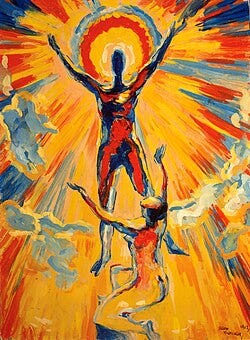
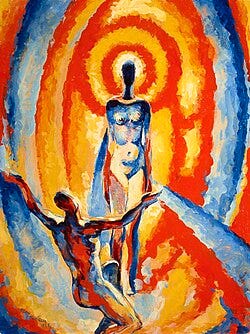
What, exactly, is the Song of Solomon doing in our Bibles? How are we to pray with it or preach or teach on it, given that God is never named, nothing even remotely religious is called for, and what the poems do describe is, well, disturbingly sexy?
One approach is simply to let it be what it is, accepting that God means to embarrass us. Rowan Williams has suggested that the one thing we must not do is “explain it away by allegory,” reducing the erotic to the merely symbolic.
The woman in the Song of Songs is neither a virgin, nor a mother, nor a prostitute, so she escapes all the usual stereotypes attached to her gender; she is allowed to express her desire in unambiguously erotic language, as indeed is the man. “Love one another fervently”—yes, certainly; but “with a pure heart”? Not so much. For this isn’t an allegory of desire: it’s the real thing. Passion fierce as the grave, love strong as death, raging flames…
It has become a familiar critique, the one Williams suggests. Ancient and medieval Jewish and Christian readers, the majority of them, at least, felt the need to spiritualize the poem because they were deeply ambivalent toward sex and sexuality. The Song itself, however, has no such qualms. It forces the reader to face the naked truth of desire. As human beings, we are, as C.S. Lewis famously put it, made for need-love as well as gift-love; so, we actually do need both to want and be wanted, both to get what we want and to give satisfaction to others. That, Williams, argues, is what the Song reveals. He ends the homily with a call to let ourselves be needy, to long for God and to love like God, passionately, unashamedly, refusing to be satisfied with anything less:
Love is not for the faint-hearted. That’s the charge laid against the church in Laodicea, in our second reading. They are too lukewarm, too dispassionate. There may be purity in their hearts, but there is no fervour. God’s love demands more. It is uncompromising, bringing with it “reproof and discipline” for those who do not give everything. But it is not self-indulgent. For God’s love treats us as absolutely real. God wants our fulfilment, our satisfaction and completion. God wants us to be who we are, who we are called to be; complete with our unruly bodies and our messy desires. Whether it is a person or a principle we want most, to love them—with a pure heart, fervently—is the most Godlike thing we could ever do.
Williams is not wrong. Too many readers have been scandalized by the Song’s eroticism, and repelled by the naughtiness/knottiness of human sexuality. But I would contend that that discomfort is more modern than it is ancient. It was a Protestant theologian, after all, who so famously set erosand agape into total contrast.
I agree too that the Song is not an allegory. The text does not speak of one thing meaning another. Indeed, it is because it is not an allegory that the Song is ripe for a particular kind of allegorical interpretation. As Williams makes clear in the closing words of his homily, it precisely because the Song is about these lovers and their love that it reveals what is true of God’s love affair with us. The letter of the Song does not hide the spirit we are meant to receive but is wholly inspired by it, the flesh of the letter quickened, flushed with desire, luminous in longing.
Origen and Gregory and the other great allegorists knew this. They read the Song as the celebration of the marriage of the divine and the human, agape and eros, gift and need. So, whatever the errors and excesses of their methods ,and notwithstanding their sometimes quite serious misunderstandings and anxieties about sexuality and embodiment, they still come nearer than we do to the sacred heart of the Song. For they come to the text knowing that all things are what they are only in Christ, in his divine-human heart. They come knowing that that because of him all things are related to all other things, held in at-one-ment. They come knowing that that must be so, because the Father has created all things simply by the giving of the Son to Mary and her family, her people, her friends. The Father speaks no Word other than the Son, and in speaking him calls every creature into being. In the words fo the master preacher: “the Father always speaks the Son in unity and pours forth all creatures in him.”¹
All things have come into being in him, the uncreated Word, eternally begotten before all ages with and in the same Spirit who overshadows his mother in the fulness of time. Because of him, because of how he is who he is, nothing exists by or for itself, self-grounded and self-fulfilled, but exists instead for him and with him. Therefore, everything—truly, everything—is capable of bearing and revealing everything else. As Nicholas of Cusa says, going beyond even Anaxagoras: “all is in all and each in each” because “God is the actuality of all things” (On Learned Ignorance 2.5.117-118). This is why in the Song the garden is a body and the body a garden, the man a cedar and the mountain into which the cedars reach their roots, a king and a pillar of smoke, and the woman a grande city, an army arrayed with banners, her eyes doves, her neck a balustrade, their kisses, goblets of wine.
Perhaps tautegory, then, is what we should say the Song is, not allegory. Or even better: it is all-egory. The lovers in the Song do not represent a bride and bridegroom; they are the Bride and Bridegroom. And precisely in their wanting and finding, their trysts and romances, we know and are known.
Franz Rosenzweig, in a lengthy meditation on the Song in The Star of Redemption, speaks for the traditional reading, the tried-and-true appreoach that led to the canonization of the text in the first place:
The allegory of love, as allegory, goes through the whole Revelation. It is the allegory that keeps coming up in the Prophets. But it is supposed to be more than an allegory. And it is so only when it appears without a “this means,” without any reference to that for which it is supposed to be the allegory. So it is not enough that the relationship of God to man is presented in the allegory of the lover and the beloved; God’s word must immediately hold the relationship of the lover to the beloved, without the signifier making any allusion at all to the signified. And so we find it in the Song of Songs. It is no longer possible to see in that allegory “only an allegory.” The reader seems to be confronted here with the choice either of allowing the “purely human,” purely sensuous meaning, and then of asking himself by what surprising error these pages managed to get into the word of God, or of recognizing that here, precisely in the purely sensuous meaning, the deeper significance is hidden, immediately and not “only” in the allegorical form.²
Modern biblical criticism called into question what the synagogue and the church had always known, inventing a rift between the “original” fully human love poems and the supposedly later mystical interpretations of it. This hermeneutics of disjunction (it is not enough to speak of it as suspicious) sundered what God had joined together, as Rosenzweig explains:
Until the beginning of the nineteenth century, the Song of Songs was recognized as a love song, and at the same time immediately as a “mystical” poem. One simply knew that the I and You of inter-human language are also quite simply the I and You between God and man. One knew that in language the difference between “immanence” and “transcendence” is extinguished. It is not although but because the Song of Songs was an “authentic,” that is to say a “worldly” love song, that it was an authentic “spiritual” love song of God’s love for man. Man loves because, and as, God loves. Man’s human soul is the soul awakened and loved by God.³
Like Wittgenstein a decade or so later in his response to Frazer’s Golden Bough, Rosenzweig recognized biblical criticism’s main failing as its refusal to be honestly critical of its own aims and methods. Through the “hopelessly arbitrary and venturesome character of textual criticism,” the “I and You of the lyric” is reduced into the “He and She of the epic,” a reduction that is done, quite intentionally, to generate distance from the holy.
The language of the Revelation of the soul had something disquieting in it for the spirit of that century, which modeled all according to its image in order to make it something objective and worldly. At first, the denial of the word of God had still taken place in an exuberant joy for the word of man, now qualified by “pure,” but it lost no time in taking revenge on the word of man, which, detached from its immediate, living, trustful union with the word of God, hardened into the dead objectivity of the third person.⁴
We should have listened to Rosenzweig. But we did not. Too many of us, including “conservatives,” invented or adopted methods and (more importantly) attitudes that could not help but distort the truth we were supposedly seeking. Like a restorer using the wrong solvent, we damaged and deface—and at times erased altogether—the very image we sought to renew. “The dead objectivity of the third person”—that is the dead giveaway, the ugly smear left by the hermeneutics of disjunction and its pseudo-scientific “findings.”
The traditional ways of reading knew that the reading of Scripture is always an I-Thou exchange—communion, intercourse—not an I-It enterprise. For Origen and the other allegorists who follow him as he follows Hebrews, following Paul, following Jesus, spiritual exegesis, far from turning away from reality, is instead always about “encountering the Logos who speaks in the text.”⁵ They could expect such an encounter because they believed that the “opening of the Scriptures” was a mystical reality, as indeed all realities are, and not some “subjective” experience happening only in the heart and mind of the individual via some reader-response meaning-making process. It is not as if in reading the text and finding some meaning in it we have met the Lord. No, the Word speaks in the words so that the Scriptures are fulfilled in our hearing. Gregory, in one of his homilies on the opening chapter of the Song, says plainly that “the words of the present passage are a participation in divinity itself…”⁶ Think of what that must mean.
Ben Myers has identified this approach to reading Scripture as “exegetical mysticism,” a way of knowing and being that refuses to separate being from knowing, a form of attention ordered toward first-person intimacy not third-person mastery. Christ is no idea to be grasped, the canonical texts not artifacts of a now-dead history, teaching never a matter of analyzing and applying information. The Word is the Word, and we have been captured by the sight and sound of him, as the Shulamite is captured by the sight and sound of her beloved. What we call “interpretation,” then, is nothing less than lived communion with him, born of hearing what was once said about him as what he is saying now, speaking for himself to us in the words of his friends.
Laboring over a difficult passage, the reader suddenly catches a glimpse of the divine Logos and “perceives him to be present” in the text. As Christ “draws near to [the] senses” he “illuminates the things that are obscure,” so that the soul sees him clearly. He “leaps” over the text toward the expectant soul… In the disciplined contemplative reading of scripture, “the hand of the interior soul” reaches out and touches the living Word.⁷
This, then, is the crux of the matter, the determining factor in our approach to the Song: the human body cannot not speak of God and our ache to be in secret with God, especially in the acts and angst of love, because the God who created the body reveals himself as love by what is done to his body. Now, thanks to the Spirit, what is true of his body is true of all bodies, including yours and mine, and true of the body of these sacred texts. For, when all is said and done, we are ourselves and they are themselves just because we are all his—no, more than that: because we are him, bone of his bone and flesh of his flesh.
