The Glory of God in Us
Thursday, August 27, 2026
Father Richard first encountered the concept of the true self and false self from the Trappist monk Thomas Merton (1915–1968), who had a mystical experience on the corners of Fourth and Walnut (now Fourth and Muhammed Ali Boulevard) in Louisville, Kentucky. Merton wrote:
At the center of our being is a point of nothingness which is untouched by sin and by illusion, a point of pure truth, a point or spark which belongs entirely to God, which is never at our disposal, from which God disposes of our lives, which is inaccessible to the fantasies of our own mind or the brutalities of our own will. This little point of nothingness and of absolute poverty is the pure glory of God in us. It is so to speak [God’s] name written in us, as our poverty, as our indigence, as our dependence, as our [birthright]. It is like a pure diamond, blazing with the invisible light of heaven. It is in everybody, and if we could see it we would see these billions of points of light coming together in the face and blaze of a sun that would make all the darkness and cruelty of life vanish completely…. I have no program for this seeing. It is only given. But the gate of heaven is everywhere. [1]
Father Richard reflects:
Most people spend their entire lives living up to the mental self-images of who they think they are, instead of living in the primal “I” that is already good in God’s eyes. But all we can “pay back” to God or others or ourselves is who we really are. This is what Merton is describing above. It’s a place of utter simplicity. Perhaps we don’t want to go there because it is too simple and almost too natural. It feels utterly unadorned. There’s nothing to congratulate myself for. I can’t prove any worth, much less superiority. There I am naked and poor. After years of posturing and projecting, it will at first feel like nothing.
But when we are nothing, we are in a fine position to receive everything from God. As Merton says, our point of nothingness is “the pure glory of God in us.” If we look at the great religious traditions, we see they all use similar words to point in the same direction. The Franciscan word is “poverty.” The Carmelite word is nada or “nothingness.” The Buddhists speak of “emptiness.” Jesus speaks of being “poor in spirit” in his very first beatitude (Matthew 5:3).
A Zen master would call the true self “the face we had before we were born.” Paul would call it who we are “in Christ, hidden in God” (Colossians 3:3). It is who we are before we’ve done anything right or anything wrong, before we even have a conscious thought about who we are. Thinking creates the separate self, the ego self, the insecure self. The God-given contemplative mind, on the other hand, recognizes the God self, the Christ self, the true self of abundance and deep inner security.
References:
[1] Thomas Merton, Conjectures of a Guilty Bystander (Doubleday & Company, 1965, 1966), 142.
Adapted from Richard Rohr, Everything Belongs: The Gift of Contemplative Prayer (Crossroad Publishing, 2003), 76‒78.
Image Credit and inspiration: Mick Haupt, untitled (detail), 2022, photograph. Unsplash. Click here to enlarge image. A shattered mirror reveals the light within each broken piece. Letting go of the false self is not a loss, but a breaking through that allows more light in.
=============================================================================
Unseen Existences – Brian Zahnd
A Brief Q&A
NOV 06, 2025
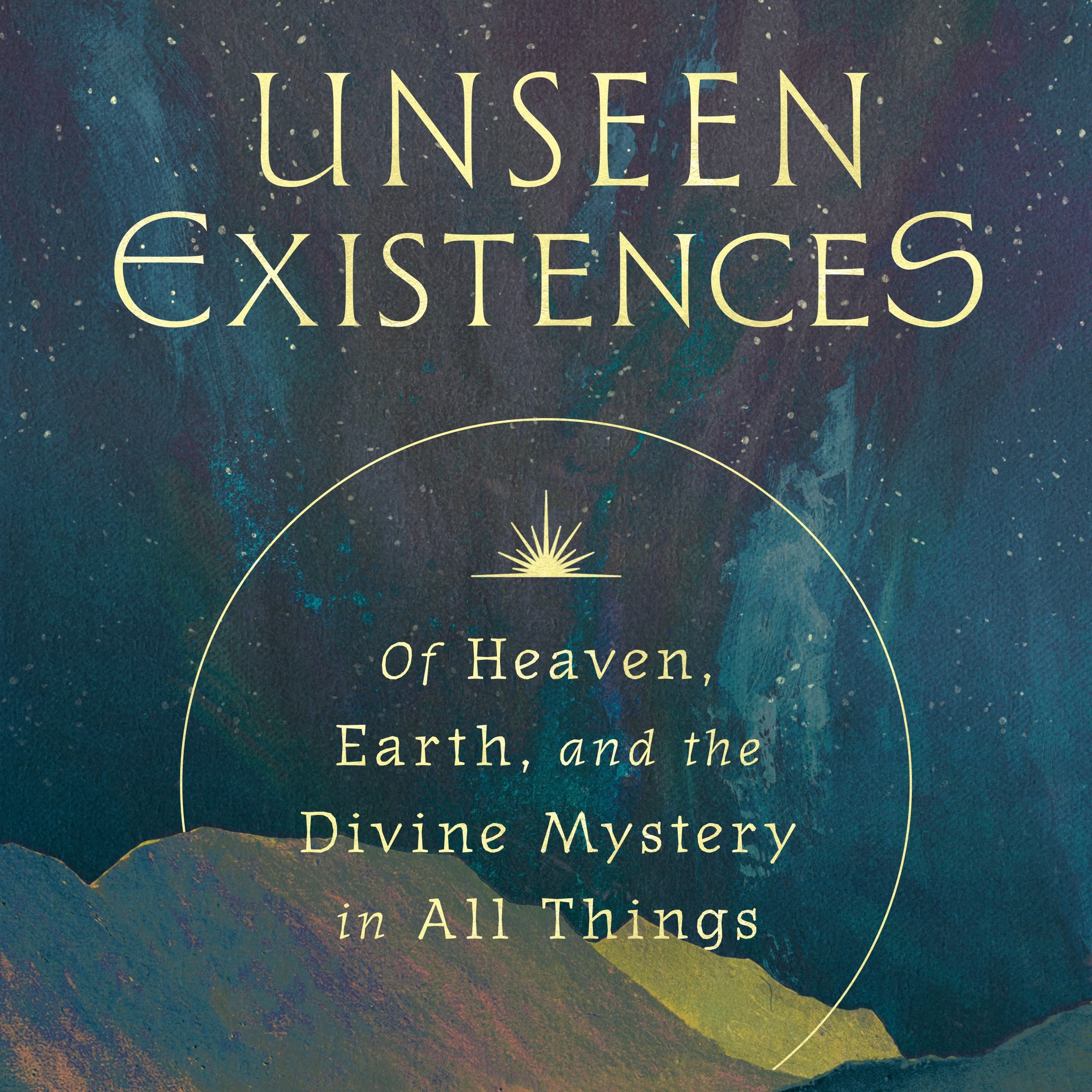
Q. What prompted you to write Unseen Existences? Was there a particular moment or experience that made you realize the need for this book?
I began to notice that with a desire for a “this world” faith (a desire with which I fully concur) many theological circles had overcorrected to the point that heaven had gone missing from any serious consideration. But without heaven as the spiritual world of unseen existences Christian theology is rendered incoherent. Without metaphysics Christianity is reduced to mere ethics. Or to put it more severely, Christianity without transcendence degenerates into politics. We need to recover heaven—not the escapism of The Late Great Planet Earth and its successors; not the sensationalism of “my thirty minutes in heaven;” not the sentimentalism of kitschy social media memes—but heaven as the awareness of the spiritual world enfolded into the material world all around us. This was my motivation for writing Unseen Existences.
Q. Many people today struggle with belief in anything beyond the material. How would you invite skeptics or disenchanted Christians to rediscover the “unseen”?
To quote Nick Cave, “We must take our subtle spiritual intuitions seriously and view them as the quintessence that underlies the ordinary world. The rejection of the sacred is the fundamental reason for our existential discontent.” Our modern existential discontent will not be healed unless we remember what our ancestors knew: A spiritual world underlies what we think of as the ordinary world. Furthermore, philosophical materialism has the embarrassing problem of being unable to account for matter itself! With just a modicum of thought most people recognize that meaning must be derived from something that transcends the material world. If all there is is matter, not much really matters. I want to encourage people to lean into what they already intuit in the deepest part of their being. In a world where existential discontent is a genuine phenomenon I want to offer something constructive. Not a trite solution but a gesture in the direction of where I believe hope can be found. What is needed is a pilgrimage—a pilgrimage of the soul toward the homeland where we’ve never been. If our pilgrimage is true, it is a journey inspired by wonder, waymarked by beauty, and ultimately a quest for a forgotten realm called heaven.
Q. How do you see this book fitting into your broader body of work?
In many ways Unseen Existences is the natural successor to When Everything’s on Fire.
Q. If readers only take away one thing from Unseen Existences, what do you hope that one thing is?
I’m going to be ambitious and hope that readers can take away two things from Unseen Existences: Our true home is in the unseen world of heaven, and life is a pilgrimage of the soul toward our true home of union with God.
BZ
