https://www.youtube.com/watch?v=HS5SdnrqZvs&list=RDHS5SdnrqZvs&start_radio=1

Full of Suffering, Full of Love
Thursday, September 3, 2026
Father Richard considers the cross as the center of Jesus’s life—fully human, fully divine—and expressing total solidarity with the pain of the world:
The Divine Mind transforms all human suffering by identifying completely with the human predicament and standing in full solidarity with it from beginning to end. This is the real meaning of the crucifixion. The cross is not just a singular event. It’s a statement from God that reality has a cruciform pattern. Jesus was killed in a collision of conflicting interests and half-truths, caught between the demands of an empire and the religious establishment of his day. The cross was the price Jesus paid for living in a “mixed” world, which is both human and divine, simultaneously broken and utterly whole.
In so doing, Jesus demonstrated that Reality is not meaningless and absurd, even if it isn’t always perfectly logical or consistent. Reality is filled with contradictions, what St. Bonaventure and others (such as Alan of Lille and Nicholas of Cusa) called the “coincidence of opposites.”
Jesus the Christ, in his crucifixion and resurrection, “recapitulated all things in himself, everything in heaven and everything on earth” (Ephesians 1:10). This one verse is the summary of Franciscan Christology. Jesus agreed to carry the mystery of universal suffering. He allowed it to change him (resurrection) and—it is to be hoped—us, too. Christ frees us from the endless cycle of projecting our pain elsewhere or remaining trapped inside of it.
This is the fully resurrected life, the only way to be happy, free, loving, and therefore “saved.” In effect, Jesus was saying, “If I can trust it, you can too.” We are indeed saved by the cross—more than we realize. The people who hold the contradictions and resolve them in themselves are the saviors of the world. They are the only real agents of transformation, reconciliation, and newness. Christians are called to be the visible compassion of God on earth.
These “saviors,” who are inevitably also disciples, exist in every period of time and in every faith tradition. At times they exist even with no “faith” at all, beyond a consciously held belief that solidarity with all of life is, in fact, the meaning of life. For whatever reason, such people agree to share the fate of God for the life of the world now. These people feel called and agree to not hide from the shadow side of things or the rejected group, but in fact draw close to the pain of the world and allow it to radically change their perspective. They agree to embrace the imperfection and even the injustices of our world, allowing these situations to change them from the inside out, which is the only way things are changed anyway.
The gospel is simply the wisdom of those who agree to carry their part of the infinite suffering of God. It must be recognized that many non-Christians fully accept this vocation with greater freedom than many Christians.
Reference:
Adapted from Richard Rohr, The Universal Christ: How a Forgotten Reality Can Change Everything We See, Hope for, and Believe (Convergent Books, 2021), 147–148.
Image credit and inspiration: Jenna Keiper, CAC Environment, 2019-10-09, Photograph, CAC campus, Albuquerque NM. What does it look like to lay down burdens and die to ourselves while still on the path to becoming?
=============================================================================
“Living Presence”
Ancient Wisdom for Modern Anxiety
AUG 01, 2026
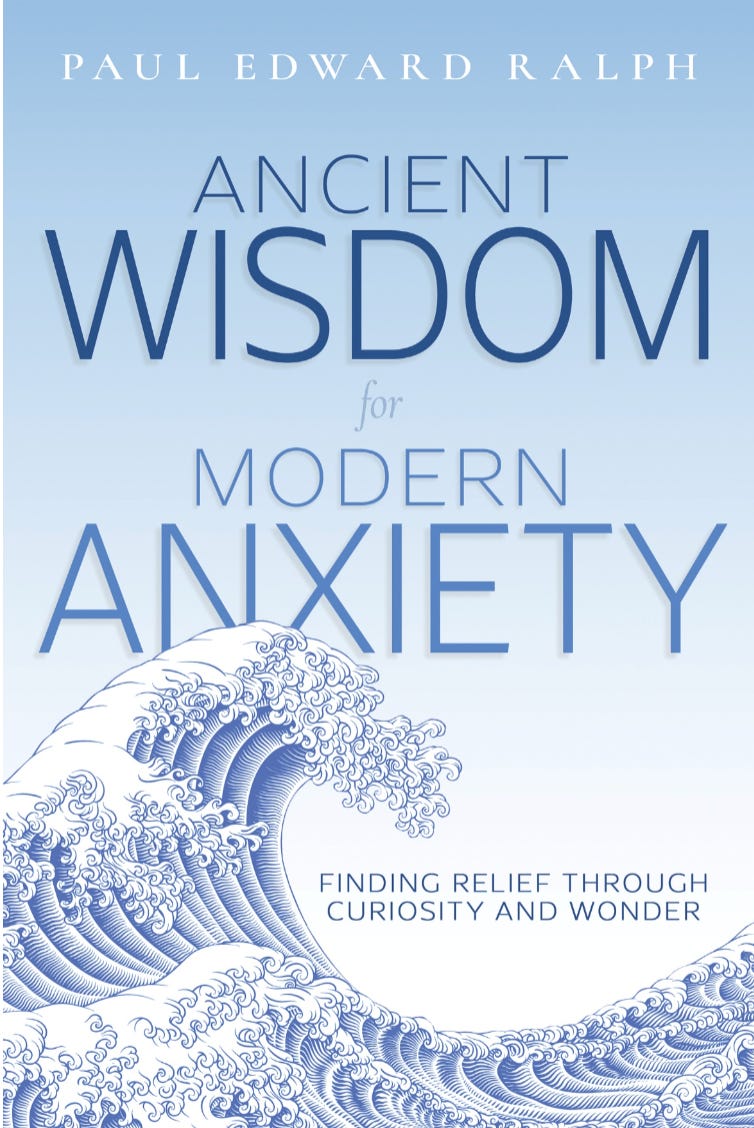
In his profoundly helpful forthcoming book, Ancient Wisdom for Modern Anxiety: Finding Relief through Curiosity and Wonder (Whitaker House, 2027 – preorders available now), Paul E. Ralph (hereafter PER or Paul) uses the personified language of “Living Presence” as a divine name or title. I like that for reasons I’ll mention below.
Paul isn’t the first to use the phrase—a few earlier examples are notable:
J.A. Motyer (OT scholar and former Principal of Trinity College, Bristol) once wrote,
Over and over again in the Old Testament you come across the familiar phrase, “The word of the LORD came to …” Now in Hebrew that is: ‘The word of the LORD was to …’ The verb used is the verb ‘to be’, not a verb of motion but a verb of realistic experience. ‘The word of God became a living reality to …’ The verb ‘to be’ in Hebrew means living reality, living presence, not just some bare abstract idea of existence as compared with non-existence. When God focusses attention upon this divine name, ‘I am Yahweh’, he is saying, ‘I am the God of living presence with my people…’
J.A. Motyer, “The Normative Covenant,” Evangel (April, 1983), 4.
A decade later, Kabir Edmund Helminski wrote a book that draws on the wisdom of Sufism to address contemporary life. He titled it Living Presence: A Sufi Way to Mindfulness & the Essential Self (Tarcher, 1992).
Rounding out the Abrahamic religions, PER cites Nahum Ward-Lev’s book on the Hebrew prophets as one of his sources to using the phrase as a proper name:
Seeking an alternative to “the Lord,” I have chosen to translate God’s Name as “the Living Presence.” … The four letters of God’s Name seem to refer to “being” itself, to “Being” or “Being-ness” that transcends time. My use of “the Living Presence” is also guided by God’s interaction with Moses at the burning bush. When Moses asks for God’s Name, God replies, “I will be what I will be” (Exodus 3:14). With this response, God both informs Moses that God’s nature cannot be defined by any limiting quality, such as a name, and God assures Moses that God will be with him throughout time. Looking for a term that reflects this sense of “Being” or “Being-ness” accompanying human beings and creation throughout time, I chose the term “the Living Presence.”
Nahum Ward-Lev. The Liberating Path of the Hebrew Prophets Then and Now (Orbis Books, 2019).
All of these uses of “living presence” are descriptions or translations, but in Paul’s book and in our prayers together, he often uses that term as a proper name:
“Living Presence, help me stay curious.”
I find this especially helpful on several fronts. To begin with, it is inclusive. Paul’s intentional use of the phrase welcomes all. It allows space for those who are suspicious of terms like “God”—a placeholder both too vague and too narrow to those who don’t identify with a faith tradition.
Unlike “Ground of Being,” “Ultimate Reality,” or “Sacred Presence,” Living Presence is deeply biblical in resonance (“the living God,” but so far, unburdened by centuries of doctrinal or philosophical baggage.
For me personally, as I work in interfaith spaces, terms like “universe” or “the divine” seem too impersonal. I have no objection to those who use them (as I do if it helps them), but “Living Presence” includes the immanence (radical nearness) and intimacy that pairs well with our experiences of infinite Love.
In that sense, Living Presence is a descriptor vast enough for anyone whose concept of a “higher power” is also open to the Mystery of Something or Someone that is at least as relational, responsive, and caring as the mother archetype.
Further, even religious notions of “God” can become a non-experience of “dead absence.” “Living Presence” acknowledges an immersion (“in whom we live and move and have our being”) and an indwelling (infinite Love encountered within us). Yet even the agnostic is welcome to experience and experiment with the transforming aspects of a more impersonal living presence apart from the imaginary “old man in the sky” imagery of God. Paul’s meditations on the Living Presence require no prior faith commitment—all he asks for is openness to be met and held in our anxiety.
I love Paul and I love this book. Well worth the pre-order while you remember.
