
Changing the Paradigm of Power-Over
Thursday, September 17, 2026
Be kind to one another, tenderhearted, forgiving one another, as God in Christ has forgiven you.
—Ephesians 4:32
The theologian Kat Armas describes how Paul’s belief in Christ’s presence in each person upended cultural hierarchies that strictly defined power and authority:
When we encounter the household codes in the New Testament, we see a [patriarchal] framework that’s already deeply embedded in the culture. Those writing and receiving these letters [from Paul] were grappling with how followers of Jesus should engage with and respond to this cultural structure.
Take Ephesians 5, which says that wives must submit to their husbands [5:22]. But just before that, it says that all believers, men and women, are to submit to one another out of reverence for Christ [5:21]. Mutual submission was a radical shift from the Roman household codes that demanded strict hierarchy, with only one—the father—having ultimate authority. Ephesians 5 disrupts this by speaking to every member of the household. Instead of granting authority to one man who speaks and acts for his household, the Christian household codes grant each member agency and “the right to hear and act for themselves.” [1]
[Paul] was a complicated figure, toggling between supporting empire and resisting it. He wasn’t fully aligned with the imperial structures, but he also wasn’t entirely outside them. His writings reveal both a longing for liberation and dutiful adherence to the constraints of his world. To engage Paul’s work with honesty and care is to resist the urge to reduce him to either a revolutionary or a mere enforcer of empire, recognizing instead a man shaped by both revelation and limitation.
Paul’s teachings about the role of women in the early churches reflect this tension:
In 1 Corinthians 7:4, Paul writes that a husband’s body belongs to his wife, a shocking statement for his time. In a world where a husband had nearly unchecked control over his wife’s body, Paul is saying no, this power is shared. This reveals the egalitarian nature of the kingdom of God, where authority is redefined. And yet, in 1 Corinthians 11:5–10, it seems Paul is upholding gendered practices by instructing women to cover their heads while praying, grounding his reasoning in creation order.
Perhaps the most powerful challenge to the imperial order comes in Galatians 3:28, where Paul declares that in Christ there is no male or female, no slave or free—a radical vision that upends the social hierarchies of his time. If the household is a microcosm of the state, what kind of world might take shape if families lived as if this were true? It would be something unrecognizable to Rome, something that threatened the very foundations of its rule….
[Paul’s] teachings suggest a kind of shared power within the family—a power-with not a power-over.
Power-with is mutual. It requires listening, respecting, and honoring the dignity of each person, no matter their age or status…. Power-with creates a culture of empathy and co-operation, not domination through fear or force.
References:
[1] Beth Allison Barr, The Making of Biblical Womanhood: How Subjugation of Women Became Gospel Truth (Brazos Press, 2021), 34.
Kat Armas, Liturgies for Resisting Empire: Seeking Community, Belonging, and Peace in a Dehumanizing World (Brazos Press, 2025), 75–76, 77. Watch Kat Armas in the Daily Meditations author interview.
Image credit and inspiration: Chris Chow, untitled (detail), 2020, photo, Roscoe Village, Coshocton, OH. Click here to enlarge image. Like threads pulled taut on a loom, we weave a bigger story only when we’re willing to let go of the pattern we thought we knew.
=============================================================================
Our Final Authority: The Bible or Jesus?
| BRADLEY JERSAKSEP 16 |
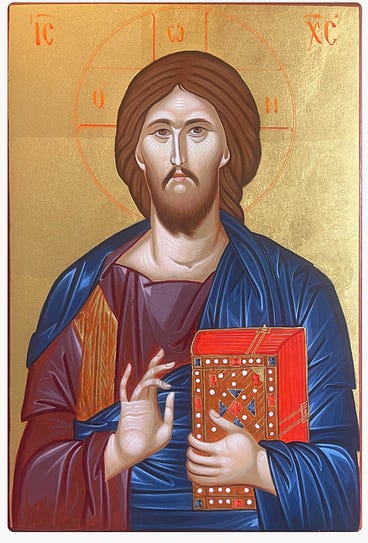
Our final authority
It was one of my classic last-minute cancellations. A church whose pastor and elders had invited me to speak on prayer found themselves awkwardly withdrawing their invitation. The pastor had moved on and the interim minister had done some digging. He was offended that my church had nothing in our statement(s) of faith about the Bible. That was because our doctrinal statements were the Nicene Creed and the Apostles’ Creed. I told him that I was not comfortable with creating statements of faith or redacting the great creeds. In the end, what he explicitly demanded was this confession, similar to many confessions across modern Evangelicalism:
“We believe that the Bible is the inspired Word of God,
infallible and inerrant in all it affirms
and our final authority for faith and practice.”
My inability to make that confession was the deal-killer … and just as well, I suppose. But so unnecessary.
Our final authority… there’s the rub. Debates and definitions of inspiration aside, what I found myself balking at was sola scripture … i.e. the “final authority” of Scripture alone. The Bible itself makes no such claim and in fact, within its pages, we see quite contrary claims. I’ll dispense with my long-form arguments for now.
In the end, my confession is that:
Jesus Christ alone is my final authority,
whose will is discerned through the interdependent witness
of the Body of Christ, the testimony of the Scriptures
and the illumination of the Holy Spirit.
At some point in my journey, final authority was transferred from the Bible to the Christ in my faith and practice, my theology and my ethics (though I still struggle daily to surrender to Jesus’ authority).
Toppling dominos
What I didn’t expect was how that shift would inevitably and dramatically topple other dominos. When your faith is led by who Jesus is rather than what the Bible says, you’re in for a wild ride. Lest my dear Baptist mother becomes worried, I’m not advocating for the careening bumper cars of “anything goes” post-Christian faithlessness. Note that my “Christ alone” proposal doesn’t ditch the Bible. It merely subordinates the Scriptures to the eternal Word-made-flesh and then welcomes both the Spirit of God and people of God to explore how the Bible points to Christ.
What theological shifts follow when Jesus is our final authority?
The WHY may come first. When Christ is our final authority, we must interpret the character of God through the Incarnation. When Christ is our final authority, we must read the human words of Scripture through the divine revelation of Christ’s life. When Christ is our final authority, Scripture passages can no longer be read in isolation to describe God’s nature or works in ways that don’t align with the nature and works of Christ or his unique and infallible unveiling of Abba. As long I took the Bible as my final authority, I could and did make that error all the time. Having stepped back, I still see it regularly and probably continue to stumble on it more than I imagine.
All of the above leads me to think about what changed following my shift to Christ as the Alpha and Omega of revelation. Among these were my convictions about God’s nature, atonement theology and Sermon on the Mount living (including active nonviolence).
From the Bible to Jesus, from eternal hell to eternal life
But there’s one specific example I’m observing a lot as the decade winds up. I won’t posit this observation in absolute terms but … is it just me or does the shift from Scripture alone (biblicism) to Jesus alone also inevitably lead from “I believe in eternal conscious torment because the Bible says______” to “I believe in ultimate redemption because Jesus is_____”?
Isn’t the notion of eternal conscious torment utterly dependent on a particular set of Scriptures, isolated from the grand narrative and interpreted apart from the Christ-revealed character and intentions of God as ultimate Good and perfect Love? And isn’t the hope of ultimate redemption the inevitable telos of the (biblical) saga of the Christ, by whom, through whom and for whom all things were created, whose every enemy will be vanquished and whose kingdom shall reign without limits? Thus, with Christ as our supreme authority, our final end and our ultimate destiny, this beautiful hymn of ultimate redemption makes perfect sense (from Colossians 1)?
15 The Son is the image of the invisible God, the firstborn over all creation.16 For in him allthings were created: things in heaven and on earth, visible and invisible, whether thrones or powers or rulers or authorities; allthings have been created through him and for him.17 He is before all things, and in him all things hold together.18 And he is the head of the body, the church; he is the beginning and the firstborn from among the dead, so that in everything he might have the supremacy.19 For God was pleased to have all his fullness dwell in him,20 and through him to reconcile to himself all things, whether things on earth or things in heaven, by making peace through his blood, shed on the cross. [my emphasis on all]
When Christ is recognized as our final authority, as the One who will deliver his kingdom over to the Father of all-in-all (1 Cor. 15), then the whole of Scripture will find its rightful place in humble service of its King and his kingdom. Hopefully, its interpreters will do likewise.
