Tuesday, September 22, 2026
The Palestinian Quaker Jean Zaru bears witness to her commitment to nonviolent resistance:
I call myself a Quaker or a Friend. And Friends, throughout history, have maintained a testimony to nonviolence. War, we say, is contrary to the teachings of Christ. Therefore, we are challenged to live in the presence of that power which wins through love rather than through war. This is no easy testimony. It has three aspects:
- To refuse to take part in acts of war ourselves.
- To strive to remove the causes of war.
- To use the way of love open to us to promote peace and to heal wounds.
As Quakers we believe that there is something of God in every person. Why, then, is it so hard for us to see what is of God in one another? Both sides in any conflict often have difficulty seeing the other at all, let alone seeing that of God in the other.…
Living under military occupation has forced me to go through deep self-searching. I have been confronted with three loyalties. The first loyalty is to Christ, who calls us to love our enemy. The second loyalty is to our fellow human beings wherever they are in need or trouble. The third loyalty is to our country, its people, and its way of life…. No one can set rules for us to follow, but what we can do is testify that, in our experience, the spirit of God leads us into truth and gives us the guidance and courage we need in every situation….
It requires great self-denial and the surrendering of our selves to God to be committed to peace and to nonviolent action to bring about change. This technique may have no immediate positive effect, and it may lead to outward defeat. Whether successful or not, it will bring suffering. But if we believe in nonviolence as the true way of peace and love, we must make it a principle not only of the individual but also of national and universal conduct.
Zaru writes of the ongoing commitment necessary to live out nonviolent struggle for justice:
I believe that we are called to conversion: to be converted to the struggle of women and men everywhere who have no way to escape the unending fatigue of their labor and the daily denial of their human rights and human worth. We must be converted, so to speak, to a new vision of human dignity, what we call “that of God” in each person, even in those we oppose….
Ultimately, I have learned that the nonviolent struggle for justice is one struggle, and that action to subvert violence and strengthen human rights in one place is an action on behalf of all people everywhere.
I have managed to find peace within—without having to embrace with approval the violence around me. Love of one’s enemies forces me to recognize that my enemy, too, is a child of God. This realization is necessary if our enemies are ever to make the changes we are requiring of them. It is really only in the light of love that I am liberated to work for peace and freedom.
================
From A Beautiful Year. Diana Butler Bass
(Referring to Matthew 20:1-16 The parable of the Generous Landowner)
Are you envious because I am generous?
Those words fly like arrows from the page to my heart. Of the seven deadly sins — pride, envy, anger, sloth, greed, gluttony, and lust — envy is my secret and, admittedly, most shameful companion. Writers are prone to it, constantly weighing ourselves and our work against others, nursing wordy dissatisfaction in our souls.
I wish that weren’t true — it is hard to confess. But, having lived more than a few decades now, I know myself pretty well.
Envy is not jealousy. Jealousy is a kind of protective impulse. One is jealous if a lover seems inappropriately attentive to another. You might be jealous to guard your reputation against attack or jealous in defense of familial honor.
Envy is resentment, a passionate spite that can become cancerous hostility. Joseph Epstein, in a brilliant little book, called envy “a self-poisoning of the mind, envy is usually less about what one lacks than about what other people have.” Envy grows from rivalry — when we are unable to see our own gifts without comparing them to the gifts of others. Capitalism thrives on envy. Envy drives marketing and advertising, is the emotional engine of influencer culture, and elevates some humans to god-like celebrity so that other, lesser beings might, eventually, dash them on the rocks for the fun of it.
And there is Jesus, wandering through Judaea with his followers, teaching them in parables. Shortly before he told the disciples this story, they’d encountered a rich young man. “What must I do to be saved?” Jesus said, “Go and sell your possessions and give to the poor, and you shall have a treasure in heaven, and come follow me.” The young man went away sadly; he was jealous for his wealth and possessions. Jesus turned to his friends, and said, “I tell you, it is easier for a camel to enter in through the eye of a needle than for a rich man to enter the Kingdom of God.”
The disciples looked at him, astonished and shocked. They asked, “How then can anyone be saved?” But I suspect they were secretly pleased. Who, after all, really likes the idea of Elon Musk going to heaven?
Jesus pivoted from that encounter with the words, “But many who are first will be last, and the last first,” to this parable — a story of a rich landowner who does something good with his money and is met by his workers’ grumbling, ingratitude, and envy.
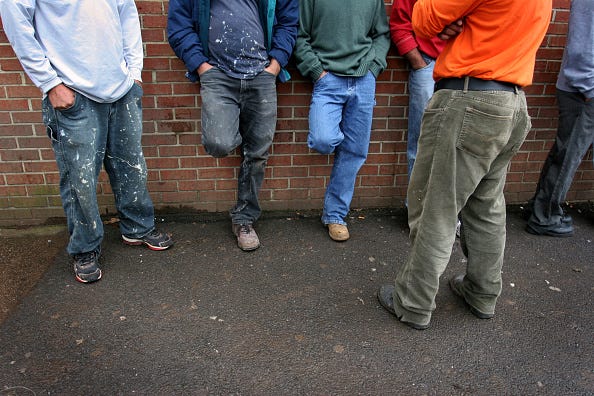
It is amusing to think of Jesus praising a landowner who pays all his workers the same while sounding vaguely like Karl Marx — “From each according to his ability, to each according to his needs” — in one of the New Testament’s greatest take-downs of capitalism. But, ultimately, the workers who showed up early in the day don’t inspire admiration. They resent that the landowner has given everyone the same wage. And they begrudge the workers who showed up late: Why them? Why not us?
There it is: envy. Jesus didn’t even have to put the word in the landowner’s mouth because it is so obvious. The disciples who, just a short time ago, might have secretly rejoiced when Jesus sent the rich guy away, now find themselves on the back foot. Surely they identified more with workers being treated unjustly than a landowner sharing his cash with abandon to those who showed up late. Why them? Why not us?
“I am not being unjust to you,” the landowner said, “did you not agree to this wage? Take what is yours and go; but I wish to give to the last workers what I also give to you.”
I’ve always wondered why the lectionary doesn’t pair this text with the story of Cain and Abel, because I’m convinced the disciples would have immediately thought of it. Theologians may argue about the sin committed by their parents, but few disagree about this violent tale of sibling rivalry. The elder brother, Cain (whose name in Hebrew folklore meant “acquisition”), envies his younger brother, Abel, when the LORD favors the younger’s offering. Cain is furious and full of rage. Why him? Why not me?
The LORD says, “Why are you angry?” and reminds Cain that the terms of the offering are the same for both siblings — “If you do well, will you not be accepted?” He sounds not unlike the landowner in the parable.
Are you envious because I am generous? I did as I did, it wasn’t unjust to you. If you do well, you will be accepted, just like your brother.
Jesus left his story open-ended. We’ve no idea what the resentful workers did upon leaving the vineyard. Did they take their wages, now with grateful hearts instead of anger? Did they go and beat up the late workers and take what they believed was theirs? We don’t know. We’re left to guess. Jesus’ final — and predictably ambiguous — word on the tale is: So the last will be first, and the first will be last.
But there is no guessing about Cain and Abel. The older brother, the one who was first and always wanted to remain so, acted on his envy: “Cain rose up against his brother, Abel, and killed him.”
The story, where the last’s offering is accepted before that of the first brother turns into the first slaughtering the last. Envy to rage to murder. No wonder it is called a deadly sin. That’s the path.
Since the beginning, rivalry has fueled death. Envy is a murderer — of our own souls, of others, and of the possibility of communion and community. Envy drives us to have more, to take what we think we deserve, to beat others at the game. God may promise provision, that each one sit under the vine and fig tree, but we can’t enjoy the abundance of our own vine without wanting our neighbor’s vineyard. Envy destroys our capacity for gratitude — and fixates our being on that nagging, horrible question: Why them? Why not me?
Dorothy Sayers wrote, “Envy is the great leveler: if it cannot level things up, it will level them down. . . At its best, Envy is a climber and a snob; at its worst it is a destroyer — rather than have anyone happier than itself, it will see us all miserable together.” Envy isn’t just a personal sin. It is one of shared consequences, a communal deadly sin.
We don’t often think of envy as one of the taproots of the climate crisis. How, might I ask, is it not? The never-ending race to outdo one another, living endlessly in comparison to others, to level ourselves up and tear others down, has had devastating consequences by creating our cultural and economic cycle of consumption and waste. Indeed, scientists at the National Institutes of Health studied the connection between envy and environmentalism.
While they allowed for something they called “benign envy” (scientists are permitted such; theologians are not), they discovered that “people who are high in malicious envy tend to engage in more environmentally harmful activities rather than living a sustainable life.” Their conclusions were two-fold:
First, individuals should be aware that upward social comparisons could be the antecedent of environmentally harmful behavior, especially when inferiority, hatred, and anger deplete limited self- control. Secondly, malicious motivations are not only harmful to personal mental health but also detrimental to the natural environment and climate change.
Envy kills everything.
I feel like the disciples shouting at Jesus: How then can anyone be saved?
“Love does not envy,” wrote St. Paul. Love of God, love of neighbor. Love seeks not its own way. Poetically spiritual and psychologically sound. Dwell on love, dwell in love — and watch the resentments drain away. Practicing love rearranges the heart. Love opens the possibility of empathy, sympathy, and compassion instead of envy, resentment, and malice.
And what Jesus said, of course: So the last will be first, and the first will be last. Envy drives us to elevate ourselves over others by either beating them at the game or beating others down. But the question in this parable — Are you envious because I am generous? — calls us to remember that we are all recipients of a wild generosity. Manna that falls like rain; watercourses in the desert; lilies of the field — the gifts of God for all the people of God.
Envy inhibits gratitude. However, the reverse is also true: gratitude is an antidote to envy. And that is the central point of Jesus’ little story.
Are you envious because I am generous? Don’t you understand? Gifts call forth thanks. Bask in gratitude for the generosity of the vineyard. There is no need for first and last. All are welcome, all provided for. Here is the garden without rivalry, without death. Abundant life.
When Cain’s envy consumed him, when he killed Abel, blood cried out from the ground. That poisoned Earth now cries to us: Put away your resentments of one another, knowing that you all dwell in the same vineyard, and tend to the healing, renewing work at hand.
Love God. Love one another. Love the Earth.
=================
For Reflection:
What do you see as the thru-line between these two pieces? Which one invites you most to Surrender? Or is it the thru-line between the two?
