Tuesday, September 29, 2026
The author Gina Loehr describes how God’s love empowered Thérèse of Lisieux to embrace the fullness of her own humanity and that of others:
Thérèse’s teachings were never scholarly or academic; they were simply the insights she gained through prayerful reflection on her personal experiences.
Thérèse’s understanding of the significance of love, for example, grew in part out of her experience of longing to do everything for Christ. She had felt the yearning not only to be a Carmelite, a spouse, and a spiritual mother but also to be a missionary, a warrior, a priest, an apostle, a martyr, a crusader, and a papal guard, among other things. In reflecting on the various parts that make up the body of Christ, Thérèse saw herself in all of them. But Thérèse came to an important realization when reflecting on First Corinthians 13, which explains that all the greatest gifts are nothing without love. This led Thérèse to understand that love enabled the apostles to preach and the martyrs to make their great sacrifices. Love kept the body of Christ alive in the world. She wrote in her autobiography, “I understood that love comprised all vocations, that love was everything, that it embraced all times and places…. In a word, that it was eternal!” [1]
Saint Thérèse embraced the truth that loving Jesus is the goal of life and our most important task. She said, “There is but one thing for us to do … and that is to love, to love Jesus with all the energy of our heart.” [2] Her love for Jesus, though deeply passionate, was not purely emotional. It was fundamentally a choice, a response to his love for her…. Hers was an authentic love, not a fanciful illusion, and thus it brought her deep contentment.
For Thérèse, love of God and love of the other is of one piece:
From her youth Thérèse loved Jesus with her whole heart, and she never regretted it. In addition to bringing her personal consolation, this love helped her grow in her relationships with others. She understood that when we give ourselves to God, our hearts don’t lose their natural tenderness, rather that tenderness increases as our hearts become purer and more divine. Thérèse wrote, “In loving Him the heart expands and can give to those who are dear to it incomparably more tenderness than if it had concentrated upon one egotistical and unfruitful love.” [3]
Loving God enriches not only our experience of human love but also our experience of life. Thérèse was able to see the gifts of her Beloved surrounding her. She was passionately engaged in life. She loved to explore nature and absorb the beauties of creation…. The love overflowing from her heart spilled out in her many poems and plays. Her love for God energized her daily life. She lived as a woman in love: joyful, enthusiastic, smiling.
==============
Wholeness in a Time of Hypocrisy
What If We Took What Jesus Said and Who Jesus Loved Seriously?
| CHUCK DEGROAT. SEP 27 |
“Let love be without hypocrisy.” — Romans 12:9
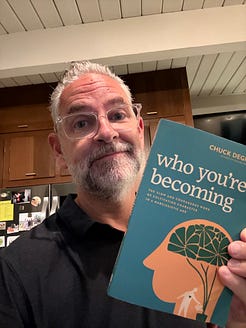
It’s a bit surreal sharing musings from my new book on character formation in a season of non-stop political advertisements.
I was thinking about this just the other day, reminded again of how we who call ourselves followers of the crucified Lamb miss the point over and over again. I posted this in various social media spaces:
When people ask me when Christianity’s cozy relationship with narcissistic leadership began, I sometimes sense they’re looking for a recent moment, like the rise of the megachurch, the prosperity gospel, or the advent of social media and digital celebrity.
History tells a much longer and more troubling story—that we who call ourselves Christian must reckon not only with elevating malignant narcissists into offices that demand integrity, but that we need to reckon with Manifest Destiny, Jim Crow, and the Doctrine of Discovery, that we need to reckon with the Crusades and “Deus vult” (God wills it), that we need to reckon with imperial power and “en toutō nika” (under the sign of the Cross, conquer).
Reckoning with narcissism and abuse in the church and in our wider culture isn’t about pointing to a few bad apples. It’s about seeing the hollowed-out tree, the root rot, and the putrid soil.
And, perhaps it’s also about eyes that can once again see the beauty of the way of the Lamb, who did not clamor after power, but became the forgiving victim.

Time and again, we choose power over humility and hypocrisy over wholeness.
Time and again, we heap shame on the the stranger, the widow, and the orphan—the biblical triad which speaks to those most vulnerable to exclusion—alongside the people Jesus so often drew near to—the poor, the socially disgraced, even those marked by sexual shame.
And time and again, we strain gnats while we’re swallowing camels (Matt. 23:24), failing to see that our elevation of those Jesus repeatedly calls “hypocrites” is far more grievous to the heart of God (see the entire Sermon on the Mount) than just about anything else.
I think often of the blind guides of Isaiah 56 who only look out for themselves. Scripture has plenty to say about leaders whose hearts are divided.
We’ve strayed far from Psalm 139’s “Search me and know me, O God.” We’ve strayed far from Jesus’s call to flourishing as wholeness (see the Beatitudes). We’ve strayed far from love, joy, peace, patience, kindness, goodness, faithfulness, gentleness, and self-control (Gal. 5:22-23).
We crave power and the preservation of power—at all costs. We elevate, quite literally, the “play actor,” called “hypocrite” as many as 30 times across the New Testament, 18 times by Jesus. Hypocrite—the one whose life is not whole.
When I wrote my third book Wholeheartedness back in 2016, I quoted the theologian and pastor Dietrich Bonhoeffer, who courageously faced the rising fascism of his day, particularly saddened that a vast majority of church leaders either supported or were quietly complicit with Hitler’s agenda. Yet, while imprisoned by those whose ideology represented a grievous departure from the way of Jesus, he was struck by his own contradictions:
Who am I? This or the other?
Am I one person today and tomorrow another?
Am I both at once? A hypocrite before others,
And before myself a contemptibly woebegone weakling?
His humility strikes me. It’s easy to point the finger. But we’re invited to do our own soul searching.
We are in a season of massive reckoning within our culture and church. A parade of play actors march before us, in political ads and offices, in pulpits, and various platforms. And if we’re honest, the hypocrite lives within us too.
Do we crave power more than we long for humility?
Are we excusing hypocrisy at the expense of wholeness?
Might we be casting out the very people Jesus loves and elevating the very ones he critiques?
These days as I’m seeing political ad after political ad, I’m prone to mutter a “Lord, have mercy” or a “How Long, O Lord?” It’s wearying. As I said in that post, narcissism and abuse in the church and in our wider culture isn’t about pointing to a few bad apples. It’s about seeing the hollowed-out tree, the root rot, and the putrid soil. In other words, the leaders we choose don’t come out of nowhere—they’re formed, and it’s time to interrogate that formation along with the systems that produce bad fruit.
But I’m also offering another prayer: “Search me and know me, O Lord.” Because, the deep reformation of life and character we long for really does begin with each of us.
Who You’re Becoming: The Slow and Courageous Work of Character Change in a Narcissistic Age comes out October 20.