
Praying with Creation
Thursday, October 8, 2026
In every work of the artist, he praised the Artist; whatever he found in made things he referred to the Maker.
—Thomas of Celano on Francis of Assisi
Father Richard reflects on how Francis and Bonaventure recognized the natural world as the place through which we learn to witness and love God:
St. Bonaventure (1221–1274) taught that to work up to loving God, we start by loving the very humblest and simplest things and then move up from there. “Let us place our first step in the ascent at the bottom, presenting to ourselves the whole material world as a mirror, through which we may pass over to God, who is the Supreme Craftsman,” he wrote. And further, “The Creator’s supreme power, wisdom, and benevolence shine forth through all created things.” [1]
In the end, we either love everything or there is reason to doubt that we love anything. This one love and one loveliness was described by many medieval theologians and others as the “Great Chain of Being.” The message was that if we failed to recognize the divine Presence in any one link of the chain, the whole sacred universe would fall apart.
Creation—be it planets, plants, or pandas—was not just a warm-up act for the human story of the Bible. The natural world is its own good and sufficient story, if we can only learn to see it with humility and love. That takes contemplative practice, stopping our busy and superficial minds long enough to see the beauty, allow the truth, and protect the inherent goodness of what it is—whether or not it profits us or pleases us. [2]
Franciscan poet Murray Bodo points to Francis as a contemplative model for praying with creation:
Francis took his place among creatures and, in reverence and prayerfulness, praised God with them. I believe that the goodness of our gestures toward the world around us and our gratitude for it depend a great deal upon the depth of the silence out of which those gestures come.
As it was with St. Francis, only in silence and solitude do we learn to see and hear and respond with reverence to creatures other than our busy, noisy selves…. Only the silence of solitary seeing and listening will remedy what today has grown into a violent use and abuse of the beauty and fertility of the very earth that nourishes, supports, and directs us….
The Umbrian words for what the earth does are sustenta (“nourishes”) and governa, which in one translation means “directs,” “shows the way,” and “produce,” which together mean “brings forth.” These three verbs are what silent contemplation does and is for us: it nourishes us, directs us, and produces understanding and wisdom.
I cannot prove such an assertion, nor do I wish to, for that would be just another argument. I can only ask you to try it, experience it, and feel it. That is what St. Francis did in his own time and place. And something began to grow in him, slowly, like a plant. [3]
References:
[1] Bonaventure, The Soul’s Journey into God 1, 9–10 (Paulist Press, 1978), 63.
[2] Richard Rohr, The Universal Christ: How a Forgotten Reality Can Change Everything We See, Hope for, and Believe (Convergent Books, 2019), 57–58.
[3] Murray Bodo and Susan Saint Sing, God’s Love Song: The Vision of Francis and Clare (Franciscan Media, 2024), 122–123.
Image credit and inspiration: Nina Plobner, untitled (detail), 2020, photo. Unsplash. Click here to enlarge image. The mystery of creation reveals itself most fully when we pause to notice something small and simple, like dew caught on a single blade of grass.
=============================================================================
From the margins (1): Attrait, Baron von Hügel, the Grail, and Joseph Campbell
Three posts that “plunder the Egyptians” (Exodus 12:36)
| ADDISON HODGES HARTSEP 30∙PREVIEW |
There are four “yogas” that are essential aspects of Vedanta (the word yoga literally refers to a “yoke,” and by extension, a “yoga” is a practice that fosters “union” with the divine). All four are “branches” of a single religious “tree,” but each of the four, as Swami Vivekananda (1863 – 1902) described them in his book Raja Yoga (1896), appeals to different human temperaments. Karma Yoga, the way of selfless or non-egocentric service, appeals to the active, hands-on type; Bhakti Yoga, the way of affective or loving devotion, appeals to the feeling type; Jñāna Yoga is the way of intellect and philosophy, and appeals to the intellectual type (it is what we might call “apophatic” or the via negativa – neti, neti – “not this, not this”); and Rāja Yoga is the way of meditation, appealing to those who invest their energies in practicing deep contemplation. I don’t bring up these four kinds of yoga as systematized in Vedantic teaching to explore them, but only to illustrate a universal principle wherever religion (“natural” or “revealed”) is concerned, which is simply this: each holds a special appeal for persons possessing different temperaments or characteristics, all of whom are joined in the same faith and devoted to achieving union with the transcendent. Within classical Christianity, too, there is a similar variety of models of devotion. Within the corporate body of “Adam,” so to speak, God creates individuals of a near-endless multiplicity; and in the corporate Body of Christ, that united multiplicity of individual souls is brought collectively, and each one distinctively, to perfection. The Christian models of spirituality do not correspond neatly with the four Vedantic yogas (in Christianity, it should be stressed, there is no understanding of “spirituality” or of a “spiritual man” — pneumatikos — that has not God the Holy Spirit, who proceeds from the Father and is sent by the Son, specifically in mind), but it can be said that one or another of those models, which have grown up in the Church over the centuries, will tend to attract an individual of this or that temperament more strongly than will any of the others. Some persons are more emotional than cerebral (not to the exclusion of the latter, of course) and thus will require a more immediately affective form of devotion. Some are more intellectual and will need a spirituality that ignites their minds before it can begin to warm their hearts (as it should). Many are drawn into greater seclusion and to a “rule” (regula) that emphasizes silence and contemplation. And so on. A single method is not advanced in the Church to the utter exclusion of all the rest. Even in Orthodoxy, while hesychasm (a consistent but developed tradition of the prayer of quiet) is standard, it cannot be said to exclude other expressions of Orthodox piety. In short, then, each person has his or her own attrait, to use the apt word introduced into the study of the inner life by the influential Austrian-Scottish Catholic theologian, Baron Friedrich von Hügel (1852 – 1925). It is — it cannot be stressed sufficiently — of first importance in spiritual guidance to know the various temperaments of the persons with whom one has to do. One size doesn’t fit all.
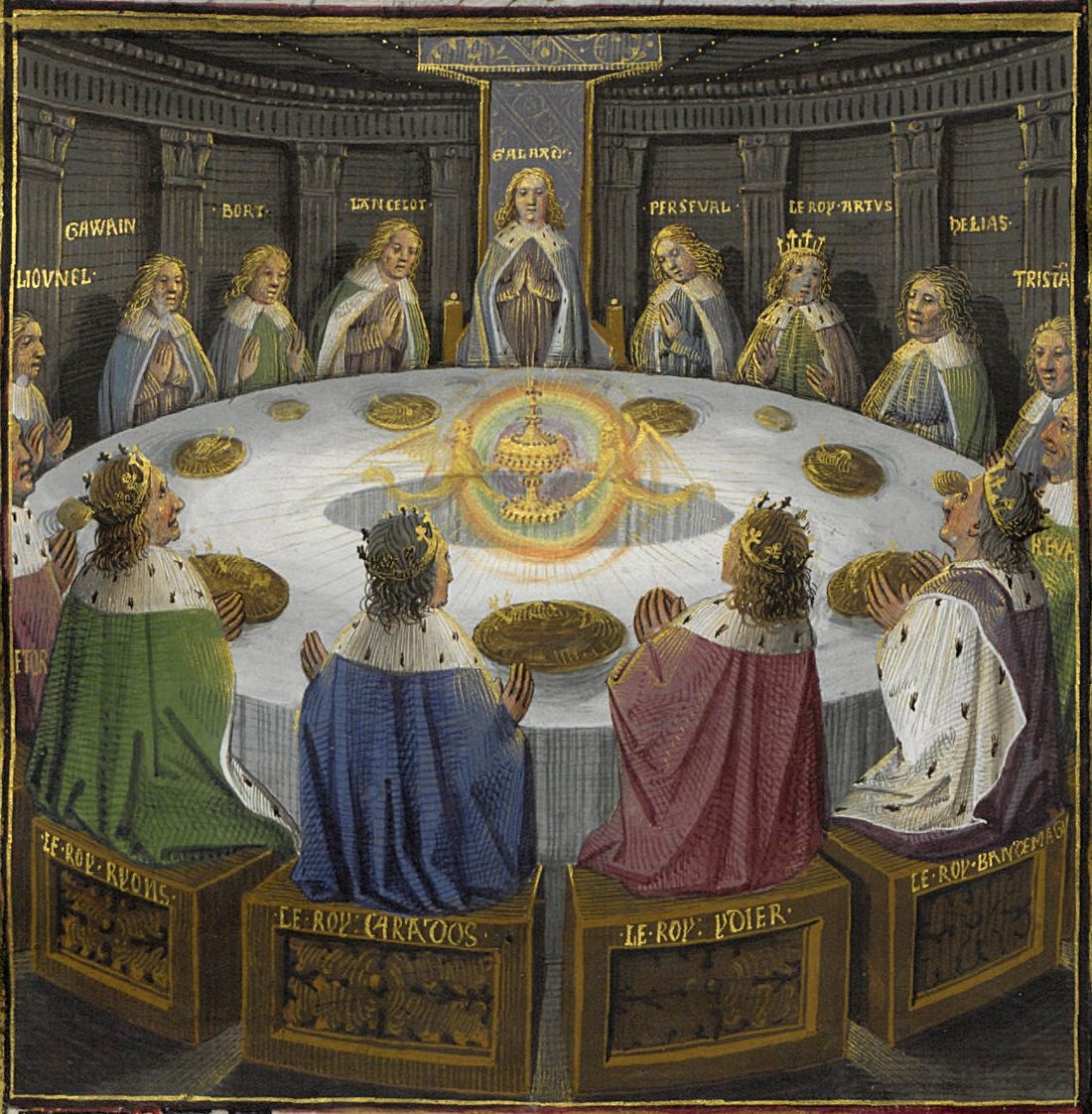
(King Arthur’s knights, gathered at the Round Table to celebrate Pentecost, see a vision of the Holy Grail; Medieval illumination) …
