Wednesday, October 14, 2026
Father Richard reflects on Homer’s Odyssey as an archetypal story that reveals the necessary journey from and return to home:
Home is another word for the Spirit that we are, our true self in God. The self-same moment that we find God in ourselves, we also find ourselves inside God, and this is the full homecoming. Until then, we are homesick, although today most would probably just call it loneliness, isolation, longing, sadness, restlessness, or even a kind of depression.
The common word for this inner abiding place of the Spirit, which is also a place of longing, has usually been the word soul. We are born with our soul. The end is already planted in us at the beginning, and it gnaws away at us until we get there freely and consciously.
In The Odyssey, the stirring of longing and dissatisfaction is symbolized by the collapse of Troy and the inability of most of the Greeks to return home. It seems they had forgotten about home, had made home in a foreign land, or were not that determined to return home (which are all excellent descriptions of the typical detours or dead ends on the spiritual journey). Only Odysseus was trying to get home at all costs, and he is the stand-in for what we all must be. Those who do not seek their home are symbolized perhaps by the lotus eaters whom Odysseus encounters, who forgot themselves and lost their own depths and consciousness.
Remember Odysseus’s oar that an inland wayfarer thought was a winnowing fan? His oar, a symbol of his first-half-of-life occupation, had become a tool for inner work, a means for knowing the difference between wheat and chaff, essentials and nonessentials, which is precisely the turn toward discernment and subtlety that we come to in the second half of life.
It’s no surprise that this marks the end of Odysseus’s journey. Now he can go home because he has, in fact, come home to his true and full self. His sailing and rowing days of mere outer performance are over, and he can now rest in the simplicity and ground of his own deeper life. He is free to stop his human doing and can at last enjoy his human being, at home in himself.
And so, like Odysseus, we leave from Ithaca and we come back to Ithaca, but now it is fully home because all is included and nothing wasted or hated; even the dark parts are used in our favor. All is forgiven. What else could homecoming be?!
Poet C. P. Cavafy (1863–1933) expressed this understanding most beautifully in his famous poem “Ithaca.” This is my rendering of its final lines:
Ithaca has now given you the beautiful voyage.
Without her, you would never have taken the road.
With the great wisdom you have gained on your voyage,
with so much of your own experience now,
you must finally know what Ithaca really means.
=====================
| CHRIS EW GREEN OCT 12 |
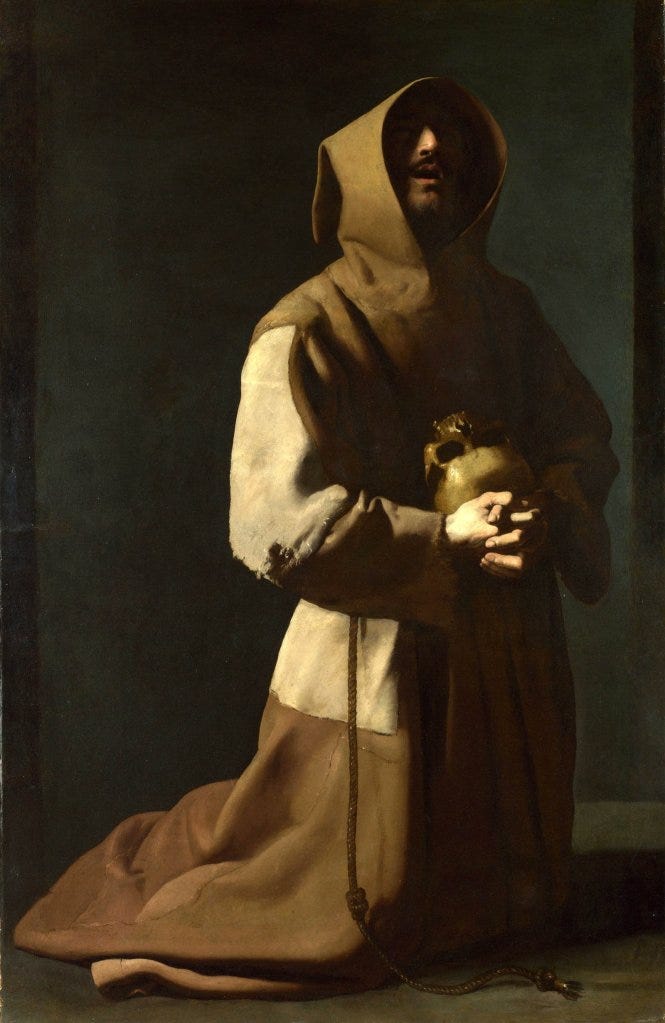
In her book, Eating Beauty: The Eucharist and the Spiritual Arts of the Middle Ages, Ann Astell, drawing on Balthasar’s reading of Bonaventure’s meditations, shows how Francis’ reception of the stigmata was the outworking of his inner conformity to Christ:
The imprint of the wounds corresponds to the opening wide of the saint’s soul… In Bonaventure’s theological aesthetics, expressio and impressiobelong together and are proportioned to each other. “It is significant,” Balthasar insists, “that although the power of expression goes out from the Crucified, the bodily sign [of the stigmata] is imprinted only because Francis, through grace and his own inflamed love, has already become in spirit an expression of the love of the Crucified.” The “open seeing of faith” that is an expression of Francis’s soul is exactly configured to the image of the crucified Seraph, so that the image, in turn, “stamps [its] impression” on Francis’s body. Like Christ, the stigmatized Francis becomes a book that is “written within and without” (Ezec. 2:10).¹
The same opening-out marks, one way or another, the lives of all the saints. And it is that that draws us to them. What made and makes them so attractive is that they mirrors the love from which they do not look away. They are transfixing because they let us see them being transfigured.
“I’m no saint.” When, in everyday conversations, we say this, we imply that being a saint is about perfection, blamelessness, purity. Ironically, though, the saints we’re actually drawn to are much more “human” than that. We’re drawn to saints like Augustine, who was open about his failings, and saints like Francis, who was unafraid of the failings and frailty of others. So, despite what we sometimes suggest, we are compelled not by the innocence of the saints but by their vulnerability and compassion—their openness to God, and their God-like openness to others. They make grace visible precisely because they need it.
That said, the saints are not always easy for us to take. That is because their lives, attractive in their openness, disclose how much we have closed ourselves against. But they do not expose and shame us. They reveal us, as well as the mercy of God. And in that way they spark hope—that all-consuming fire in the bramble-bush of our gut that says despite everything that it is good to be alive, here and now, to have these people around us, to have this future opening up before us.
The saints don’t always look like God. They always look to God. Just so, they make it so we can take more of God, more of ourselves and others, more of reality in all its seeming absurdity and dumbfounding complexity. In their company, we are surprised to find we are not as out on life as we had feared we were. All that at is what this poem is trying to honor:
The saint is a question
God has left open. A safe

blown apart, nothing
missing. A flower

that blossoms for water
to know the truth

of its nature. A tear in the
veil made of tears,

a wound in the shape of
the cleft we were borne through.

The lion’s carcass—
honeycomb sweet

under its ribs.
The grace of a grave

robbed of its dead.
An iris widening its dark.

A window blue with bruised light.
The space in the sentence

to stop,
listening.
1
Ann Astell, Eating Beauty: The Eucharist and the Spiritual Arts of the Middle Ages (Cornell University Press, 2006), 127-128.
