Tuesday, October 27, 2026.
Richard Rohr maps the expansion from self-love and group love to the gospel call of universal love:
We’re told by developmental psychologists that there’s a staging in our growth in love. We have to start with self-love and respecting the self. If we don’t respect ourselves, we won’t know how to respect anybody else.
Then God moves us to group love, family love, which is basically the love of people who are connected to us or who are like us. A lot of people don’t even get there. They don’t know how to love their family or those close to them or those in their group.
From there, God moves us to the third level, which is universal love. I’m afraid a much smaller number of people get to this place. As we see in politics, in our country, and throughout the world, at best most people just get to the second stage of knowing how to love people who are like them: their race, their nationality, their religion, their political party. When we stay at this second stage of group love, we clearly don’t create a healthy society. We can look at countries and politics the world over to witness how this is true.
In Acts 10, we discover that even Peter had to be taught by the Holy Spirit how to grow in love. Peter was at the stage of group love, believing that God only loved the Jewish people. And then this strange thing happened where the Holy Spirit fell upon gentiles! Peter looked around and said, “Oh my gosh! God seems to be for everybody and not just for the Jewish people!” He understood that it was okay to include gentiles into what eventually became known as the church. In spite of this, most of church history has not really imitated Peter’s insight. We pulled back into group think and group love.
Peter said, “In truth, I see that God shows no partiality. In any country, whoever fears God and acts uprightly is acceptable” (Acts 10:34–35). At that moment he became both a Jewish and Christian heretic! Peter himself began to recognize that God works with all people of goodwill — not just people in his group. But he had to be pushed there. Little by little, God leads him to universal love.
==============
The Best Days of Our Lives
Ten Years Later
| BRIAN ZAHND OCT 27 |
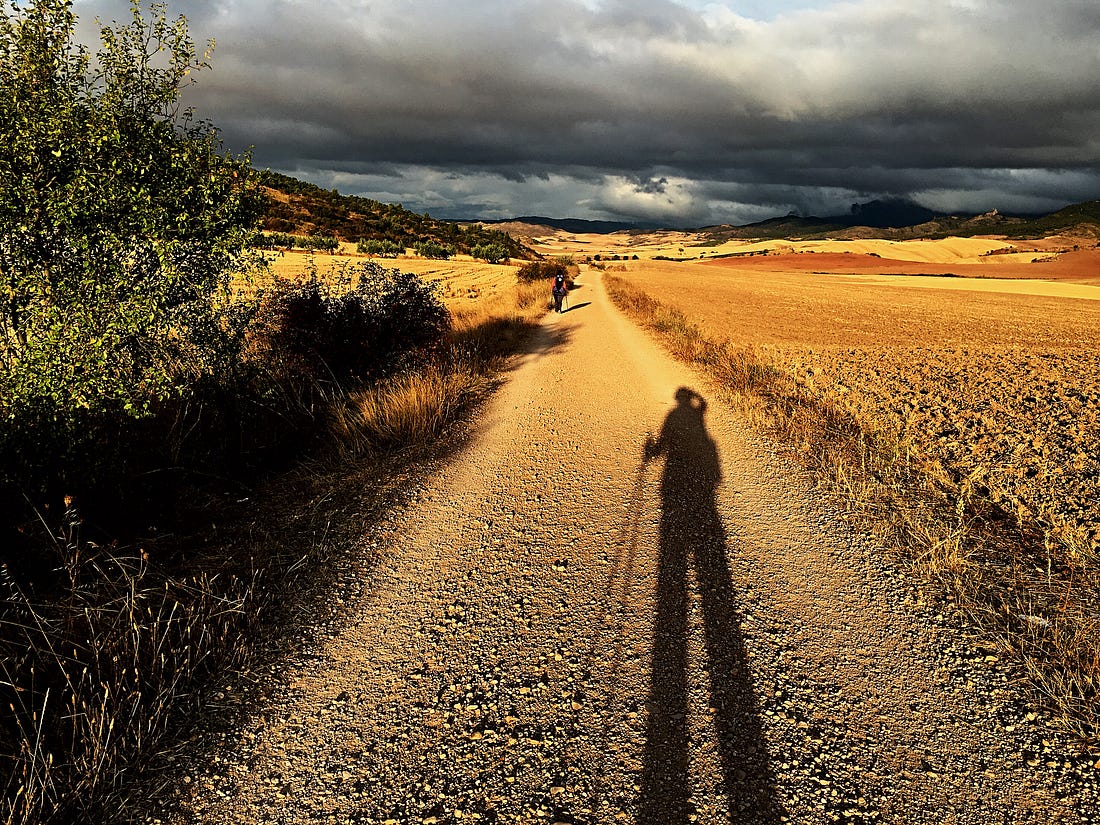
My shadow with Peri walking on ahead on the Camino de Santiago.
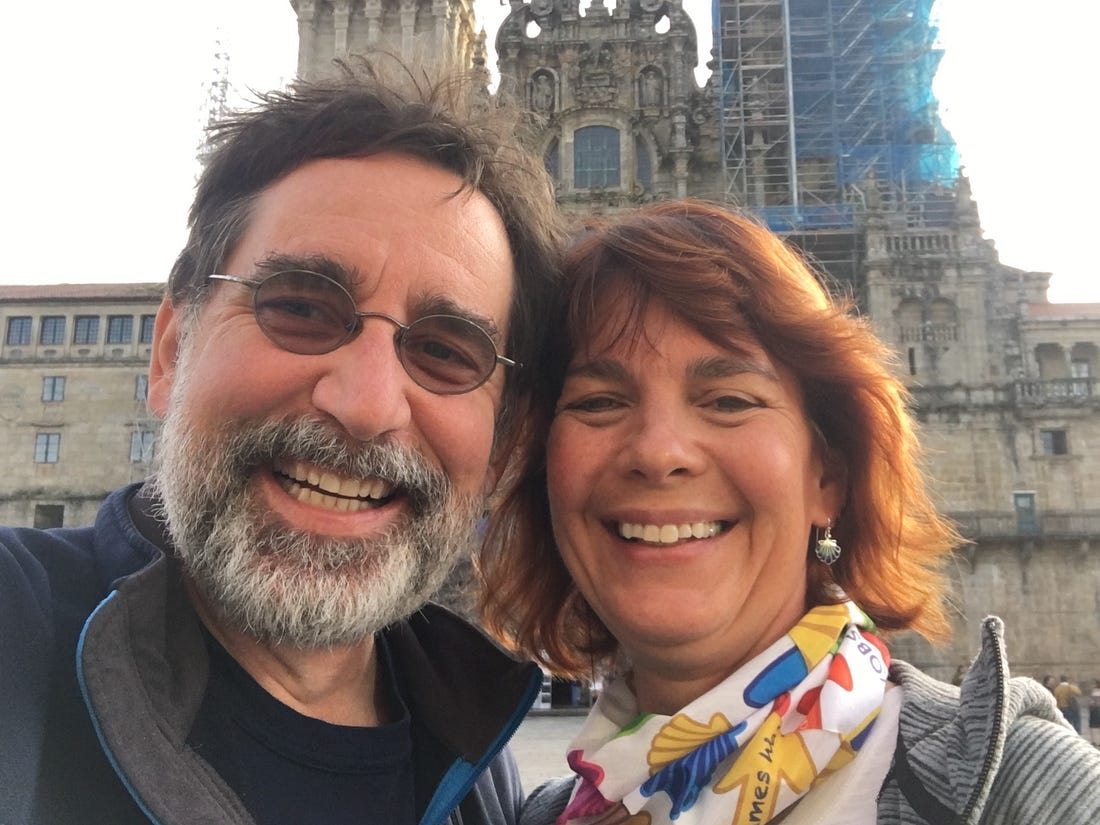
Ten years ago today Peri and I completed our first 500-mile pilgrim walk across Spain on the Francés route of the Camino de Santiago. It changed our lives. This is not hyperbole, it’s just a stone-cold fact. Peri has written a memoir of our experience—Every Scene By Heart. The following is my brief reflection on those blessed days ten years ago.
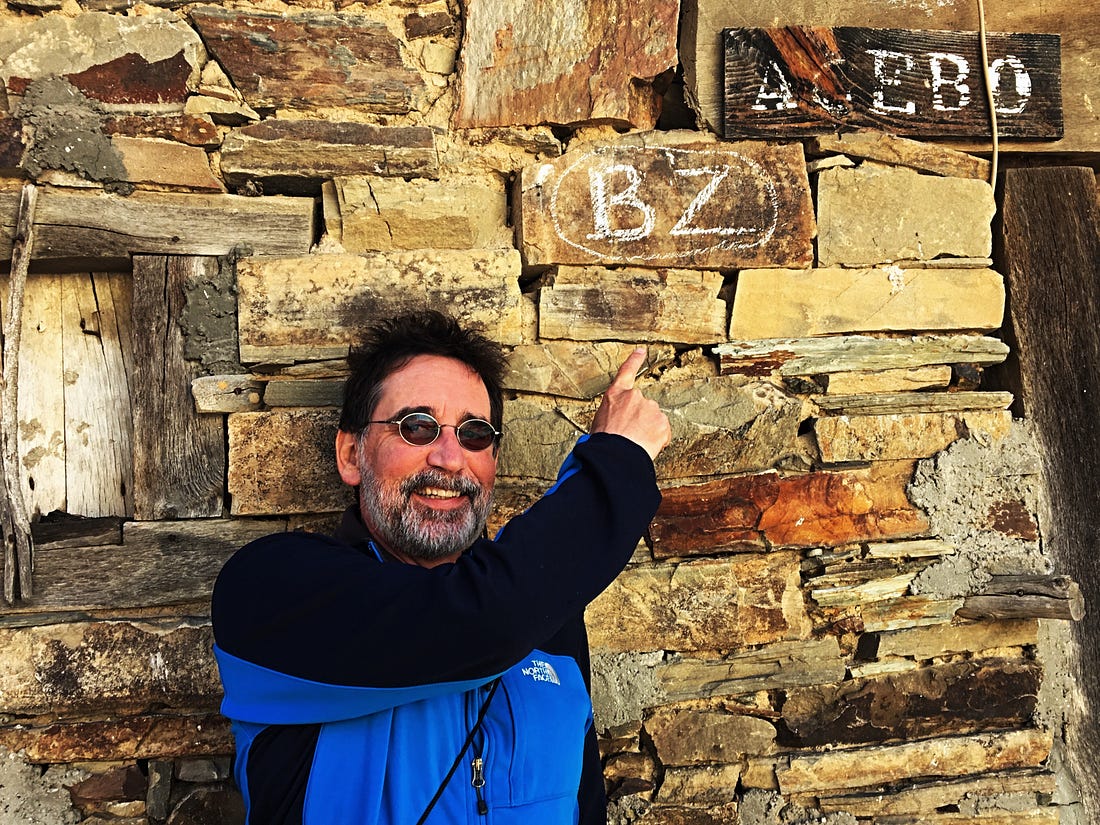
Finding my initials in El Acebo, population 37.
It was a long walk across Spain—the best days of our lives. We knew it while we were doing it. Even when we were beset with blisters and worn down by fatigue, we would turn to one another and say, “This is the best thing we’ve ever done.” While walking thousand-year-old paths made holy by the feet of millions of pilgrims, we found respite “far from the madding crowd” of modernity. For forty days and forty nights our lives were reduced to the blessed simplicity of walking from town to town, from church to church, from shelter to shelter, always moving a bit closer to Santiago. We didn’t dart here and there, back and forth in a frenzy; we didn’t speed through the world in cars, trains, and planes; we just moved steadily westward, no faster than foot-speed. And with the simplicity and the slowing down came that which we miss most in our high-speed, high-tech, high-stress age: Peace.
We had come to the Camino to escape the quadrennial madness that falls upon America during presidential elections. We had come to the Camino for our first sabbatical in thirty-five years of ministry. We had come to the Camino in hope of finding healing for our overwrought souls. And on the Camino we found all we were looking for and more. It’s not often that a much-anticipated experience exceeds our expectations, but the Camino de Santiago was better than we had dared to hope. It was a gift from God; a five-hundred mile walk deep into the grace of Christ.
As it became known that we planned to walk the Camino, people who had already had their own Camino contacted us; they were as eager to tell us of their experience as we were to gain what advice we could. Over time I noticed that these Camino veterans tended to say the same three things in their own way:
- It’s harder than you think.
- You will love it.
- It will change you.
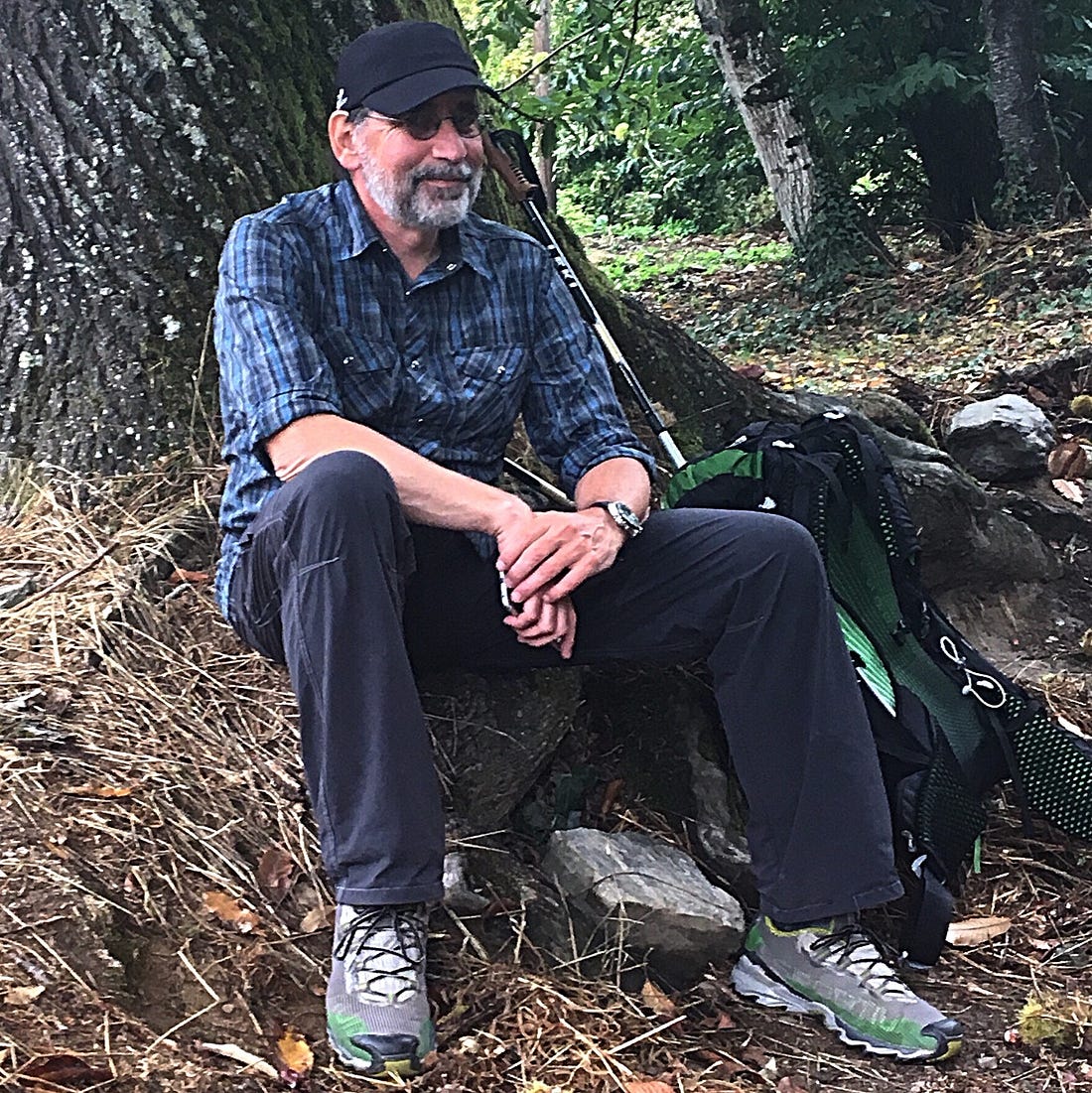
Taking a break near the village of Trabadelo, population 321.
Today, ten years after our arrival in Santiago, I can say that all three prophecies were precisely true. It was harder than I anticipated—as Peri’s memoir makes clear. And I did love it. Even when I had seventeen blisters I was aware that I loved the privilege of being a pilgrim on this wonderful journey. And, most importantly, I know the Camino has changed me. I found a peace on the Camino that I’m still consciously aware of today.
Over those five-hundred miles I shed a layer of skin—a layer that was too easily blistered by anxiety. At Cruz de Ferro I laid down a burden I have not retrieved—I left it at the base of an iron cross and there it remains.
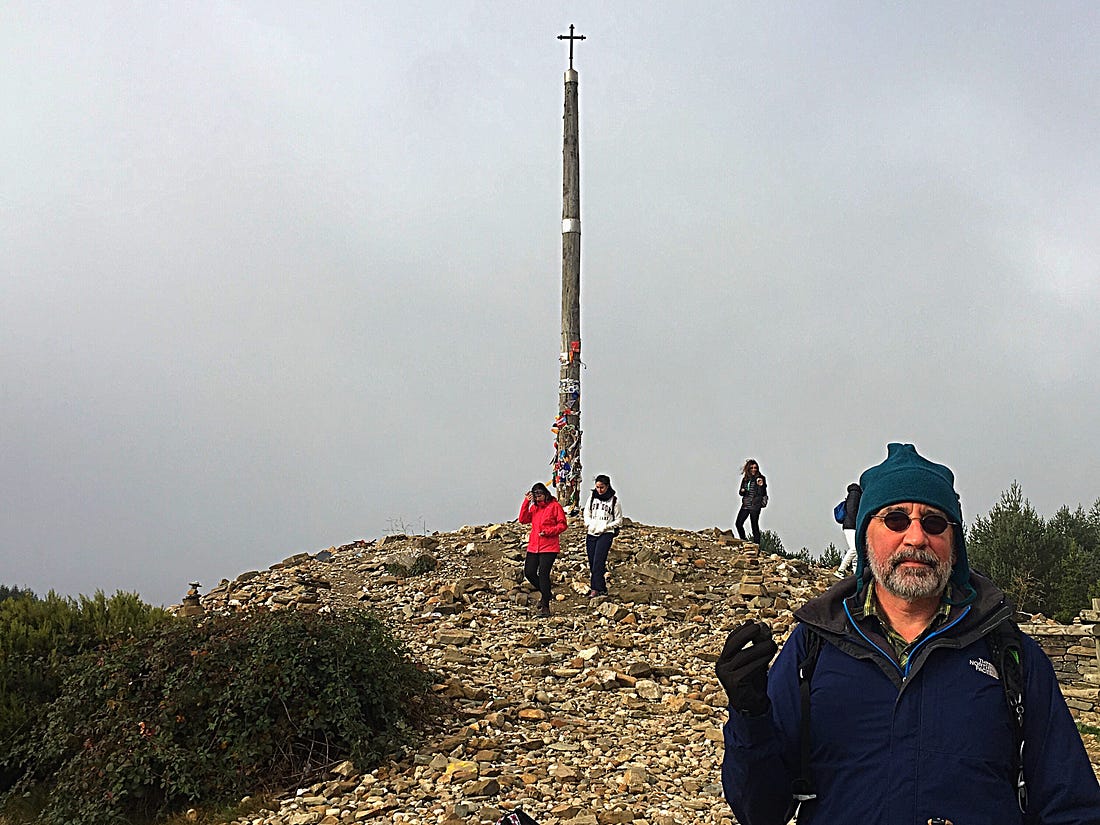
At Cruz de Ferro, where pilgrims lay down a small stone they have carried on the Camino, representing something they want to let go of.
Those long walks through the lovely mountains of the Pyrenees, the vineyards of Navarra, the plains of the Meseta, and the wooded hills of Galicia brought me to a new place of calm and contentedness. This was an answer to prayer. The Camino was a forty-day, five-hundred-mile prayer, and with the Amen offered in the Cathedral of Santiago I found a new depth of the peace of God which surpasses all understanding. Thank you, Camino. Thank you, Peri. Thank you, Jesus.
Buen Camino.
BZ