copy link to browser to play Kari Jobe – Forever

Ripening: Aging with Grace
https://www.google.com/goto?url=CAESaAHEIkXXm0Whzm2hngofjfvT4x8rDOJOpD0uCt81FLevaKT4pBhYN1Z7ylR9f_v2HQyRkPnAdWu7umY-KHGNs2XOZAzYzonsTTTDpS7GDqoANmddbTH0rjSO90zyDPv_IsO05lepYhQh&gsessionid=7b4pop63w4fzHoTHlHRnjEV5jRMF2Zjb5uRzohvGaqHV0qyhrny0pw
Thursday, November 5, 2026
To ripen into an elder, into a being that is more than simply elderly, … is a deliberate, thoughtful, sustained choice.
— Kathleen Dowling Singh, The Grace in Aging
Buddhist teacher Kathleen Dowling Singh (1946–2017) considers the opportunity aging offers us to know our authentic selves:
Aging can offer us the time to deliberately reorient ourselves toward the inner life, an infinitely more reliable refuge than anything the world can offer. To open these inner vistas is to enter a time of awakening, to lighten our attachment to self, the cause of all our unease. We have the opportunity to, first, recognize that living attached to our own sense of self is a small, confined, and stressed way to live and, then, to wholeheartedly engage in practices that will free that myopic attachment….
Using these last years of our life as a time to awaken can help us cope and even grow in love and wisdom as we confront decline, illness, and loss…. We can give ourselves, finally, the experience of freedom and illumination and grace while still in the midst of life. We can, also, with our own spiritual ripening, offer all those younger ones who follow behind us in our spiritually impoverished culture the witness that awakening is possible….
We can, if we so choose, dedicate these last years to waking up. [1]
For Singh, choosing to awaken to reality is a gift in service to others:
Opening deeply to the truth of our own aging is wise. Opening deeply to the truth of our own impermanence is wise. Although such opening may not come easily at first—we all know how the ego tends to resist vulnerability—it is important to do so if we wish to mindfully use the time remaining to us….
To live a life of an elder is to ripen into being that is more than simply elderly, more than just old. It involves ripening into clear-eyed acceptance of the way things actually exist. That ripening involves, for each of us, many difficult reckonings in the multifaceted, multidimensional understanding that everything that can be lost will be lost….
If we are to claim the last years of life as years that hold the possibility of awakening into equanimity and lightness, into the very embodiment of grace, we need to bear witness to the ripening of that possibility. Not only would it be a blessing for each of us, it would be a blessing for a world starving for such witnessing….
Mindful of impermanence, the breath-by-breath arising and abiding and falling of each moment, we can remain in remembrance of our longing to exist in wisdom and love and compassion. We can remain in our intention to ripen into the spiritual maturity that is our birthright to cultivate. There is no more noble way to spend these years than to become an elder, to bear witness to the world as placeholders for peace, love, wisdom, and fearlessness. [2]
Brad Jersak
THE RANSOM: Excerpt from A More Christlike God
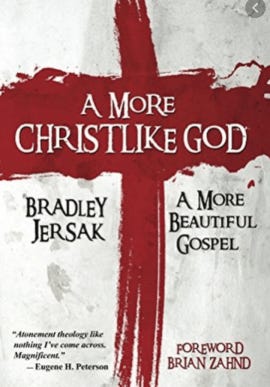
Jesus once said, “the Son of Man did not come to be served, but to serve, and to give his life as a ransom for many”(Mark 10:45). And Paul writes to Timothy that Jesus “gave himself as a ransom for all people” (1 Tim. 2:6).
In modern times, we associate ransoms with the demands of a kidnapper who wants payment for someone they hold in bondage. In this case, giving oneself in exchange for a prisoner, like we see in C. S. Lewis’s The Lion, the Witch and the Wardrobe, when Aslan gives himself over to the witch Jadis to be slain on the stone table in exchange for the life of Edmund. She is able to leverage this deal because under the law, someone must die. Again, seeing it this way can be a bit confusing, and in fact, it’s actually problematic on three counts. Specifically,
a. Was the ransom paid to God? If Christ’s life was given in ransom (or redemption), the church fathers reasoned that the ransom could not be paid to God, because God is not the slaveholder. The Book of Hebrews makes that clear: “by his death he [broke] the power of him who holds the power of death—that is, the devil—and free those who all their lives were held in slavery by their fear of death” (Heb. 2:14-15).
Lewis’s tale solves this problem because he doesn’t picture God requiring the payment. The witch is the one who demands punishment—a life for a life—leveraging the law of sin and death against Aslan. As in the New Testament, Aslan gives his own life and, in the end, “a deeper magic [self-giving love] from before the dawn of time” resurrects an innocent killed in place of a traitor.
b. Was the ransom paid to Satan? While some of the church fathers dabbled with this theory (i.e., a ransom paid to Satan), they ultimately reject this idea too. The truth, they said, is that God owes the devil—the thief—nothing. The prolific theologian Origen (182- 254 AD) starts out with a ransom to Satan, but like Lewis, treats Christ’s offering to Satan as a trap, where Jesus’ humanity is the bait. The devil takes the bait, but Christ’s divine nature and supernatural love overcome—it’s too hot to handle— and Jesus emerges from death along with all those Satan had held in his dungeon.
The truth is that Jesus utterly judged and defeated Satan on the Cross (John 12:31; 16:11; Col. 2:15). There’s no deal-making going on here. In another of his metaphors, Jesus said,
26 If Satan opposes himself and is divided, he cannot stand; his end has come. 27 In fact, no one can enter a strong man’s house without first tying him up. Then he can plunder the strong man’s house. —Mark 3:26-27
In this metaphor, there is no deal on the table, no careful trap being set. Jesus describes his ministry in terms of an overpowering home invasion where he storms Satan’s house, immobilizes him, binds him up and plunders his goods (namely, all those he had enslaved). This echoes the Exodus backstory, when God plundered Pharaoh of his slaves and Egypt’s gold (Exod. 12:36). Rather than paying Satan or Pharaoh, quite the reverse is true: he ransacks their territory and leaves them penniless.
A ransom?
Christ ‘gave his life as a ransom’ (Matt. 20:28). But to whom?
Not to God, for God is not the slave-holder.
Not to Satan, for God owes Satan nothing.
Not to the Law, for mercy trumps Law.
Jesus ransoms us from death, paying with his life.
But Christ owed death nothing either, and so conquers it.
c. Was the ransom paid to the Law? Origen and Lewis both hint at a third possibility—that the ransom meets the demands of some law. That is, the enemy’s leverage was an appeal to the rightful requirements of the law. Sometimes passages from Leviticus and Hebrews are quoted as proof-texts:
For the life of a creature is in the blood, and I have given it to you to make atonement for yourselves on the altar; it is the blood that makes atonement for one’s life. —Lev. 17:11
In fact, the law requires that nearly everything be cleansed with blood, and without the shedding of blood there is no forgiveness. —Heb. 9:22
And yet the Bible also insists on these five points:
- 1. There is no law or principle of justice higher than God to which he is beholden. ‘Justice’ is not a god to whom Yahweh must bow or appease with blood. Nor is God’s ‘Law’ some retributive principle that binds him. The whole point of the prophetic Book of Hosea is exactly this: that God is utterly free to forgive sinners—to show mercy to the guilty. He is able to respond to legal demands for punishment with a counter-verdict: complete pardon based in God’s own grace.
- 2. Similarly, there is no judgment or statute that cannot be trumped by mercy, for mercy triumphs over judgment. On the scale of justice, mercy is always an ‘older magic’ than retribution or sacrifice.
- 3. In fact, even well before the Cross, Israel could testify to the mercy of God. God had not treated them as their sins deserved. They had received superabundant compassion and mercy (Ps. 103:10-12) rather than tit-for-tat, eye-for-an-eye justice.
- 4. Rather than blood sacrifice or burnt offerings, the response God looks for is “a broken heart and a contrite spirit” (Ps. 51:16-17).
- 5. Further, legal provisions existed for a ransom (basically paying a fine) that would cover the debt for some crimes. But the Bible is clear: Under the law, “No one can redeem the life of another or give to God a ransom for them—the ransom for a life is costly, no payment is ever enough—so that they should live on forever and not see decay” (Ps. 49:7-9). You could ransom people from debts and slavery, but who could pay you out of the grave?
Here we have our answer to whom or what was paid as ransom in exchange for our lives. When Jesus gave his life for ours, to whom did he give it? The life of Christ was given over to death itself. But, as in the case of Satan, Christ did not ‘owe’ death anything. He did not ‘owe’ Hades (the Greek god of death) a life. Instead, death is the gate by which Jesus entered Hades (death) and plundered its captives. In Psalm 49 we read, “But God will redeem me from the realm of the dead; he will surely take me to himself ” (v. 15). The early church (drawing from texts such as Matt. 27:52-53; Eph. 4:8; 1 Pet. 3:18-20; 4:6) called this victory raid ‘the harrowing of Hades’ and celebrated Christ’s posthumous saving work on ‘Holy Saturday.’
So, in Christ, the ransom metaphor points to the rescue of those taken by death and held in the grave. The ransom ‘price’ is Jesus’ life—Death (personified) is paid—but ‘payment’ might be too strong a word because Death can’t hold him. And so, in John’s Revelation, Jesus announces: “Do not be afraid. I am the First and the Last. I am the Living One; I was dead, and now look, I am alive forever and ever! And I hold the keys of death and Hades” (Rev. 1:17-18).
Finally, let me ask you: If Jesus now holds the keys of death and Hades, what do you think he’ll do with them? In ransoming us, he also frees us from bondage and into lives of liberty.
