The work of the Center for Action and Contemplation is made possible thanks to the generosity of people like you. Thank you for your partnership and trust.


Loving a World We Have Yet to See
Dear Dave (& COFew) ,
Ever since I read a novel about Saint Francis when I was fourteen, I knew I wanted to be a friar. Francis of Assisi (1182–1226) seemed to understand something that I was only beginning to glimpse: God is not somewhere else. God is present in all things, being revealed in all creation.
Francis lived in remarkable harmony with the world. He knew that care for the earth, justice for the poor, and nonviolence were not separate concerns. They were all expressions of one reality. What intuitive genius! I am blessed to include Francis among my spiritual teachers.
We are always being shaped by lives we did not witness and people we never know. We carry our parents and grandparents within us, along with generations stretching farther back than we can imagine. We have also been impacted by the lives of the saints and mystics throughout history, whether we know them by name or not.

The Christian tradition gives us a beautiful name for this: the communion of saints. Past, present, and future are not nearly as separate as our ordinary minds imagine them to be. Once we begin to see ourselves as part of this much larger story, we can take our lives very seriously—we are part of the Great Whole—and not take ourselves too seriously at all—we are only one small part of the Great Whole. What freedom!
We do not have to fix everything. We do not have to complete the work ourselves. We only have to listen for what is ours to do and then have the courage to do it.
Contemplation helps us live from this deeper place. It returns us to the Divine center beneath all our striving, fear, and need for control. From there, we can participate in something much larger than ourselves—the healing of our world today and planting seeds of love for people we will never know.
I was touched by the way one reader of the Daily Meditations described this kind of discernment:

“I will retire from teaching at the end of this school year but, at the age of sixty, I know I am not done. I feel God is calling me to something more—but what? I feel called to more activism, but so much needs to be done. Where does one begin? I now see that I need to take a longer view and not push this process of discernment. I am grateful for the assurance that leaving teaching is not a failure, but an opportunity to grow anew wherever God leads me.“
I suspect many of us know that question: With so much suffering in the world, where does one begin?

We are grateful for the hundreds of thousands of spiritual seekers like you who allow the Daily Meditations to accompany you as you listen for what is yours to do and as part of your contemplative practice, seeking loving guidance from spiritual ancestors and contemporary companions on the journey.
Twice per year, we pause our usual Daily Meditations and ask for your financial support. If the CAC’s work, including the Daily Meditations, has supported you on your spiritual journey, please consider making a gift.
If you are able, we invite you to consider making a monthly gift as a member of the Bonaventure Circle of Support, CAC’s monthly giving community. Monthly gifts help provide scholarships to learners, expand the programs we offer, and make transformative wisdom more accessible for future generations.

The world has changed in unimaginable ways since I was a small boy in Kansas, and it will change again and again. We can’t know for certain what is coming, but we have an opportunity in our lifetimes to love the world we have not yet seen.
Somehow, our occupation and vocation as believers in this time is to restore and strengthen the Divine center in us. From there, we will know what is ours to do—and have the courage to do it.
Peace and every good,
Fr. Richard Rohr


Founder, Center for Action and Contemplation
a faith we’re meant to outgrow
trading control for the cruciform path
| CHUCK DEGROAT NOV 8 |
From ancient spiritual writers to contemporary developmental psychologists, there is a long tradition that recognizes unique seasons within a journey to maturity.
Irenaeus, Bernard of Clairvaux, Jan van Ruysbroeck, Teresa of Avila, and others from centuries past intuited what James Fowler, Janet Hagberg, Robert Guelich, Walter Brueggemann, and Richard Rohr have made more widely known—growth isn’t an up-and-to-the-right rocket-ship of righteousness. It’s a long-and-winding wilderness journey, to be sure, but it’s a journey that unfolds in a discernible pattern. And it’s a journey that invites us to reckon with everything within us prone to control, certainty, and ego-centricity for the sake of our maturity—aimed at a cruciform life in communion with God.
That sounds beautiful—but we’re too often stuck, personally and collectively, at the stage of control, certainty, and ego-centricity. And sometimes this is baptized as godly strength, even a masculine ideal in a weak and woke world—which tells me that we’ve lost the Storyline, we’re missing the ultimate aim, and we’ve traded the strength-through-weakness of Jesus for the power-to-conquer of Caesar.
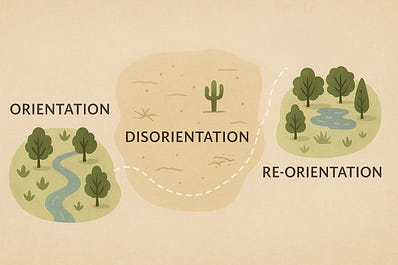
Many models of the unfolding journey see something similar—an early spiritual journey which requires some strengthening of the ego. Just as a child learns to stand on her own two feet and declare her presence to her parents, so we learn early in the journey to develop convictions, establish boundaries, make commitments, and grow in competence.
Early on, we’re often formed within communities with clear theological frameworks and moral certainties and a clear sense of where they stand—and this is quite necessary for the formation of selfhood. But this isn’t a destination, it’s only a passageway on the journey. Conviction is meant to deepen into wisdom. Competence is meant to ripen into service to others. Control is meant to soften into humility. Even boundaries are meant to cultivate generosity.
However, what I’ve observed personally and culturally over decades is that this early scaffolding of the faith is mistaken for maturity itself. In fact, the scaffolding meant to be a support is turned into a sword. What was meant to nurture and develop early in the faith journey is traded for self-protection and defense.
Why?
One reason is that we lack wise elders in the cruciform way.
Ancient traditions, including the Christian tradition, have often taught that we need elders to apprentice us in an initiation into maturity, where we learn the gift of limitations, where we learn to metabolize rather than resist suffering, where we abandon the sturdy scaffolding for surrendered trust.
This is the cruciform journey, where humility grows. Here, we don’t demonstrate our strength. Rather, a deeper strength is recognized in the character of one who no longer needs to prove or protect.
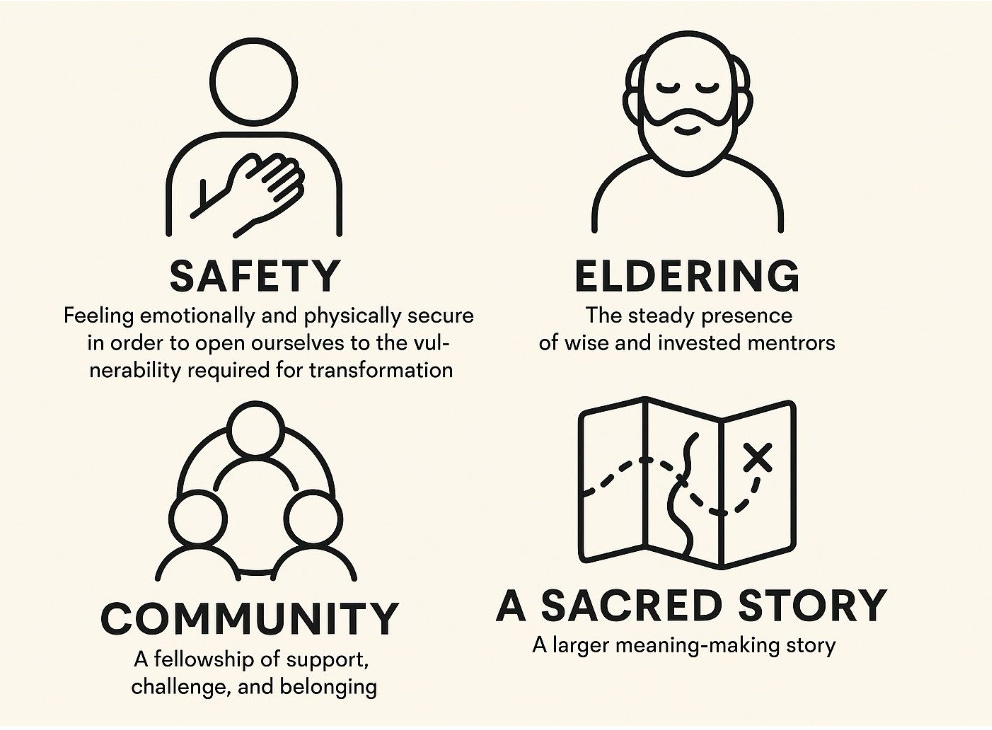
Ancient traditions recognized the significance of an early, safe community where the scaffolding is offered, where an elder guides our path, where a community invites vulnerability and mutuality, and where a sacred story provides a frame and telos for unfolding maturation.
But we’ve largely lost the ancient vision and the tested path. Today, we are seeing a diminishment of curiosity, a narrowing of empathy, an intolerance to difference, a fear of weakness, and a clinging to control.
And the more tightly we control, the more narrow our world becomes.
Instead of growing into generosity, we calcify in arrogance. This is where some of my larger work on narcissism is relevant—narcissism, as I’ve often said, isn’t excessive self-love, it’s self-defense. It’s a shame-based self, one who needs to prove himself in outward displays of strength—like the Caesars of old and the contemporary “Patriots” of today—outwardly impressive but inwardly impoverished.
The ancient sages and contemporary theorists agree—it’s a life stuck in a developmental rut, a perpetual adolescence, like a boy with his guns playing cowboys and Indians at 13 who hasn’t learned the wisdom of surrender and humility. He simply isn’t able to live in a world the prophet Isaiah imagined, a world where God reigns and where the “proud and lofty” are judged, where:
They will beat their swords into plowshares
and their spears into pruning hooks.
Nation will not take up sword against nation,
nor will they train for war anymore. (see Isa. 2).
As ancient and modern sages might say, a sure sign that you’re stuck in an adolescent faith is that the world centers on you, your power, even (as we see today) your capacity to save Christianity, even to save God.
And while that’s a stage of early faith, we’re meant to grow in cruciform hope and loving communion, a life shaped more by a paradoxical victory through the Cross rather than by the sword of control.
I sense today that we have too few elders of maturity and character who are able to hold space for others on this unfolding journey.
We’ve elevated the charismatic and the competent at the expense of character.
We’ve prized quick and microwavable formation for the sake of efficiency and influence while sacrificing the slow and courageous work of cultivating depth and wisdom.
Many shout from the mountaintops these days that we’re abandoning orthodoxy, but perhaps the orthodoxy we’ve more tragically abandoned is the cruciform way.
But what Scripture and history attest to is this: while the way of power and control makes for quick and spectacular victories, the way of the Cross endures. Caesar’s palaces and military complexes lie in ruins today, as vanity projects often do when the shine wears off.
But among the ruins and ashes, a shoot invariably appears, small and unrecognizable at first, yet capable of greening the earth and bearing fruit, if we have the eyes to see and the patience to allow it.
And if you listen closely, you might even hear the hopeful whisper:
“See, I am doing a new thing! Now it springs up; do you not perceive it? I am making a way in the wilderness and streams in the wasteland.” (Isaiah 43:19)
