
Contemplation and Art
Letting Art Speak
Tuesday, November 17, 2026
We are grateful for all who have given freely and joyfully to support the Daily Meditations over the past week! Your generosity makes all of this work possible. If you haven’t donated and wish to do so, please consider making a one-time or recurring gift. Thank you for journeying the contemplative path with us.
Art moves us because it speaks of the Really Real. The creation power embedded in every work of art, its hue and texture—these are just rumors, whispers of a truer Beauty, a deeper Reality that can only be made complete in God.
—Meredith Hite Estevez, Art Is How God Loves Us
The author Meredith Hite Estevez describes creativity as an act of participation with God:
If God is an artist, then there are melodies and words and colors waiting in the stillness, divine gifts. They are breadcrumbs leading the way….
The act of paying attention, being still long enough to stop the incessant striving in your own strength—this type of listening is essential to life as an artist. Listening is the work. Inherent in each moment is an invitation to trust something already at work, to walk out of the studio and into the forest, to let the art speak. [1]
Hite Estevez considers how appreciating art in its many forms allows us to access emotional depth and presence:
In grief and in joy, we stand in front of the rivers and sunsets of our lives, feel the spring wind against our skin after a long winter, and it is the closest we can get to seeing our love, our pain, our hope on a grand scale. God’s artwork speaks of an audacious, unapologetic, abundant, extravagant love—one that holds space for grief and pain—and we are part of it.
This large-scale love and its whispered wisdom are beautifully manifested in [Indigenous visual artist and activist] Christi Belcourt’s Wisdom of the Universe. [2] The towering, nine-by-six-foot canvas imitates traditional Métis beadwork against a dark background. It teems with life, depicting colorful plants, flowers, and animals, many of them endangered in the artist’s native Ontario. In her artist’s statement for the piece, Belcourt says, “The planet already contains all the wisdom of the universe, as do you and I.”
The first time I saw the impossibly bright reds and blues of Belcourt’s canvas, the lush and wild symmetry—which upon closer inspection is playfully disrupted here and there like nature itself—when I heard the questions it asks about abundance and potential loss of the plants and animals it depicts, I felt the artist’s yearning in the glimmering roots. I sensed her broken heart for all she feared losing and had already lost….
That day by the river, the rapids spoke to me of the irrevocability—the cost and the beauty—of love. The timeworn chasm of rock, the persistence and strength of water for millennia, finding a way, it met my longing with powerful and particular questions that pierced my heart with wisdom. I saw my grief and pain reflected in jagged rock and raging rapids; this integral part of an ecosystem carried a message just for me. Like Belcourt’s tiny dots making up a complex and intricate image, one river in a landscape was greater than the sum of its parts.
The wisdom of creation is not so much a soliloquy or sermon, but a whispered question left hanging in the air; more discourse than proclamation, impossibly particular yet universal.
========================
Confessions of a Pastor Trying to Go Analog in 2026
Index cards, a leather notebook, and a cell phone dock are slowly giving me my life back
| BEAU STRINGERNOV 17 |
A few weeks ago, part of our Adult Discipleship Team at Resurrection took a retreat day away together. We spent a portion of that day in solitude, walking around a beautiful pond and thinking about what God has been teaching us lately and what God might want to teach the people of Resurrection. As I walked around that pond, I felt so strongly in my spirit that I needed to slow down. To catch my breath. I’ve been going at a pace that is crushing me. Between weekly essays, teaching classes, and writing a book, the last seven or eight months have been a whirlwind.
After that retreat I decided to make some changes. First, I decided to dock my phone when I’m at home. I keep the ringer on so I can hear texts and phone calls as they come in (that’s the life of ministry), but all other notifications are silenced. The phone sits on a holder in our living room, and I only check it when I have to.
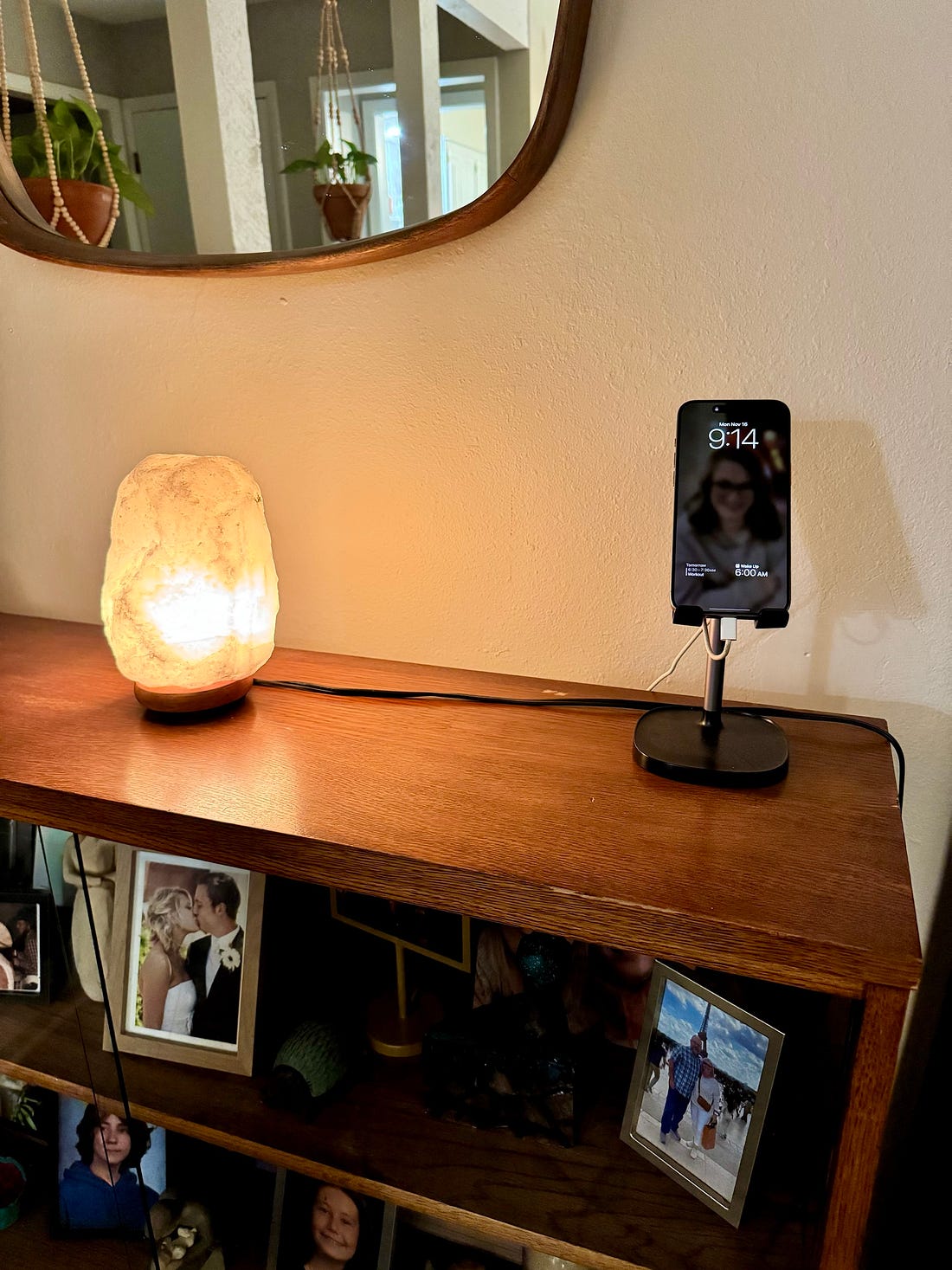
What I didn’t notice when I snapped this photo were the pictures right underneath it. My wife and me on our wedding day. Portraits of my kiddos. My phone is docked directly above the people that darn thing pulls me away from. I didn’t do that on purpose (it had an outlet and it was in a central spot), but I plan to leave it there because it preaches a little sermon to me every time I walk by.
Another piece of this took root after that retreat when I picked up a book that had been sitting on my shelf unread, The Ruthless Elimination of Hurry by John Mark Comer. I’ve owned it for quite a while, but I’ve been on a big fiction kick lately, so it’s just been collecting dust. The title comes from a piece of advice Dallas Willard gave John Ortberg (two people I’ve learned so much from over the years). When Ortberg asked Willard what he needed to do to be spiritually healthy, Willard told him he needed to ruthlessly eliminate hurry from his life. I haven’t been able to stop thinking about that advice ever since.
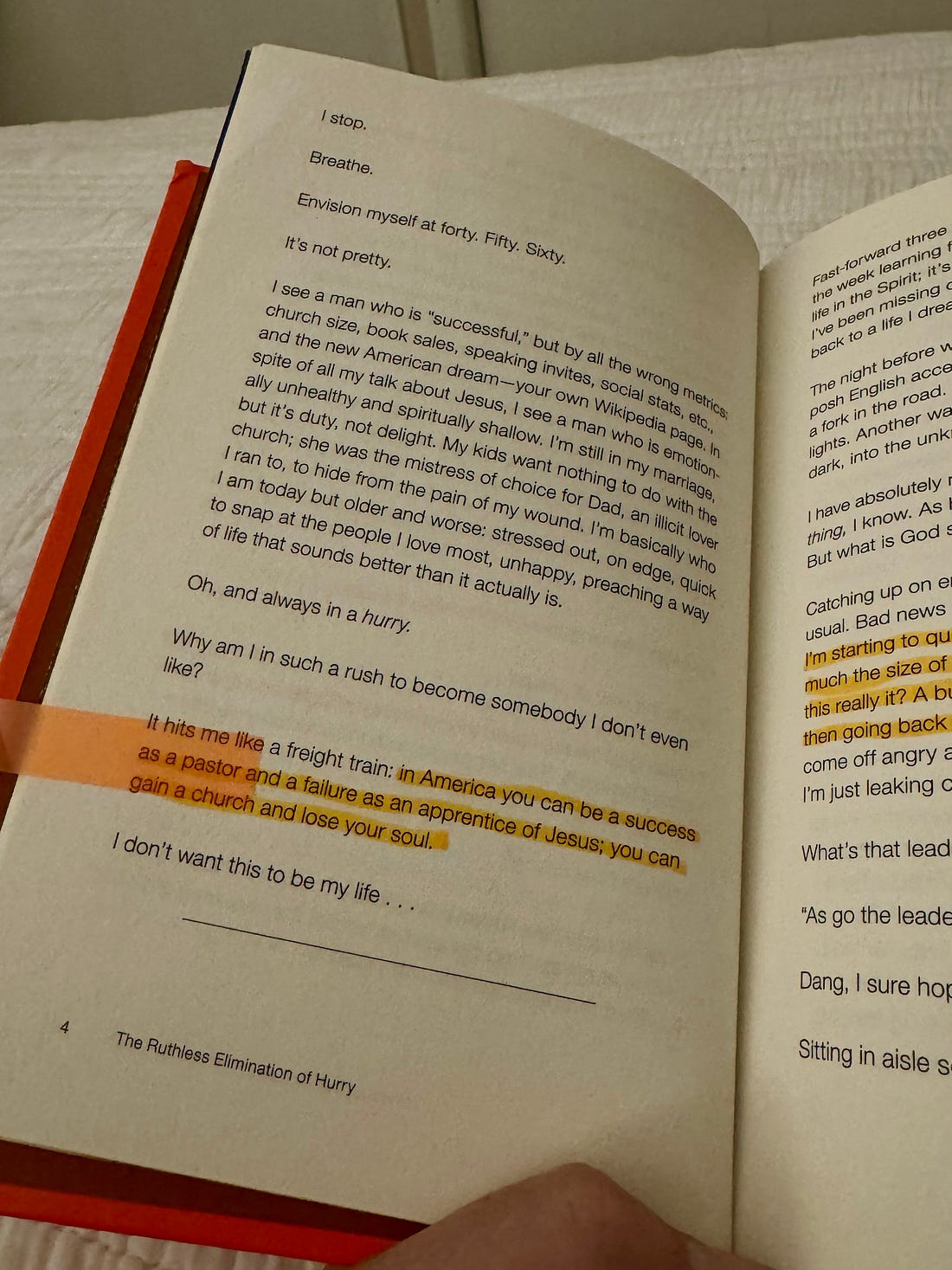
Early in the book, Comer pictures what his life might look like at forty, fifty, and sixty years old, and he doesn’t love what he sees. His metrics for “success” were all wrong. Things like church size, book sales, speaking invites, social stats, and so on. Then he wrote a line I had to highlight.
“In America you can be a success as a pastor and a failure as an apprentice of Jesus; you can gain a church and lose your soul.”
Woof.
I’ll be honest, that was a dagger. Those are the things I’ve cared too much about. I have a book coming out, a newsletter to grow, and a social media platform to manage. Reading that page felt like someone had been looking over my shoulder at my phone, which is maybe the whole point.
So, I decided to go analog.
Part of going analog for me has been changing the way I read. I read A LOT. Mostly fiction the last few years, plus plenty of theology and essays online about Scripture, faith, leadership, and the church. Because I do most of that reading on my computer or phone, I realized I was constantly getting distracted and not being fully present with the material. I tend to fly through things without retaining much. I want to change that, so I’ve started keeping a commonplace book.
Have you heard of this?
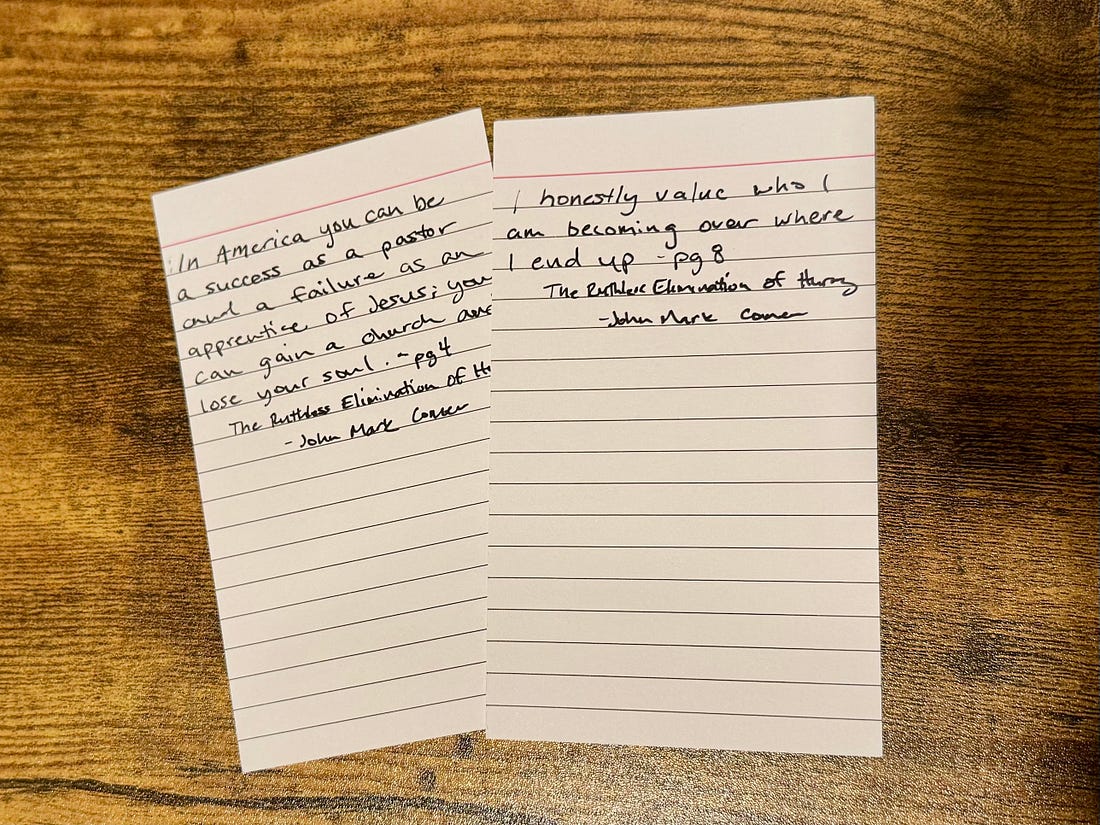
I learned the idea from Ryan Holiday (look up his videos on YouTube). You read with a highlighter and pen in hand, highlighting and taking notes as you go. When you finish the book, you let it sit for a few days, then come back and transfer all your notes and highlights to index cards. This forces you to engage with the text again, and it’s a physical thing. Sure, you could do it digitally, but going analog helps with retention. Once all your highlights and notes are on index cards, you file them by topic or theme. The whole process slows you down. I read a lot less, but I remember a lot more of what I read.
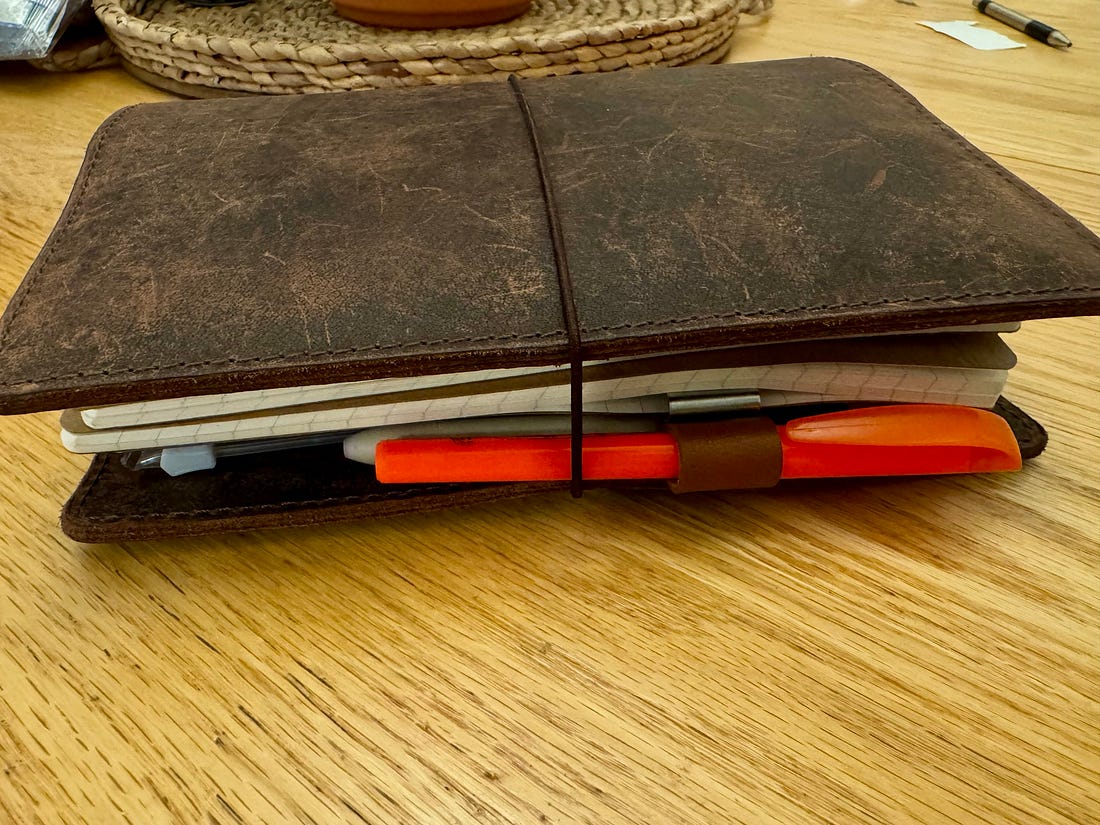
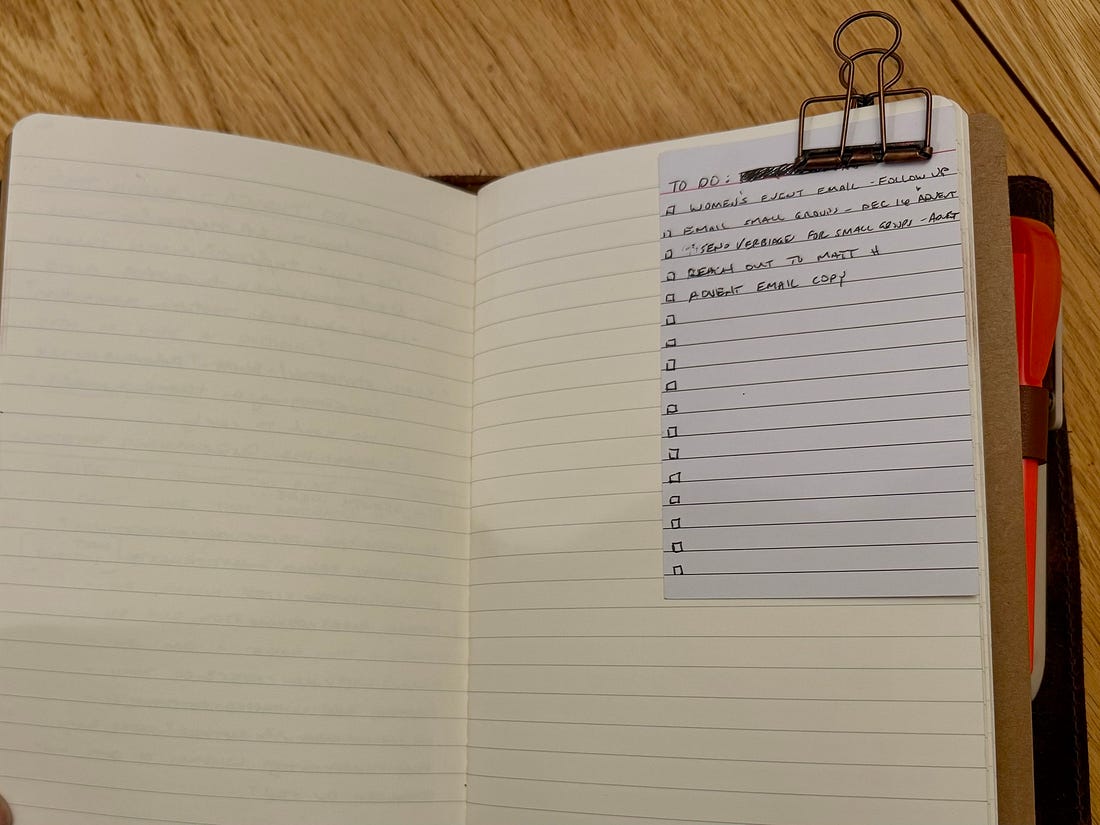
The other big piece for me has been this beat up leather traveler’s notebook. I bought it a while ago, but I’ve recently made some additions and adjustments to what I keep in it. Basically, I’m trying to use my phone less. So my to-do list lives on a notecard in here, and in meetings I try to take notes by hand and keep them in here too.
I also decided to fill it with things I love. There’s a card with the Three General Rules of the Methodists on it. There’s a sticker that says Love Boldly, Serve Joyfully, Lead Courageously, which is a great reminder every time I open it. There are Mister Rogers stamps, because he’s one of my heroes and I like having him nearby. And there’s an old Apple employee card a congregant gave me years ago because he knew how much I love Apple products. I love having that little piece of Apple history riding around in my analog notebook.
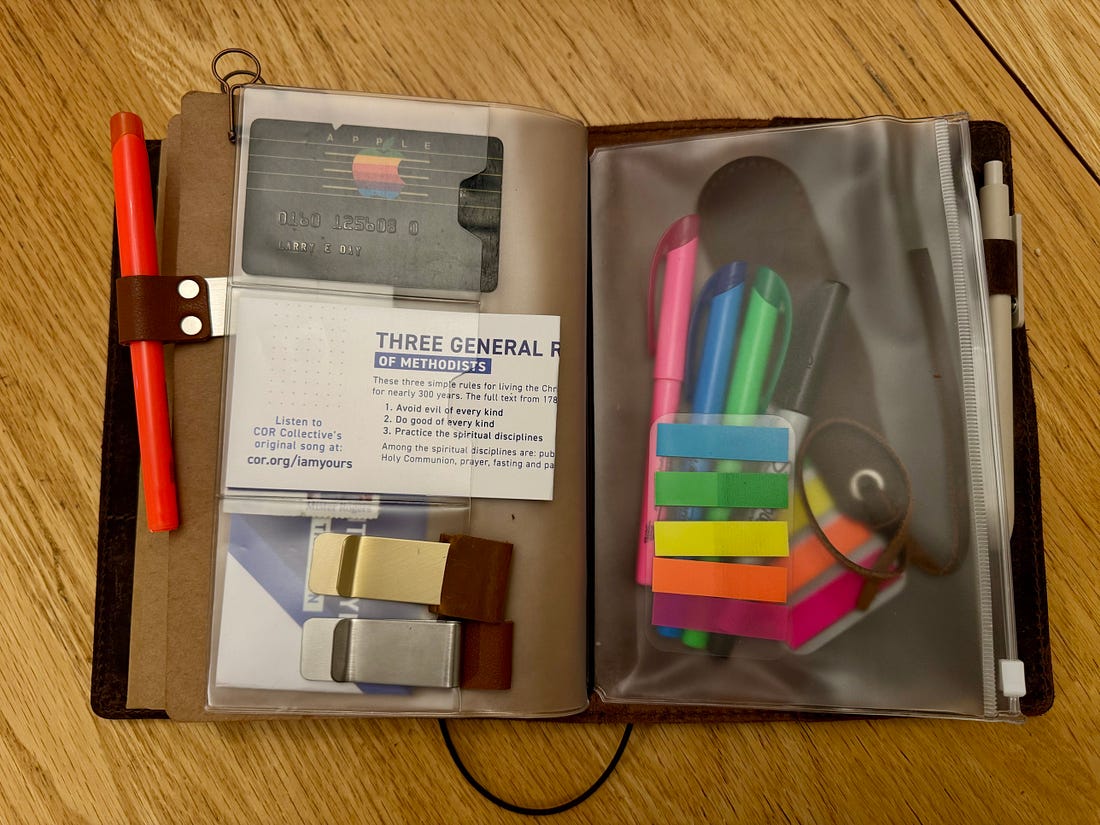
None of this stuff is super fancy, but it matters to me and brings a smile to my face during the day.
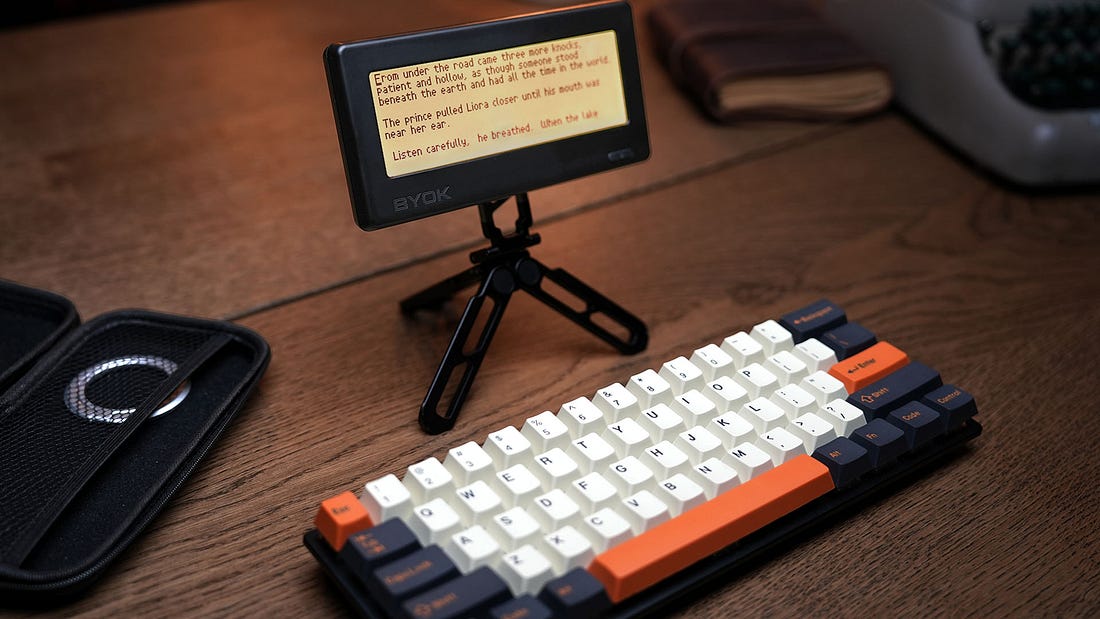
One other thing I’m really excited about (an early Christmas gift from my wife) is something called a BYOK. BYOK stands for “bring your own keyboard,” and it’s a distraction free writing device. I do a lot of writing, and this is basically a small screen and a keyboard. That’s it. No notifications, no distractions. The screen connects wirelessly to the keyboard, so I can write just about anywhere, on a park bench or an airplane, without anything pulling at me. It’s not here yet, but I’ll let you know how it goes once it shows up.
So what about social media? This is the part I’m still trying to figure out. I get the irony of you reading this on a screen. I know. Writing to you all online is part of my ministry (so I plan to keep at it) but I want to do it with wisdom. When I can, I want to draft things on paper or on the BYOK first. That should slow me down. I have also been checking messages and comments during a set time each day instead of all day long. That’s been going well so far.
Something I didn’t see coming, even after just a few weeks of these changes, is how much more present I am. This past weekend I was a weepy mess. Words at a funeral touched my heart, worship songs moved me, and I felt a huge sense of gratitude for Resurrection and for where God has our family in this season. I’m more present with my family. I’m more sensitive to what God is doing around me. Simone Weil said that attention is the rarest and purest form of generosity, and I’m learning that my attention is one of the only things I really have to give to God and the people around me. For a long time I was handing most of it to my phone.
If any of this stirs something in you, start small. Dock your phone, try and slow down, take some notes while you read, write with a pen and paper and without distractions, or be more intentional with your presence.
See if God surprises you.
