Author and
Benedictine sister Joan Chittister catalogs how some of the most common images
of God influence our behavior and reminds us that we can choose more helpful
and loving images.
In the long light of human history, then, it is not belief in God that sets us apart. It is the kind of God in which we choose to believe that in the end makes all the difference. Some believe in a God of wrath and become wrathful with others as a result. Some believe in a God who is indifferent to the world and, when they find themselves alone, as all of us do at some time or another, shrivel up and die inside from the indifference they feel in the world around them. Some believe in a God who makes traffic lights turn green and so become the children of magical coincidence . . . . Some believe in a God of laws and crumble in spirit and psyche when they themselves break them or else become even more stern in demanding from others standards they themselves cannot keep. They conceive of God as the manipulator of the universe, rather than its blessing-Maker. . . .
I have known all of those Gods in my own life. They have all failed me. I have feared God and been judgmental of others. I have used God to get me through life and, as a result, failed to take steps to change life myself. I have been blind to the God within me and so, thinking of God as far away, have failed to make God present to others. I have allowed God to be mediated to me through images of God foreign to the very idea of God: God the puppeteer, God the potentate, God the persecutor make a mockery of the very definition of God. I have come to the conclusion, after a lifetime of looking for God, that such a divinity is a graven image of ourselves, that such a deity is not a god big enough to believe in. Indeed, it is the God in whom we choose to believe that determines the rest of life for us. In our conception of the nature of God lies the kernel of the spiritual life. Made in the image of God, we grow in the image of the God we make for ourselves. . . .
Chittister invites us to the
prayerful inner work necessary to discover the God we really believe in, for
the sake of encountering the true and living God:
Until I discover the God in which I believe, I will never understand another thing about my own life. If my God is harsh judge, I will live in unquenchable guilt. If my God is Holy Nothingness, I will live a life of cosmic loneliness. If my God is taunt and bully, I will live my life impaled on the pin of a grinning giant. If my God is life and hope, I will live my life in fullness overflowing forever.
Sarah Young……
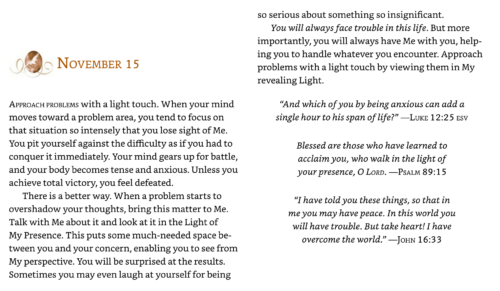
PROBLEMS ARE PART OF LIFE. They are inescapable, woven into the very fabric of this fallen world. You tend to go into problem-solving mode all too readily, acting as if you have the capacity to fix everything. This is a habitual response, so automatic that it bypasses your conscious thinking. Not only does this habit frustrate you, it also distances you from Me. Do not let fixing things be your top priority. You are ever so limited in your capacity to correct all that is wrong in the world around you. Don’t weigh yourself down with responsibilities that are not your own. Instead, make your relationship with Me your primary concern. Talk with Me about whatever is on your mind, seeking My perspective on the situation. Rather than trying to fix everything that comes to your attention, ask Me to show you what is truly important. Remember that you are en route to heaven, and let your problems fade in the Light of eternity.
PSALM 32:8; I will instruct you and teach you in the way
you should go; I will counsel you with my loving eye on you
LUKE 10:41–42; “Martha, Martha,” the LORD
answered, “you are worried and upset about many things, ⁴²but few things
are needed-or indeed only one. Mary has chosen what is better, and it will not
be taken away from her.”
PHILIPPIANS 3:20–21; But our citizenship is in heaven.
And we eagerly await a Savior from there, the LORD Jesus Christ, ^21who, by the
power that enables him to bring everything under his control, will transform
our lowly bodies so that they will be like his glorious body.
Young, Sarah. Jesus Calling Morning and Evening
Devotional (Jesus Calling®) (p. 690). Thomas Nelson. Kindle Edition.
lover of GodItalian: from the personal name Amadeo, Amodeo, coined in the early Middle Ages with the meaning ‘lover of God‘ or ‘loved by God’.
Creating God in Our Own Image
The Advent season begins with Scriptures that focus on the “second coming” of Christ. At times, this has been presented as a frightening event, exacerbated by the negative images of God which many Christians hold. Father Richard writes:
Your image of God creates you—or defeats you. There is an absolute connection between how we see God and how we see ourselves and the universe. The word “God” is a stand-in word for everything—Reality, truth, and the very shape of our universe. This is why good theology and spirituality can make such a major difference in how we live our daily lives in this world. God is Reality with a Face—which is the only way most humans know how to relate to anything. There has to be a face!
After years of giving and receiving spiritual direction, it has become clear to me and to many of my colleagues that most people’s operative image of God is initially a subtle combination of their mom and dad, or other early authority figures. Without an interior journey of prayer or inner experience, much of religion is largely childhood conditioning, which God surely understands and uses. Yet atheists and many former Christians rightly react against this because such religion is so childish and often fear-based, and so they argue against a caricature of faith. I would not believe in that god myself!
Our goal, of course, is to grow toward an adult religion that includes reason, faith, and inner experience we can trust. A mature God creates mature people. A big God creates big people. A punitive God creates punitive people.
If our mothers were punitive, our God is usually punitive too. We will then spend much of our lives submitting to that punitive God or angrily reacting against it. If our father figures were cold and withdrawn, we will assume that God is cold and withdrawn too—all Scriptures, Jesus, and mystics to the contrary. If all authority in our lives came through men, we probably assume and even prefer a male image of God, even if our hearts desire otherwise. As we were taught in Scholastic philosophy, “whatever is received is received in the manner of the receiver.” [1] This is one of those things hidden in plain sight, but it still remains well-hidden to most Christians.
All of this is mirrored in political worldviews as well. Good theology makes for good politics and positive social relationships. Bad theology makes for stingy politics, a largely reward/punishment frame, xenophobia, and highly controlled relationships.
For me, as a Christian, the still underdeveloped image of God as Trinity is the way out and the way through all limited concepts of God. Jesus comes to invite us into an Infinite and Eternal Flow of Perfect Love between Three—which flows only in one, entirely positive direction. There is no “backsplash” in the Trinity but only Infinite Outpouring—which is the entire universe. Yet even here we needed to give each of the three a placeholder name, a “face,” and a personality.
Finding Ourselves in God
Father Richard reminds us that we are created in the image and likeness of God, which offers us a solid foundation from which we can operate in the world.
The biblical creation story says, “Let us make humans in our image” (Genesis 1:26). The plural pronoun is a first hint that we are going to be brought into a relational, participatory, and shared life. The secret is somehow planted within our deepest identity and slowly reveals itself—if we are attentive to this “reverence humming in [us],” as Jane Fonda once described it. [1]
Our DNA is divine, and the divine indwelling is never earned by any behavior, group membership, or ritual whatsoever, but only recognized and realized (see Romans 11:6; Ephesians 2:8–10) and thus fallen in love with. When we are ready, we will be both underwhelmed and overwhelmed at the boundless mystery of our own humanity. We will know we are standing under the same waterfall of mercy as everybody else and receiving an undeserved radical grace, which is the root cause of every ensouled being.
When I started in ministry in the early 1970s in Cincinnati and worked with young people, it seemed like I spent most of the time trying to convince teenagers that they were good. They all seemed to endlessly hate and doubt themselves, often with a little help from parenting and clergy. Later I saw it in adults, too, who were also well practiced in hating and fearing themselves. What the Scriptures promise us is that we are objectively and inherently children of God (see 1 John 3:2). And you can’t change that! This is not psychological worthiness; it is ontological, metaphysical, substantial worthiness that cannot be gained or lost. When this given God image becomes our operative self-image, we are home free! Such a Gospel is just about the best good news anyone could hope for!
I am convinced that so much guilt, negative self-image, self-hatred, and self-preoccupation occurs because we have taken our cues and identity from a competitive and comparing world. But Jesus told us to never take this world as normative. Jesus asks, “Why do you look to one another for approval instead of the approval that comes from the one God?” (John 5:44). So many of us accept either a successful or a low self-image inside of a system of false images to begin with! (Smart, good looking, classy, loser—are all just words humans create). This will never work. We must find our true self “hidden within Christ in God,” as Paul says in Colossians 3:3. Or, as Teresa of Ávila envisioned God telling her, “If you wish to find Me / In yourself seek Me.[2] Then we do not go up and down, but we are built on the Rock of Ages. It is the very shape of all spiritual maturity, regardless of what religion we may belong to.
This is from the Irish Prayer book I mentioned. It’s part of the introduction.
How to use this book
I have always wanted to write a book of recipes. Soups, probably; something to warm the heart. My recipes are vague about amounts but come with poetry suggestions. When cooking stew, for instance, it is best to read Patrick Kavanagh’s In Memory of My Mother (both versions, check out Tom Stack’s edited collection) aloud; when making roast pear, chicken and garlic soup (topped with blue cheese) it is always wise to read Marie Howe’s Magdalene − the Seven Devils; and when you mix red onion, with red peppers, fresh tomatoes and fresh strawberries, topped with a suspicion of chilli, lime, basil and saltflakes, you should always, and only, read Mary Karr’s Disgraceland. If you’re putting roast butternut squash in a soup with coconut milk, make sure to toast pine nuts, and top the soup with those and a little sesame oil. Read Seán Ó Riordáin’s Oidhreacht Fán Anam while you do it, it’ll break your heart. You’ll need to learn Irish first, but everything good requires effort. Alternatively, listen to Íarla Ó Lionaird’s sung version with The Gloaming. My friend Devin phoned me from California once wanting to know whether a recipe I’d written required one clove of garlic or two. He was asking the wrong person, but he was a man in need of detail and he believed that I loved him enough to give him detail even if I didn’t have detail to give. How many do you feel you need? I asked him. He laughed and called me an idiot. He asked me again, how many cloves of garlic? Use your imagination, I said, but he wanted to use mine. I love him dearly, so I made an answer up. It worked, I think. I forget how many cloves. Most of us are in a dialogue when we read a book. I know I am. That’s the point, I think; to listen to the writer, to listen to yourself and to listen to the space between where things said by neither are nonetheless said. The things we take away are the things that we were already looking for. What you seek is seeking you, said Rumi, and while this is a frightening concept, it can a consoling one if we listen to the desires that will feed us, not destroy us. Rumi asks us to trust that wisdom waits, and might be found in unlikely corners. So read a lot, make pots of soup and use this book however you want. Mix up the prayers, and make your own. Write in the margins, cross words out, fix them, make a solution. Sometimes I pray the morning prayers and then turn to the day of the month for a text and a collect, and then add in intentions of my own, finishing with the Prayer for Courage. Courage is the mixture between fear and resolution, and only exists when we do something about it. Do not fear, we hear over and over. The prayers in this book are prayers that start with the fear and move toward the doing. Do not only fear, we say. It’s a fine beginning, let courage be your moving. Let prayer help. Ignatius of Loyola said: ‘That level of prayer is best for each particular individual where God our Lord communicates Himself more. He sees, he knows, what is best for each one and, as he knows all, he shows each the road to take. What we can do to find that way with his divine grace is to seek and test the way forward in many different fashions, so that an individual goes ahead in that way which for him or her is the clearest and happiest and most blessed in this life.’ All of that goes to say: you’ll need to make your own damned soup, because only you can make it. You know your own needs, or you will. Take bones and flesh and blood and fruits of the dark earth, put in water, put in salt and put a fire to it. Let it boil, let it cool a little. Season with what your season needs. Eat it, drink it, survive and look around. Be a little bit glorious. Be warm and open. Share. Keep some for tomorrow. Give plenty away. Amen.
Tuama, Padraig O. Daily Prayer with the Corrymeela Community . Hymns Ancient & Modern. Kindle Edition.
Father Richard elaborates on Jung’s teaching on the importance of inner experience as the only pathway to transformation.
Carl Jung wanted to bring externalized religion back to its internal foundations. He saw how religion kept emphasizing the unbridgeable distance between the Creator and creation, God and humanity, inner and outer, the one and the many. In spite of creation’s ecological unity (Genesis 1:9–31), Christianity too often began by emphasizing the problem of separation (“original sin”) instead of beginning with the wonderful unity between creation and Creator.
Except for the experience of many saints and mystics, religion has greatly underemphasized any internal, natural resonance between humans and God. This gives us clergy an almost impossible job! First, we must remind everyone that they are “intrinsically disordered” or sinful—which then allows us to just happen to have the perfect solution. It is like a vacuum cleaner seller first pouring dirt on the floor to show how well this model works. As if the meaning of this beautiful universe could start with a foundational problem!
Christianity rarely emphasized the plausibility or power of inner spiritual experience. Catholics were told to believe the pope, the bishops, and the priests. Protestants were told to believe the Bible. The Catholic version has fallen apart with the pedophilia crisis worldwide; Protestantism’s total reliance on preaching the Bible has been undone by postmodern worldviews. But both Catholics and Protestants made the same initial mistake, I’m sorry to say. It’s all about trusting something outside of ourselves. We gave people answers that were extrinsic to the soul and dismissed anything known from the inside out. “Holiness” largely became a matter of intellect and will, instead of a deep inner trust with an inner dialogue of Love. It made us think that the one with the most willpower wins, and the one who understands things the best is the beloved of God—the opposite of most biblical heroes. We’ve been gazing at our own “performance” instead of searching for the Divine in us and in all things.
We must begin with a foundational “yes” to who we are and to what is (Reality). This is mature religion’s primary function. It creates the bedrock foundation for all effective faith. If we begin with a problem, the whole journey remains largely a negative problem-solving exercise that never ends. We’re left with inherently argumentative and competitive Christianity.
If we begin with the positive, and get the issue of core identity absolutely clear, the rest of the journey—even though it isn’t always easy—is by far more natural, more beautiful, more joyful and all-inclusive. What else should the spiritual journey be? When we start in the basement, most people never believe they can even get to the first floor, and they just opt out. Isn’t this obvious at this point in Christian history? Sadly, we clergy became angry guards instead of joyful guides, policing dogma instead of proclaiming the Great Gift which is perfectly hidden and perfectly revealed at the heart of all creation from the very beginning.
Ann Ulanov is a noted Jungian scholar, theologian, and therapist. Here she writes about “aliveness” as the key to transformation:
Aliveness comes down to one thing—consenting to rise, to be dented, impressed, pressed in upon, to rejoin, to open, to ponder, to be where we are in this moment and see what happens, allowing the breath of not knowing to be taken, wanting to see what is there and what is not there. Aliveness springs from our making something of what we experience and receiving what experience makes of us. This is the wonder of the child the New Testament always recommends us toreturnto, what the philosopher Paul Ricœur calls our “second naiveté”. . . . In such a space we allow ourselves to depend on something greater than ourselves, to take what it gives us and respond to it. . . . [RR: This is the beginning of an actual relationship with God and the movement beyond mere religion.]
Wanting to protect ourselves from psychic pain, we limit our imaginations, our ability to play around with ideas, our bodily sensations. We take someone else’s words instead of fumble for our own. We neglect giving attention to our dreams. We fear to go down into the depths of one relationship and instead substitute ever new ones. We avoid saying the hard truth to one we love. . . . We may sacrifice whole parts of ourselves in order to protect against pain, but then the whole of us loses some of its essential vitality. . . .
This struggle to live all we can in the face of death, illness, loss of relationship, unbearable grief, acts of injustice, is a struggle we share in all our different circumstances of life. . . . In the New Testament words, the pearl of great price [Matthew 13:45–46] is what we sell all we have for the sake of; riches, fame, security do not ensure simple happiness in being, only this precious aliveness. What, then, is that pearl of great price? It is feeling alive and real, vibrantly the aliveness that belongs to each of us. [1]
CAC teacher and author Brian McLaren reflects on the spiritual journey as a quest for aliveness. He writes:
What we all want is pretty simple, really. We want to be alive. To feel alive. Not just to exist but to thrive, to live out loud, walk tall, breathe free. We want to be less lonely, less exhausted, less conflicted or afraid . . . more awake, more grateful, more energized and purposeful. We capture this kind of mindful, overbrimming life in terms like well-being, shalom, blessedness, wholeness, harmony, life to the full, and aliveness. . . .
The quest for aliveness is the best thing about religion, I think. It’s what we’re hoping for when we pray. It’s why we gather, celebrate, eat, abstain, attend, practice, sing, and contemplate. When people say “I’m spiritual,” what they mean, I think, is simple: “I’m seeking aliveness.” [2]
Father Richard
continues to explore how archetypes connect us to the story of God and the
universe.
The small self is intrinsically unhappy because it fundamentally
lacks reality. To use a philosophical word, its nonbeing means it does not
exist “ontologically.” It will thus always be insecure, afraid, and scrambling
for significance. With no storyline, no integrating images that define who
we are or direct our lives, we just won’t be happy. Carl Jung developed this
idea for our generation of Western rationalists, who had thought that myth
meant “not true”—when in fact the older meaning of myth is precisely “always
and deeply true”!
Jung goes so far as to say that transformation only
happens in the presence of story, myth, and image. A great story pulls us
inside of a universal story; it lodges in the unconscious where it is
inaccessible to the brutalities of our own mind or will, [1] as Thomas Merton
observed. From that hidden place we are healed. For Christians, Jesus’ life is
the archetypal map of Everyman and Everywoman: divine conception, ordinary
life, betrayal, abandonment, rejection, crucifixion, resurrection, and
ascension. It all comes full circle, as we return to where we started, though
now transformed. Jung saw this basic pattern repeated in every human life. He
called it the Christ Archetype, “an almost perfect map” of the whole journey of
human transformation. Jung’s notion of an Archetype or Ruling Image can help us
understand the “Universal Stand-In” that Jesus is and was meant to be.
A Great Story Line connects our little lives to the One
Great Life, and even better, it forgives and uses the wounded and seemingly
“unworthy” parts (1 Corinthians 12:22), which Jung would call the necessary
“integration of the negative.” What a message! Like good art, a Cosmic Myth
like the Gospel gives a sense of universal belonging and personal participation
in Something/Someone much larger than ourselves.
We are finding it is nearly impossible to heal isolated
individuals inside of a culture as unhealthy and unhealed as the USA, and
inside any version of Christianity that supports exclusion and superiority.
Individuals who remain inside of an incoherent and unsafe universe soon fall
back into anger, fear, and narcissism. I sadly say this after 46 years of
giving retreats, conferences, and initiation rites all over the world. Only
people who went on to develop a contemplative mind could finally grow and
benefit from the message that they heard.
In the most recent issue of Oneing, Father Richard honors those who
make the full journey of integration. These are people who find their own
smaller stories within God’s great story, what Richard calls “The Story”:
Those who truly live in The Story have embraced and integrated their personality, shadow, woundedness, family issues, culture, and contextualizing life experiences under The One. . . . This is a truly integral spirituality, a truly catholic worldview, and the unrecognized goal of all monotheistic religions. These, like Jesus, desire “nowhere to rest their head” except in the One and Universal Love. [2]
______________________________________
Sarah Young…
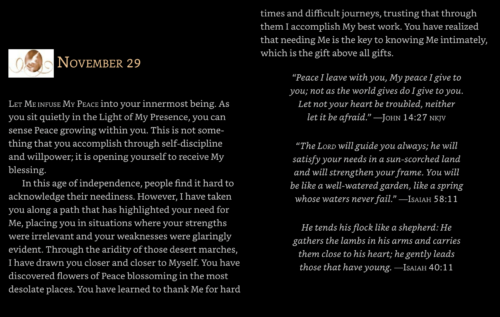
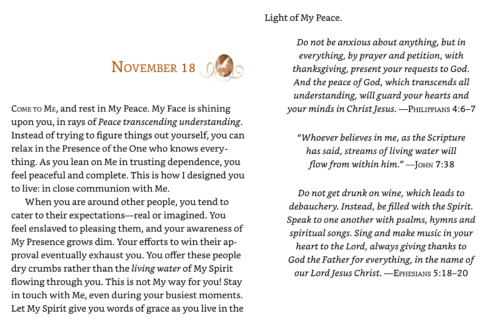
AS YOU SIT QUIETLY IN MY PRESENCE, let Me fill your heart and mind with thankfulness. This is the most direct way to achieve a thankful stance. If your mind needs a focal point, gaze at My Love poured out for you on the cross. Remember that nothing in heaven or on earth can separate you from that Love. This remembrance builds a foundation of gratitude in you, a foundation that circumstances cannot shake. As you go through this day, look for tiny treasures strategically placed along the way. I lovingly go before you and plant little pleasures to brighten your day. Look carefully for them, and pluck them one by one. When you reach the end of the day, you will have gathered a lovely bouquet. Offer it up to Me with a grateful heart. Receive My Peace as you lie down to sleep, with thankful thoughts playing a lullaby in your mind.
ROMANS 8:38–39; For I am convinced that neither death nor
life, neither angels nor demons, neither the present nor the future, nor any
powers, ³⁹neither height nor depth, nor anything else in all creation, will be
able to separate us from the love of God that is in Christ Jesus our LORD.
1 CORINTHIANS
3:11; 11For no one can lay any foundation other than the one already laid,
which is Jesus Christ.
PSALM 4:7–8; Fill my heart with joy when their grain and
new wine abound. ⁸In peace I will lie down and sleep, for you alone, LORD, make
me dwell in safety.
Father Richard shares the importance of archetypes for the soul’s encounter with God, which Jung explored in great depth.
Depth psychology tells us that our lives are guided by subconscious, ruling images which Jung calls archetypes. Jungian archetypes include the father, the mother, the eternal child, the hero, the virgin, the wise old man, the trickster, the devil, and the God image. These worldwide archetypes just keep recurring in different ways and form part of what he called “the collective unconscious.” These fundamental patterns show up in dreams and behavior in every culture, fascinate the soul, and appear in symbols and stories that go as far back in time as we can go.
For Jung, the God archetype is the soul’s whole-making function that drives us toward giving ourselves totally to something or someone, and initiates our desire for the absolute. It says to us: “Become who you are. Become all that you are. There is still more of you to be discovered, forgiven, and loved.” In the journey toward psychic wholeness, Jung stresses the necessary role of religion or the God archetype in integrating opposites, including the conscious and the unconscious, the one and the many, good (by embracing it) and evil (by forgiving it), masculine and feminine, the small self and the Big Self. I call this deep center of the psyche the True Self, the Christ Self, which has learned to consciously abide in union with the Presence within us (John 14:17).
Jung sees the unconscious as the seat of the “numinous,” where the God archetype lives. The Latin word numen is actually another word for the Divine. Something numinous is an awesome, wondrous experience that pulls you into a transcendent moment. Jung thus offers a foundation for rediscovering the soul and recognizing that soul both as within and yet shared with a much greater reality. God is not just out there! This essential insight overcomes the gap between transcendence and immanence.
Augustine (354–430) said much the same: “God is more intimate to me than I am to myself.” [1] Meister Eckhart (1260–1327) preached: Between God and the soul “there is neither strangeness nor distance.” [2] Yet most people have never been told there is a place to go to that’s called the soul. Soul is the blueprint inside of every living thing that tells it what it is and what it can still become. When we meet anything at that level, we will respect, protect, and love it. Much of religion, I’m sorry to say, doesn’t teach us or give us this essential light. It doesn’t help us understand the deep character of the Incarnation and how God has chosen our soul as God’s enduring dwelling place. We would have done much better to help other Christians discover their souls instead of always trying to “save” them.
Inner Authority
Father Richard often credits the Swiss psychotherapist Carl Gustav Jung (1875–1961) as one of his primary teachers, who greatly influenced his understanding of the human psyche, religion, and theology.
I first read Jung’s work in college, and again and again he would offer concepts that I knew were true. At the time, I didn’t have the education to intellectually justify it; I just knew intuitively that he was largely right. Jung brought together practical theology with very good psychology. He surely is no enemy of religion, as some imagine. When asked at the end of his life if he “believed” in God, Jung replied, “I could not say I believe. I know! I have had the experience of being gripped by something that is stronger than myself, something that people call God.” [1] I’m convinced he is one of the best friends of the contemplative inner life. He suggested the whole problem is that Christianity does not connect with the soul or transform people anymore. He insists on actual “inner, transcendent experience” [2] to anchor individuals to God, and that’s what mystics always emphasize.
One of the things Jung taught was that the human psyche is the mediation point for God. If God wants to speak to us, God usually speaks in words that first feel like our own thoughts. How else could God come to us? We have to be taught how to honor and allow that, how to give it authority, and to recognize that sometimes our thoughts are God’s thoughts. Contemplation helps train such awareness in us. The dualistic or non-contemplative mind cannot imagine how both could be true at the same time. The contemplative mind sees things in wholes and not in divided parts.
In an account written several years before his death, Jung described his early sense that “Nobody could rob me of the conviction that it was enjoined upon me to do what God wanted and not what I wanted. That gave me the strength to go my own way.” [3]
We all must find an inner authority that we can trust that is bigger than our own. This way, we know it’s not only us thinking these thoughts. When we are able to trust God directly, it balances out the almost exclusive reliance on external authority (Scripture for Protestants; Tradition for Catholics). Much of what passes as religion is external to the self, top-down religion, operating from the outside in. Carl Jung wanted to teach people to honor religious symbols, but from the inside out. He wanted people to recognize those numinous voices already in our deepest depths. Without deep contact with one’s in-depth self, Jung believed one could not know God. That’s not just Jungian psychology. Read Teresa of Ávila’s Interior Castle. The first mansion, where we first meet God, is radical honesty about ourselves, warts and all. Similar teachers include Augustine, Thérèse of Lisieux, Lady Julian of Norwich, Meister Eckhart, and Francis of Assisi.
In this conversation, CAC teacher and therapist James Finley shares his belief that we can only be freed from our addictions by healing our original wound—a loss of connection with divine love. Jim speaks here about the healing nature of seeing ourselves as God sees us.
We can say that the deepest question of my life, really, is not what my father . . . or my mother thought of me, or what my husband or wife thinks of me, or what my pastor or my boss thinks of me. Really, the deepest issue isn’t what I think of me, but can I join God in knowing who God knows me to be? Can I join God in seeing who God sees me to be when God sees me? This is salvation.
In order to do this, I have to let go of my own present way of seeing things, and I discover I can’t. We’re afraid to lose the control that we think that we have over the life that we think that we’re living, and we’re addicted to what blinds us. . . . The mystery of the cross, then, is this mystery of just being liberated from this deep addiction to the illusion of an ultimately isolated self that has to make it on its own. To realize I’m in the presence of the love that loves us and takes us to itself. . . .
Jim envisions God saying to each of us, in the midst of our struggles:
You know what? . . . I’m in love with you. I’m so in love with you that I’m utterly giving myself away [to you] as invincibly precious in my eyes, in the midst of the unresolved matters of your heart. I find in these unresolved matters no obstacle to how infinitely precious you are to me as I pour out and give myself to you as life of my life. . . .
Jim concludes:
That’s faith in the higher power. But what if the brokenness has no authority at all over us? What if only love has the authority over us? That’s the essence of the gospel. The essence of the gospel is there. That’s why I say the miracle stories of Jesus, when you really look at the healing stories, they’re all the same, basically. A person brings suffering; Jesus listens to the suffering, responds to the suffering. But Jesus sees the essence of their suffering isn’t that their daughter died or they can’t see or they can’t walk, or they’re a prostitute or a tax collector. The issue of their suffering is they think theyare what’s wrong with them. It’s the idolatry of their shame. Reflected in [Jesus’] eyes, they see their true face before they were born, hidden with Christ in God forever. That’s experiential salvation.
Note: Because the Richard Rohr devotional today was preempted by the biannual request for donations, Sarah Young’s devotional follows.
AS YOU LOOK at the day before you, you see a twisted, complicated path, with branches going off in all directions. You wonder how you can possibly find your way through that maze. Then you remember the One who is with you always, holding you by your right hand. You recall My promise to guide you with My counsel, and you begin to relax.
As you look again at the path ahead, you notice that a peaceful fog has settled over it, obscuring your view. You can see only a few steps in front of you, so you turn your attention more fully to Me and begin to enjoy My Presence.
The fog is a protection for you, calling you back into the present moment. Although I inhabit all of space and time, you can communicate with Me only here and now. Someday the fog will no longer be necessary, for you will have learned to keep your focus on Me and on the path just ahead of you.
PSALM 73:23–24; Yet I am always with you; you hold me by my right hand. ²⁴You guide me with your counsel, and afterward you will take me into glory.
PSALM 25:4–5; Show me your ways, LORD, teach me your paths. ⁵Guide me in your truth and teach me, for you are God my Savior, and my hope is in you all day long.
1 CORINTHIANS 13:12; 12For now we see only a reflection as in a mirror; then we shall see face to face. Now I know in part; then I shall know fully, even as I am fully known.
Young, Sarah. Jesus Calling Morning and Evening Devotional (Jesus Calling®) (p. 662). Thomas Nelson. Kindle Edition.
I do not understand my own behavior. I fail to carry out the very things I want to do, and find myself doing the very things I hate. . . . For although the will to do what is good is in me, the performance is not. —Romans 7:15, 18
Father Richard Rohr continues his thoughts on addiction and transformation:
Addiction is a modern name and honest description for what the biblical tradition called “sin” and medieval Christians called “passions” or “attachments.” They both recognized that serious measures, or practices, were needed to break us out of these illusions and trances. In some cases, the New Testament calls them “exorcisms”! They knew they were dealing with non-rational evil or “demons.”
“Stinking thinking” is the universal addiction. Substance addictions like alcohol and drugs are merely the most visible forms of addiction. Actually, we are all addicted to our own habitual way of doing anything, our own defenses, and, most especially, our patterned way of thinking, or how we process reality. The very fact that we have to say this shows how little we see it. By definition, we can never see or handle what we are addicted to. It is always “hidden” and disguised as something else. As Jesus did with the demon at Gerasa, someone must ask, “What is your name?” (Luke 8:30). The problem must be correctly named before the demon can be exorcised. We cannot heal what we do not first acknowledge.
Contemplation teaches us how to observe our own small mind and, frankly, to see how inadequate it is to the task in front of us. As Eckhart Tolle says, 98% of human thought is “repetitive and pointless.” [1] How humiliating is that? When we see how self-serving, how petty, how narcissistic, and how compulsive our thinking is, we realize how trapped and unfree we truly are. We might even call it “possessed.”
The only way to be delivered from our “body of death” (Romans 7:24), or what Tolle calls the “pain body,” [2] is to find oneself inside of a “body of resurrection” (1 Corinthians 15:35–44; Romans 6:4). In other words, an experience of a deeper love entanglement absorbs all our negativity and nameless dread of life and the future. Paul’s code phrase for this positive, realigned place is en Cristo (in Christ), which is to live by choice and embodiment within the force field (“Mind”) of the Risen Christ.
I truly believe the only cure for possession is repossession—by our original Source. To use the language most often found in recovery circles, this is what a “vital spiritual experience” [3] does for all of us, whether we name it as Jesus, God, Spirit, Higher Power, or Love. Afterward, we simply know that we belong in this world, and that we are being held by some Larger Force. For some seemingly illogical reason life then feels okay and even good and right and purposeful. This is what it feels like to be “saved.”
Fr. Richard explains how a deepening trust in the Paschal Mystery of Christ can lead us to a greater commitment to the common good.
I do not think it is overly dramatic to say that Western civilization appears to be in a state of spiritual emergency. For religion to be effective in linking us with the Something More, it must create a hopeful, symbolic universe that both settles and liberates the human soul. When “God reigns,” the many disparate parts are held together in one coherent Totality, the Way-Things-Work is clear, even if demanding. But we no longer live in such a world. The cosmic egg has broken.
In the practical order, the result is polarization at every level. The rifts and chasms between even good people sometimes seem impossible to bridge. Groups are unable to respect one another, engage in civil dialogue, act in service and justice for the common good, or basically honor what God is apparently quite patient about: the human struggle and the essentially tragic nature of all life.
Catholic Christianity proclaimed this symbolic pattern mythically and brilliantly as the Paschal Mystery: “Christ has died, Christ is risen, Christ will come again!” The Eucharistic ritual continues to name this pattern as the mystery of faith, but a people obsessed with progress, consumption, and the quick-fix no longer has the appropriate software to decode the message. The hardware, I believe, is still waiting in the vast unconscious.
The breach is no one’s fault in particular, but now it is our responsibility together to mend it. I cannot imagine what else would please and honor the Creator of us all. When we no longer know how to constellate a symbolic universe, all we have left are private pathologies and storylines to explain ourselves. Each group proclaims and protects its “rights” and moral superiority to the other. A common life is no longer possible except in an ever-shrinking enclave of folks who think just like we do. While quite appropriate for protection of the ego, such self-insulating ideas usually have little to do with the daring and wonderful search for God. Mere credal or civil religion does not give us access to the rich and revelatory world of Spirit. In fact, it blocks the journey into grief, into the Mystery, into the Paradox, into ecstasy, into Universal Compassion, into the Universal Christ.
I believe that Jesus-who-became-the-Christ still stands as the perfect mediator of all that is human and good. The cross stands as the intersection of opposites between heaven and earth, divine and human, inner and outer—revealing at the same time the price of that intersection. It seems that the universal law is that something must always die for something else to live. It feels especially tragic and unacceptable when that thing is not bad but good and seemingly necessary! Such is the “pattern that connects” all things.
This CO2- (Church Of 2) is where two guys meet each day to tighten up our Connections with Jesus. We start by placing the daily “My Utmost For His Highest” in this WordPress blog. Then we prayerfully select some matching worship music and usually pick out a few lyrics that fit especially well. Then we just start praying and editing and Bolding and adding comments and see where the Spirit takes us.
It’s been a blessing for both of us.
If you’d like to start a CO2, we’d be glad to help you and your partner get started. Also click the link below to see how others are doing CO2.Odds Monkey
Steve Harvey Introduces Jesus To A Secular Audience
About
Change this text in the admin section of WordPress
You are currently browsing the CO2MannaToday blog archives.