I want to share again from the series of talks I gave years ago on the Great Themes of Paul: Life as Participation:
For Paul, love is clearly the word by which he describes this participatory life. It’s what he calls the greatest of the gifts. For Paul, love is not something we do. It is something that is done to us, and that we participate in. It’s something we fall into. Our telling English phrase is wonderful. We say, “I’ve fallen in love.” We recognize love not as something we can achieve by willpower. As Eckhart Tolle teaches, you fall through your life situation into your real life. Everything here is simply a lesson—all your life situation, all your life events are used by God. They often are not consciously religious.
Paul uses several different words for love, but for the Great Love we fall into, the Great Self with the big S, the God Self, he uses the word “agape.” We translate it as unconditional love or divine love. It’s a love we receive as a gift. We do not manufacture it by willpower. It’s a love we can only participate in. It’s a life bigger than our own.
Paul does not speak of doing the deeds of the Spirit, but instead he speaks of the fruits of the Spirit, and love as the greatest gift of the Spirit. Love is something we abide in, something we fall into—usually when we’re out of control, when we’re failing and faltering and we can’t do it right. When we reach the end of our resources—and we have to start relying on a power greater than ourselves—that’s when we fall into the Great Love that is God. Alcoholics Anonymous discovered this many years ago.
For Paul, love is the realm for perfect seeing. When we’re in love, in agape, we are able to “see” correctly. When we’re reading reality correctly, we will love, we will know how to love, and we will be in love. We will not have a judgmental, negative, or critical stance. We’ll see what’s really happening. From some place we do not completely understand comes this capacity to forgive, to embrace, to compassionately understand, to let go, and to hand over my small self to the Big Self that we call God, or our Higher Power.
Paul writes, “Now we see through a mirror darkly, but one day we shall all see face to face. The knowledge that I have now is imperfect, but one day I shall know as fully as I am known” (1 Corinthians 13:12). Paul’s conviction is that he is fully known. He’s been fully seen all the way through, warts and all, and everything has been forgiven, everything has been accepted. The realization is if I could be fully known and loved and seen for what I am, then all I can do is return the compliment to the rest of reality and know back the way I have been known. [Read that twice.]
Almost twenty years ago, I gave a series of talks called Great Themes of Paul: Life as Participation, which I still think is one of the most important sets I ever made. Paul’s conversion on the road to Damascus (Acts 9:3–6) was dramatic and utterly life-changing. In my opinion, the resulting insights from this initial experience became central to all he taught for the rest of his life. While most of us experience many smaller transformations throughout our lives, the result should be the same. With only a few updates to my language, this is how I described it:
Before conversion, we tend to think that God is out there. After transformation, God is not out thereand we don’t look at reality. We look from reality. We’re in the middle of it now; we’re a part of it. This whole thing is what I call the mystery of participation. Paul is obsessed by the idea that we’re all already participating in something. I’m not writing the story by myself. I’m a character inside of a story that is being written in cooperation with God and the rest of humanity. This changes everything about how we see our lives. If we’re writing the story on our own, we think we’ve got to write it right. We’ve got to be clever, we’ve got to figure it out. If anything goes wrong, we’ve only got ourselves to blame. That’s a terrible way to live, even though a high degree of Christians do. And I would call that bad news.
The good news is a completely different experience of life. A participatory theology says, “I am being used, I am actively being chosen, I am being led.” It is not about joining a new denomination or having an ecstatic moment. After authentic conversion, you know that your life is not about you; you are about life! You’re an instance in this agony and ecstasy of God that is already happening inside you, and all you can do is say yes to it. That’s all. That’s conversion and it changes everything.
This idea of participating in the goodness and continual unfolding of God’s creation reminds me of the prayer attributed to St. Francis of Assisi that begins, “Make me a channel (or instrument) of your peace.” I remember being so delighted when I learned my last name, “Rohr,” is the German word for “conduit” or “pipe”! As I’ve often said, I’m just a mouth in the Body of Christ. That’s my only gift. Before talks I try to pray that God will get me out of the way so God’s message will get through.
Looking back on my life, I can see that God did everything. God even used my mistakes to bring me to God and God’s wisdom to others! I hope this week will inspire you to look at what has happened when you also said yes to participating as God’s instrument in the world.
Participating in Original Goodness
Everyone and every thing is created in the “image of God.” This is the objective connection or “divine DNA” given by God equally to all creatures at the moment of their conception. The philosopher Owen Barfield (1898–1997) called this phenomenon “original participation.” [1] We could also call it original innocence, unwoundedness, or use Matthew Fox’s brilliant term, “original blessing.” As Genesis 1 clearly and repeatedly states, creation is good. So how do we first see and then practice this original goodness?
Paul gives us an answer. He says, “There are only three things that last: faith, hope, and love” (1 Corinthians 13:13). In Roman Catholic theology we called these three essential attitudes the “theological virtues,” because they are a “participation in the very life of God.” They are given freely by God, “infused” into us at our conception. In this understanding, faith, hope, and love are far more defining of the human person than the “moral virtues,” which are the various good behaviors we learn as we grow older. For all of their poor formulations, Orthodox and Catholic Christianity still offer humanity a foundationally positive anthropology. We are made out of the faith, hope, and love of God—to increase faith, hope, and love in this world. If you have a negative anthropology, as some Reformers, and many cynical Catholics do, even a good theology cannot really undo it.
From the very beginning, faith, hope, and love are planted deep within our nature—indeed they are our very nature (Romans 5:5; 8:14–17). TheChristian life is simply a matter of becoming who we already are (1 John 3:1–2; 2 Peter 1:3–4). But we have to awaken, allow, and advance this core identity by saying a conscious yes to it and drawing upon it as a reliable and Absolute Source. Again, image must become likeness. We must participate in the process!
I offer these words from Ilia Delio who draws her insights from her deep study of the Jesuit scientist Pierre Teilhard de Chardin (1881–1955):
Teilhard held that God is at the heart of cosmological and biological life, the depth and center of everything that exists. . . . Our nature is already endowed with grace, and thus our task is to be attentive to that which is within and that which is without—mind and heart—so that we may contribute to building up the world in love. Every action can be sacred action if [it] is rooted in love, and in this way, both Christians and non-Christians can participate in the emerging body of Christ. . . .
Our lives have meaning and purpose. . . . We either help build this world up in love or tear it apart. Either way, we bear the responsibility for the world’s future, and thus we bear responsibility for God’s life as well. [2]
In other words, we matter. We simply have to choose to trust reality, which is to finally trust both ourselves and God. They must work as one.
“Prayer is talking to God”:
with these words nearly all of us receive our first religious instruction.
Certainly I did. As a child, I learned the usual first prayers and graces (“Now
I lay me down to sleep” and “God is great, God is good. . .”), followed, a bit
later, by the Lord’s Prayer and the Twenty-Third Psalm. I was also encouraged
to speak to God in my own words and instructed that the appropriate topics for
this conversation were to give thanks for the blessings of the day and to ask
for assistance with particular needs and concerns.
But for all this, I was also
one of the relatively rare few who also had it patterned into me that prayer
was listening to God. Not even listening for messages, exactly, like the
child Samuel in my favorite Old Testament story [1 Samuel 3:3–10], but just
being there, quietly gathered in God’s presence. This learning came not from my
formal Sunday School training, but through the good fortune of spending my
first six school years in a Quaker school, where weekly silent “meeting for
worship” was as an invariable part of the rhythm of life as schoolwork or
recess. I can still remember trooping together, class by class, into the
cavernous two-story meetinghouse and taking our places on the long, narrow
benches once occupied by elders of yore. Occasionally, there would be a
scriptural verse or thought offered, but for long stretches there was simply
silence. And in that silence, as I gazed up at the sunlight sparkling through
those high upper windows, or followed a secret tug drawing me down into my own
heart, I began to know a prayer much deeper than “talking to God.” Somewhere in
those depths of silence I came upon my first experiences of God as a loving
presence that was always near, and prayer as a simple trust in that presence.
Almost four decades later, when
I was introduced to Centering Prayer through the work of Father Thomas Keating,
it did not take me long to recognize where I was. In a deep way I’d come home
again to that place I first knew as a child in Quaker meeting.
What I know now, of course,
is that the type of prayer I was being exposed to during those meetings for
worship was contemplative prayer. In Christian spiritual literature, this term
all too often has the aura of being an advanced and somewhat rarified form of
prayer, mostly practiced by monks and mystics. But in essence, contemplative
prayer is simply a wordless, trusting opening of self to the divine presence.
Far from being advanced, it is about the simplest form of prayer there is.
Children recognize it instantly—as I did—perhaps because, as the
sixteenth-century mystic John of the Cross intimates, “Silence is God’s first
language.”
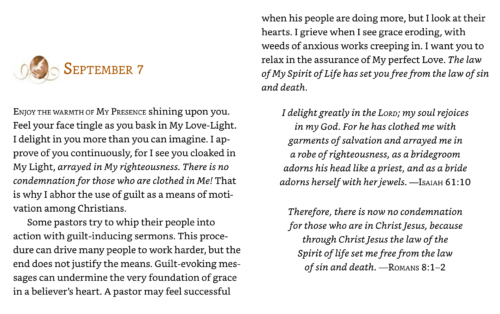
LET THE DEW OF MY PRESENCE refresh your mind and heart.
So many, many things vie for your attention in this complex world of instant
communication. The world has changed enormously since I first gave the command
to be still, and know that I am God. However, this timeless truth is essential
for the well-being of your soul. As dew refreshes grass and flowers during the
stillness of the night, so My Presence revitalizes you as you sit quietly with
Me. A refreshed, revitalized mind is able to sort out what is important and
what is not. In its natural condition, your mind easily gets stuck on trivial
matters. Like the spinning wheels of a car trapped in mud, the cogs of your
brain spin impotently when you focus on a trivial thing. As soon as you start
communicating with Me about the matter, your thoughts gain traction, and you
can move on to more important things. Communicate with Me continually, and I
will put My thoughts into your mind.
PSALM 46:10; He says, “Be still, and know that I am God;
( A) I will be exalted. ( B) among the nations, I will be exalted
LUKE 10:39–42; She had a sister called Mary, who sat at
the Lord’s feet listening to what he said.40 But Martha was distracted by
all the preparations that had to be made. She came to him and asked, “Lord,
1 CORINTHIANS 14:33 NKJV; For God is not a God of
disorder but of peace—as in all the congregations of the Lord’s people.
Young, Sarah. Jesus Calling Morning and Evening
Devotional (Jesus Calling®) (p. 510). Thomas Nelson. Kindle Edition.
Brian McLaren grew up, as I did, in a very religious home, where “our story” was defined by strict religious obligations, with clear insiders and outsiders. However, a mystical experience in nature opened Brian up to God’s Great Story. He writes:
I grew up in a religious home. A full-dose, hard-core, shaken-together-and-my-cup-runneth-over, conservative, Bible-believing, Evangelical, fundamentalist Christian home. . . . Holidays and Sundays were just the spiritual appetizers. For the main course, there was also church every Sunday night. And there was a Wednesday night prayer meeting too. . . .
Some neighborhood buddies . . . invited me on a weekend retreat with the youth group from their Southern Baptist church. And that’s where spirituality snuck up and crashed upon me like an unexpected wave at the beach. The retreat leader sent us off on Saturday afternoon for an hour of silence during which we were supposed to pray. I climbed a tree—being a back-to-nature guy—only to discover that my perch was along an ant superhighway and that mosquitoes also liked the shade of that particular tree. But eventually, between swatting and scratching, I actually prayed. My prayer went something like this: “Dear God, before I die, I hope you will let me see the most beautiful sights, hear the most beautiful sounds, and feel the most beautiful feelings that life has to offer.” . . .
In spite of my sincerity, absolutely nothing happened. . . . [After supper,] a few friends and I snuck away to a hillside and found ourselves sitting under one of those sparkling autumn night skies. I walked several paces away from my friends and lay back in the grass, fingers interlocked behind my head, looking up, feeling strangely quiet and at peace. Something began to happen.
I had this feeling of being seen. Known. Named. Loved. By a Someone bigger than the sky that expanded above me. Young science geek that I was, I pictured myself lying on a little hill on a little continent on a little planet in a little solar system on the rim of a modest galaxy in a sea of billions of galaxies, and I felt that the great big Creator of the whole shebang was somehow noticing little, tiny me. It was as if the whole sky were an eye, and all space were a heart, and I was being targeted as a focal point for attention and love. And the oddest thing happened as this realization sank in. I began to laugh. I wasn’t guffawing, but I was laughing, at first gently, but eventually almost uncontrollably. Profound laughter surged from within me.
It wasn’t a reactive laughter, the kind that erupts when you hear a good joke or see somebody do something ridiculous. It was more like an overflowing laughter, as if all that space I had been feeling opening up inside me was gradually filling up with pure happiness, and once it reached the rim, it spilled over in incandescent joy. “God loves me! Me! God! At this moment! I can feel it!”
In an episode of his podcast Turning to the Mystics,
James Finley shares how he first encountered the work of Thomas Merton
(1915–1968) and how it changed the course of his life. He says:
When I was at home growing up in Akron, Ohio with a violent,
alcoholic father—like ongoing violent abuse—I was in the ninth grade at an
all-boys Catholic school. . . . One of the instructors in the religion class
mentioned monasteries. I’d never heard of monasteries before. Because of the
role prayer played in my life to help me survive what was happening to me at
home, I was already starting to get opened up that way. I was very taken by
this idea of monasteries, that there were places you could go to, to seek God,
and so on. And he talked about Thomas Merton. So, I went to the school library
that day and they had one book by Merton, The Sign of Jonas, which is a
journal he wrote in the monastery.
On the first page of that journal, he writes, “As for me, I
have but one desire, the desire for solitude, to be lost in the secret of God’s
face.” At fourteen years old, I didn’t know what it meant, but something in me
did. . . . I got my own copy, and I read it over and over and over again. I
thought it was so beautiful. I just sensed how true it was. Therefore, in the
four years of high school, [while] the violence was still going on, I started
writing to the monastery. . . . When I graduated from high school, I entered,
and went in there, and then [Thomas] Merton was novice master. That’s how he
got to be my spiritual director. I was eighteen years old.
Jim continues to explore how working with Merton allowed
him to come to terms with his own story, while staying connected to God’s
reality:
The reality of Thomas Merton made God’s unreality impossible
to me. That is, [Merton’s] very reality was to me, the presence of God as a
transformed person. I saw it in this ancient lineage of the mystics that he was
that. I sat at his feet in the classical sense. . . .
I’d knock on his door, and he was always writing a book and
he would sit and listen and talk, and it leveled the playing field for me,
really, just absolutely in terms of compassion. And then [opened up by] that
compassion, I told him about my desire for God. . . . Then he told me, he said,
“Once in a while, you’ll find somebody to talk to about this, but they’re hard
to find. They’re really hard to find.” And he said, “The purpose of this place
is, it is a place meant to protect, to preserve, and cultivate this radical
desire, as a charism in the world.” And then he offered me guidance in my own
prayer.
________________
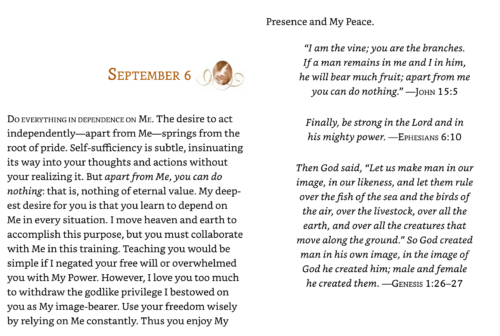
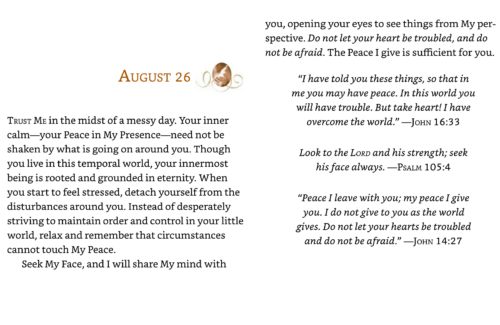
SEEK ME with your whole being. I desire to be found by you
and I orchestrate the events of our life with that purpose in mind. When things
go well and you are blessed, you can feel Me smiling on you. When you encounter
rough patches along your life-journey, trust that My Light is still shining
upon you. My reasons for allowing these adversities may be shrouded in mystery,
but My continual Presence with you is an absolute promise. Seek Me in good
times; seek Me in hard times. You will find Me watching over you all the time.
DEUTERONOMY 4:29; But if from there you seek the Lord your
God, you will find him if you seek him with all your heart and with all your
soul.
HEBREWS 10:23; Let us hold unswervingly to the hope we
profess, for he who promised is faithful.
PSALM 145:20; The Lord watches over all who love him, but
all the wicked he will destroy.
PSALM 121:7–8; The Lord will keep you from all harm — he will watch over
your life; 8 the Lord will watch over your coming and going both now and
forevermore.
Young, Sarah. Jesus Calling Morning and Evening Devotional
(Jesus Calling®) (p. 506). Thomas Nelson. Kindle Edition.
The countless “me” and “our” stories reveal the infinite ways that God draws us—as individuals, communities, and cultures—to God’s Self. None of our smaller stories are complete until they are joined to God’s Great Story. Today, my friend and colleague Barbara Holmes shares the contemplative practices she learned from her family and ancestors.
On my mother’s side of the family were slaves from the Maryland Eastern Shore. They developed their contemplative practices around meals. I can understand how people who work around crabs and blue fish can develop spiritual practices that marry full stomachs to piety. The informality of kitchen tables took the place of confessionals. Important life decisions were made as salmon cakes were shaped and collard greens were cut. Sunday meals were open to any who wanted to come. Those without families, those down on their luck, would appear for the expected fare. It was almost impossible to tell family from others by the titles attached to their names. Aunts, cousins, and uncles were often unrelated in the genetic sense but embraced and named as family. . . .
Although one could find contemplative nuances in the communal prayers and everyday work of baking biscuits, it is in the legacy of the healers that I found the most overt practices. Aunt Rebecca (on my mother’s side of the family) was a root woman. She cured the community with the herbs she collected in nearby woods. . . . Rebecca was the only one who knew which twigs and plants would fix what ailed you. After an initial diagnosis, a tea was prescribed, and whispered updates were passed after church. . . . It was understood that the tea would only address the physical disorder and that sickness required healing of spiritual disorders as well. Prayers and intercessions took place as the herbal brew was prepared. Everyone knew when someone was sick, and so the healing process became the interest of all members of the community. Since there was no health insurance, no money for medicine or doctors, it was in everyone’s best interest for Aunt Becky to succeed. And so a great deal of attention was lavished on the ailing person. As a consequence, it is impossible to determine whether healings occurred because of the medicinal effects of the herbs or the solicitous concern of the community.
On occasion, there were stories brought back from the “betwixt and between” regions where the ill dwell. These stories of a reality where healing became a tangible activity included their awareness not just of Aunt Becky’s herbal ministrations and the prayers of the community but also of the spirits of the ancestors and divine messengers. Thus, the community received spiritual witness to their beliefs about the multivalent aspects of reality and the multiple conduits to this transcendent space. In these small communities, contemplation was an everyday practice that included nurture of the body and the spirit.
At the end of September, the CAC will host the seventh and final CONSPIRE conference. We are calling it Me/Us/The World: Living Inside God’s Great Story. Our own individual stories connect us to the stories of our larger communities and to God’s Great Story—which includes everybody and all of creation. This week in the Daily Meditations, we will be sharing a “Me” story from each of our faculty members. We hope it reveals how, despite our many differences, these stories are all connected: mine, yours, ours, the world’s, and God’s.
It’s probably not hard to believe that I started teaching early, around the age of six or seven. My parents told me this years later. I would gather my siblings and neighborhood friends and have them sit on a bench in the backyard. I would hold my penny catechism upside down since I couldn’t read yet, and I would pretend to teach “about Jesus.” I must have been a weird little kid, but I was happy too! According to my mother, I would run around screaming with excitement and she would admonish me, “If you want to scream, go outside,” so I would. At some point, that spontaneous joy turned into seriousness. I became committed to being the good boy, the nice boy.
I attended Catholic school where the reward/punishment, perfection/achievement system was used to maintained order. The God I was presented with was no unconditional lover, but that was the whole Catholic world in the 1950s. Reality was shaped by a God who is punitive. It made for conformity and very little disruption since we were all agreeing together to abide by the same laws.
I have often been asked, “So, how did you learn how to love in a more unconditional way?” While I’m not sure that I have, any progress I have made has come simply by meeting people who were themselves loving, and then learning the contemplative mind. I was often surrounded by loving people, but I didn’t know how to be like them. By willpower many of us tried to force ourselves to be loving, as if to say: “Obey the law and you will go to heaven.” But when you are forcing yourself to do the loving thing, it doesn’t feel like love to other people. They can sense the difference.
Until I went to seminary, no one had taught me how to clean the lens of my awareness and perception. Studying the philosophy of Franciscan John Duns Scotus (1266–1308) for four years had a profound effect on me. Duns Scotus taught (admittedly in rarefied Latin) that good theology maintains two freedoms: it keeps people free for God and it keeps God free for people. The harder task is actually the second, because what religion tends to do is tell God whom God can love and whom God is not allowed to love. In most church theology and morality, God is very unfree.
I know now that love cannot happen except in the realm of freedom.
Absolute Grace and Acceptance
After high school seminary, my [Richard’s] next step toward becoming a Franciscan was a year-long novitiate in Cincinnati, Ohio. In those days we knelt a lot. I had calluses on my knees because we knelt so much. It was not modern spirituality, but it was a wonderful container that kept me in myself, in my inner world, in the silence. Most of the day we had to keep quiet. This was a medieval novitiate still based on asceticism. Before Vatican II, the Catholic Church was still law-based, disconnected from experience, and not incarnational. It all circled around priests and their ministrations.
I was nineteen years old and trying to be the most fervent student possible: on time, clean, reverent, and respectful, like a Boy Scout. “Yes, Father. No, Father. Whatever you want, Father.” I’d had such a good father, and I knew how to be a good son. I didn’t have the usual opposition toward authority figures, but I was still going crazy with trying to be perfect. Fortunately, over time, I discovered it was my definition of perfection, not God’s, so I learned not to take it too seriously. Everyone creates their own definition of perfection that they try to live up to, and then they experience the illusion that they’re either perfectly wonderful or completely inadequate.
Sometime in the middle of that year, I was kneeling in the choir in the Franciscan community’s novitiate house on Colerain Avenue. Suddenly, I felt chains fly in all directions. The Scripture that I had read that day was Philippians 3:7–9: “What I once considered an asset, now I consider a liability. The law that I thought was going to save me, now is my curse” (my paraphrase). Not coincidentally, I had just read the autobiography of Thérèse of Lisieux. She can change anybody.
Suddenly, I knew that God’s love did not depend on me following all these laws and mandates or being worthy. I knew I wasn’t worthy, and yet here I was experiencing absolute grace and absolute acceptance. The whole system I’d grown up with had implied that God will love us if we change. That day I realized God’s loveenables and energizes us to change.
I already had that boyhood secret discovered gratuitously in front of the Christmas tree: where I felt I had been taken over to another world, which was really this world as it truly is. I’d realized, “My God, this is inside of what everybody is living, and they don’t see it!” Now once again, I somehow knew that I was good, God is good, life is good. And I didn’t have to achieve that goodness by any performance whatsoever. At that point, I was—like a good Lutheran—saved by grace. Grace was everything!
In one moment, I got the Gospel! And I knew it had nothing to do with legalism, priestcraft, or punitiveness. I hadn’t studied theology yet, so I had no intellectual foundation by which to justify it, but I just knew that everything was grace. I was very free—inside—after that.
Perhaps because the Romans never occupied Ireland and
parts of Scotland, the Celtic Christianity that developed there retained its
connection to the natural world. The writer John Philip Newell explains how
Pelagius (c. 354–418), an early and frequently misunderstood Celtic Christian
theologian, saw creation as good and a revelation of God’s very being. Much of
Christian history wrongly interpreted this as Pelagius saying we did not need
grace to be saved, whereas he was simply saying that nature was precisely
created to receive grace! It is all grace from beginning to end! Newell
comments:
The most typical mark of the spirituality of the Celtic
tradition apparent in Pelagius’ writings is his strong sense of the goodness of
creation, in which the life of God can be glimpsed. Everywhere, he says,
‘narrow shafts of divine light pierce the veil that separates heaven from
earth.’ [1] To a friend he wrote:
Look at the animals roaming the forest: God’s spirit dwells
within them. Look at the birds flying across the sky: God’s spirit dwells
within them. Look at the tiny insects crawling in the grass: God’s spirit
dwells within them. . . . Look too at the great trees of the forest; look at
the wild flowers and the grass in the fields; look even at your crops. God’s
spirit is present within all plants as well. The presence of God’s spirit in
all living things is what makes them beautiful; and if we look with God’s eyes,
nothing on the earth is ugly. [2]
Because Pelagius saw God as present within all that has life,
he understood Jesus’ command to love our neighbor as ourself to mean loving not
only our human neighbor but all the life forms that surround us. ‘So when our
love is directed towards an animal or even a tree,’ he wrote, ‘we are
participating in the fullness of God’s love.’ [3] [4]
Thomas Berry (1914–2009), a modern mystic who shares
similar insights, was a Catholic priest of the Passionist order as well as a
cultural historian and eco-theologian. I have been very impressed with his
writings and his call to participate in what he calls “The Great Work” of our
time, which “is to carry out the transition from a period of human devastation
of the Earth to a period when humans would be present to the planet in a
mutually beneficial manner.” [5] Berry writes:
In reality there is a single
integral community of the Earth that includes all its component members whether
human or other than human. In this community every being has its own role to
fulfill, its own dignity, its inner spontaneity. Every being has its own voice.
Every being declares itself to the entire universe. Every being enters into
communion with other beings. This capacity for relatedness, for presence to
other beings, for spontaneity in action, is a capacity possessed by every mode
of being throughout the entire universe.
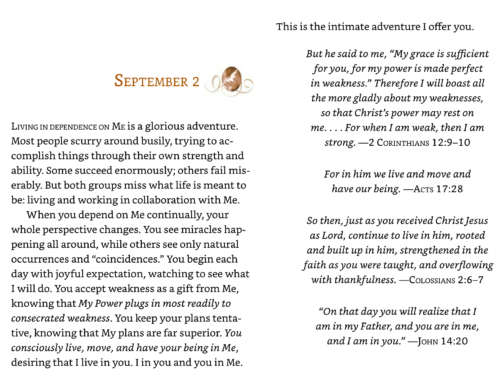
SPEND TIME WITH ME for the pure pleasure of being in My
company. I can brighten up the dullest of gray days; I can add sparkle to the
routines of daily life. You have to repeat so many tasks day after day. This
monotony can dull your thinking until your mind slips into neutral. A mind that
is unfocused is vulnerable to the world, the flesh, and the devil, all of which
exert a downward pull on your thoughts. As your thinking processes deteriorate,
you become increasingly confused and directionless. The best remedy is to
refocus your mind and heart on Me, your constant Companion. Even the most
confusing day opens up before you as you go step by step with Me. My Presence
goes with you wherever you go, providing Light for your path.
PSALM 43:4; Then I
will go to the altar of God,To God my exceeding joy;And upon the lyre I shall
praise You, O God, my God.
PSALM 63:7–8; Because thou hast been my help, Therefore in
the shadow of thy wings will I rejoice. My soul followeth hard after thee: Thy
right hand upholdeth me. |
PSALM 119:105; Your word is a lamp for my feet, a light on
my path.
Young, Sarah. Jesus Calling Morning and Evening Devotional
(Jesus Calling®) (p. 494). Thomas Nelson. Kindle Edition.
Today Barbara Holmes shares the benefits of believing in a God who is both personal (Jesus) and universal (Christ).
[As an African American woman,] I grew up with a preference for the flesh and blood divinity of Jesus because of the suffering, rejection, [and] redemption of my own people and kindred spirits oppressed around the world. Other theologians have pointed out that enslaved or marginalized people need a flesh and blood and suffering Jesus. The Christ, as depicted by dominant culture, was too polite to intervene on our behalf and too far from reach to help us.
What this meant during slavery was that the master’s wife could ground her faith in a God far, far away without any concern about attending a lynching with a picnic basket. If we take seriously the notion of a faraway, unconcerned God, there are terrible consequences. What this means today is that unarmed Black and brown children could be shot by the police, [at the southern border, immigrant and migrant] babies can be caged, and African American Bible studies, Muslim mosques, and Jewish temples can be attacked with assault rifles while the majority of folks remain largely silent. . . .
The trouble for me was making the transition from suffering Savior to cosmic Christ. Before reading The Universal Christ, I had a hard time translating the personal Jesus upon whom I depend with the everythingness of Christ.
Sure, I accepted it by faith, but curious-minded people like me always want to connect as many dots as possible. . . . After reading The Universal Christ, I understand that the tropes of overcoming that we clung to during the Civil Rights movement are being fulfilled through the embodiment and rise of the Universal Christ in us. Father Rohr says we find God simultaneously in ourselves and in the outer world beyond ourselves.
After I read The Universal Christ, the first dot that I connected was that the particularity of Jesus does not obliterate the universality or the everythingness of Christ. Moreover, the cosmic scope of the Christ is not light-years away, but in every cell of our star-born bodies. The Universal Christ offers the reality that I carry the same divine spark in me that is in every living thing. This spark is seen in the resurrecting power that transformed Jesus into the Universal Christ. (?????) That same force can resurrect and transform me and every living person and thing in creation. Father Rohr reminds us that while Jesus is described as the light of world in John 8:12, Jesus also describes us as having that same light. He says, “You are the light of the world” in Matthew 5:14. . . .
Father Rohr agrees that light is not something you necessarily see; it is something that allows you to see other things. The Universal Christ helps us to see that we can follow the embodied Jesus, accept the suffering fact that “in this life, you will have trouble” [John 16:33], [while also] knowing that all creation is moving and evolving toward more diversity, creativity, and wholeness.
To be loved by Jesus enlarges our heart capacity. To be loved by the Christ enlarges our mental capacity. We need both a Jesus and a Christ, in my opinion, to get the full picture. A truly transformative God—for both the individual and history—needs to be experienced as both personal and universal. Nothing less will fully work. If the overly personal (even sentimental) Jesus has shown itself to have severe limitations and problems, it is because this Jesus was not also universal. We lost the cosmic when we made him cozy. History has clearly shown that worship of Jesus without worship of Christ invariably becomes a time-and culture-bound religion, often ethnic or even, in the West, implicitly racist, which excludes much of humanity from God’s embrace.
I fully believe, however, that there has never been a single soul who was not possessed by the Christ, even in the ages before Jesus. Why would we want our religion, or our God, to be any smaller?
For those of us who have felt angered or wounded or excluded by the message of Jesus or Christ as we have heard it, I hope we sense an opening here—an affirmation, a welcome that we may have despaired of ever hearing. You are a child of God, and always will be, even when you don’t believe it.
I opened my book The Universal Christ with a lengthy quote from Catholic mystic and artist Caryll Houselander [1901–1954]. She describes riding the subway and seeing Christ permeating and radiating from all her fellow passengers:
Quite suddenly I saw with my mind, but as vividly as a wonderful picture, Christ in them all. But I saw more than that; not only was Christ in every one of them, living in them, dying in them, rejoicing in them, sorrowing in them—but because He was in them, and because they were here, the whole world was here too . . . all those people who had lived in the past, and all those yet to come.
I came out into the street and walked for a long time in the crowds. It was the same here, on every side, in every passer-by, everywhere—Christ. [1]
This is why I can see Christ in my dog Opie, the sky, and all creatures, and it’s why we can experience God’s unadulterated care for us in our garden or kitchen, our husband or wife or child, an ordinary beetle, a fish in the darkest sea that no human eye will ever observe, and even in those who do not like us, and those who are not like us.
This is the illuminating light that enlightens all things, making it possible for us to see things in their fullness. When Christ calls himself the “Light of the World” (John 8:12), he is not telling us to look just at him, but to look out at life with his all-merciful eyes. We see him so we can see like him, and with the same infinite compassion. Sarah Young………..
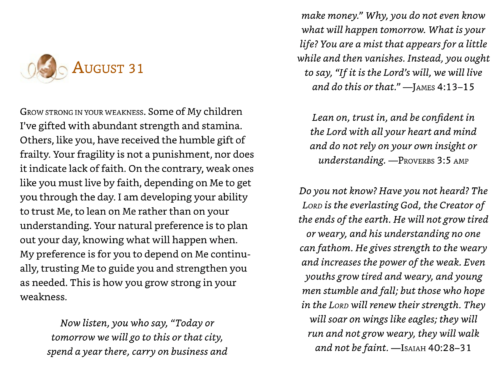
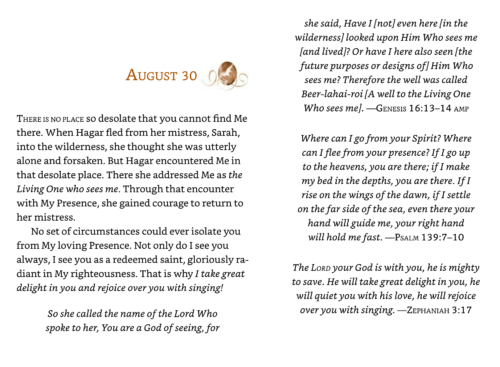
IAM THE ETERNAL I AM; I always have been, and I always will be. In My Presence you experience Love and Light, Peace and Joy. I am intimately involved in all your moments, and I am training you to be aware of Me at all times. Your assignment is to collaborate with Me in this training process. I have taken up residence within you; I am central in your innermost being. Your mind goes off in tangents from its holy Center, time after time. Do not be alarmed by your inability to remain focused on Me. Simply bring your thoughts gently back to Me each time they wander. The quickest way to redirect your mind to me is to whisper My Name.
EXODUS 3:14; 14 And God said unto Moses, I Am That I Am: and he said, Thus shalt thou say unto the children of Israel, I Am hath sent me unto you.
1 CORINTHIANS 3:16; 16 Do you not know that you are God’s temple and that God’s Spirit dwells in you?
PSALM 25:14–15; The Lord confides in those who fear him; he makes his covenant known to them. 15 My eyes are ever on the Lord, for only he will release my feet from the snare.
Young, Sarah. Jesus Calling Morning and Evening Devotional (Jesus Calling®) (p. 490). Thomas Nelson. Kindle Edition.
This CO2- (Church Of 2) is where two guys meet each day to tighten up our Connections with Jesus. We start by placing the daily “My Utmost For His Highest” in this WordPress blog. Then we prayerfully select some matching worship music and usually pick out a few lyrics that fit especially well. Then we just start praying and editing and Bolding and adding comments and see where the Spirit takes us.
It’s been a blessing for both of us.
If you’d like to start a CO2, we’d be glad to help you and your partner get started. Also click the link below to see how others are doing CO2.Odds Monkey
Steve Harvey Introduces Jesus To A Secular Audience
About
Change this text in the admin section of WordPress
You are currently browsing the CO2MannaToday blog archives.