An Ordinary Prayer

October 7th, 2022 by JDVaughn No comments »

Professor Joan Mueller, a Franciscan Sister of Joy, shares how Clare of Assisi taught her version of Franciscan prayer (1194–1253):

Often, when we think of mysticism, we conjure up images of difficult prayer techniques and workshops with meditation gurus. Prayer, we believe, is for professionals. . . . We love God, believe in God, but just don’t feel that we can talk with God like the “professional pray-ers.”

But, Franciscanism is a spirituality of the people. The largest order of Franciscans is made up of lay people, and both Francis and Clare chose a quasi-lay lifestyle over the monasticism of their time. Neither Francis nor Clare participated in prayer workshops, nor did they have extensive monastic training, and yet both experienced profound union with God. What was their secret?

Although we have prayers that were written by St. Francis, it is St. Clare, in her fourth letter to St. Agnes of Prague, who explains what is meant by Franciscan prayer. In this letter, written on her deathbed, Clare teaches Agnes to make a habit of daily prayer. This daily practice of prayer, however, is not a difficult task as Clare explains it. . . .

Clare suggests that we . . . “consider the midst of Jesus’ life, his humility, his blessed poverty, the countless hardships, and the punishments that he endured for our redemption.” [1] Here Clare is asking us simply to reflect on the public life of Christ.

Medievals had a great way of doing this type of meditation. When a cathedral or local church was being frescoed, a painter would come to town and the subjects for the paintings that were being commissioned for the church’s walls and ceilings would be decided. But whom would the painter use for his artistic models? Most often, he wandered the local streets, interacted with the villagers, and decided whose faces he might portray. One day you might go to church and find yourself in a fresco listening to Jesus preach. Maybe your face would represent one of the disciples, or one of the women who cared for Jesus. Perhaps one of your children would be listening to Jesus teach. In any case, you would be placed right in the story of the gospel; your face would actually be central to the story.

This is what Clare is asking us to do. Take the gospel for the day, a gospel from mass or the liturgy of the hours, or a gospel passage from a daily devotional and imagine yourself in the midst of the story. Who would you be most comfortable portraying? What are you hearing, seeing, smelling, tasting? Clare asks us to spend a few minutes really entering into the gospel story of Jesus’ public life and imagining what it would be like to be there. . . .

This perseverance and commitment to engaging deeply in ordinary, Christian prayer is what identifies the friar, Poor Clare nun, the Franciscan lay mystic, or the person inspired by Francis.

___________________________

Sarah Young

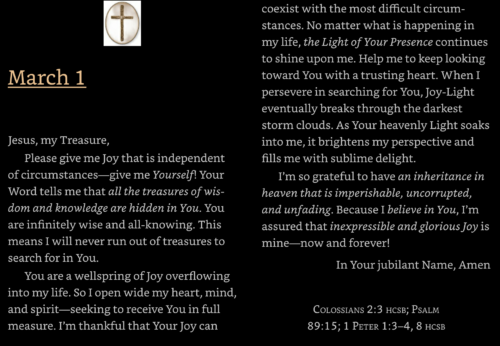
In order to hear My voice, you must surrender all your worries and concerns into my care. Thank Me in all circumstances; trust in Me and rest in my sovereignty. Surrender, connect with Me, live and rejoice out of that.

1 Peter 5:6-7
Humble yourselves therefore under the mighty hand of God, that he may exalt you

Psalm 118:24
Good morning, Lord. I am grateful that, once again, you have offered me a new day as an incredible gift to unwrap and enjoy. Thank you that it is not a blank slate waiting to be filled, but a treasure chest beckoning to be explored.

1 Thessalonians 5:18
Be thankful in all circumstances, for this is God’s will for you who belong to Christ Jesus.

A Web of Infinite Love

October 6th, 2022 by JDVaughn No comments »

God, for Bonaventure, is not an offended monarch on a throne throwing down thunderbolts, but a “fountain fullness” that flows, overflows, and fills all things in one exclusively positive direction. God is a one-directional waterwheel of love, with no backsplash. Reality is always in process, participatory; it is love itself. —Richard Rohr, Eager to Love

Franciscan mystical theologian Bonaventure (1221–1274) used dynamic, creation-centered metaphors to describe God. Theologian and Franciscan sister Dawn Nothwehr summarizes:

God, as Trinity, is like a gushing fountain—that is, the source from which the river of all reality flows and to which it ultimately returns. Again, God is like the water of an overflowing fountain, generously showering all of creation with love. Or, God is like the expansive deep oceans that are like the vast depth of God’s faithful love. Like a song—where all of the notes in a carefully crafted order must be heard for the song to be known—so too, in its wide diversity, the various dynamic cosmic elements make up the interrelated cosmos. God’s self-revelation is like a book: it is first “written” within the consciousness of God . . . and then becomes the book “written without” as the whole creation—all created things are the expression of the divine Artist. . . .

Then there is Bonaventure’s window metaphor. Each element of creation reveals something of the Creator like the array of colored glass in a stained-glass pane, which flashes with dynamic hues as sunlight passes through it. [1]

Drawing insight from Bonaventure’s metaphors for God, Ilia Delio writes that contemplation naturally leads to compassionate care for the earth:

While this Franciscan path of contemplation is desperately needed in our world today as we face massive suffering and vast ecological crises, we still live, in our western culture, with an emphasis on rationality, order and mind. Because our “I” is separated from the world around us, we struggle to be incarnational people and to see our world imbued with divine goodness. We fail to contemplate God’s love poured out into creation. . . . The Franciscan path to God calls us to gaze on the crucified Christ and to see there the humble love of God so that we may, like Francis, learn to see and love the presence of God’s overflowing goodness hidden, and yet revealed, in the marvelous diversity of creation. The one who contemplates God knows the world to be charged with the grandeur of God. Contemplation leads to a solidarity with all creation whereby all sorrows are shared in a heart of compassionate love, all tears are gathered in a womb of mercy, all pain is healed by the balm of forgiveness. The contemplative sees the threads of God’s overflowing love that binds together the whole of creation in a web of infinite love. We are called to see deeply that we may love greatly. And in that great love, rejoice in the overflowing goodness of God.

Sarah Young…..

Be willing to follow Me wherever I lead; follow me with great anticipation; expecting my richest blessings right around every corner. Walk by faith, surrender and expect to rise above all daily issues of life, returning back into community to allow your light and the reflection of Christ to shine on others.

2Corinthians 5:7
For we live by faith, not by sight.

Psalm 96:6
Splendor and majesty are before him; strength and beauty are in his sanctuary.

John 8:12
He that follows me shall in nowise walk in darkness – In ignorance, wickedness, misery: but shall have the light of life – He that closely, humbly, steadily follows me, shall have the Divine light continually shining upon him, diffusing over his soul knowledge, holiness, joy, till he is guided by it to life everlasting.

Psalm 36:9
With thee is the fountain of life — From which those rivers of pleasure flow. Life is in God as in a fountain, and from him is derived to us. As the God of nature, he is the fountain of natural life; in him we live, and move, and have our being.

October 5th, 2022 by Dave No comments »

Loving Things in Themselves

Inspired by Franciscan philosopher-theologian John Duns Scotus (1266–1308), Father Richard teaches about loving things in and as themselves: 

What does it mean when we’re told we should love God with our whole heart, with our whole soul, with our whole mind, and with our whole strength? The first commandment is that we should love God more than anything else. The only way I know how to love God is to love what God loves; only then do we love with divine love and allow it to flow through us.

Just how does God love? Franciscan philosopher-theologian Duns Scotus said in his doctrine of “thisness” (“haecceity”), that we are to love things in and as themselves, to love things for what they are, not for what they do for us. That’s when we really begin to love our spouses, our children, our neighbors, and others. When we free them from our agendas, then we can truly love them without concern for what they do for us, or how they make us look, or what they can get us. We begin to love them in themselves and for themselves, as living images of God. Now that takes real work!

So why is “thisness” so good and important? Duns Scotus mirrors Jesus as the Good Shepherd leaving the ninety-nine sheep and going after the one (Luke 15:4–6). The universal incarnation of Christ always shows itself in the specific, the concrete, the particular; it refuses to let life be a mere abstraction. No one says this better than Christian Wiman: “If nature abhors a vacuum, Christ abhors a vagueness. If God is love, Christ is love for this one person, this one place, this one time-bound and time-ravaged self.” [1]

The doctrine of haecceity says that we come to universal meaning deeply and rightly through the concrete, the specific, and the ordinary, and not the other way around. The principle here is “go deep in any one place and we will meet all places.” When we start with big universal ideas, at the level of concepts and -isms, we too often stay there— arguing about theories, forever making more distinctions. At that level, the mind is totally in charge. It’s easier to love humanity then, but not any individual people. We defend principles of justice but can’t muster the courage to live fully just lives ourselves. Only those who live like Francis and Clare do that.

Francis lived such “thisness” simply by looking at things and loving things in themselves and for themselves. I think this is what it means to love God. When we love things in themselves, we are looking out at the world with God’s eyes. When we look out from these eyes, we see that it’s not about us! And I promise, when we begin seeing the world this way, everything starts to give us joy. Simple things start to make us happy, and Reality begins to offer us inherent joy.


October 4th, 2022 by Dave No comments »

≠≠
A Mystical Way of Life

Francis of Assisi’s experiences of God led him to solidarity with those who suffer, whether lepers, people in poverty, or the Crucified Christ himself. Franciscan priest and author Murray Bodo writes:

Francis experienced a profound conversion as a young man. . . . When he was on his way to fight in the Papal army [he] was told in a dream to leave his fellow soldiers and return to Assisi where it would be shown him what he was to do. He listened to the dream and returned home confused and despondent. One day, he met a leper on the road. Something impelled him to dismount his horse and not only place coins in the leper’s hand, but to embrace the leper. In so doing, he was filled with indescribable sweetness. . . . In that instant he knew he had embraced Jesus Christ. He knew then what he was to do with his life: to embrace Jesus in the poor and rejected, in those who previously had repulsed him. 

Shortly afterwards, praying before the crucifix in the dilapidated chapel of San Damiano outside Assisi’s walls, he heard a voice from the crucifix saying, “Francis, go and repair my house which, as you see, is falling into ruin.” And Francis responded immediately, begging stones and rebuilding this little chapel with his own hands. As he was to learn later, it was the Catholic Church itself that he was to restore. How he was to do this he learned while attending mass one day. He heard in the Gospel that the true disciples of Christ should take no gold, or silver, or copper in their belts, no bag for their journey, or two tunics, or sandals, or a staff (Matthew 10:9–10). He was filled with joy and said, “This is what I want; this is what I desire with all my heart.” He renounced his patrimony, gave away all his possessions, and began the life of an itinerant preacher who dwelled among the lepers. Others followed, and the Franciscan way of life began. 

In all of this it was Jesus whose footsteps he followed. It was Jesus who was his all. He fell in love with Christ in an intimate, almost overwhelming way. . . .

Two years before he died, [Francis] was given one of the most extraordinary of mystical experiences. He was praying on a mountain in Tuscany in preparation for the Feast of St. Michael the Archangel when suddenly he was caught up in ecstasy and saw above him a six-winged flaming Seraph angel. Four wings were outstretched and two covered the body of the Crucified Christ. Francis’ response to this image was so intense that when he awoke, he bore within his own flesh the Sacred Stigmata, the wounds of the crucified Christ in his feet and hands and side. And they remained all the rest of his life as visible signs of the profound mystical life of St. Francis.

Acting In Conscious Love

September 30th, 2022 by JDVaughn No comments »

A few years ago, Father Richard was invited by Carmelite priest Bob Colaresi on a pilgrimage to Thérèse’s community in France. Richard shares:

Our small group of five visited the infirmary where Thérèse died. I stood nearest the window. I could see the black hole in the bushes that Thérèse likened to her own soul when she was in pain, dying of tuberculosis, and trying to believe that Jesus still loved her. The sister guiding our tour was telling us the story of Thérèse’s death when she suddenly paused and said, “We have a visitor!” The way she said it, we all got goose bumps!

We followed the sister’s gaze and saw by the window a beautiful orange and yellow butterfly. It was only April 3, way too early for butterflies in northern France. She said, “Let it out, let it out!” Since I was closest to the window, I tried to open the latch, but I didn’t understand how it worked and just kept struggling with it. All of a sudden, I felt as though I were levitating. I had to look down at my feet to make sure I was still on the ground. I was definitely standing there, but I felt such ecstatic feelings of presence, joy, love, and power. All the blood seemed to flow out of my head.

The sister could only see me from behind. She asked, “What’s wrong? Open the window. The butterfly wants out! The butterfly wants out!” I finally got the window open, and the butterfly flew away. I turned around and the others said my face was white. “What just happened?” I asked, even though I knew I had just been visited. I don’t know how else to say it: Thérèse was there.

Before she died, Thérèse promised to spend her heaven doing good on earth. [1] Whether we believe in miracles of the saints or not, it seems like everybody who loves Thérèse has some miraculous story. She gets involved in our lives. I think she is present in millions of lives. There is something beautiful happening through this woman who said she wanted to perfect “the science of love.” [2] My own experience in her convent felt like an affirmation of what I truly believe and what has been a lot of my message. The little way is the spirituality of imperfection; we come to God not by doing it right, but by doing it wrong. It’s not a matter of doing great things. Whenever we act in conscious love, this is the little way. And I think whatever we do in conscious union and love is prayer. So many of our Catholic saints are examples of heroic martyrdom; the message they give is, “If I am perfect, then God will love me.” Because I was so programmed to think that way, I really needed to be released from that pursuit of perfection. Thank God both Thérèse and Francis of Assisi did that for me!

Sarah Young…..

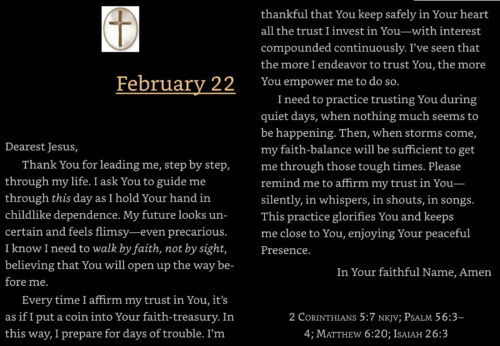
Leave the future to Me; live each day as a precious gift living in the moment by surrendering the future to Me. Surrender, connect and live out of that……… in the moment; for that is where I provide your spiritual energy.

Matthew 6:34
“Give your entire attention to what God is doing right now, and don’t get worked up about what may or may not happen tomorrow. God will help you deal with whatever hard things come up when the time comes.

John 10:10
The thief comes only to steal and kill and destroy; I came so that you may have life and life more abundantly

James 4:13-15
And now I have a word for you who brashly announce, “Today – at the latest, tomorrow – we’re off to such and such a city for the year. We’re going to start a business and make a lot of money.” 14 You don’t know the first thing about tomorrow. You’re nothing but a wisp of fog, catching a brief bit of sun before disappearing. 15 Instead, make it a habit to say, “If the Master wills it and we’re still alive, we’ll do this or that.

Accepting Our Imperfections

September 29th, 2022 by JDVaughn No comments »

Richard shares how the teachings of Thérèse of Lisieux have supported his own spiritual journey: 

French Catholicism in Thérèse’s time emphasized an ideal of human perfection, but Thérèse humbly trusted her own experience and taught the spirituality of imperfection instead. Thérèse is one of my favorite saints, perhaps because I’m an Enneagram Type One. The trap for the One is self-created perfectionism, which makes us dissatisfied and disappointed by nearly everything, starting with ourselves. 

Thérèse has helped me to embrace imperfection—my own and others. When her sister Céline was upset with her own faults, Thérèse instructed, “If you want to bear in peace the trial of not pleasing yourself, you will give [the Virgin Mary] a sweet home.” [1] If we pay attention even for an hour, we observe how hard it is to be “displeasing” to ourselves! Often, this is the emotional snag that sends us into terribly bad moods without even realizing the origins of these moods. To resolve this problem, Thérèse teaches us to let go of the very need to “think well of yourself” to begin with! That’s our ego talking, not God.

Worthiness is not the issue; the issue is trust and surrender. As Thérèse understood, “Jesus does not demand great actions from us but simply surrender and gratitude. [2] Let’s resolve this once and for all: You’re not worthy! None of us are. Don’t even go down that worthiness road. It’s a game of denial and pretend. We’re all saved by grace. We’re all being loved in spite of ourselves. That’s why I can also say, “You’re all worthy!” But your worthiness has nothing to do with you, and everything to do with the goodness of God.

Brené Brown, a contemporary teacher who extols the gifts of imperfection, writes:

It is in the process of embracing our imperfections that we find our truest gifts: courage, compassion, and connection. . . .

When we can let go of what other people think and own our story, we gain access to our worthiness—the feeling that we are enough just as we are and that we are worthy of love and belonging. When we spend a lifetime trying to distance ourselves from the parts of our lives that don’t fit with who we think we’re supposed to be, we stand outside of our story and hustle for our worthiness by constantly performing, perfecting, pleasing, and proving. . . .

There is a line from Leonard Cohen’s song “Anthem” that serves as a reminder to me when . . . I’m trying to control everything and make it perfect. The line is, “There is a crack in everything. That’s how the light gets in.” [3] . . . This line helps me remember the beauty of the cracks (and the messy house and the imperfect manuscript and the too-tight jeans). It reminds me that our imperfections are not inadequacies; they are reminders that we’re all in this together. Imperfectly, but together. [4]

Sarah Young…..

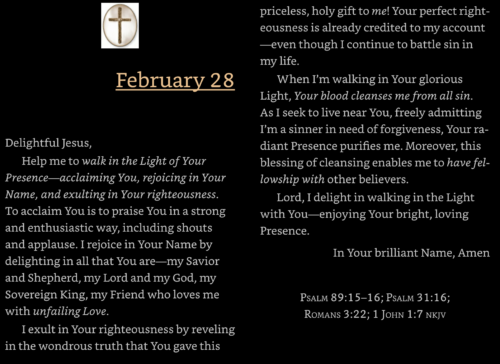
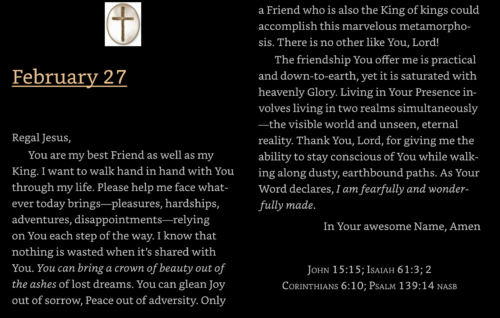
You can walk with Me as if you and I are the only one’s in the universe. Walk with Me in intimate love steps, knowing you are wonderfully and fearfully made to love Me.

Psalm 34:4-6
I sought the Lord, and he heard me, and delivered me from all my fears. 5 They looked unto him, and were lightened: and their faces were not ashamed.

Peter 1:16-17
since it is written, “You shall be holy, for I am holy.” 17 And if you call on him as Father who judges impartially according to each one’s deeds, conduct yourselves with fear throughout the time of your exile

JOHN 17:3
Now this is eternal life: that they know you, the only true God, and Jesus Christ,

Psalm 139:14
I am fearfully and wonderfully made 

September 28th, 2022 by Dave No comments »

Strength in Weakness

In this homily, Father Richard reflects on the paradoxical relationship between weakness and strength: 

I must be up front with you. I don’t really understand why God created the world in this upside-down way. I do not know why “power is at its best in weakness,” as Paul wrote in 2 Corinthians 12:9. I cannot pretend to understand God, but this is what I see: People who have moved from one seeming success to another seldom understand success at all—except for their own very limited version. People who fail to do something right, by even their own definition of right, are those who often break through to enlightenment and compassion.

Paul can talk in this paradoxical way about power and weakness because he meditated on the mystery of the cross. The one who was a failure became the redeemer. The one who looked naked and weak and like a loser became the ultimate winner. And so Paul sums it up in his beautiful philosophy, ending with the line, “It is when I am weak that I am strong” (2 Corinthians 12:10). 

Let’s honestly admit almost none of us believe that. We think it’s when we’re strong that we’re strong. But no, it’s when we’re weak that we’re strong. It doesn’t make a bit of sense to the rational, logical mind. Only people of the Spirit understand how true it is. The Twelve Step Program made it the first step: We have to experience our powerlessness before we can experience our power.  

Paul says he experienced God telling him, “My grace is sufficient for you. Power is made perfect in weakness” (2 Corinthians 12:9). But the philosophy of the United States of America is that power is made perfect in more power. Just try to get powerful: more guns, more weapons, more wars, more influence, more billionaires. Everybody’s trying to get higher, trying to get up, up, up. While Jesus, surprise of surprises, is going down.

The experience of powerlessness is where we all must begin, and Alcoholics Anonymous is honest and humble enough to state this, just as Jesus himself always went where the pain was. Wherever there was human suffering, Jesus was concerned about it and sought to heal it in the very moment of encounter. It is both rather amazing and very sad that we pushed it all off into a future reward system for those who were “worthy”—as if any of us are.

Is it this human pain that we fear? Powerlessness, the state of being shipwrecked, is an experience we all share anyway, if we are sincere, but Bill Wilson (1895–1971), co-founder of AA, discovered we are not very good at that either. He called it “denial.” It seems we are not that free to be honest, or even aware, because most of our wounds are buried in the unconscious. So, it is absolutely essential that we find a spirituality that reaches to that hidden level. If not, nothing really changes.

Tiny Opportunities to Love

Memoirist Heather King spent a year praying with Thérèse of Lisieux’s insights, and describes how Thérèse practiced her “little way” through relationships: 

Some of the best-known anecdotes about Thérèse concern her saintlike, though seemingly small efforts with respect to her fellow nuns:

  1. She overcame her instinctive dislike of a particular nun, and . . . [exhibited] such charity that the sister actually thought Thérèse felt a special fondness for her.
  2. She stifled her almost compulsive desire to turn around and glare at the nun behind her in choir who made a clicking noise (apparently by tapping her rosary against her teeth), realizing that the more charitable act would be to pretend that the sound was music to Christ’s ears and endure the annoyance in silence.
  3. Every evening at dinnertime Thérèse took it upon herself to usher a particularly vexatious elderly nun from chapel to her place at table in the refectory, even going the extra mile to lovingly cut the crabapple’s bread.

Saints do not live in some other world. . . . They live in the same world we do, and they show us that spirituality is intensely down-to-earth. We learn to love through frustration, disappointment, and failure. We learn through the seemingly trivial incidents of our daily lives.

“When I am feeling nothing . . . then is the moment for seeking opportunities, nothings, which please Jesus. . . . For example, a smile, a friendly word, when I would want to say nothing, or put on a look of annoyance,” [1] Thérèse wrote, and “I have no desire to go to Lourdes to have ecstasies. I prefer (the monotony of sacrifice)!” [2]

King applies the spirit of Thérèse’s small, loving acts to her own life: 

I began to see the almost superhuman strength required to refrain from, say, repeating a juicy bit of gossip, or rolling my eyes, or allowing my voice to get harsh when I was upset. I began to sense as well that, just because they’re so difficult, such acts perhaps do far more good than we can ever know. Standing patiently in line helped the other people in line to be patient as well. Blessing the other person in traffic, even though nobody heard or saw, somehow encouraged someone else to bless the next person. When the neighborhood noise bothered me, I sometimes took to starting with one corner of my apartment complex, visualizing the person or people who lived there, and working my way around, praying for the inhabitants of each. (Other times I took to tearing out my hair and cursing.) . . .

We can try, at great personal sacrifice, to be perfectly righteous, a perfect friend, perfectly responsive, perfectly available, perfectly forgiving. But at the heart of our efforts must lie the knowledge that, by ourselves, we can do, heal, or correct nothing. The point is not to be perfect, but to “perfectly” leave Christ to do, heal, and correct in us what he wills.


September 26th, 2022 by Dave No comments »

Discovering the Little Way

During Richard Rohr’s novitiate year of becoming a Franciscan, he discovered the writings of Saint Thérèse of Lisieux (1873–1897). Father Richard describes Thérèse’s teaching as “a spirituality of imperfection”: 

I have often mentioned my love for Thérèse of Lisieux, a French Carmelite nun with minimal formal education, who in her short, hidden life of only twenty-four years captured the essence of Jesus’ core teachings on love. Thérèse was declared a Doctor of the Church in 1997 [1], which means her teaching is seen as thoroughly reliable and trustworthy. She “‘democratized’ holiness,” as Brother Joseph Schmidt (1934–2022) said, “making it clear that holiness is within the reach of anyone willing to do God’s will in love at each successive moment as life unfolds.” [2]   

Thérèse came into a nineteenth-century Catholic Church that often believed in an angry, punitive God, perfectionism, and validation by personal good behavior—which is a very unstable and illusory path. In the midst of this rigid environment, Thérèse was convinced that her message, taught to her by Jesus himself, was “totally new.” [3] The gospel of radical grace had been forgotten by many Christians, so much so that Thérèse had to call it “new.”  

Thérèse called this simple, childlike path her “little way.” It is a spirituality of imperfection. In a letter to priest Adolphe Roulland (1870–1934), she writes: “Perfection seems simple to me, I see it is sufficient to recognize one’s nothingness and to abandon oneself as a child into God’s arms.” [4] Any Christian “perfection” is, in fact, our ability to include, forgive, and accept our imperfection. As I’ve often said, we grow spiritually much more by doing it wrong than by doing it right. That might just be the central lesson of how spiritual growth happens, yet nothing in us wants to believe it. 

If there is such a thing as human perfection, it seems to emerge precisely from how we handle the imperfection that is everywhere, especially in ourselves. What a clever place for God to hide holiness, so that only the humble, “little,” and earnest will find it! A “perfect” person ends up being one who can consciously forgive and include imperfection rather than the ones who think they are totally above and beyond imperfection. It becomes rather obvious once we say it out loud. 

Near the end of her life, Thérèse explained her little way to her sister, and this became part of her autobiography Story of a Soul. In contrast to the “big way” of heroic perfectionism, she teaches, in essence, that as a little one “with all [her] imperfections,” God’s love is drawn toward her. God has to love her and help her because she is “too small to climb the rough stairway of perfection.” [5] With utter confidence, she “believed herself infinitely loved by Infinite Love.”  

A Gospel of Humility

In this talk, Richard unpacks the parable of the tax collector and the Pharisee (Luke 18:9–14), showing how Jesus affirmed a spirituality of imperfection: 

With this parable, Jesus invites us to struggle with the contrast between a spirituality of perfection and what I’m calling a spirituality of imperfection. Notice the beginning lines: “Then he spoke this parable, to some who trusted in themselves, that they were righteous and therefore despised others. ‘Two men went up to the Temple to pray, one a Pharisee, the other a tax collector’” (Luke 18:9–10). Jesus, a consummate Jew, uses examples from his own culture and time. According to common definitions of the day, the Pharisees are the good guys and tax collectors are the bad guys. The tax collectors are those who have totally aligned with the Roman Empire, charging money to their own Jewish people, and giving it to the Empire. No one likes the tax collectors, and everyone looks up to the Pharisees. The Pharisees are simply religious people trying to obey the law, just like faithful Catholics or Bible-reading Protestants today. And as always, Jesus, with his nondual way of thinking, turns it all on its head.

“The Pharisee stood and prayed thus with himself, ‘God, I thank you that I am not like other people. Extortioners, adulterers, or even this poor tax collector here. I fast twice a week. I give tithes of all that I possess’” (18:11–12). None of us would be so foolish as to state our spiritual credit so forthrightly, but we do feel it inside. We think: “I’m a good person. I don’t steal; I don’t cheat.” We’ve all fashioned our positive, superior self-images on why we’re right and why we’re good. In contrast, “The tax collector, standing afar off, would not so much as raise his eyes to heaven. Instead, he beat his breast, saying ‘God be merciful to me, a sinner.’” Jesus said, “This man went down to his house justified—rather than the other” (18:13–14).

This repositions the whole role of religion. Didn’t most of us think that it’s all a meritocracy? I certainly did! Many religious people think that it’s all a merit badge system—all achievement, accomplishment, performance, and perfection. The good people win and the bad people lose. Of course, once we cast anything as a win-lose scenario, the irony is that everybody loses. Why can’t people see that competitive games are not the way to go?

I’m convinced that Jesus’ good news is that God’s choice is always for the excluded one. Jesus learned this from his Jewish tradition: God always chooses the rejected son, the barren woman, the people enslaved in Egypt or exiled in Babylon. It’s not a winner’s script in the Bible—it’s a loser’s script. It’s a loser’s script where, ironically, everybody wins.

Becoming a Grandparent

September 23rd, 2022 by JDVaughn No comments »

Richard Rohr draws on the archetype of the wise ruler to describe what it means to be a “grand” parent, someone who has become a mature elder:

The final stage of the wisdom journey in mythology is symbolized by the ruling image of the king or queen or what I like to call the grand father or grand mother.

When we can let go of our own need for everything to be as we want it, and our own need to succeed, we can then encourage the independent journey and the success of others. The grand parent is able to relinquish center stage and to stand on the sidelines, and thus be in solidarity with those who need their support. Children can feel secure in the presence of their grandparents because, while their parents are still rushing to find their way through life’s journey, grandpa and grandma have hopefully become spacious. They can contain problems, inconsistencies, inconveniences, and contradictions—after a lifetime of practicing and learning.

Grand parents can trust life because they have seen more of it than younger people have, and they can trust death because they are closer to it. Something has told them along the way that who they are now is never the final stage, and this one isn’t either. We need to be close enough to our own death to see it coming and to recognize that death and life are united in an eternal embrace, and one is not the end of the other. Death is what it is. I am a grand father when I am ready to let go. To the grand mother, death is no longer an enemy, but as Saint Francis called it, a “welcome sister.”

The soul of the grand parent is large enough to embrace the death of the ego and to affirm the life of God in itself and others, despite all imperfections. Its spaciousness accepts all the opposites in life—masculine and feminine, unity and difference, victory and defeat, us and them and so on—because it has accepted the opposition of death itself. Grand parents know that their beliefs have less to do with unarguable conclusions than scary encounters with life and the living God. They have come to realize that spiritual growth is not so much learning as it is unlearning, a radical openness to the truth no matter what the consequences or where it leads. They understand that they do not so much grasp the truth as let go of their egos, which are usually nothing more than obstacles to the truth.

I cannot imagine a true grand father or grand mother who is not a contemplative in some form. And contemplatives are individuals who live in and return to the center within themselves, and yet they know that they are not the Center. They are only a part, but a gracious and grateful part at that.

Sarah Young.

Walk with Me with the freedom of forgiveness. I have buried guilt at the foot of the cross. When you surrender you feel the power of My unconditional love. Live in this freedom.

Psalm 68:19
Blessed be the Lord, who daily bears our burden, the God of our salvation. 

1John 1:7-9
But if we walk in the light, as he is in the light, we have fellowship with one another, and the blood of Jesus, his Son, purifies us from all sin. If we claim to be without sin, we deceive ourselves …

1John 4:18
There is no fear in love, but perfect love casts out fear. For fear has to do with punishment, and whoever fears has not been perfected in love.

September 20th, 2022 by Dave No comments »

What Kind of Person Are We Becoming?

Contemplative elder and Benedictine Sister Joan Chittister writes of the humility we must cultivate if we hope to grow in love and compassion as we age:  

If we learn anything at all as time goes by and the changing seasons become fewer and fewer, it is that there are some things in life that cannot be fixed. It is more than possible that we will go to our graves with a great deal of personal concerns, of life agendas, left unresolved. . . . So has life been wasted? Has it all been for nothing?

Only if we mistake the meaning of the last period of life. This time of life is not meant to solidify us in our inadequacies. It is meant to free us to mature even more. . . .

This is the period of life when we must begin to look inside our own hearts and souls rather than outside ourselves for the answers to our problems, for the fixing of the problems. This is the time for facing ourselves, for bringing ourselves into the light.

Chittister invites us to consider aging as an opportunity to grow into our true and larger selves:

Now is the time to ask ourselves what kind of person we have been becoming all these years. And do we like that person? Did we become more honest, more decent, more caring, more merciful as we went along because of all these things? And if not, what must we be doing about it now? . . .  

Can we begin to see ourselves as only part of the universe, just a fragment of it, not its center? Can we give ourselves to accepting the heat and the rain, the pain and the limitations, the inconveniences and discomforts of life, without setting out to passively punish the rest of the human race for the daily exigencies that come with being human?

Can we smile at what we have not smiled at for years? Can we give ourselves away to those who need us? Can we speak our truth without needing to be right and accept the vagaries of life now—without needing the entire rest of the world to swaddle us beyond any human justification for expecting it? Can we talk to people decently and allow them to talk to us? . . .

Now, this period, this aging process, is the last time we’re given to be more than all the small things we have allowed ourselves to be over the years. But first, we must face what the smallness is, and rejoice in the time we have left to turn sweet instead of more sour than ever.

A burden of these years is the danger of giving in to our most selfish selves. 

A blessing of these years is the opportunity to face what it is in us that has been enslaving us, and to let our spirit fly free of whatever has been tying it to the Earth all these years.