March 6th, 2022 by Dave No comments »

The Five M’s

In The Wisdom Pattern, Father Richard summarizes five stages of change that have taken place historically in religious and cultural institutions. He calls these stages the “Five M’s”: human, movement, machine, monument, and memory. This week we explore these stages as inspiration for spiritual renewal in our faith communities and our lives. 

It seems that many great things in history start with a single human beingIf a person says something full of life that names reality well, the message often moves to the second stage of becoming a movement. That’s the period of greatest energy. The church is at its greatest vitality as the “Jesus Movement,” and the institution is merely the vehicle for that movement. The movement stage is always very exciting, creative, and also risky.

It’s risky because God’s movement in history is larger than any denomination, any culture, or any tradition’s ability to verbalize it. We feel out of control in this stage, and yet why would anybody want it to be anything less? Would we respect and love a God that we could control? I don’t think so! Yet we move rather quickly out and beyond the risky movement stage to the machine stage. This is predictable and understandable.

The institutional or machine stage of a movement will necessarily be a less-alive manifestation. This is not bad, although it is always surprising for those who see church as an end in itself, instead of merely a vehicle for the original vision. We need “the less noble” parts of the Body to keep us all growing toward love (1 Corinthians 12:22–24). There is no other way; but when we don’t realize a machine’s limited capacities, we try to make it into something more than it is. We make it a monument, a closed system operating inside of its own, often self-serving, logic. By then, it’s very hard to take risks for God or for gospel values.

Eventually this monument and its maintenance and self-preservation become ends in themselves. It is easy just to step on board and worship at a monument without ever knowing why or longing for God ourselves. At this point, we have jumped over the human and movement stages and have become what authors Mark Gibbs and T. Ralph Morton called “God’s frozen people.” [1] There is no hint of knowing that we are beloved by God and invited to an inner journey. In this state, religion is merely an excuse to remain unconscious, holding on to a memory of something that must once have been a great adventure. Now religion is no longer life itself, but actually a substitute for life or, worse, an avoidance of life. The secret is to know how to keep in touch with the human and movement stages without being naïve about the necessity of some machines and the inevitability of those who love monuments. We must also be honest: all of us love monuments when they are monuments to our human, ourmovement, or our machine.


Rediscovering the “Jesus Movement”

Yesterday’s meditation outlined a pattern of change based on what Father Richard calls the “Five M’s”: human, movement, machine, monument, and memory. Today Father Richard reflects on examples of individuals who were inspired by the “Jesus movement” to transform the “machines and monuments” in their lives.

Sometimes machine and monument people can be recaptured by the vision of the human and the movement. In the CAC’s early years, we were often visited by our friend Frank, who worked for the nuclear test site outside of Las Vegas, Nevada. In fact, Frank headed the operation for a number of years—and then dared, by the grace of the gospel, to call it into question. He even joined me once as we practiced civil disobedience at the test site. I will never forget seeing him walk toward me with a half-worried half-smile on his face. “I have trusted your teaching all these years. Now I have to trust where it has led me,” he said. We stood together as his former employees drove by and gave less-than-flattering gestures to their old boss. I was humbled and awed by such courage and humility. He had let go of his secure monument through an encounter with the man Jesus and the vision of the peace movement.

It’s hard and very rare to call your own job into question. When Jesus called his disciples, he also called them away from their jobs, and their families too (see Matthew 4:22). Of course, jobs and families are not bad things. But Jesus called them to leave their nets, because as long as anyone is tied to job security, there are a lot of things they cannot see and cannot say. This is one of the great recurring disadvantages of clergy earning their salary from the church, and perhaps why Saint Francis did not want us to be ordained priests. We tend to think and say whatever won’t undermine the company or brand.

Father Richard points to St. Francis of Assisi (1182–1226) as an example of how to make holistic change: 

Francis of Assisi offers us a model of transformation because he did not attack the monuments or machines directly but went out to the edge and did it better. For his inspiration, Francis went back to the original dynamism and nonviolent style of Jesus the man.

Assisi is surrounded by city walls. Inside those walls are the cathedral and the established churches, all of which are good. That’s where Francis first heard the gospel and fell in love with Jesus. But then he quietly went outside the walls and rebuilt some old ruins called San Damiano and the Portiuncula. He wasn’t telling the others they were doing it wrong. He just gently and lovingly tried to do it better. I think that’s true reconstruction. Remember, the best criticism of the bad is the practice of the better. That might be a perfect motto for all reconstructive work. It does not destroy machines or monuments but reinvigorates them with new energy and form.
March 2nd, 2022 by Dave No comments »

Ash Wednesday

CAC faculty member James Finley reflects on Thomas Merton’s teaching about the True Self and the separate (or false) self:

Our true self is a self in communion. It is a self that subsists in God’s eternal love. Likewise, the false self is the self that stands outside this created subsisting communion with God that forms our very identity. As Merton puts it,

When we seem to possess and use our being and natural faculties in a completely autonomous manner, as if our individual ego were the pure source and end of our own acts, then we are in illusion and our acts, however spontaneous they may seem to be, lack spiritual meaning and authenticity. [1]

In our zeal to become the landlords of our own being, we cling to each achievement as a kind of verification of our self-proclaimed reality. We become the center and God somehow recedes to an invisible fringe. Others become real to the extent they become significant others to the designs of our own ego. And in this process the ALL of God dies in us and the sterile nothingness of our desires becomes our God. . . .

Merton makes clear that the self-proclaimed autonomy of the false self is but an illusion. . . .

My false and private self is the one who wants to exist outside the reach of God’s will and God’s love—outside of reality and outside of life. And such a self cannot help but be an illusion. [2]

Father Richard Rohr describes further how the false self lives disconnected from God and from what is ultimately real:

Our false self, which we might also call our “small self,” is our launching pad: our body image, our job, our education, our clothes, our money, our car, our sexual identity, our success, and so on. These are the trappings of ego that we all use to get us through an ordinary day. They are a nice enough platform to stand on, but they are largely a projection of our self-image and our attachment to it. None of them will last! When we are able to move beyond our false self—at the right time and in the right way—it will feel precisely as if we have lost nothing. In fact, it will feel like freedom and liberation. When we are connected to the Whole, we no longer need to protect or defend the mere part. We are now connected to something inexhaustible.

To not let go of our false self at the right time and in the right way is precisely what it means to be stuck, trapped, and addicted to ourselves. If all we have at the end of our life is our false self, there will not be much to eternalize. It is essentially transitory. These costumes are all “accidents” largely created by the mental ego. Our false self is what changes, passes, and dies when we die. Only our True Self lives forever. [3]

A Stirring of the Soul

March 1st, 2022 by JDVaughn No comments »

Author and retreat leader Paula D’Arcy shares an experience she had as part of a workshop with women inmates of a Texas county jail. An opera piece sung by two visiting performers brought a resonant stillness to a noisy room and awakened a sense of the True Self in the people present. Paula writes:

The music pulled us into the brevity of a lifetime; the mistakes we make; our longings for things to be different, to be better; the despair of being without hope; and the pure and the holy. When I turned around to look, I saw that many inmates were overcome by emotion. Something sublime was moving in that room—a sound that directly entered our hearts. . . .

It was as if the enveloping sound was saying to a hidden place in each of us: Something great is alive in you, and something more than this surface reality is intended for your life. Beyond your circumstances lies a different destiny.

It was not just the inmates who were visibly affected, but everyone else who was present as well. Something inexpressible in the music had broken our hearts open. . . .

It wasn’t the first time I had felt this. In the early 1980s, when I was still trying to put the pieces of my life together after the sudden deaths of my husband and daughter in a drunken-driving accident, I felt challenged by everything. In the blink of an eye my conclusions, my worldview, and my image of God were upended. It was an unsettling time. I kept reaching to the mind, searching for ideas and philosophies to guide me. That old way of managing things was very familiar.

Father Richard teaches that the mind and our thoughts are the source of the separate self. As he often says, “The false self is who you think you are. Your thinking does not make it true.” [1] Paula continues:

But the mind could not bring me where I needed to go. It was a long while before I turned in a different direction and began to look within. Eventually I saw that the seeds of a greater journey are waiting in everything and I understood that, when the time is right—when we are finally willing to meet “what is” and stop insisting on our own version of life [RR: which the separate self cannot help but do]—real change and transformation become possible.

It was an important waking-up. My familiar default was to rely on old voices and experiences—on the mind’s many concepts and ideas. Yet the force of love that sustains life is not a concept, and there are not a set of holy conditions to attain. As I opened my heart, love moved through the pain and slowly changed my sight. Things that once seemed fixed and defining were unmasked. When the [opera piece] “Flower Duet” was sung in the jail, it was again an experience of the flame of love.

­­­­­­­­­­­­­­­­­­­­­­­_____________________________________________

Sara Young

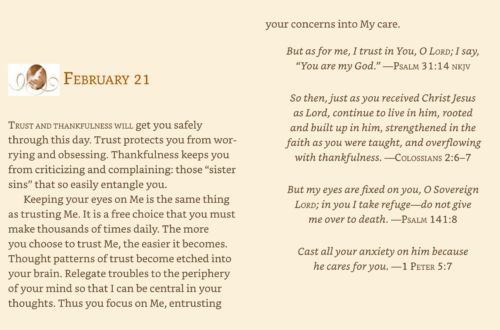
WHEN SOMETHING IN YOUR LIFE OR THOUGHTS makes you anxious, come to Me and talk about it. Bring Me your prayer and petition, with thanksgiving, saying, “Thank You, Jesus, for this opportunity to trust You more.” Though the lessons of trust that I send to you come wrapped in difficulties, the benefits far outweigh the cost. Well-developed trust will bring you many blessings, not the least of which is My Peace. I have promised to keep you in perfect Peace to the extent that you trust in Me. The world has it backwards, teaching that peace is the result of having enough money, possessions, insurance, and security systems. My Peace, however, is such an all-encompassing gift that it is independent of all circumstances. Though you lose everything else, if you gain My Peace you are rich indeed.

PHILIPPIANS 4:6; Don’t worry about anything; instead, pray about everything. Tell God what you need and thank him for all he has done.

ISAIAH 26:3; No one should not imagine that God’s peace will fill their hearts if they are going through life ignoring him. His peace comes to those who fix their minds on him.

2 THESSALONIANS 3:16 NKJV; Now may the Lord of peace Himself give you peace always in every way. The Lord be with you all.

Young, Sarah. Jesus Calling Morning and Evening Devotional (Jesus Calling®) (p. 126). Thomas Nelson. Kindle Edition.

February 28th, 2022 by Dave No comments »

Trusting Our Essential Self

This week Father Richard Rohr shares some of his core teachings about the True Self, the place where the Divine Presence exists in us: 

Searching for and rediscovering the True Self is the fundamentum, the essential task that will gradually open us to receiving love from and giving love to God, others, and ourselves. We are created in the image of God from the very beginning (Genesis 1:26–27; Ephesians 1:3–4).

You (and every other created thing) begin with your unique divine DNA, an inner destiny as it were, an absolute core that knows the truth about you. This true believer is tucked away in the cellar of your being, an imago Dei that begs to be allowed, to be fulfilled, and to show itself. “You were chosen in Christ before the world was made—to stand before God in love—marked out beforehand as fully adopted sons and daughters” (see Ephesians 1:4–5). This is your True Self. Historically, it was often called “the soul.”

Jesus revealed and accepted a paradox in his entire being: the human and divine are not separate, but one! His life shouted it. I wonder why we so resist our same destiny? For most of us, this seems just too good and too dangerous to be true. There is so much contrary evidence! Many clergy fight me on this, even though it is quite constant in the Tradition. Is it because we are afraid to bear the burden of divinity? As Marianne Williamson says: “Our deepest fear is that we are powerful beyond measure.” [1] Maybe we realize subconsciously that if we really believed that we are temples of God (see 1 Corinthians 3:16, 6:19; 2 Corinthians 6:16), then we would have to live up to it.

The True Self is the Divine Indwelling, the Holy Spirit within you. I would say that the True Self is precisely the divine part of you that is great enough, deep enough, gracious enough to fully accept the human part of you. If you are merely human, you will tend to reject your embarrassingly limited humanity. Think on that!

Paradoxically, immense humility, not arrogance, characterizes someone who lives in this True Self. You simultaneously know you are a child of God, but you also know that you didn’t earn it and you are not worthy of it. You know it’s entirely a gift (see Ephesians 2:8–9 and throughout the Pauline writings). All you can do is thank Somebody Else, occasionally weep with joy, and kneel without any hesitation.

The true purpose of mature religion is to lead you to ever new experiences of your True Self. If religion does not do this, it is junk religion. Every sacrament, every Bible story, every church service, every sermon, every hymn, every bit of priesthood, ministry, or liturgy is for one purpose: to allow you to experience your True Self—who you are in God and who God is in you—and to live a generous life from that Infinite Source.

Our True Self Is Life Itself

Father Richard shares his belief in the eternal nature of the True Self and its ability to connect us to ultimate purpose and meaning: 

As disappointed as I get with religion, I can’t give up on it. Only healthy religion is prepared to point us beyond the mere psychological to the cosmic, to the universal, to the absolute. Only healthy religion is prepared to realign and reconnect all things and reposition us inside of the whole, in true community instead of mere individualism.

Only your soul can know the soul of other things. Only a part can recognize the whole from which it came. But first something within you, your True Self, must be awakened. Most souls are initially “unsaved” in the sense that they cannot dare to imagine they could be one with God/Reality/the universe. This is the illusion of what Thomas Merton (1915–1968) called the “false” self and what I have taken to calling the “separate” or small self that believes it is autonomous and separate from God.

Thomas Merton said that the True Self should not be thought of as anything different than life itself—but not my little life—the Big Life. [1] Franciscan philosopher John Duns Scotus (c. 1266–1308) said that the human person is not different or separate from Being itself—not the little being that you and I get attached to and take too seriously, but Universal Being or “the One in whom we live, and move, and have our being,” as Paul said to the Athenians (Acts 17:28).

When we’ve gotten too comfortable with our separate self and we call it Life, we will get trapped at that level and we will hold onto it for dear life—because that’s the only dear life we think we have. Unless someone tells us about the Bigger Life or we’ve had a conscious connection with the deepest ground of our being, we will continue to live as though we are separate from God.

The final, stupendous gift is that our “separate” self becomes the raw material for our unique version of True Self. Our ordinary lives and temperaments are not destroyed or rejected. They are transformed. Or, as the Preface of the Catholic funeral liturgy puts it, our little life is “not ended but merely changed.” “This perishable nature will put on imperishability, and this mortal body will put on immortality” (see 1 Corinthians 15:52–54)—one including the other, not one in place of the other.

Your True Self is Life and Being and Love. Love is what you were made for and love is who you are. When you live outside of Love, you are not living from your true Being or with full consciousness. The Song of Songs says that “Love is stronger than death. . . . The flash of love is a flash of fire, a flame of YHWH” (Song of Songs 8:6, Jerusalem Bible). Your True Self is a tiny flame of this Universal Reality that is Life itself, Consciousness itself, Being itself, Love itself, God’s very self.


You and God Are Already One

February 25th, 2022 by JDVaughn No comments »

In his podcast Turning to the Mystics, CAC teacher James Finley uses the teachings of Spanish mystic Teresa of Ávila (1515–1582) as a starting point to talk about intimacy with God:

Let’s say that we’re approaching Teresa for spiritual direction, and we’re coming to her saying that we want her to help us to deepen our experience of and response to God’s presence in our life, and we seek her guidance. . . . We’re turning to God and from this present situation of our busy-ness, and our limitations, and our confusion, and all the rest of it, and we’re seeking to know, “How can I enter into a deeper, habitual relationship with God, a deeper sense of God’s presence in my life, my presence in God? I want to learn to do that. I want to deepen my spiritual life.” . . .

We listen to [Teresa] then as she says to us, “You know, you’re seeking union with God, which is a grace to desire this.” And it is helpful to know, in the light of faith, that you and God are already one in the intimate and mysterious sense in which God is creating you as God’s self-donating love. God makes your very soul, that is, your very essence of who you are as a person created by God in the image and likeness of God, to be a relational mystery with God. That in your very soul, the very mystery of who you are and the very mystery of who God is are already intertwined. . . .

I think a way of maybe getting at this, too, is to say, when two people love each other very, very much, when we’re in love with and deeply love someone, we might say that in our love for them, we see their soul. That is, we see in our love for them, the preciousness of who they are, like the innermost depths of the gift and the miracle of their presence. . . .

Then they return the favor, by seeing that self-same preciousness in you. That is, in their love for you, they see through the appearances. They see this kind of indescribable preciousness of you that they’re empowered to see in you, through their love. You can see that they see you. You can see that you’re seen. This mutuality of seeing and being seen by and with each other in love, I think that’s why the Church speaks of matrimony as a sacrament. But a sacrament of what? It’s a sacrament that God sees you, that you’re God’s beloved, that God sees in you the God-given godly preciousness of you, in which the very depths of God, by the generosity of God, have been given to you as the very depths and reality of the mystery of your own soul in the presence of God. That God sees that. God sees that.

_____________________________________

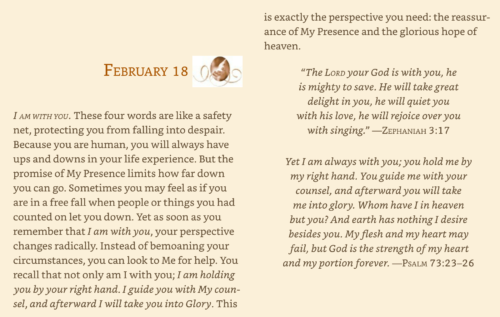
REST IN MY PRESENCE, allowing Me to take charge of this day. Do not bolt into the day like a racehorse suddenly released. Instead, walk purposefully with Me, letting Me direct your course one step at a time. Thank Me for each blessing along the way; this brings Joy to both you and Me. A grateful heart protects you from negative thinking. Thankfulness enables you to see the abundance I shower upon you daily. Your prayers and petitions are winged into heaven’s throne room when they are permeated with thanksgiving. In everything give thanks, for this is My will for you.

MATTHEW 11:28 NKJV; Come to Me, all you who labor and are heavy laden, and I will give you rest

COLOSSIANS 4:2; Devote yourselves to prayer, being watchful and thankful.

1 THESSALONIANS 5:18 NASB; in everything give thanks; for this is God’s will for you in Christ Jesus

Young, Sarah. Jesus Calling Morning and Evening Devotional (Jesus Calling®) (p. 114). Thomas Nelson. Kindle Edition.

February 23rd, 2022 by Dave No comments »

An Opportunity to Grow Stronger

The more we see [and know our failures], the more by grace we shall long to be filled full of endless joy, for we are created for that. 
—Julian of Norwich, Revelations of Divine Love, chapter 8

Father Richard believes that marriage and friendship are fruitful training grounds for intimacy with both God and people. He writes:  

We all need experiences of being loved unconditionally. Without direct experience of unconditional love, as shared in a good marriage or close friendship, it’s hard to believe in God’s unconditional love. Our friend or partner constantly holds a mirror up to us, and shows us our good side and our bad side, and reminds us that we still haven’t really learned to love. We come face-to-face with an infinite mystery that assures us that we can’t live up to it. That’s why Jesus gave a symbolically infinite number, “seventy times seven,” to describe countless times even good people will need to forgive each other.

Thankfully, the gospel gives us a blessed assurance that we operate inside of an abundant, limitless, infinite Love. Even though we will constantly fail, failure is not the final word. We also have hope that everything can be mended, healed, and restored. A welded connection can be the strongest part of a metal bar. It’s the breaking and the welding and the mending that create the real beauty of relationship. This is the dance of intimacy: we ask one another for forgiveness as we confess that once again we didn’t do it right. We needn’t be surprised or punish ourselves for it—though we all do. Darn it, I didn’t love right again! How can I miss the point so many times? 

I don’t think getting it right teaches us vulnerability. It’s when we’re wrong that we are taught to be vulnerable. We finally realize we are falling ever-deeper into something that we can never live up to—a sustained vulnerability, a continual risk. It’s not a vulnerability and intimacy that we choose just now and then. Eventually, it becomes second nature to apologize, to admit we are wrong, to ask for forgiveness but not hate ourselves for it.

Divine intimacy and human intimacy share the same dynamics. I believe one is a school for the other. Most people start with human intimacy and move toward divine intimacy. But I do believe there are a few souls who start with God’s divine ambush, who first learn how to be vulnerable before God and then transfer this to their human relationships. Two who have taught me that best are Thérèse of Lisieux and Julian of Norwich. Both are among my favorite mystics, and both are women. Women, and those in touch with their feminine side, seem to have a readiness for intimacy, mutuality, and vulnerability that offers a central message for all believers.

A Human and Devine Pattern

February 22nd, 2022 by JDVaughn No comments »

Therapists Sue Johnson and Kenneth Sanderfer write about how loved ones can deepen their emotional connection to each other and become more open to receiving God’s love:
Those who know and live with a sense of secure connection to special loved ones have been shown to be more able to tune in to and be compassionate toward others, deal with anger constructively, cope with distress, stay open to and forgive others, show more generosity and tolerance, and shape a positive sense of self as one who is worthy of love and care. These qualities go a long way in exemplifying the human virtues laid out in Christ’s teachings. . . .
When our most important love relationships, those with parents and life partners, are positive, they open us up to the love of God. When we feel precious, held, and protected by loved ones, it appears to be easier for us to feel comfortable seeking closeness to God, have confidence in [God’s] benevolence, and open ourselves up to faith. . . . When the bonds of human love are positive, one secure connection cascades into another.
As Father Richard teaches, an early loving connection with our parents or caregivers helps create a capacity and desire for intimacy with God:
Our initial sense of connection with our mother, and hopefully with our father, is the beginning of the unitive consciousness to which we ultimately want to return. If, in the early months and years, we received wonderful gazes of love from our parents (or other caregivers), mirror neurons were formed that provide the physiological foundation for intimacy. They allow us to grow into an adult capable of intimate, close, tender I-Thou relationships with others and with God. [1]
Johnson and Sanderfer point to the mystical traditions of experiencing God as a lover, which deepen our ability to be intimate with others:
Even in a monastery, this link appears between devotion to a partner and devotion to God. At Sant’Antimo Abbey in the Tuscan hills, built some nine hundred years ago on the Via Francigena—the ancient pilgrims’ path to Rome—the monks’ chant echoes out from the soft stone at lauds, terce, sext, and vespers. They sing in joy, “O God, you are my God, at dawn and dusk, I search for you.” It is not accidental, surely, that the bell calling them to prayer is named “the spouse.”
In this sacred circle, where a sense of closeness to the divine and a loving connection with important others work in tandem, love is the gift that keeps on giving. Love for the divine guides and enhances bonding between partners, and the daily practice of love between partners helps to strengthen a sense of secure connection with God. The sacred circle is illustrated in this verse from 1 John 4:7: “Dear friends, let us love one another, for love comes from God. Everyone who loves has been born of God and knows God.”

_________________________________________

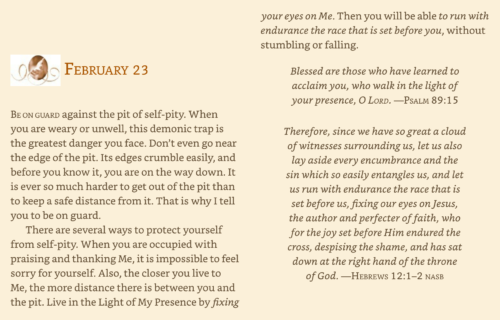
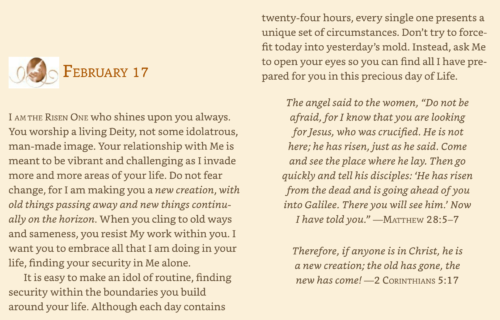
YOU NEED ME EVERY MOMENT. Your awareness of your constant need for Me is your greatest strength. Your neediness, properly handled, is a link to My Presence. However, there are pitfalls that you must be on guard against: self-pity, self-preoccupation, giving up. Your inadequacy presents you with a continual choice—deep dependence on Me or despair. The emptiness you feel within will be filled either with problems or with My Presence. Make Me central in your consciousness by praying continually: simple, short prayers flowing out of the present moment. Use My Name liberally, to remind you of My Presence. Keep on asking and you will receive, so that your gladness may be full and complete.
PSALM 86:7; When I am in distress, I call to you, because you answer me.
1 THESSALONIANS 5:17; be unceasing and persistent in prayer.
JOHN 16:24 AMP; Until now you have not asked [the Father] for anything in My name; but now ask and keep on asking and you will receive, so that your joy may be full and complete

Young, Sarah. Jesus Calling Morning and Evening Devotional (Jesus Calling®) (p. 108). Thomas Nelson. Kindle Edition.

February 21st, 2022 by Dave No comments »

What Is Intimacy?

Father Richard Rohr shares his understanding of intimacy and what prevents us from experiencing intimacy with God and one another: 

Intimacy could be described as our capacity for closeness and tenderness toward things. It is often revealed in moments of risky self-disclosure. Intimacy lets itself out and lets the other in. It makes all love possible, and yet it also reveals our utter incapacity to love back as the other deserves. None of us can go there without letting down our walls, manifesting our deeper self to another, and allowing the flow to happen.

True human intimacy or divine intimacy is somewhat rare and very hard for all of us, but particularly for men and for all who deem themselves important people, that is, those who are trained to protect their boundaries, to take the offensive, and to avoid all signs of weakness or neediness. God seems to have begun thawing this glacial barrier by coming precisely in male form as Jesus, who exposes maleness itself as also naked, needy, and vulnerable. The transmission of the inner mystery of God continues in space and time primarily through what Jesus calls again and again “the little ones” and “the poor in spirit,” which he himself became.

I think that many of us are afraid of intimacy, of baring our deepest identity to another human or even to God. Yet people who risk intimacy are invariably happier and much more real people. They feel like they have lots of “handles” that allow others to hold onto them and that allow them to hold onto themselves. People who avoid such intimacy are imprisoned in a small and circumscribed world. Soulful intimacy is a gateway into the sacred realm of human and divine love.

Therapists Jett Psaris and Marlena Lyons have found that our longing for intimacy can only be met when we soften the guardedness around our hearts:

We long to love from the fullness of our undefended hearts and we long to be loved unconditionally and without reservation. . . . The dual yearning of the human heart finds its satisfaction in the struggle to know ourselves at our most vulnerable levels. The deeper we know ourselves, the deeper is our capacity to know others intimately. . . . It is our deep hunger for this level of loving that moves us beyond our resistance, fear, and shortcomings to see what is special and unique about us. It allows us to see the profound core of another and to have that core be fully seen in ourselves. [1]

Father Richard concludes:

We all desire true and intimate love. This longing seems to be hardwired into our beings. We have to want very strongly to love and to be loved—or we will never go to this strange place, and we will never find our True Selves. So, God obliges and creates us in just that way, with a bottomless and endless need to be loved and to love.


Responsive Vulnerability

Father Richard believes that we can only experience true intimacy when we are willing to be vulnerable ourselves: 

The big and hidden secret is this: an infinite God seeks and desires intimacy with the human soul. Once we experience such intimacy, only the intimate language of lovers describes what is going on for us: mystery, tenderness, singularity, specialness, nakedness, risk, ecstasy, incessant longing, and also, of course, suffering. This is the mystical vocabulary of the saints.

Our biggest secrets and desires are often revealed to others, and even discovered by ourselves, in the presence of sorrow, failure, or need—when we are very vulnerable, and when we feel entirely safe in the arms of love. When that happens, there is always a broadening of being on both sides. We are larger people afterwards.

And it is only when we are in such a tender place that God can safely reveal the “inside” of God to us. All self-sufficient people remain outsiders to the mystery of divine love because they will always misuse it. Only the need of a beloved knows how to receive the need and gift of the lover, and only the need of a lover knows how to receive the need and gift of the beloved without misusing such love. It is a kind of deliberate “poverty” on both sides. A mutually admitted emptiness is the ultimate safety net for love.

“Fullness” in a person cannot permit love because it leaves no openings, offers no handles, no give and take, nor is there any deep hunger. Human vulnerability gives the soul an immense head start on its travels.

Our desire for intimacy or communion first creates the very hunger that God, with a little help from God’s friends, can then satisfy (though never totally) in this world. In fact, the bit of satisfied desire only increases the desire for more and again! The mystics (those who personally know the inner space of God) are aware that they have been let in on a big and wondrous secret. Anyone not privy to this inner dialogue would call such people presumptuous, foolish, or even arrogant. This is without a doubt “God’s secret, in which all the jewels of wisdom and knowledge are hidden” (Colossians 2:3).

The secret becomes unhidden when people stop hiding—from God, from themselves, and from at least one other person. Such risky self-disclosure is what I mean by intimacy and it is the way that love is transmitted. Some say the word comes from the Latin intimus, which is interior or inside. Some say its older meaning is found by in timor, “into fear.” In either case, the point is clear. Intimacy happens when we expose our insides and this is always scary. We never really know if the other can receive what is exposed, will respect it, or will run fast in the other direction. We must be prepared to be rejected. It is always a risk.


February 18th, 2022 by Dave No comments »

Opening to God

Franciscan theologian Ilia Delio speaks of the love of God which is at the heart of the eternal and ineffable desire to pray: 

Prayer is the longing of the human heart for God. It is a yearning and desire for relationship with God, and it is God’s attention to our desire: God-in-communion with us. The great spiritual writer Augustine of Hippo [354–430] captured the longing of the human heart in the beginning of his Confessions: “You have made us for yourself, and our heart is restless until it rests in you.” [1] We long for God because we are created by God, and this longing is both the source of our hope in God and the very thing we resist. Prayer is an awakening to the fact that the fulfillment of my life lies in God.

God delights in creation and loves each of us with a personal love. Prayer, therefore, is God’s desire to breathe in me, to be the spirit of my life, to draw me into the fullness of life. When I pray—when I breathe with God—I become part of the intimacy of God’s life. The Franciscan theologian, Saint Bonaventure [c. 1217–1274], wrote in his Soliloquy, “[God] is the One who is closer to you than you are to yourself.” [2] Prayer is recognizing the intimate in-dwelling of God in our lives, the One who remains faithful in love even when the world around us may fall apart. . . .

Delio writes of the risk and vulnerability that we are invited to share with God in prayer and the fruit it offers us: 

To pray is to open up oneself to God who dwells within us. It means holding back nothing from God and sharing everything with God. . . . Only the grace of God can enable us to let go of our fears and allow God to be the God of our lives. True prayer is fundamental for life in God. It is that grace of conversion that opens up our hearts to realize the humble presence of God in our lives. Prayer of the heart is unceasing prayer, where God breathes in us and our hearts are turned toward God. This deepening of our lives in the divine life is the path to self-discovery. In and through prayer we discover our true selves, the self that God has created each of us to be. . . .

Life in God should be a daring adventure of love but often we settle for mediocrity. We follow the daily practice of prayer but we are unwilling or, for various reasons, unable to give ourselves totally to God. To settle on the plain of mediocrity is to settle for something less than God, which leaves our hearts restless and unfulfilled. . . . Prayer is that dynamic, life-giving relationship with God by which we grow deep in God’s Word, strong in God’s grace, and free in God’s love to dream with God the unimaginable.


February 17th, 2022 by Dave No comments »


An Intimate Sharing

Contemporary mystic and writer Beverly Lanzetta has thought deeply about how to live a contemplative life in the world. In describing prayer, she turns to Teresa of Ávila (1515–1582) and Thomas Merton (1915–1968):

Teresa of Avila describes mental (contemplative) prayer as, “nothing else than an intimate sharing between friends; it means taking time frequently to be alone with [God] who we know loves us.” [1] We can imagine God as our intimate friend, with whom we share everything. We can talk to the Divine about our needs, complaints, and difficulties. We can ask for advice, offer thanksgiving, and make acts of faith or reparation for our sins. We can seek guidance for our children, or shed tears about illness and death.

Quite frequently, the most efficacious [way to] pray is found in darkness, emptiness. When we find ourselves simply open to the vast mystery surrounding us, when we center our hearts on an obscure faith, and are absorbed into the divine Presence. This is the contemplation of night, when darkness quiets the soul, and we surrender to unknowing. Thomas Merton prays:

Your brightness is my darkness. I know nothing of You and, by myself, I cannot even imagine how to go about knowing You. If I imagine You, I am mistaken. If I understand You, I am deluded. If I am conscious and certain I know You, I am crazy. The darkness is enough. [2]

James Finley describes what happens inside us when we commit to such a path of prayer: 

As you develop the habit of meditation, you will become more skilled in learning to enter more directly into a quiet state of meditative openness to God. Little by little you will experience yourself becoming more familiar with the inner landscape of your newly awakened heart. As your newly awakened heart is allowed to repeatedly rest in meditative awareness, it slowly discovers its center of gravity in the hidden depths of God. . . .

Since “God is love” (1 John 4:8), God’s ways are the ways in which love awakens you again and again to the infinite love that is the reality of all that is real. As you ripen and mature on the spiritual path that meditation embodies, you will consider yourself blessed and most fortunate in no longer being surprised by all the ways in which you never cease to be delighted by God. Your heart becomes accustomed to God, peeking out at you from the inner recesses of the task at hand, from the sideways glance of the stranger in the street, or from the way sunlight suddenly fills the room on a cloudy day.

Learning not to be surprised by the ways in which you are perpetually surprised, you will learn to rest in an abiding sense of confidence in God. Learning to abide in this confidence, you learn to see God in learning to see the God-given Godly nature of yourself, others, and everything around you. [3]