Participatory Hope

June 24th, 2026 by Dave No comments »

Wednesday, June 24, 2026

Father Richard reflects on the shared hope that characterized the first community he founded in the late 1970s:

I will always cherish my early years among the youth of the New Jerusalem Community in Cincinnati, Ohio. If nothing else, we were enthusiastic! With the help of the Holy Spirit, there was belief, there was trust, there was hope, there was positive energy. We didn’t immediately critique or analyze everything. We didn’t call everything into question right away.

I believe we must be free to say “yes” before we say “no,” but most of us aren’t that free. Our first response is normally dualistic, negative, and probably even fear based. We often respond initially with something like: “I don’t trust that. I don’t like that. I don’t want that.” The word “yes” before “no” allows for some enthusiasm (en-theos in Greek), which means “filled with God.” I’m encouraging an enthusiasm that is based on intelligence, wisdom, and the great gift of hope.

Hope is a participation in the very life of God. It has nothing to do with circumstances or events going well. It can even thrive in the midst of adversity and trial. True faith, which always includes hope and love, is a predisposition to “yes.” I would go so far as to say that a foundational “yes” is the most distinguishing element between an ego- and fear-based agenda and a Spirit-guided one. As Paul writes of Jesus, “With him it was always ‘yes,’ and however many the promises God made, the ‘yes’ to them all is in him” (2 Corinthians 1:19–20).

Deconstruction comes naturally to most of us, but deconstruction is rather useless without reconstruction and a positive vision. It’s the easiest thing in the world to stand on a pedestal of superiority and point out who and what is wrong—without doing anything positive or becoming a positive answer ourselves. After we criticize and deconstruct, what are we actually for? An awful lot of activists on the left and reactionaries on the right have no positive vision, nothing they believe in, no one they are in love with. They are just overwhelmed with what’s wrong and think that by eliminating the so-called “contaminating element,” the world will be just, peaceful, and right again.

The book of Proverbs says that without a positive vision the people will perish (see 29:18). What the gospel, true religion, and true mythology give us is a cosmic and positive vision, inside of which the soul can live safely. That’s the only place from which lasting change ever comes. Jesus’s term for that totally positive vision—not against anybody or expelling anything—is the reign of God.

==================

The Parable of the Wicked Tenants
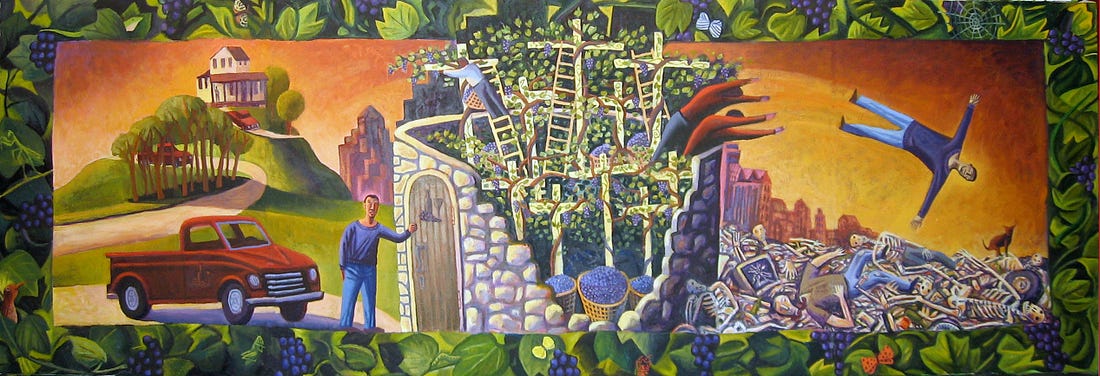
“The Wicked Tenants,” artist, James B. Janknegt. Used with permission. Please visit his website, https://www.bcartfarm.com

The Paradigm Shift

DIANA BUTLER BASS JUN 24

WELCOME TO THE SUMMER SERIES WEDNESDAY!

This year, unlike past years, the Cottage Summer special — Parables & Pentecost — is open to all subscribers (paid and free) to nurture your spirit this season.

In addition to these Wednesday posts on the parables in A Beautiful Year, paid subscribers have access to weekly recorded conversations during Parables & Pentecost. Last week’s recording can be found HERE


Today, we explore the story of the Wicked Tenants in our summer series on Parables and Pentecost.

A wee reminder: the word “parable” means to “overturn” or “cast aside.” The parables are STORIES told by Jesus and intended to upset what we think!

A few readers have written to say they were upset with some of last week’s suggestions for reading the parable. Well, my friends, that’s what a parable is supposed to do — overturn conventional wisdom. Indeed, the Gospel of Matthew itself says that these Jesus stories set “the whole city … in turmoil.”

Today’s parable continues the task of casting off convention.

***

The above audio excerpt is courtesy of my publisher from the audiobook version of A Beautiful Year, “The Parable of the Wicked Tenants.” If you are reading the book, it is found on pages 242-246; in the e-book, this parable is in the Pentecost section.

Read and reflect on this parable. How do you feel about this story? Where are you in the story? Does this parable challenge you — and us — at this moment in history?

Explore the suggestions below for further reflection and understanding — as you choose. 

This isn’t a homework assignment! This is an invitation and a guide. Think about all three topics or pick one. Leave comments and observations. Read the comments of others and learn from the community. Reply to each other. I’ll jump into the thread a few times during the day.

Ask questions, wonder together.


THE STORY

The parable itself is found in Matthew, Mark, Luke, and the non-canonical Gospel of Thomas. This version is from Matthew 21:33-44

Listen to another parable. 

There was a landowner who planted a vineyard, put a fence around it, dug a wine press in it, and built a watchtower. Then he leased it to tenants and went to another country. 

When the harvest time had come, he sent his slaves to the tenants to collect his produce. 

But the tenants seized his slaves and beat one, killed another, and stoned another. Again he sent other slaves, more than the first; and they treated them in the same way. 

Finally he sent his son to them, saying, “They will respect my son.” But when the tenants saw the son, they said to themselves, “This is the heir; come, let us kill him and get his inheritance.” So they seized him, threw him out of the vineyard, and killed him. 

Now when the owner of the vineyard comes, what will he do to those tenants?’ They said to him, ‘He will put those wretches to a miserable death, and lease the vineyard to other tenants who will give him the produce at the harvest time.’

Jesus said to them, ‘Have you never read in the scriptures:

The stone that the builders rejected
has become the cornerstone;
this was the Lord’s doing,
and it is amazing in our eyes?

Therefore I tell you, the kingdom of God will be taken away from you and given to a people that produces the fruits of the kingdom. The one who falls on this stone will be broken to pieces; and it will crush anyone on whom it falls.

WHAT IS THIS STORY ABOUT?

How would you explain this story to someone who had never heard it before? What’s the point? Is there more than one point to this parable?

Do you like the story? Do you not like it? Does it puzzle you? Anger you? Make you resentful? What emotions does it stir? Be honest!

What do you think a person who had never heard this story before would make of it?

Do you think it is better described as a moral parable, an example parable, or a challenge parable? It is tempting to say “all three,” but which of these styles is most prominent?


THE STORY AND YOUR STORY

WHAT DOES THIS STORY MEAN TO YOU?

When did you first hear this story? How many times do you think you’ve heard it? Have you heard it in other forms (film, novel, poetry, art, music) in addition to the biblical story?

To which character do you most relate? Who garners your sympathy? Who is the hero of this story? The villain? Who do you like the most? 

How has your understanding of this story changed over the years? What stands out for you differently today than at other times in your life? As you re-read it or listen to my reflections on it, what surprised you? Is there something you’ve never noticed before?


THE STORY AND OUR STORY

During the first week of this series, John Dominic Crossan joined with the paid subscriber community in an online conversation about the parables.

We focused on how the parables challenged empire, how they present an alternative to Christian nationalism, and how they widen our vision toward evolutionary — and revolutionary — possibilities for a sustainable, peaceable future for humankind.

In his book, The Power of Parable, Crossan interprets this parable as a very particular kind of challenge parable — a “paradigm shift” parable of the Kingdom of God.

Crossan explains that Jesus, in his parables, transformed expectations of the Messiah. According to many scholars, at the time of Jesus, the Jewish people generally expected a “Davidic Messiah,” a warrior king who would restore the kingdom of Israel and defeat the enemies of God. Crossan argues that “Jesus proclaimed nonviolent resistance to the injustice of Roman imperialism in a world that belonged to a just and nonviolent God.” 

This biblical shift seems, in retrospect, obvious — and central to the nascent Christian message. But at the time, it wasn’t. Jesus told stories to invite hearers into a different vision of the Messiah and the Kingdom, and this was the “kingdom paradigm-shift.”

Now, with the shift in mind, imagine you are a first-century Jew. It would be easy to think that the landowner was Rome. Because the land was owned by Roman colonizers and flunkies! They might have thought of themselves as the tenants, those who had to work the vineyard (rather like sharecroppers) and turn the profits over to this distant absentee owner. When the slaves show up to collect on the master’s behalf, the workers rebel and kill the slaves. And when the master sends his son, well, they kill him, too. 

See what this sounds like? Enslaved people on a plantation killing their enslavers? A colonial uprising? The rightful overturning of injustice?

If you heard this parable and you were being forced to hand over the work of your hands to Roman authorities, you’d probably be siding with the tenants! They wouldn’t seem so wicked. They’d seem like their cause was just.

Here’s Professor Crossan’s view:

Think about the parable of the Wicked Tenants … imagine a first-century Galilean audience hearing (this) story. 

Would some find that murder acceptable — even by divine law? Would they agree the tenants were, as we say, “wicked”? Would others find it understandable, but not prudent — the authorities would surely exact vengeance? Would some, many, or even most find it unacceptable on moral grounds?

Jesus could not have known their reactions beforehand and neither can we afterward. 

But, the story holds another possibility (indeed, more than one additional possibility!). My sense — and I think Crossan’s as well — is that the landowner (in this particular parable) may well be God. The tenants aren’t all Jews; rather, they are Jews who are collaborating with Roman colonizers (they “work” Rome’s vineyard on behalf of the imperialists). The “slaves” are God’s faithful servants and prophets (like John the Baptist). And the son is the Messiah who, in this case, does not respond with violence to the tenants’ murderous intent. Instead, he dies revealing the wickedness of the collaborators of empire.

Ouch. That must have hurt. And it surely shocked them.

That’s the power of a paradigm shift. 

HOW DOES THIS PARABLE CHALLENGE YOU — AND US — AT THIS SPECIFIC MOMENT IN HISTORY?

Can you imagine how a first-century Jew in Galilee, a region occupied by Rome, might have felt about this story? Might they have sympathized more with the landowner, the tenants, or the slaves? Do you understand how shocking this parable may have been in its original context?

Crossan claims, “Jesus is not just announcing to his audience that God’s kingdom is now present. He is announcing that is only present if and when it is accepted, entered into, and taken upon oneself.” The question, “Where are you in this parable?” is an invitation to change, to shift your consciousness about the meaning and nature of the Kingdom of God. Can you grasp that? (Hint: some of the collaborators couldn’t!)

What is most challenging for you? For your community? What’s the challenge for NOW — socially, politically, or economically?

Is this Kingdom paradigm-shift needed now? What if Christian nationalists changed their vision of the kingdom from a warrior-king Messiah to a nonviolent, non-imperial, self-giving one? What if people like, say, Pete Hegseth, shifted from collaborating with a violent empire to co-creating the Kingdom? Can you imagine? Is this parable speaking to people like him?

Maybe we humans always collaborate. The question is: With which paradigm do you collaborate?


Leave a comment


An example parable may be good, a challenge parable is a far more importantly subversive operation. Why? Because challenge parables humble our prejudicial absolutes, but without proposing counter-absolutes in their place. They are tiny pins dangerously close to big balloons. They push or pull us into pondering whatever is taken totally for granted in our world.

— John Dominic Crossan


INSPIRATION


Jesus tells a story about wicked tenants
who want to take over a vineyard.
A vineyard would have been repossessed land
taken from farmers, turned to an export crop,
where they are now sharecroppers.
The story is a commentary on economic systems
that use people.
And also a hit at leaders
who are doing a lousy job.

But what if it’s also about us,
about our urge to take over religion
and make it ours?

God, I confess
sometimes I want to possess your vineyard,
to make my religion work out for me,
not merely to receive it but to control it,
to manage your grace,
to center it on me.
I repent of my mutiny.

I will let this be yours,
and I will work your fields.
— Steve Garnaas-Holmes, “Wicked Tenants”

In a room where
people unanimously maintain
a conspiracy of silence,
one word of truth
sounds like a pistol shot.

― Czesław Miłosz
Hope Takes Practice

June 23rd, 2026 by Dave No comments »

Tuesday, June 23, 2026

At the CAC’s virtual gathering “How Do We Find Hope in Hard Times?,” Grammy Award–winning artist and musician Jon Batiste joined the CAC team in conversation. Dean of Faculty Carmen Acevedo Butcher asked Batiste about joy and celebration as a way to affirm our humanity amid circumstances that dehumanize us: “Where are you seeing that dehumanization right now, and how might we lean into joy as an act of resistance?” Batiste responded:

There are so many things that we can say about the times we’re in, and so many ways to look at it. In general, I like to look at things as happening on different axes. There are all these things happening at once from the perspective of your own life, the perspective of observing the world around you, and ultimately, observing history. We can see the ebbs and flows of time, and how we’ve gone through all of these different phases within the course of our generation and generations past. 

So you have to start by finding a rooting that is true and meaningful for you. That’s ultimately where we begin to find authentic joy, because joy comes from pain. It’s a transmutation and an alchemizing of pain. It shifts it into a space that is true and authentic for you, even if the circumstances around you don’t change. Deep hope can’t be suppressed by bad circumstances. Hope transcends the conditions of your circumstances.

We [can] lose hope when we don’t believe or see evidence of a positive outcome anymore, but the deepest hope is this inner knowing that the brightest light can come from the darkest moments. You find that hope … by first questioning, “What are the things that I’m hoping for? Who are they for? Who is in control of hope? What is my hope rooted in? What is my belief about the ultimate outcome?” 

I’ve started to learn that hope transcends the physical. Hope is the language of the invisible. It transcends circumstances because it transcends physicality. It’s spiritual. It’s the language of the invisible realm, which is just as real, if not more real, than the things we can see and touch. Hope is the deep inner knowing that comes from building that [foundation]. That’s why I like to say that hope is like a contact sport. You work on it. You get better at it. My house could be flooded, and the roof could be on fire, and still, there’s a sense of hope I can have. I’m going to stay in that boat. 

This isn’t easy all the time, but it’s a choice that—once we make it and we root ourselves in the deepest, most authentic place in our life, however we arrived there—then we can truly live that out. We can build on that, and it compounds, no matter what the circumstances surrounding us are, no matter what they could be, and whether we have control of them or not

============

Welcome to Bradley Jersak’s Substack! In the parable of the prodigal son(s), I love the verse, “And while he was still a long way off, his father saw him and was filled with compassion for him; he ran to his son, threw his arms around him and kissed him.” That’s my story. I hope that in the posts to follow, you’ll see it shine through. 


Open Arms, Open Heart

With Wisdom from Volf and Kierkegaard

BRADLEY JERSAK. JUN 21

I’m just in the editing process of my next book, to be published by Brazos next year, titled Christ in Unexpected PlacesIt features a lot of stories about encountering Jesus in the people we tend to overlook or even avoid. That requires something of us: the need for open arms and open hearts that embrace the other—including those Jesus called “the least of these.” We offer loving hugs literally and metaphorically to represent the open arms of God here on earth. I wrote something about this twenty years ago while co-pastoring a church of precious misfits: 

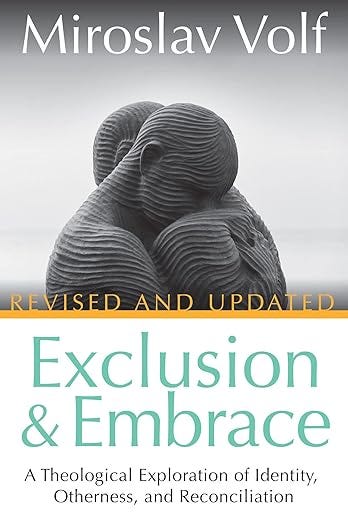
Whenever we open our arms to welcome the very least and the most lost, we imitate God in four ways outlined in theologian Miroslav Volf’s must-read text on justice and reconciliation, Exclusion and Embrace:

1. Open arms are a gesture of reaching for the other. They signal discontent with my self-enclosed identity and suggest desire for the other.

2. Open arms say that I have created space in myself for the other to come in. No longer “full of myself,” I set out on a journey toward the other, moving beyond my own fortified boundaries.

3. Open arms suggest a fissure in myself—an open door into my space through which the other might enter. They signify an aperture in the boundary of my self.

4. Open arms are a gesture of invitation, like an open door to an expected friend that beckons, come in. But unlike the open door, open arms are also a soft knock on the other’s door, politely asking if I might enter their space. 

We open our arms to the world to proclaim the message of reconciliation—the open temple, the open table, the open arms, the open heart—limited only by what we offer, i.e. the extravagant love of Christ. To those who respond, to those we receive, we become the Bethlehem innkeeper who might have made room for Christ and his family. If only we have eyes wet enough to see.

I don’t know if I could have written that even two years later—I went through a rough patch—but two decades later, I do still believe it, even with a lot less energy and zeal. But I’m pretty sure Jesus believed it, and I believe him.

So did Sören Kierkegaard, though far more boldly than me. I’ll leave you with his ever-probing words! 

Sören Kierkegaard

Sören Kierkegaard
THE INVITATION – II 
Training in Christianity

Come here all, all, all of you, with Him is rest, and He makes no difficulties, He does but one thing, He opens His arms.

He will not first (as righteous people do, alas, even when they are willing to help)—He will not first ask thee, “Art thou not after all to blame for thy misfortune? Hast thou in fact no cause for self-reproach?” 

It is so easy, so human, to judge after the outward appearance, after the result—when a person is a cripple, or deformed, or has an unprepossessing appearance, to judge that ergo he is a bad man; when a person fares badly in the world so that he is brought to ruin or goes downhill, then to judge that ergo he is a vicious man. Oh, it is such an exquisite invention of cruel pleasure to enhance the consciousness of one’s own righteousness in contrast with a sufferer, by explaining that his suffering is God’s condign punishment, so that one hardly even… dares to help him; or by challenging him with that condemning question which flatters one’s own righteousness in the very act of helping him.

But He will put no such questions to thee, He will not be thy benefactor in so cruel a fashion. If thou thyself art conscious of being a sinner, He will not inquire of thee about it, the bruised reed He will not further break, but He will raise thee up if thou wilt attach thyself to Him. He will not single thee out by contrast, holding thee apart from Him, so that thy sin will seem still more dreadful; He will grant thee a hiding-place within Him, and once hidden in Him He will hide thy sins. For He is the friend of sinners: When it is a question of a sinner He does not merely stand still, open His arms and say, “Come here”; no, He stands there and waits, as the father of the lost son waited, rather He does not stand and wait, He goes forth to seek, as the shepherd sought the lost sheep, as the woman sought the lost coin. He goes—yet no, He has gone, but infinitely farther than any shepherd or any woman, He went, in sooth, the infinitely long way from being God to becoming man, and that way He went in search of sinners.

After Kierkegaard, do I say “Enjoy”? Well, at least feel free to subscribe and share.

==========

Individual Reflection:
Where in your life right now is hope something you’re practicing rather than something you feel?

Group Discussion — choose one:
What does it mean to you that the Father in this story doesn’t wait but goes looking?
What has hope cost you?
Where have you found that brightness Batiste describes emerging from a dark moment — and did you trust it?

Love Is the Foundation of Hope

June 21st, 2026 by Dave No comments »

Sunday, June 21, 2026

Hope arises when we embrace a sacred reality.
—Steven Charleston, Ladder to the Light

Father Richard Rohr finds encouragement in his belief that we are created in the image of God, who is love: 

The Jesuit priest and scientist Pierre Teilhard de Chardin wrote, “Love is the physical structure of the universe.” [1] Our theological or scriptural way of saying the same thing is “Let us create in our image” (Genesis 1:26). The universe—and each of us—are made in the image of the triune God, who is love, a dynamic cycling of infinite outpouring and infinite receiving.

If God is both incarnate and implanted, both Christ and Holy Spirit, then an unfolding inner dynamism in all creation is not only certain but also moving in a positive direction. If we are to have foundational hope, it almost demands a foundational belief in a world that is still and always unfolding toward something better. This is the virtue of hope. Personally, I have found that it is almost impossible for individuals or communities to heal over the long haul if they do not trust that the whole cosmic arc is also on a trajectory toward the good.

Admittedly, sometimes the suffering and injustices of our time make it hard to believe in that arc of love. I think that is part of the church’s major failure: to provide Western civilization with a positive, hopeful, and cosmic understanding of our own “good news.” [2]

Choctaw elder and Episcopal bishop Steven Charleston describes how this love and foundational hope surround us at all times: 

The tipping point of faith is the threshold of spiritual energy, where what we believe becomes what we do. When that power is released, there is no stopping it, for love is a force that cannot be contained….

Hope lets us literally see the presence and action of the holy in our everyday lives. This is not an imaginary desire viewed through rose-colored glasses. It is the solid evidence of the power of love made visible in abundance….

Sometimes, in this troubled world of ours, we forget that love is all around us. We imagine the worst of other people and withdraw into our own shells. But try this simple test: Stand still in any crowded place and watch the people around you. Within a very short time, you will begin to see love, and you will see it over and over and over. A young mother talking to her child, a couple laughing together as they walk by, an older man holding the door for a stranger—small signs of love are everywhere. The more you look, the more you will see. Love is literally everywhere. We are surrounded by love…. Hope makes room for love in the world.

=================

Mercy and Mystical Hope

Monday, June 22, 2026

CAC faculty emerita Cynthia Bourgeault describes hope as a quality of God’s mercy, fully available to us:

Hope’s home is at the innermost point in us, and in all things. It is a quality of aliveness. It does not come at the end, as the feeling that results from a happy outcome. Rather, it lies at the beginning, as a pulse of truth that sends us forth. When our innermost being is attuned to this pulse it will send us forth in hope, regardless of the physical circumstances of our lives. Hope fills us with the strength to stay present, to abide in the flow of the Mercy no matter what outer storms assail us. It is entered always and only through surrender; that is, through the willingness to let go of everything we are presently clinging to. And yet when we enter it, it enters us and fills us with its own life—a quiet strength beyond anything we have ever known.

And since that strength is, in fact, a piece of God’s purposiveness coursing like sap through our own being, it will lead us in the right way. It sweeps us along in the greater flow of divine life as God movestoward the fulfillment of divine purpose which is the deeper, more intense, more subtle, more intimate revelation of the heart of God. [1]

Through contemplative practice and surrender, Bourgeault believes we can experience God’s mystical hope and become a healing presence in the world:

In the contemplative journey, as we swim down into those deeper waters toward the wellsprings of hope, we begin to experience and trust what it means to lay down self, to let go of ordinary awareness and surrender ourselves to the mercy of God. And as hope, the hidden spring of mercy deep within us, is released in that touch and flows out from the center, filling us with the fullness of God’s own purpose living itself into action, then we discover within ourselves the mysterious plentitude to live into action what our ordinary hearts and minds could not possibly sustain. In plumbing deeply the hidden rootedness of the whole, where all things are held together in the Mercy, we are released from the grip of personal fear and set free to minister with skillful means and true compassion to a world desperately in need of reconnection.

Hope is not imaginary or illusory. It is that sonar by which the body of Christ holds together and finds its way. If we, as living members of the body of Christ, can surrender our hearts … and listen for that sonar with all we are worth, it will again guide us, both individually and corporately, to the future for which we are intended. And the body of Christ will live, and thrive, and hold us tenderly in belonging.

===========

Individual Reflection

Where have you been generating hope rather than receiving it — and what would it feel like to stop?


Group Discussion — choose one:

  1. Bourgeault says hope is “entered always and only through surrender.” What are you currently clinging to that might be blocking it?
  2. Charleston invites us to stand still and watch for love. When did you last see it somewhere you weren’t expecting it?
  3. If hope is the sonar that holds the body of Christ together, what would it mean to listen for it rather than produce it?

The Way Of The Early Church

June 19th, 2026 by JDVaughn No comments »

Re-Enlivening Ministries

Friday, June 19, 2026

Juneteenth

Father Richard turns to the apostle Paul’s advice to the first churches to envision church renewal today:

Prior to the imperial edicts in the fourth-century that pushed Christians to the top and the center of the Roman Empire, the church was still countercultural and non-imperial—a social movement for the reign of God. In a two-hundred-year period, Christians went from being complete outsiders to directing the inside! Christianity increasingly accepted, and even defended, the dominant social order, especially concerning war, money, and authority. [1]

While Christian churches today do much good, they are still largely aligned, especially in the West, with cultural and political power. To recover the early church’s emphasis on faith as a loving and communal way of life, we clearly need to support good and compassionate pastoral and healing practices. We must begin to validate Paul’s original teaching on “many gifts and many ministries” (1 Corinthians 12:4–11) that together “make a unity in the work of service” (Ephesians 4:12–13). We need Christian people who are trained in, validated for, and encouraged to make home and hospital visits; do hospice work and jail ministry; support immigrants and refugees; help with soup kitchens; counsel couples before, during, and after marriage; teach classes in parenting; offer ministries of emotional, sexual, and relational healing; help with financial counseling; build low-cost housing; take care of the elderly; run thrift centers—all of which put Christian people in immediate touch with other people. Remember, healing was most of the work Jesus appeared to do. It is almost too obvious. Either we see Christ in everyone, or we hardly see Christ in anyone. Either we are Christ to everyone, or we cannot be Christ to anyone.

My vision of any future church needs to be much flatter and much more inclusive. It is much less “churchy,” surely less patriarchal, and more concerned with fulfilling its mission statement than with endlessly reciting its heavenly vision and philosophy statement—the Nicene Creed—every Sunday. Simply put, any notion of a future church must be a fully practical church that is concerned about getting the job of love done—and done better and better. Centuries of emphasis on art and architecture, songs, liturgy, and prescribed roles have their place, but their overemphasis has made us a very top-heavy, decorative church that is largely, and constantly, concerned with its own in-house salvation.

Most people today, in fact, understand church to mean a building, rather than “where two or three gather in my name,” where the Divine Presence is promised just as certainly as it is promised in the bread, in the Bible, in the Sacraments, or in any anointed leadership: “There I am in your midst” (Matthew 18:20).

Authentic leadership, I think, implies people who can spot, affirm, train, support, finance, and validate gifts and leadership wherever they see them in actual practice (think multipliers instead of monarchs). Then we are not all striving toward the top but striving toward supporting the supreme work of love flowing into the world. [2]

References:
[1] Adapted from Richard Rohr, Dancing Standing Still: Healing the World from a Place of Prayer (Paulist Press, 2014), 48–50.

[2] Adapted from Richard Rohr, “Powering Down: The Future of Institutions,” ONEING 7, no. 2, The Future of Christianity (2019): 46–47. Available in print or PDF download.

——————————————————————————————————
John Chaffee – Five On Friday

1.

“Trauma blocks loving connection;

Loving connection heals trauma.”

– Unknown

I’m just gonna leave this one here without further commentary, it’s that good.

2.

“Humanity needs not the death of God but the birth of a new understanding of divine reality.”

– Pierre Teilhard de Chardin, French Jesuit Priest

Or, as Thomas Keating says, “We need a theology that matches our current cosmology.”

We know that the universe is still expanding, growing, and birthing new stars and universes.  We know the Earth is not the center of the universe, but that we circle around a star that is also not the center of the universe.  We also have to reckon with the fact that we do not live in a 3-tiered universe, with “hell” literally below us and “heaven” literally above us.  (Rather, the Kingdom of Heaven is already near and among us.)

We also know that God is not some Divine Tyrant like a Pharaoh or Genghis Khan.  Jesus reveals that Yahweh is nothing like Zeus.  Infinite Love looks nothing like a cosmic Santa Claus keeping a list and checking it twice.

It is possible that in 6,000 years, people will look back at Christianity now and think that we were still in “kindergarten Christianity.”  We still believe in the Sword more than the Cross, and we often still believe that God utilizes fear more than love…  How pagan to believe such things!

But I believe something is changing.

We are now in a Post-Secular society, one in which the fullness of secular life was attempted and found to also be lacking… which means a return to faith and religion.

As I say that, though, I do not mean a return to how faith and religion were done in the past, but hopefully a more robust, integrative, mature, healthy, and holy one.  We now have more access to the whole of the Christian tradition than ever before, thanks to the internet, so hopefully the chaff will be separated from the wheat, the cream will rise to the top, and we will see a resurgence of people rediscovering the best of the Christian tradition.

3.

“Those who would know much, and love little, will ever remain at but the beginning of a godly life.”

– Mechtild of Magdeburg, 13th-Century German Nun

As a recovering Enneagram 5, this one is directed at me, who, for years, made the mistake of caring more about knowledge and information than about learning to love and be loved.  Or, I guess you could say I wanted to be loved for what I knew rather than for who I am (because that felt terrifying).

Granted, I have been through some things that led me to put up some serious walls, but fortunately, the older I get, the more those walls continue to crumble like Jericho’s.

Notice, though, that Mechtild does not say such a person is not godly.  She only says that such a person will “ever remain but at the beginning.”

4.

“People use drugs, legal and illegal, because their lives are intolerably painful or dull. They hate their work and find no rest in their leisure. They are estranged from their families and their neighbors. It should tell us something that in healthy societies drug use is celebrative, convivial, and occasional, whereas among us it is lonely, shameful, and addictive. We need drugs, apparently, because we have lost each other.”

– Wendell Berry, Eco-Poet

I grew up in beach culture, in which there was a culture of recreational drug use.

Although I never fell into it, I knew of its presence.

And even then, I knew that some people were not really using it “recreationally” but as an escape or attempt to numb some deeper pain.  Obviously, this numbing can work for a short while, but the deeper pain will always be there until it is exhumed.

It was much later on in life that I heard a very important term: Adverse Childhood Experiences (or, ACEs).

The ACE study, done between 1995 and 1997, helped put into the collective consciousness that childhood trauma can lead to many issues later on in life.  The study named 10 “Adverse Childhood Experiences.”

  1. Physical Abuse
  2. Sexual Abuse
  3. Emotional Abuse
  4. Physical Neglect
  5. Emotional Neglect
  6. Household Substance Abuse
  7. Household Mental Illness
  8. Parental Separation or Divorce
  9. Domestic Violence
  10. Incarcerated Family Member

It’s quite a sad list, isn’t it?

And get this… While driving to work, I was listening to a podcast about Homeboy Industries in Los Angeles, which does fantastic work rehabilitating gang members, and it said that some homies have 9/10 or even 10/10 of those experiences!  Lord, have mercy.

Back to the Wendell Berry quote… We have lost each other.  We need each other in order to heal.

Huh.  I guess that goes back to the first quote above, which I did not intend.

Love is the solution, isn’t it?  It is always the solution.

5.

“If you do not learn to deny yourself, you can make no progress in perfection.”

– St. John of the Cross, 16th-Century Spanish Mystic

Before I say anything, allow me to note that for St. John of the Cross, “perfection” is nearly synonymous with “union with God.”

We will never make any progress on the journey of being united with God if we do not learn to deny ourselves.

By this, I do not mean that it is a matter of denying cake, cocaine, materialism, etc.  (Although denying those things would be healthy for us in probably both the short and the long run.)

To deny ourselves is to choose someone else’s good over our own.  It is a matter of denying all the ways our ego gets in the way of healthy and holy relationships.  This applies not only to our relationship with God but also to the people around us.  The ego wants to get ITS way, which means there is little room for others.

To deny ourselves might mean creating space for others in our lives, which brings me back to “perfection as union.”  To deny ourselves does not mean abandoning ourselves.  To deny ourselves might mean refusing to allow ourselves to find all our fulfillment within ourselves and reaching out for loving union.

After all, love is the perfection of the law.

The Way of the Early Church

June 18th, 2026 by JDVaughn No comments »

A Movement that Continues

Thursday, June 18, 2026

What kind of spiritual movement could challenge willing sectors of Christian faith to migrate from their systems of belief to a shared way of life centered on love?
—Brian McLaren, The Great Spiritual Migration

CAC faculty member Brian McLaren shows how Jesus and his followers embodied a communal, public way of life representing a social movement:

On page after page [of the Gospels], Jesus and his disciples practiced movement dynamics in Galilee, Judea, and Samaria. Jesus seized the opportunity for change created by unrest in Galilee … by the injustices of the Roman occupation, and by corruption among the religious elite. He framed his message through a powerful central image (kingdom of God), a unique art form (parables), and through powerful slogans (“Repent for the kingdom of God is at hand,”… “Love your enemies,” “Deny yourself, take up your cross, and follow me,” for example). He developed a protest and messaging strategy that included public teach-ins (the Sermon on the Mount), demonstrations (healings, exorcisms, feeding of the five thousand), guerrilla theater (his triumphal entry into Jerusalem), and advanced action-reflection leadership training (deployments and retreats with disciples).

His mobilizing structures included the three, the twelve, the seventy, and special two-by-two initiatives. In addition, he taught his disciples to build allies among “people of peace,” and to be willing to let people walk away if they were not ready for the demands of movement involvement. He developed rituals of initiation (baptism) and renewal (Eucharist), calling people to initial commitment and strengthening them for the long haul. His movement culture was unique and distinctive, characterized by feasts, parties, joyful processions, and outdoor festivals at which usually stigmatized and outcast people were warmly welcomed. He gave women an unprecedented level of responsibility in his movement, and among his inner circle he included people of diverse gifts and temperaments, from a poet like John to an activist like Simon the Zealot to a steady pillar like Peter (at his best). His movement culture also emphasized the value of contemplative solitude and withdrawal to nourish the inner life and sustain the struggle over the long haul…. Their lives in the movement were characterized by great joy, great sorrow, and great love.

I could see these same dynamics at work in Paul and his colleagues around the Mediterranean, as the “kingdom of God” movement expanded to the far corners of the earth. And I could see similar patterns reemerging throughout Christian history—in the desert fathers and mothers, in Saint Patrick and the Celts, in Saint Francis and Saint Clare, in the Wesleys and the early Pentecostals, in Dr. King and Desmond Tutu, in Dorothy Day and Oscar Romero. Since its earliest and most dynamic centuries, Christianity has been most vital when it has been energized by movements of self-organizing—or perhaps we should say “Spirit-organizing”—cells. These cells have taken root and grown like seeds in communities and institutions. There they have grown, multiplied, and borne fruit—fruit in just and vibrant institutions, fruit in thriving, peaceful, joyful communities.

Reference:
Brian D. McLaren, The Great Spiritual Migration: How the World’s Largest Religion Is Seeking a Better Way to Be Christian (Convergent Books, 2016), 141–143.

Living Fearless by Jamie Winship

Abiding

As I rookie police officer back in 1983, I spent fifty weeks of four-day, ten-hour shifts with the first real disciple of my life. The Troll, as he was unaffectionately known by all police rookies, was one of the most feared training officers in the police department. Although the Troll was not a Christ-follower, he understood the art of discipleship better than anyone I had met previously. The first question the Troll would ask me at the beginning of a shift was, “Are you sure you want to stay with me?” 

I always felt as if this was the question Jesus Himself would have asked me if He were my field training officer. “Are you going to stay, remain, dwell, continue, abide in and with me today?” Jesus didn’t preach formulaic, chapter-and-verse sermons to His followers. He didn’t lead others through a linear outline of propositional truth points. He spent time with His disciples, asking a lot of questions and telling a lot of stories—stories that we are still trying to understand today. 

After every single shift, when I had left the presence of the Troll, my wife asked, “How was your shift?” My answer was often, “I don’t think I’m going to make it. The Troll is making my life miserable. Why keep trying?” 

Why didn’t the Twelve leave Jesus? It wasn’t as if Jesus was guaranteeing them a happy, quiet, prosperity-filled life of leisure and comfort. He was leading them straight into their deepest, darkest fears. So, what made them stay? 

Peter’s response to Jesus’s challenge is stunning: “Lord, to whom shall we go? You [alone] have the words of eternal life. We have believed and confidently trusted, and we have come to know You are the Holy One of God, the Christ, the Son of the living God” (John 6:68–69). 

Peter explains his relationship with Jesus as divinely initiated, a covenantal relationship, the benefits of which are quite one-sided. Jesus alone has the words of eternal life, and Jesus is the only hope because Jesus is the Christ, the Son of the living God. Peter’s part was to receive. 

This abiding, life union with Jesus is available to us today and includes all the fullness of the Godhead; spiritual fruitfulness; the fullness of the words, love, and joy of the Father; answered prayer; and the glory and honor of God. I ask again, who would want to leave that relationship? 

Where do your fears invite you to turn? Do you fear turning to God?

Scripture

Psalms 73:28

John 6:67-69

John 15:4-5

Christianity: A Love Song

June 17th, 2026 by Dave No comments »

Wednesday, June 17, 2026

Church historian Diana Butler Bass recounts how some early Christians lived their faith in the way of Jesus:

Throughout the first five centuries people understood Christianity primarily as a way of life in the present, not as a doctrinal system, esoteric belief, or promise of eternal salvation. By followers enacting Jesus’s teachings, Christianity changed and improved the lives of its adherents and served as a practical spiritual pathway. This way—and earliest Christians were called “the People of the Way”—bettered existence for countless ancient believers….

Christian defenders, such as Justin Martyr (ca. 100–ca. 165), used the example of Christian practice to make the case that Jesus’s way “mended lives”:

We who formerly … valued above all things the acquisition of wealth and possessions, now bring what we have into a common stock, and communicate to everyone in need; we who hated and destroyed one another, and on account of their different manners would not live with [people] of a different tribe, now, since the coming of Christ, live familiarly with them, and pray for our enemies. [1]

To Justin, the old ways had passed; a new way opened in Jesus. Far from being divisive, Christianity was an inclusive faith that might bring diverse peoples together. However one interpreted the effects of the new faith, both enemies and defenders of Christianity understood that the new religion transformed people, giving even women, peasants, and slaves a meaningful ability to reorder their lives.

In the first centuries of the church, Jesus’s command to love God with our whole selves and to love our neighbor as ourselves was central to Christian identity and practice. 

More than anything else, Christianity is a love song. People shy away from saying that out loud, though…. Perhaps Christians fear that they themselves barely understand the radical implications of a way of life based on the love of God…. Certainly, in the eyes of many contemporary critics, Christianity does not seem very loving….

Yet love is what Jesus preached—and what he embodied. In the early church, devout Christians tried to embody God’s love and to experience God in such a way that love reshaped their lives. “Love for God is ecstatic, making us go out from ourselves,” wrote Dionysios the Areopagite around 500; “it does not allow the lover to belong anymore to himself [or herself], but he [or she] belongs only to the Beloved.” Not all Christians achieved this; they too struggled with loving God. But Romans frequently criticized the Christian emphasis on love as somehow a little deluded and perhaps prurient, suggesting that followers of the Jesus Way made it known that theirs was a path of love. Early Christians insisted that love—not rationality or politics or even virtue—was the primary bond between God and human beings. Love was God’s symphony, the perfect beauty that human beings experienced through practices of faith—by imitating Christ and following his way.

=======

When Spiritual Practices Fall Flat

How I Learned to Listen More Deeply

CHUCK DEGROATJUN 16

Are you listening to your body?

I didn’t realize, when I was hospitalized in Mexico in April 2012, that my body was screaming at me to stop.

Intuitively, I knew something was wrong. That’s when I really began to listen, at least as best I could. And I chose to pivot, personally and vocationally.

With a major shift in lifestyle and geography, I settled into a slower routine and began engaging new practices with regularity. I was proud of myself for slowing down, even for making a courageous vocational move, one I characterized using Nouwen’s language of “downward mobility.” I sometimes wonder if I was more interested in the performance of downward mobility than the experience of it.

Nevertheless, with this massive pivot, I created more space to intentionally enter into new practices. Contemplative prayer. Yoga. Regular exercise. More intentional time with my kids. But within a year, I still felt restless. It still felt like the old me was driving the fast-moving bus.

What I didn’t realize then, but can see now, was that I was merely adding practices on top of a neglected and dysregulated nervous system.

My body had been living in a chronic, small-t trauma state for years. And I was the classic minimizer, the helper who regularly dismissed his own needs.

My nightstand included works by Rothschild, Siegel, and Badenoch, but I was reading for other people’s bodies and nervous systems, not mine. Even with a significant move from San Francisco to Michigan, even with an earnest effort to simplify and slow down, I was still living chronically outside my window of tolerance. What I couldn’t see then was that I was using silence and solitude to foster a bit of calm and connection to God without addressing the deeper, dysregulated undercurrents below.

Don’t get me wrong. The practices did create some calm, some joy, even some connection to God. My kids loved that I was around more. Life’s slower pace offered some gifts. But it was a little like cleaning and decluttering the house while ignoring the electrical wiring sparking behind the walls.

Here’s the thing.

We may sincerely desire deeper communion with God while our body remains braced, scanning constantly for danger.

We may acknowledge the shadow side of our Enneagram type without attending to the lingering survival energy that animates our reactions.

We may leave an abusive community or relationship and become champions of justice or reform without realizing how much oppositional energy still lives in us.

We may practice contemplation or meditation or yoga or self-help vagal exercises without honoring the surging flight energy within, the very energy that can turn healing into another form of spiritual perfectionism.

We may be told by a therapist to grieve our mother’s past absence while never attending to our present inner disconnection.

And it’s frustrating, isn’t it?

I would find myself perpetually restless and dissatisfied, always scanning for the next thing that might finally help. Another book. Another practice. Another retreat. Another insight. All of it driven by an unseen survival energy within.

And I’ve learned, through my own work and thousands of hours with others, that many of us live here without knowing it. You may be sincere, eager, wanting to grow. You may be doing the practices, reading the books, naming your patterns, pursuing justice, engaging therapy, seeking God.

But beneath it all, your body may still be braced.

And a braced body will turn almost anything into a strategy for survival, even the most beautiful spiritual practices. This does not mean the practices are bad. It means they need to meet us where we actually are.

Because addressing our deeper dysregulation is different from engaging vagal exercises that foster calm.

Because identifying how and why we live in perpetual vigilance is different from naming our Enneagram type.

Because acknowledging the chronic functional freeze that leaves us numb and going through the motions is different from committing to a morning quiet time.

For me, the invitation was not to abandon silence and solitude, but to stop using them to bypass the truth my body was telling. I had to learn to listen beneath my thoughts, beneath a typology, beneath my helper identity, beneath my well-practiced spiritual language, beneath the breathing exercises, beneath the yoga, even beneath my more faithful presence to my family. These were all good, but they did not help me see and name the hidden, dysregulating cycle.

I had been trying to calm my body before I had learned to listen to it.

Reflect

  • Where have I been using good and beautiful practices to create calm, or even connection with God, without attending to the deeper survival energy still moving within me?
  • What might my body be trying to tell me beneath my thoughts, my spiritual language, my personality type, my productivity, or my role?
  • What would it look like to stop managing my body and begin listening to it as a place where truth, ache, longing, and God’s invitation may be revealed?

Living Out the Good News

June 16th, 2026 by Dave No comments »

Tuesday, June 16, 2026

Religious scholar Huston Smith describes how the first Christians spread the gospel message through their happiness, beyond any particular words they shared:

The compassion the disciples had encountered in Jesus was powerful—victorious over everything. This conviction had transformed a dozen or so disconsolate followers of a slain and discredited leader into one of the most dynamic forces in human history, and the tongues of fire that descended upon them at Pentecost set the Mediterranean world aflame. People who were not speakers waxed eloquent. They exploded across the Greco-Roman world, preaching what has come to be called “the gospel”; in the original Greek the phrase is “the Good News.” They spread their message with such fervor that in Jesus’s very generation it took root in every major city of the region….

The people who heard Jesus’s disciples proclaiming the Good News were as impressed by what they saw as by what they heard. They saw lives that had been transformed—men and women who were ordinary in every way except for the fact that they seemed to have found the secret of living. They evinced a tranquility, simplicity, and cheerfulness that their hearers had nowhere else encountered. Here were people who seemed to be making a success of the enterprise everyone would like to succeed at—life itself.

Smith highlights two remarkable qualities witnessed in the first Christians:

One of the earliest observations by an outsider about Christians that we have is, “See how these Christians love one another.” Integral to this mutual regard was a total absence of social barriers; it was a discipleship of equals. Here were men and women who not only said that everyone was equal in the sight of God but who lived as though they meant it. The conventional barriers of race, gender, and status meant nothing to them, for in Christ there was neither Jew nor Gentile, male nor female, slave nor free. As a consequence, in spite of differences in function or social position, their fellowship was marked by a sense of genuine equality.

Their second distinctive quality was happiness. When Jesus was in danger, his disciples were alarmed; but otherwise it was impossible to be sad in Jesus’s company. And when he told his disciples that he wanted his joy to be in them, “that your joy may be complete,” to a remarkable degree that objective was realized.

Outsiders found this baffling. These scattered Christians were not numerous. They were not wealthy or powerful, and they were in constant danger of being killed. Yet they had laid hold of an inner peace that found expression in a joy that was uncontainable. Perhaps “radiant” would be a better word. “Radiance” is hardly the word used to characterize the average religious life, but no other word fits as well the life of these early Christians.

===================

The Slow Yes

Why a process feels like care instead of bureaucracy.

BEAU STRINGERJUN 16

Hey friends, 

I spent a good chunk of last weekend at a UMC Candidacy Summit. This is a weekend long virtual gathering where the conference staff helps pastoral candidates explore and discern their call to pastoral ministry. Now, I have been a pastor for a long time. I have preached hundreds of sermons, and officiated dozens of funerals and weddings. And there I was sitting on a zoom call sharing my call to ministry story (which began 19 years ago).

The pathway to pastoral ministry in the UMC is a long road. You must be a member of a UMC for at least a year and then then once you start the process (depending on which route you take) it could be another year until they make it official. If I am being honest, there is a version of me from a few years back who would have found the whole thing a little insulting. “I already know how to do this”, or “Now you want me to jump through hoops for a piece of paper that says I am allowed to do the thing I have already given my life to?” But the me who showed up last weekend felt something I did not expect, and it caught me off guard. I felt grateful. Truly grateful. I felt like I was being handed a gift.

The Zoom Call

I visited with people from all over the Midwest, some of them young and bright-eyed and a little terrified, others coming in from other careers, a few of us further down the road or transferring in from other denominations. We went around and told pieces of our stories. Many of us had gotten lost, gotten hurt, talked ourselves out of it and back into it, and somehow found our way to a tradition that had a door propped open for us. It really was beautiful.

I have written a lot about leaving. This newsletter mostly exists because of the two years I spent in the wilderness after a decade of evangelical ministry. Lately I have been sitting with the other half of that story, the arriving. The quiet, undramatic, paperwork-heavy work of actually planting yourself somewhere new and saying out loud that you want to belong to it.

The Process Is the Point

Here is the thing I sat with after I got off the Zoom call on Saturday. The candidacy process is slow on purpose. There are mentors and interviews and forms and committees, and it takes as long as it takes. 

I used to read all of that as bureaucracy. Now I see it as care

A tradition that makes you take your time before it hands you over to a congregation is a tradition that takes both you and the people seriously. Nobody is going to rush me into pastoral ministry on the strength of charisma and a good story. And that’s a good thing. That was pretty much the whole game in the world I came from, and I watched it wreck more than a few good people.

So, I sat in those sessions as a candidate, fully aware of how strange it looked, and I let it be good. I let myself be a beginner again. There is a real freedom in handing yourself over to a process you trust. I have spent so much of my life being the one with the answers, the one expected to have it all figured out. Sitting on a call with people who were carrying their own questions, none of us pretending to have it nailed down, felt like the way of Jesus. It felt like home.

I am a candidate. After all these years, I am just beginning. And I cannot tell you how at home that makes me feel.

I look forward to sharing more of that journey with you.


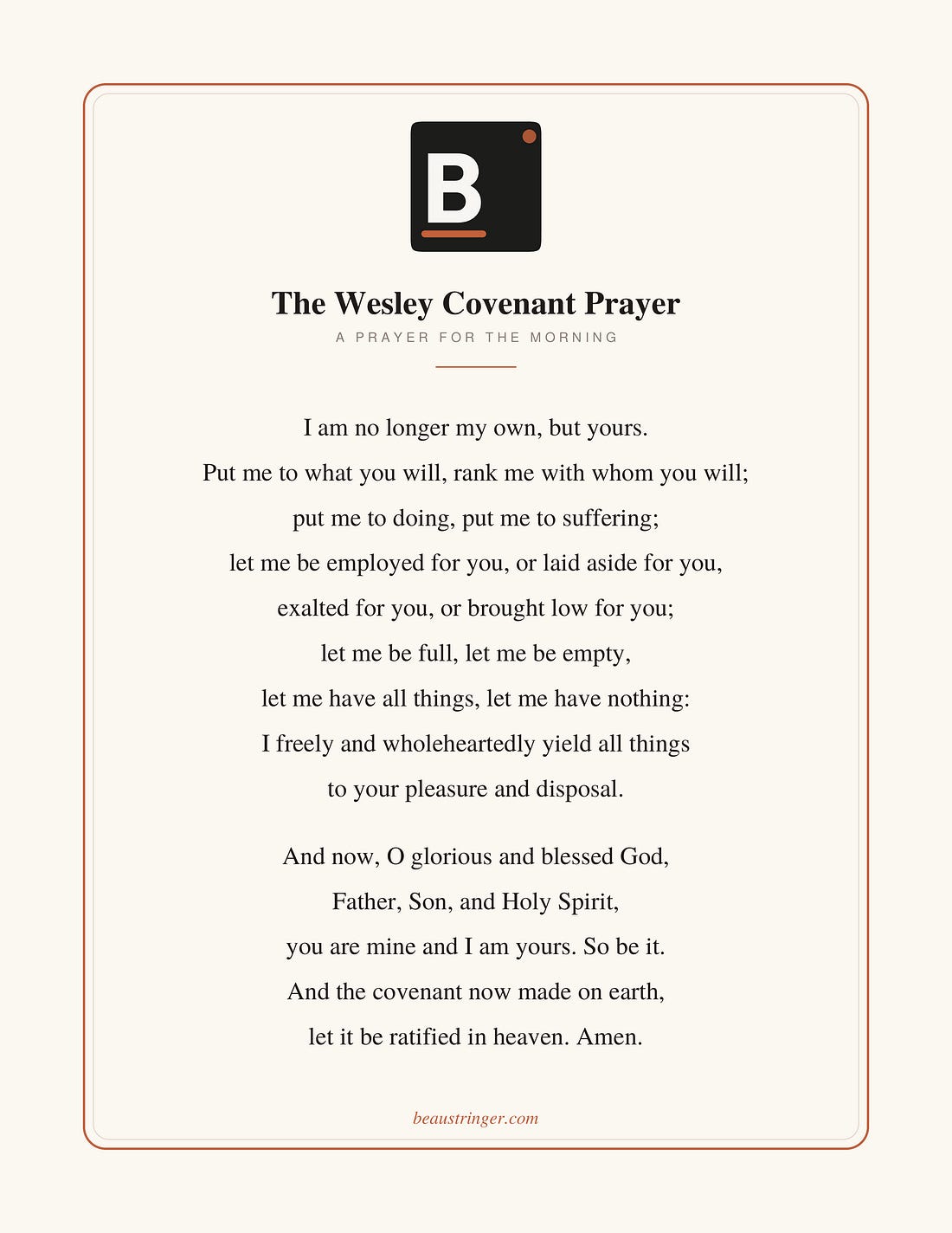
This week I want to put the Wesley Covenant Prayer in your hands. It is the prayer Methodists have prayed for generations when they want to hand their whole lives over to God. Try praying it first thing, before your feet hit the floor and the day starts making its demands. 

I made a little card with it you can print and keep by your bed or tuck into whatever you carry around. You can download the .pdf below.

Wesley Covenant Prayer Card17.7KB ∙ PDF file
Download

Richard Rohr has a talk on what he calls the Jesus Hermeneutic, and I am not exaggerating when I say it lines up with where I have landed on scripture better than anything I have come across in a long time. If you handed me a microphone and asked me to explain how I read the Bible now, I would just play you this. 

The short version is that Rohr studies how Jesus himself read his own scriptures, and he notices that Jesus did not treat every verse as carrying the same weight. Jesus kept reaching for the texts that point where the whole story is heading, toward mercy and inclusion and justice, and he read everything else in that light. 

If you have ever felt worn out trying to defend parts of the Bible that seem to cut against the heart of Jesus, this is going to feel like fresh air in your lungs. 

Watch it, then save it and watch it again. 

https://www.youtube.com/watch?v=JjUlQDwEIH0

============

Individual Reflection

Where are you currently rushing a process that wants to take its time with you?

Group Discussion — choose one

  1. Smith says the early Christians were marked by joy that was “uncontainable” — what’s blocking that kind of joy in you right now?
  2. Stringer says he used to read the slow process as bureaucracy and now sees it as care — what’s one slow thing in your life you’re starting to see differently?
  3. What would it look like for your “yes” to God to be unhurried rather than performed?

A New Way of Living

June 15th, 2026 by Dave No comments »

A New Way of Living

Sunday, June 14, 2026

Father Richard Rohr reflects on the origin of the Christian church as “the Way”: 

Christianity first emerged not as a new religion, but as a reform and sect of Judaism within Judea and the Mediterranean. Wherever Paul, Peter, and other early missionaries traveled, they formed small communities of believers in “the Way,” a movement that emphasized Jesus’s teachings, death, and resurrection as the path to transformation. Gradually the movement grew and took on a life of its own, welcoming non-Jews as well as Jews, becoming more inclusive and grace-oriented, until it eventually called itself “catholic” or universal. By 80 CE, there were Christians as far away as India and France.

The early church period (the five hundred or so years following Jesus’s resurrection) was a time of dramatic change in culture, politics, and economy. All these changes affected the development of the fledgling religion, shaping liturgy, rituals, and theology. Historian Diana Butler Bass writes, “For all the complexity of primitive Christianity, a startling idea runs through early records of faith: Christianity seems to have succeeded because it transformed the lives of people in a chaotic world.” [1] During this time, Christianity was not so much about doctrines or eternal salvation, but about how to live a better life here and now, within the “reign of God.”

From the perspective of occupying Roman powers, the Christian sect was radical because it encouraged alternative behaviors that were both attractive to those at the bottom and threatening to the worldview of empire. Rather than acquiring wealth, this new sect shared possessions equally. Followers of the Way lived together with people of different ethnicities and social classes rather than following classist and cultural norms. [2]

Much of what Jesus taught seems to have been followed closely during the first several hundred years after his death and resurrection. As long as Jesus’s followers were on the bottom and the edge of empire, as long as they shared the rejected and betrayed status of Jesus, they could grasp his teaching more readily. Values like nonparticipation in war, simple living, inclusivity, and love of enemies could be more easily understood when Christians were gathering secretly in the catacombs.

Several writings illustrate this early commitment to Jesus’s teachings on simplicity and generosity. For example, the Didache, compiled around 90 CE, says: “Share all things with your brother, and do not say that they are your own. For if you are sharers in what is imperishable, how much more in things which perish!” [3] At the time, Christianity was still pure, simple, and loving, relatively untouched by empire, rationalization, and compromise.

===================

Being the Body of Christ

Monday, June 15, 2026

Father Richard describes the influence of the apostle Paul on the formation of the first Christian churches: 

The apostle Paul knew that the gospel message must have concrete embodiment, so he set about founding what he called “churches.” Jesus’s first vision of church is so simple we could miss it: “For where two or three are gathered in my name, I am there among them” (Matthew 18:20). This is surely why Jesus insists that the message be communicated not by a lone evangelist but by sending the disciples out “two by two” (Mark 6:7). The individual alone is not a fitting communicator of the core message.

During Paul’s lifetime, the Christian church was not yet an institution or a centrally organized set of common practices and beliefs. It was a living organism that communicated the gospel primarily through relationships. Paul’s brilliant metaphor for this living, organic, concrete embodiment is “the body of Christ”: “Just as a human body, though it is made up of many parts, is a single unit, because all those parts make up a single body, so it is with Christ” (1 Corinthians 12:12). At the heart of this body, providing the energy that enlivens the whole community, although each in different ways, is “the love of God that has been poured out into our hearts through the Holy Spirit” (Romans 5:5).

This Spirit is itself the foundational energy of the universe, the Ground of All Being, described in the first lines of the Bible (Genesis 1:2). Union is not just pious rambling, but the very concrete work of God. It’s how God makes love to what God created. Paul writes that it is precisely “in your togetherness that you are Christ’s Body” (1 Corinthians 12:27). By remaining—against all trials and resistance—inside this luminous web of relationship, this vibrational state of love, we experience a very honest and healthy notion of communal salvation.

The churches or communities Paul founded are his audiovisual aids that he can point to inside of a debauched empire (where human dignity was never upheld as inherent) to give credibility to his message. To people who asked, “Why should we believe there’s a new or different life possible?” Paul could say, “Look at these people. They’re different. This is a different social order.” In Christ, “there are no more distinctions between Jew and Greek, slave and free, male and female, but all of you are one in Christ Jesus” (Galatians 3:28). This is not just a religious idea, but a socioeconomic message that began to change the world—and still can.

For Jesus, teachings such as forgiveness, healing, and justice work are the real evidence of a new and shared life. If we do not see this happening in churches and spiritual communities, religion is “all in the head” and largely an illusion. Peacemaking, forgiveness, and reconciliation are not some kind of ticket to heaven later. They are the price of peoplehood—the signature of heaven—now.

==============

Individual Reflection

Where in your life right now are you most aware of being held inside a web of relationship larger than yourself?


Group Discussion — choose one:

  1. What does it cost you to remain inside community “against all trials and resistance”?
  2. Where have you experienced togetherness itself as the saving thing — not belief, not doctrine, but the web?
  3. What would it mean to treat your belonging to this body as the spiritual practice, not a support for some other practice?

Embracing The Divine Exchange

June 12th, 2026 by JDVaughn No comments »

Remain in Me as I Remain in You

Friday, June 12, 2026

Jesus said, “Remain in me, as I remain in you. Just as a branch cannot bear fruit on its own unless it remains on the vine, so neither can you unless you remain in me. I am the vine, you are the branches. Whoever remains in me and I in him will bear much fruit, because without me you can do nothing…. As the Father loves me, so I also love you. Remain in my love.” —John 15:4–5, 9

In this homily, Father Richard speaks of Jesus’s desire for us to remain connected:

I want you to be honest: Would you rather have a friend who is always right or one who is in right relationship with you? I think I know the answer: We’d rather have someone who’s in right relationship with us. In fact, someone who’s right all the time can be pretty obnoxious. Would we rather have a friend who’s always correct or a friend to whom we’re always connected? Of course, we’d rather have the second.

So why did we in the West seemingly change the rules for God? Many of us grew up thinking God wanted us to be right, to be correct, even to be perfect. This passage in John’s Gospel is saying that God wants people who are in right relationship, which means that we are open, and that we can listen to others with understanding and compassion. It means that we can admit when we’re wrong, which is almost every day for most of us. It certainly is for me. 

Yet we keep condemning ourselves and others for not being perfect, for not being right, or for not being correct. This parable, one of the most beautiful in all the Gospels, tells us what God desires—simply that we remain connected, a branch on the vine, which is the love of God.

Everybody seems to be trying to prove that they are right. We have almost a collective incapacity to admit failure, to ever admit that we are wrong, which makes us liars most of the time. Jesus is calling forth a very different kind of human being.

Jesus says people who live a vulnerable life of connection and relationship will bear much fruit. These are the people we trust, like, and admire, so why are so many of us afraid to be the very thing that we admire the most? How foolish human beings are! But again, Jesus has told us the way: He is the vine; we are the branches. None of us can be or need to be correct, but we can always be connected. 

Reference:
Adapted from Richard Rohr, “Being Connected over Being Correct,” homily, April 28, 2018.

John Chaffee’s Five On Friday


1.
“Dear God,
I am so afraid to open my clenched fists!
Who will I be when I have nothing left to hold on to?
Who will I be when I stand before you with empty hands?
Please help me to gradually open my hands
and to discover that I am not what I own,
but what you want to give me.”
– Henri Nouwen, Dutch Catholic Priest
 
This is best if you read it slowly.
 
It is a simple prayer, but I deeply resonate with it.
 
Probably just as many of you, I have a difficult time letting go of controlling outcomes, and figuring out what it means to give to the world who I am, rather than what I think I have to offer.
 
I think that is why Henri Nouwen resonates with many of us.  Apparently, he was an Enneagram 2, also known as a “Helper.”  He had incredibly rich and deep emotions from which he wrote his most impressive books.  He was able to put into words what many of us experience, but for some reason or another are unable to voice!

2.
“A genius is the one most like himself.”
– Thelonius Monk, American Jazz Pianist
 
Jazz is a form of pure expression.
 
Not only that, but you must be a master of your instrument to such a degree that improvisation is normalized.
 
It might be that the more we settle into our true selves, like a musician who has mastered his craft, the better we are able to navigate the ebbs and flows of life.  Is it possible that the more we set aside our masks and learn to let go of our false self, we can then act more and more directly and straight from the essence of who God made us to be?
 
Is it not possible that life and jazz actually have very much in common?

3.
“Have enough courage to trust love one more time and always one more time.”
– Maya Angelou, American Poet
 
It takes an enormous amount of courage to love, doesn’t it?
 
We each have various scars and bruises from either failed attempts to love others or from their failed attempts to love us.
 
This reminds me of the opening lines of 1 Corinthians 13:1-3…
 
“If I speak in the tongues of men or of angels, but do not have love, I am only a resounding gong or a clanging cymbal. If I have the gift of prophecy and can fathom all mysteries and all knowledge, and if I have a faith that can move mountains, but do not have love, I am nothing. If I give all I possess to the poor and give over my body to hardship that I may boast, but do not have love, I gain nothing.”
 
We must choose to have the courage to love and love again and again, because without it, there is nothing else that matters.

4.
“Seek first the Kingdom of God: that is, the first order of business is to transform one’s own inner life, not the accumulation of external trappings of speculative knowledge.”
– Jack Caputo, Philosopher and Theologian
 
It is very likely that we mistake the “Kingdom of God” as being something external.
 
However, unless the Kingdom of God exists within us first, then any external Kingdom of God would be utterly subverted or invalidated by our own internal chaos, ruining it for others.
 
One thing that is interesting in the Sermon on the Mount (found in Matthew 5-7) is that Jesus seems to highlight not external actions but internal motivations.  This is because he is concerned with matters of the heart, from which we act out our vices or virtues and either tear down or build up the world around us.
 
Systematic theology, for all its good, can easily be a trap.  It can be an academic discipline through which we spend so much time, energy, and thought attempting to understand God logically, and yet never get around to the vulnerable work of allowing the Spirit of God to conform our inner landscapes into the redemptive shalom that God wishes it to become.
 
If I had to guess, Jack Caputo is not exactly putting down theology as an academic discipline anywhere near as much as he is encouraging us to hold it in its proper place.

5.
“Find the real world, give it endlessly away, grow rich flinging good to all who ask. Live at the empty heart of paradox. I’ll dance there with you – cheek to cheek.”
– Rumi, Sufi Poet
 
This is just delightful.
 
“Grow rich flinging good to all who ask.”  That’s a great line.
 
Then, after commenting on the paradox, it takes an intimate turn, talking about dancing cheek to cheek.
 
These three sentences do more for me than three whole books on generosity, paradox, and intimate joy.
 
The older I get, the more I appreciate poetry.

Embracing The Divine Exchange

June 11th, 2026 by JDVaughn No comments »

EMBRACING THE DIVINE EXCHANGE

The Laborers in the Vineyard

Thursday, June 11, 2026

In The Divine Exchange course, Cynthia Bourgeault explores the parable of the laborers in the vineyard:

The parable of the laborers in the vineyard (Matthew 20:1–16) is a beautiful and much misunderstood story. There was a vineyard owner who wanted people working in his vineyard to get his crops harvested. He went out and contracted with laborers at sunrise for the usual daily wage. He went out again at nine and at noon. At three in the afternoon, he saw a bunch of guys hanging around and asked, “Why aren’t you working, for God’s sake?” and they responded, “Because nobody asked us.” He says, “Well, you go into the vineyard as well.” Finally, when it came time to settle accounts, he gave everybody the same amount of money.

This just drives the egoic consciousness nuts! It’s not fair, everybody screeches, and it won’t be, as long as we’re using the egoic mind that operates out of separation and scarcity. It’s going to tell us that the ones that got there first got a bum deal. This parable only “works” when we understand that it’s not about the vineyard owner getting his crops harvested. The vineyard, as it tends to be throughout Jesus’s teaching, is a symbol of the relational field, the dynamic interactiveness of the kingdom of God.

Whatever reason we may project onto the vineyard owner for bringing people in, what he actually states is that he’s bringing people in because he can’t stand to see them isolated and just sitting around on their own: “You too go into the vineyard.” The real fruit of this day is not a bunch of grapes getting harvested. It is human beings working together, doing something that’s dignified. You can imagine the songs, the work, and all the things that happen when you’re participating and engaged jointly in an activity. The idea of paying them the same simply invites people to put their attention on what the real proportions are. When “more and less” are introduced into the equation at the end of the parable, we’re just scattering our attention.

The bottom line is that everybody has enough. The ones that came in early thought the usual daily wage was fair. That’s taken care of. The real fruit being generated, just like grapes turn into wine, was the work together. In these circumstances, it’s fermented and transformed into some fragrance of human interactivity and abundance that doesn’t exist otherwise.

Reading this parable against the backdrop of a relational field rather than individual competition, entirely different elements jump out. Without that relational field, you simply can’t see where Jesus is going. Trying to understand it with your mind, you’ll never get it because your mind will keep coming back to “more and less” and “it’s not fair.” It’s not until you begin from the fullness of love, and the order and coherence that arise from it, that you can recognize what’s being said and how radical it is.

We get the invitation to go into the vineyard, but it’s only in stepping up, saying yes, and trusting the relational field that we’re going to actually be participants in the kingdom of God.

Reference:
Adapted from Cynthia Bourgeault, “Exchange in the Teachings of Jesus” in The Divine Exchange: Living in Sacred Rhythm (Center for Action and Contemplation, 2026). Enroll now to explore Christian wisdom traditions in this self-paced online course.

Ray’s Thoughts:

Luke 23: 39-43

39 One of the criminals who hung there hurled insults at him: “Aren’t you the Messiah? Save yourself and us!”

40 But the other criminal rebuked him. “Don’t you fear God,” he said, “since you are under the same sentence? 41 We are punished justly, for we are getting what our deeds deserve. But this man has done nothing wrong.”

42 Then he said, “Jesus, remember me when you come into your kingdom.[b]

43 Jesus answered him, “Truly I tell you, today you will be with me in paradise.”

What’s fair about this? This criminal has likely done whatever he wants his entire life without regard for his immortal soul, or any semblance of focus on being “good”? He likely has left a swath of relational carnage in his wake while pursuing his path of pathological narcissistic hedonism. He clearly did not play by the “rules” and is on the cross as a consequence. So why does he get a get out of hell free card?

Could it be that he is invited by Jesus because for the first time in his miserable earthly existence he has been touched by the message to his heart, not to his head or “gut” or groin?

The “coherence of the fullness of Jesus’ love”, as Cynthia shares in the writing above, adjusts our lense to help us understand the heart relationship is the thing and it is never too late to awaken…