May 27th, 2026 by Dave No comments »

The Spirit Is Always with Us

Wednesday, May 27, 2026

Father Richard envisions the Holy Spirit as the loving immensity of God’s presence within us:

On one level, soul, consciousness, love, and the Holy Spirit can all be thought of as one and the same. Each of these points to something that is eternal, larger than the self, and shared with God. That’s what Jesus means when he speaks of “giving” us the Spirit or sharing his consciousness with us. One whose soul is thus awakened actually has “the mind of Christ” (see 1 Corinthians 2:10–16). That does not mean the person is psychologically or morally perfect, but such a transformed person does see things in a much more expansive and compassionate way. St. Paul calls it “a spiritual revolution of the mind” (Ephesians 4:23)—and it is!

Jesus calls this implanted Spirit the “Advocate,” who is “with you and in you,” makes you live with the same life that he lives, and unites you to everything else (John 14:16–20). He goes on to say that this “Spirit of truth” will “teach you everything” and “remind you of all things” (John 14:26) as if we already knew this somehow. Talk about being well-equipped from a secret Inner Source! It really is too good to believe—so we didn’t believe it. [1]

Consciousness, the soul, love, the Holy Spirit, on both the individual and shared levels, have sadly become largely unconscious! No wonder some call the Holy Spirit the “missing person” of the Blessed Trinity. No wonder we try to fill this radical disconnectedness through various addictions.

There is an Inner Reminder, an Inner Rememberer, (see John 14:26, 16:4) who holds together all the disparate and fragmented parts of our lives, fills in all the gaps, owns all the mistakes, forgives all the failures, and loves us into an ever-deeper life. This is the job description of the Holy Spirit, who is the spring that wells up within us (John 7:38–39)—and unto eternal time. This is the breath that warms and renews everything (John 20:22). These are the eyes that see beyond the momentary shadow and disguise of things (John 9); these are the tears that wash and cleanse the past (Matthew 5:4). And better yet, they are not only our tears but are actually the very presence and consolation of God within us (2 Corinthians 1:3–5).

You must contact this Immensity! You must look back at your life from the place of this Immensity. You must know that this Immensity is already within you. The only thing separating you from such Immensity is the ego’s unwillingness to trust such an utterly free grace, such a completely unmerited gift.

=====================

Interview with our friend, Brad Jersak

Q&A: On Surrender / Letting Go

I was recently interviewed for a forthcoming book for which some of my responses may be selected and distilled into a larger collection. But for now, I’d like to share my raw responses word-for-word.
Q1. How would you define surrender? Who or what is one surrendering to, in your opinion? God, Universe, Self, Soul, present moment…?

Surrender has been a key word in my spiritual vocabulary for decades and as a result, has become layered. My definition is drawn from my experiences in prayer, from the influence of Simone Weil in my life, my interactions in spiritual direction, and from the twelve-step recovery movement.

I typically define surrender as “letting go, which applies to how I try to let go of control (self-will), of agendas, of “my will be done.” In recovery language, I make a decision to surrender my life and will to the care (not the control) of a loving God. In Weil’s terms, I consent to the divine will as Christ did in Gethsemane. In prayer, I actually picture standing or kneeling before Christ and offering him whatever he asks for—releasing attitudes, emotions, intentions, worries, resentments, regrets, etc., over to him. Most of all, I surrender people. Those I’ve harmed, those who’ve harmed me, those I love most, worry about most, obsess over most. I picture delivering them into the hands or arms of God. I picture him taking responsibility for their care or correction or healing because it’s too much for me. I am no one’s saviour. 

This is how I process my anxieties when I lay awake thinking about my children or grandchildren. It’s how I process forgiveness for those who my resentments chain me to. It’s how I deal with my own self-pity, self-loathing, and self-centeredness.

But I also think about surrender in terms of acceptance. Dr. Walter Thiessen calls this “compassionate consent to reality.” Surrender here is connected to the distinction in the Serenity Prayer between accepting what I cannot change versus the courage to change what I can (including my reorientation back toward love and life). 

An elderly sage once said to me, “Your biggest struggle is that you struggle,”or in the kind rebuke of one massage therapist, “Stop fighting me!” My wife tells me that in her contractions through labour, she learned how even in pushing, she could surf the pain rather than fighting against it. All these analogies are a kind of surrender, so we might also say “rolling with” along with “letting go.” That is, we learn to take life on life’s terms. 


Q2. Is there a practice to surrender that does not cause more suffering?

I’ve already suggested one method in terms of a visual exercise of handing over. Along those lines, I also use other pictures when I need to be most gentle with myself. Sometimes, I simply enter a state where I lay my head on Jesus’ lap and gaze into a small campfire in front of us. Silent surrender. At other times, when there’s a lot of grief, I kneel beside him in Gethsemane. This helps me because I sync up with Jesus’ own experience and notice that he doesn’t get stuck. His surrender leads mine from grief to comfort to hope.

But when I’m on the verge of a panic attack, I resort to pre-established prayers that begin on their own in my heart… the Jesus Prayer (“Lord Jesus Christ, have mercy on me”) or the Serenity Prayer—either of which I use in conjunction with deep breathing, where the surrender is expressed as an exhale or a sigh.

I also do surrender work in the presence of non-judgmental listening with a spiritual director, a sponsor, or my godfather. I confess all that causes me anxiety (not just my sins) in a kind of surrender where I unpack and offload my most authentic feelings with a safe person who is not inclined to fix or rescue, but can sit with me as a peace-centered companion.

Q3. What happens when you surrender?

Any range of outcomes can happen when I surrender, but I’ve learned not to attach myself to outcomes—which is itself another important layer of surrender. Let’s not overlook that!

When I surrender, I may feel a great burden lift from my shoulders, or the easing of my queasy stomach, or a blessed stillness settles in. These can be quite visceral since body and soul are so connected. I may feel the well-being of realizing it will be okay or I will be okay, no matter what. I can then resist the demands of the ego to take over (control) or take back (what I let go)—to cling or to grasp.

I think about these practices and their results a lot precisely because I need to. Today, I need to let go again. Another disappointment, another burden… I’m a chronic worrier and I’ve even had to surrender the delusion that I’ll overcome that. I regress. I relapse. But I see a path, and for this moment, open my hands once again.

Q4. What is the ego or mind? What’s holding on?

“Ego” is a tricky term because it gets defined in a variety of ways. It’s literally just the Greek word for “I.” At one time, I spoke in terms of “the death of the ego.” But I was corrected by those who reminded me that ego is essential for a sense of self (or even is our sense of self). As tiny children, we gradually begin to differentiate from others and form our own sense of “me” as object, then “I” as subject.

Further, therapists tell me that many of their clients need their ego to be strengthened, especially in order to escape the demoralizing imprisonment of domestic abuse. So we should never tell a battered partner to crucify their ego!

However, when we use the word ego negatively, what we typically mean is egoism—the enthronement of the ego in self-will, self-centredness, self-importance. When ego is king, I don’t surrender. I don’t follow the wisdom of my higher power. I don’t live in the Jesus Way of self-giving, others-centered love. “I” becomes Lord. It may even develop an insidious, bullying voice increasingly devoid of conscience.

In a previous post, I mentioned pesky voices that, for me, include self-pity, self-loathing, and self-centeredness. In some models, these self-voices are all variations of the ego that, when disordered, share an incorrigible resistance to surrender—to letting go.

But when Jesus said, “Blessed are the poor in spirit,” we might paraphrase that, “Blessed are those who’ve learned to say no to the demands of the egoor “Blessed are those who’ve bankrupted the ego” [Ron S. Dart]. In that sense, ego can be shorthand for willfulness and surrender is willingness. But again, beware of how you process this with those who’ve been belittled. If they have internalized the voice of an oppressor, the “surrender” message may be a form of gaslighting. Someone more qualified than me can help distinguish whether the ego-voice is reinforcing the bully’s control or helping us resist it.

Q5. Is there a practice/methodology you follow that would create surrender? 

For me, it’s more of a recognition that self-will has not worked. “I admitted that I was powerless [in my own strength] over my addiction/circumstances/crazy thoughts/self-destructive and others-harming behaviors, and that my life had become unmanageable.”

“Bottoming out” does not mean you go as low as you can go. It describes any point at which (1) you admit that self-will is not working , (2) you come to believe only Someone greater than yourself is able to restore your sanity, and (3) you decide to surrender to the care of that Someone. “Bottoming out” is a grace—a spiritual awakening that leads to a daily reprieve.

But I didn’t wake myself up. I needed God to wake me up. I didn’t create surrender… I suppose life did that, or grace, or both.

There are also times when advising someone to “let go” can be harmful. A friend of mine had a stillbirth child seven months through her pregnancy. To feel the child stop moving but carry it through to delivery was traumatic. Worse, she discovered that the medical staff had discarded the tiny body rather than allowing a burial. My friend retreated for recovery outside the city and connected with some caring Buddhist women for comfort. But when they began saying, “It’s okay. Just let go. The baby’s soul has left and will find its way to a new reincarnation,” she tells me that she erupted in rage. “Let go” was not the message she needed. Better to sit in silent pain with her until she discovered for herself what she needed… Instead of “letting go” of the pain, she says she needed to face it head on, enter it, and she there she discovered she could create something beautiful with it. 

The idea was not to get rid of the grief—she couldn’t—but she was able to use everything at her disposal to weave something beautiful. Even there, I would caution against co-opting her words as new platitudes but instead, learn how to companion people through affliction until they emerge on the beautiful side of grief.

====================

Individual Reflection

Where in your life right now are you still running the show — and what would it feel like to actually step back?


Group Discussion — choose one

  1. Jersak describes surrender as an exhale, an open hand, a laying of the head — what’s your body’s experience of it?
  2. Rohr says the Immensity is already within you; what makes that so hard to believe?
  3. Jersak says “I regress, I relapse, but I see a path” — what keeps you returning to the path?
A Spirit-Given Voice

May 26th, 2026 by Dave No comments »

Tuesday, May 26, 2026

Feminist theologian Rebecca Button Pritchard describes how the Spirit accompanies our embodiment: 

After hours of painful labor, of breathing deeply and quickly, a body comes from a body. Pain and hope, relief and anxiety spin together wildly as the tiny body, bloody, waxen, draws air into lungs and bellows. Tears of pain and joy flow together. The cord is cut; the child becomes a living, breathing soul. The grown-ups, who’ve been breathing on their own for many years now, are exhausted, delighted, relieved.

Inspiration, respiration, inhalation, exhalation, these are the evidence that a new life has begun. New birth is confirmed with a cry, the sound of air moving across vocal chords. Just so, embodied existence has begun for one of us, for all of us. The breath of life, the animating spirit, moves through the systems of bodies created in the image and likeness of God. New life breathes by the grace of God and depends on the grace of parents for sustenance and love.

Lungs, larynx, and lips give us the power to speak, to cry, to sing, to name, to praise, to pray…. “Let everything that breathes, praise the Lord,” sang the psalmist (150:6). The rush of God’s Spirit, mighty and creative, blows also across windpipes, forming words, language, speech. Finding a voice, speaking up, being heard into speech, these give our lives meaning and value, enabling us to make sense of things, including our lives as creatures related to God, to creation, to others, to self. Just so, the sound of God’s Spirit, the mighty wind of Pentecost, is the sound of human language, of being heard and understood. [1]

Recognizing how the Spirit lives, moves, and breathes in our bodies allows us to live a wholehearted, courageous faith: 

True spirituality, embodied spirituality, may be described as wholeheartedness, as the integration of body and spirit, of nephesh and basar, of heart and soul. It is with this wholeheartedness that we hear and follow God’s voice; it is wholeheartedly that we find the words to cry out to God, to sing praise, to speak a prophetic word, a comforting word, to tell our stories, and to make sense of all our relationships.

Wholehearted spirituality in the freedom of the Spirit gives us courage, courage to bear witness to God’s grace against all odds, courage to speak despite efforts to silence us, courage to act authentically and in ways that encourage and empower the weak and the vulnerable. The Spirit gives us the wisdom to discern truthful moments, to bring both suspicion and trust to the interpretation of both past and present.

==================

Solidarity in our Suffering

How the Cross (and Trauma Research) Offer Better News Than Unhelpful Christian Clichés

CHUCK DEGROAT. MAY 25

“This is the good news. God writes your story—including your story of suffering—in a way that grows you into his likeness and reveals his glory,” he said at a conference years ago, the audience nodding in affirmation. 

I don’t recall the speaker’s name, but I do recall my dismay, even disgust. 

I’ve sat with families navigating cancer diagnoses for their children and with spouses hearing early dementia diagnoses and with women and men sharing stories of unspeakable abuse. And I’d never, ever consider it good news that God somehow orchestrated these things. 

I’ve long believed the Christian good news (aka “Gospel”) is not that God stands at a distance arranging our suffering for some secret purpose, but that God meets us in solidarity with our suffering in Jesus Christ, entering in to what feels cruel and pointless in order to heal, redeem, and ultimately undo all that fractures humanity and creation itself.

Even still, I have dozens of phrases from sermons and talks stretching back into my childhood that make their way from the recesses of my psyche every now-and-then…phrases like:

  • “God won’t give you more than you can handle.”
  • “Everything happens for a reason.”
  • “God is using this to teach you something.”
  • “This is part of God’s plan.”
  • “God must be preparing you for something greater.”
  • “God is more concerned with your holiness than your happiness.”
  • “Maybe God allowed this to draw you closer to him.”
  • “Trials are blessings in disguise.”
  • “If God brought you to it, he’ll bring you through it.”

I think back to my seminary days where it seems we spent more time trying to discern the mind of God than we did learning what it means to sit in suffering-solidarity with others in the name of Jesus. And nearly 30 years of pastoral care and clinical therapy have convinced me that we’ve too often lost the real goodness of the good news.

Can suffering mature us? Can our painful stories manifest in transformation? Of course.

I’ve written about this, and most of us—religious or not—know this intuitively. 

Those I’ve cared for over the years have taught me this. A woman who I accompanied through years of processing the trauma of her father’s abuse later told me, “Because of what I’ve experienced, I can sit with others with fewer answers and more compassion.” She is now someone who cares for others navigating abuse. 

Suffering can deepen compassion, humility, courage, surrender, and love. But suffering does not automatically mature us. Sometimes, it fragments us. Unaccompanied, it may overwhelm the nervous system, leaving us vigilant, shut down, or despairing. Trauma research has helped us see what many therapists, pastors, and wise elders have long known: suffering that is witnessed, held, and accompanied is far more likely to become transformative than suffering borne alone. 

I thought about how this happens recently while talking with my friend Jim Herrington on his podcast. We were discussing the tension between safety and suffering, and how easy it is to drift toward one of two extremes. On one side, we can valorize suffering in ways that make God seem cruel, calculating, even sadistic. On the other, we can valorize safety in ways that leave us unwilling to risk discomfort, grief, change, conflict, or vulnerability.

We don’t need to pit safety and suffering against each other. In fact, when safety and suffering walk hand-in-hand, maturity follows. I was reflecting on this again recently as my youngest got married last weekend, rendering Sara and I true empty-nesters. I was thinking about our shared story as a family, with two difficult cross-country moves—something not uncommon to those in ministry, but also profoundly painful. 

When our girls were young, we prioritized safety, connection, and attachment. But that did not mean protecting them from every hard thing. We made those difficult decisions to move, and we suffered, leaving family and friends, even homes and geographies we loved. There was grief in it, and Sara and I struggled to make those decisions knowing the cost to us, to our girls. But we were together in it. The suffering was accompanied—Emma and Maggie were safe with us, held in their pain. And that makes the difference. 

Maybe this is one of the reasons the Gospels spend so little time trying to explain suffering philosophically. Yes, there is a place for that—I don’t deny that. But, the Gospel writers were far more concerned with presence, solidarity, renewed communion—Jesus, God-in-the-flesh, announcing an end to exile and the kingdom come. 

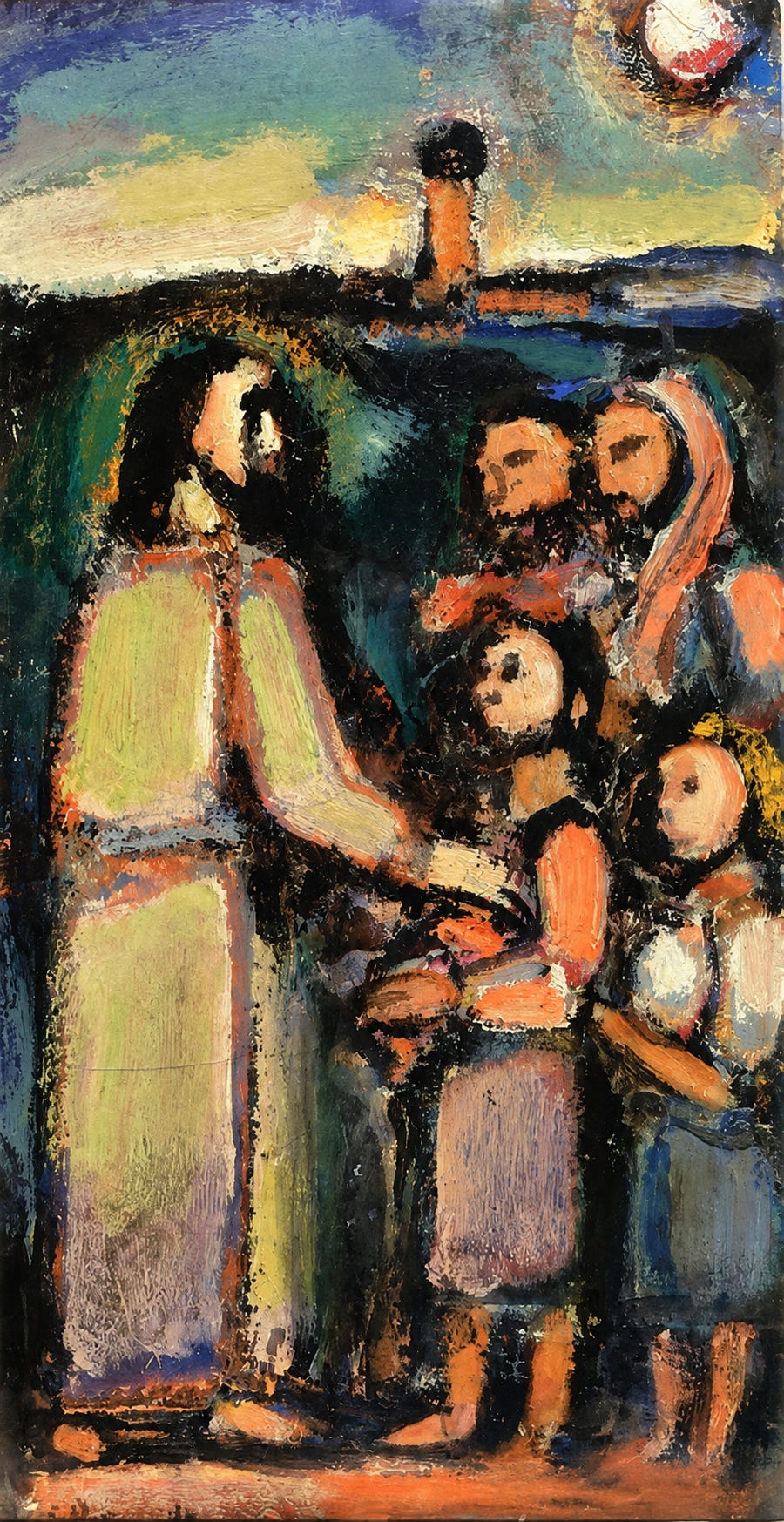
Georges Rouault (1871-1958) Etching “Christ and the Children,” 1935.

Friends, we don’t need to exhaust ourselves trying to decipher the hidden intentions of God behind every painful event. We don’t need to live in a story of a God who stands at a distance scripting tragedy for our growth. 

God became flesh and joined us in the struggle. 

That God knows the hell you’ve been through. He’s been there. 

And while there are no easy answers, there is companionship in the pain. 

==============

Individual Reflection

Where in your body do you notice the difference between suffering that is witnessed and suffering that is borne alone?


Group Discussion — choose one

What does it cost you, emotionally or theologically, to let go of the idea that God is orchestrating your pain for a purpose?

What would it mean for you to find your voice — to cry out, name, or speak — in a place where you’ve been silent?

Where have you experienced God’s presence as accompaniment rather than arrangement?

================

Contemplating the Song Selection

The theological center of both pieces is accompaniment — Pritchard on Spirit breathing through embodied creatures giving them voice, DeGroat on God entering suffering rather than scripting it from a distance. Both push against a disembodied, managing God toward an incarnate, with-us God.

Available to All

May 25th, 2026 by Dave No comments »

Sunday, May 24, 2026

Pentecost

When the day of Pentecost had come, they were all together in one place. And suddenly from heaven there came a sound like the rush of a violent wind, and it filled the entire house where they were sitting. Divided tongues, as of fire, appeared among them, and a tongue rested on each of them. All of them were filled with the Holy Spirit and began to speak in other languages, as the Spirit gave them ability.
—Acts 2:1–4  

In this Pentecost homily, Father Richard Rohr encourages Christians to recognize the presence of the Holy Spirit as a gift that God has already given. 

It’s a shame that the Holy Spirit tends to be an afterthought for many Christians. We don’t really draw upon the Spirit within us. We tend, I’m afraid, to simply go through the motions. We formally believe, but there isn’t much fire or conviction behind it, so there isn’t much service either.

In the Gospels there are two clearly distinguished baptisms. There’s the baptism with water that most of us are used to, and then there’s the baptism “with the Holy Spirit and fire” (Matthew 3:11); that’s the one that really matters.  

The water baptism that many of us received as children demands little conviction or understanding. Some parents simply do it to make their parents or grandparents happy. Until this baptism by water becomes real, until we know and rely on Jesus, and until we call upon, share, and love Jesus, we’re just going along for the ride. 

We can recognize people who have had a second baptism in the Holy Spirit. They tend to be loving and lively. They want to serve others and not just be served themselves. They forgive life itself for not being everything they once hoped for. They forgive their neighbors, and they forgive themselves for not being as perfect as they would like to be.  

Even though we pray, “Come, Holy Spirit,” I hope you know that the gift of the Spirit is already given. The Holy Spirit has already come. We all are temples of the Holy Spirit—equally, objectively, and forever! The only difference is the degree to which we know it, draw upon it, and consciously believe it. All the scriptural images of the Spirit are dynamic—flowing water, descending dove or fire, and rushing wind. If there’s rarely any movement, energy, excitement, deep love, service, forgiveness, or surrender, we can be pretty sure we aren’t living out of the Spirit. If we’re just going through the motions, we aren’t experiencing our connection to the Spirit. We would do well to fan into flame the gift we already have.  

God doesn’t give the Spirit to those of us who are worthy, because none of us are worthy. God gives the Spirit in this awakened way to those who want it. On this Feast of Pentecost, quite simply, want it! Rely upon it. Know that it has already been given and live out of that trust.

=======================

Speaking the Church into Existence

Monday, May 25, 2026

How is that each of us hears them in our own native language?
—Acts 2:8

Theologian Willie Jennings recounts how the Holy Spirit created a new community through common language: 

The miracle of Pentecost is less in the hearing and much more in the speaking. Disciples speak in the mother tongues of others, not by their own design but by the Spirit’s desire. The new wine has been poured out on those unaware of just how deeply they thirsted…. This is the beginning of the miracle of Pentecost, the revolution of the intimate. This is the beginning of a community broken open by the sheer act of God, and we are yet to comprehend the extent to which God acts and is acting to break us open….

This is God touching, taking hold of tongue and voice, mind, heart, and body. This is a joining, unprecedented, unanticipated, unwanted, yet complete joining. Those gathered in prayer asked for power. They may have asked for the Holy Spirit to come, but they did not ask for this. This is real grace, untamed grace. It is the grace that replaces our fantasies of power over people with God’s fantasy for desire for people.

Through the Spirit, an intimacy with one another and with God is born:

God has come to them, on them, with them. This moment echoes Mary’s intimate moment. The Holy Spirit again overshadows. However, this similar holy action creates something different, something startling. The Spirit creates joining. The followers of Jesus are now being connected in a way that joins them to people in the most intimate space—of voice, memory, sound, body, land, and place. It is language that runs through all these matters. It is the sinew of existence of a people. My people, our language: to speak a language is to speak a people. Speaking announces familiarity, connection, and relationality.…

This is not generic speech, formal pronouncements, but the language of intimate spaces where peoples inside talk to one another. The hearers query a past that does not exist for these followers of Jesus. “How do they know my language and know my people? When did they gain that knowledge?” But their miraculous tongues are not about the past but about the future, a future shaped by divine desire. This is why we must see more than a miracle of hearing. Such limited seeing … exposes our modern failure to grasp the revolutionary intimacy that will give birth to a belonging that we will call church. This is a revolution of the Spirit always poised to unleash itself at the slightest moment of faithful waiting and yielding

===================

Individual Reflection

Where in your life are you aware of the Spirit already at work — and where are you still waiting for an invitation that’s already been given?


Group Discussion — choose one:

  • Where have you experienced the Spirit creating an intimacy or belonging you never asked for?
  • What does it mean to you that God gives the Spirit to those who want it rather than those who deserve it?
  • What would it look like to “fan into flame” something that’s already in you rather than reaching for something outside yourself?

Practicing “Just This”

May 22nd, 2026 by JDVaughn No comments »

Beholding God Everywhere

Friday, May 22, 2026

I say, “I am here, I am here” to people who do not even invoke my name.
—Isaiah 65:1 

Father Richard views each moment as an opportunity to practice contemplation, to see things as they are, and to receive the gift of divine presence.  

The real gift of contemplative practice is to be happy and content, even while we are simply sitting on the porch, looking at a rock, or benevolently gazing at anything in its ordinariness. When we can see, accept, and say that every single act of creation is “just this,” we allow it to work its wonder on us. 

So go learn, enjoy, and rest in inner contentment and positivity—a full reservoir of fresh water, both before what feels like success and after what we might experience as failure. Then we have the treasure that no one can take from us or give to us. We will be ready to be captured by many moments of awe—and we will be capable of the surrender that brings both foundational union and joy. 

Remember, the whole process most often begins by one, long, relished moment of awe, one fully sincere moment of beholding anything and saying, “Just this!” And, as Isaiah promised, we will know that every moment is shouting, “I am here! I am here!” [1]

Spiritual writer Amy Frykholm acknowledges that while contemplation may sound simple, the practice of “beholding” anything takes desire and discipline.

Let’s be clear, though, contemplation of any object, person, idea, or being is much more difficult than it sounds. First of all, we face the difficulty of sitting down for beholding at all…. Don’t underestimate the paradigm shift required for the act of beholding, just how different it is from our everyday lives and just how shiny and compelling our everyday life will seem when we propose pausing for some time beholding. In our society, we talk frequently about the pull of technology, … but the problem we are describing is much older in nature than our cell phones.

If we are able to get ourselves situated for beholding, we will notice the next difficulty arising: We are constantly being taken out of presence by our own thoughts…. Any act of attention is not a sustained experiencing. It’s a series of successive efforts to bring attention back to the same thing, considering it again and again. This kind of encounter is a series of repeated acts of will. We gradually train our attention to encounter, discovering its fruits in slow and subtle movements over time. Whatever you behold, you eventually become beholden to. You enter into a love relation. You recognize your own dependence on the created world, the way that you are held, even as you are holding.

And sometimes grace carries us away, and we glimpse, maybe even for several seconds at a time, the whole interconnected, openhearted world … welcomes us. [2]

References:
[1] Adapted from Richard Rohr, Just This (CAC Publishing, 2017), 24, 25.

[2] Amy Frykholm, Journey to the Wild Heart (Orbis Books, 2025), 28–30.

Never Stop Praying!

 SCRIPTURE READING — 1 SAMUEL 12:19-25

“Far be it from me that I should sin against the LORD by failing to pray for you.”

— 1 Samuel 12:23

MAY 22, 2026

When I was in my twenties and going through some hard times, I asked my mother to pray for me. She said, “Do you mean, in addition to the prayers that began before your birth and have not ceased to this day?” I hadn’t realized that my mom prayed so fervently for me, and that was humbling.

Samuel prayed persistently for God’s people, and we do well to follow that example.

Are you a persistent and fervent pray-er? I can’t think of anything we can do that is more pleasing to God and useful to others than prayer.

Silent, or internal, prayer is a miracle brought about by the presence of the Holy Spirit in our lives. Through the voice of the Spirit, who comes to live within us, our thoughts are heard by the triune God. We can think with and talk to God about anything, at any time, and in any place. Through our thoughts we can connect with the most powerful being in the universe, who loves us more than any other. We don’t even need an introduction; God already knows us intimately.

If you are looking for a dialogue with God, turn to Scripture, read a few verses, and pray whatever comes to mind. Any fears, worries, and wrongs you have done can be laid at God’s feet and forgotten.

Samuel and my mother were fervent and faithful pray-ers. Knowing that God loves us so much, how can we not pray?

O God, we come to you in prayer through the work of your Spirit in us. We know that you hear us. Guide us to pray faithfully. Please fill us with your grace and peace each day. Amen.

 Kent Van Til

Kent Van Til was a missionary in Costa Rica. He taught theological ethics both there and in the USA. He is the author of four books. The most recent is a spiritual biography of his grandmother entitled, “A Name for Herself: A Dutch Immigrant’s Story.” Kent likes to fish, hunt, make music, and entertain his grandchildren.

May 21st, 2026 by JDVaughn No comments »

PRACTICING “JUST THIS”

Lift Your Voice to God

Thursday, May 21, 2026

Carmen Acevedo Butcher shares a contemplative practice that allows her to accept “just this”:

My name, Carmen, means song or poem, which is kind of perfect. I’ve found that I can always sing, especially when things are difficult. We tend to think there are people who can sing, and then there are the rest of us, who probably shouldn’t. But we can bring singing into our everyday lives as a contemplative practice. It creates these wonderful vibrations in our bodies and allows emotions and energies to move through us.

We don’t need to know a song by heart. Even if we just remember a favorite verse or a line, we can make it our own. It doesn’t have to be a hymn or a song that someone else recommends. We just need to find something that echoes with our hearts. It could be a line from Cole Arthur Riley or a Mary Oliver poem. We might go to Scripture to find a line like “Be still and know” (Psalm 46:10), or something in the Gospels. I like to jot the words down on a little note card and carry them around with me. Once we have our words, we can just start reading them, saying them, living with them, and letting a song come from there. We can make whatever kind of chant we want with them. For when we steep in words mindfully and repetitively, often a tune emerges spontaneously over time.

Acevedo Butcher encourages us to begin contemplative practice wherever we are in our lives:

I don’t think we wait until we feel like we’re ready to do it. We don’t have to wait until we’re feeling good. We start even if we’re tired. We start even in the middle of the mess. We start in the middle of a good day or in the middle of a difficult one. It doesn’t matter. We start now. If we want to, we just start.

If we wait to start singing—or any kind of contemplative practice—until we feel peaceful or worthy, we’ll be waiting a very long time. Sometimes, we do a practice, and if we don’t feel peaceful or holy immediately, we think we’ve failed or are doing it wrong. But that’s not the point. The point is that we do them like breathing, just in and out, over and over again. Fidelity to the practice brings about a healing alchemical effect.

Sometimes I’ll begin to sing, “Be still and know that I am God,” and at the same time I’m thinking, “I’m so stressed out today.” It turns into a little dialogue with God, “Why can’t I be stiller and know that you are?” All these thoughts go around, and this practice—this repetition of “Be still and know I am God”—holds the space of stillness and silence. We can pause and “Be still” enough to remember that we are made in God’s image, and we can honor our own voice, God’s voice within us. We don’t have to wait for a special key. The key is already within us.

Reference:
Adapted from Carmen Acevedo Butcher with Mike Petrow, “Taking the Practice Out of the Monastery,” Essentials of Engaged Contemplation, Trimester 1, mod. 3 (Center for Action and Contemplation, 2025). Unavailable.

Jesus Calling – Sarah Young

     Heaven is both present and future. As you walk along your life-path holding My hand, you are already in touch with the essence of heaven: nearness to Me. You can also find many hints of heaven along your pathway, because the earth is radiantly alive with My Presence. Shimmering sunshine awakens your heart, gently reminding you of My brilliant Light. Birds and flowers, trees and skies evoke praises to My holy Name. Keep your eyes and ears fully open as you journey with Me.
     At the end of your life-path is an entrance to heaven. Only I know when you will reach that destination, but I am preparing you for it each step of the way. The absolute certainty of your heavenly home gives you Peace and Joy, to help you along your journey. You know that you will reach your home in My perfect timing; not one moment too soon or too late. Let the hope of heaven encourage you, as you walk along the path of Life with Me.

RECOMMENDED BIBLE VERSES:
1st Corinthians 15:20-23 (NLV)
  20 But it is true! Christ has been raised from the dead! He was the first one to be raised from the dead and all those who are in graves will follow. 21 Death came because of a man, Adam. Being raised from the dead also came because of a Man, Christ. 22 All men will die as Adam died. But all those who belong to Christ will be raised to new life. 23 This is the way it is: Christ was raised from the dead first. Then all those who belong to Christ will be raised from the dead when He comes again.

Additional insight regarding 1st Corinthians 15:20: Jesus as the first part of the harvest was brought to the Temple as an offering (Leviticus 23:10-44). Christ was the first to rise from the dead and never die again. He is our forerunner, the proof of our eventual resurrection to eternal life. 

Additional insight regarding 1st Corinthians 15:21: Death came into the world as a result of Adam and Eve’s sin. In Romans 5:12-21, Paul explained why Adam’s sin brought sin to all people, how death and sin spread to all humans because of the first sin, and the parallel between Adam’s death and Christ’s death.

Hebrews 6:19 (NLV)
19 This hope is a safe anchor for our souls. It will never move. This hope goes into the Holiest Place of All behind the curtain of heaven.

Additional insight regarding Hebrews 6:19: God embodies all truth; therefore, he cannot lie, and we can be secure in his promises. We don’t need to wonder if he will change his purposes and plans. Our hope of heaven stands secure and immovable, anchored in God, just as a ship’s anchor holds firmly to the seabed. To someone truly seeking who comes to God in belief, God gives an unconditional promise of acceptance. When you ask God with openness, honesty, and sincerity to save you from your sins, he will do it. If this truth gives you encouragement, assurance, and confidence, grasp it. Don’t let go no matter what happens around you.

Books & Literature

Today’s Prayer:

Lord,

As I journey with You, I’m reminded of heaven’s nearness. Your presence fills me with Peace and Joy, reassuring me that You’re leading me to my heavenly home. Help me keep my eyes and ears open to Your guidance along the way. Amen.

Inner Awareness and Acceptance

May 20th, 2026 by Dave No comments »

Inner Awareness and Acceptance

Wednesday, May 20, 2026

Richard Rohr describes authentic prayer and contemplation as a mutual gaze of love:

Much of the early work of contemplation is discovering a way to observe ourselves from a compassionate and nonjudgmental distance until we can eventually live more and more of our lives from this calm inner awareness and acceptance. In a contemplative stance, we find ourselves smiling, sighing, and weeping at ourselves, much more than needing either to hate or to congratulate ourselves—because we are finally looking at ourselves with the eyes of God.

In these moments, we are letting God gaze at us, in the way only God can gaze—with infinite mercy, love, and compassion. God initiates a positive gaze, which now goes in both directions. (Unfortunately, we seldom allow that to happen.)

As we receive God’s compassionate gaze in contemplation, all negative energy and motivation is slowly exposed and eventually falls away as counterproductive and useless. There will be no mistrust, fear, or negativity in either direction! If we resort to any form of shaming ourselves, we will slip back into defense, denial, and overcompensation. We will not be able to “know as fully as we are known” (see 1 Corinthians 13:12).

But if we can connect with the Indwelling Presence, where the “Spirit bears common witness with our spirit” (see Romans 8:16), it can and will change our lives! This mutually loving gaze is always initiated by God and grace. Once we learn to rest there, nothing less ever satisfies. This is foundational.

To keep this space within ourselves open, we need some form of meditative practice—something much more than “saying” prayers. Authentic prayer is invariably a matter of both emptying the mind and filling the heart, and often one follows the other. We have to move beyond recited, formulaic, and social prayers to bring the mind down into the heart.

So when you pray, try to stay beneath your thoughts, neither fighting them nor thinking them. Everything that comes also goes, usually in waves. Hold yourself at a more profound level, perhaps in your chest, solar plexus, or deep breath, but stay in your body-self somehow. Do not rise to the mind and its endlessly repetitive commentary.

Just rest in what I like to call our animal contentment. It will feel exactly like nothing, like emptiness. Stay crouched there at the cellular level, without shame or fear, long enough for the Deeper Source to reveal itself. Universal love flows through you from that Deeper Source as a vital energy much more than an idea.

=======================

MAY 20, 2026
Appearance Isn’t Everything. Skye Jethani
“Take off your engineering hat and put on your management hat.” That sentence became infamous after the Space Shuttle Challenger explosion in 1986. Here’s the backstory. The night before the launch had been extremely cold, and NASA engineers warned that the freezing temperatures could have damaged the o-ring seals on the Shuttle’s rocket boosters. They recommended postponing the launch.However, political and media pressure for the launch was intense. Not least because the Challenger crew included Christa McAuliffe, a public school teacher who was central to NASA’s public-relations campaign.

This is why those calling for a delay because of safety concerns were told, “Take off your engineering hat and put on your management hat.” In other words, the space agency’s public image was more important than an invisible and unlikely safety failure. The launch proceeded, and 73 seconds later, the Challenger exploded, killing all seven crew members.

The Challenger tragedy illustrates the danger of overvaluing public perception. The need to please an audience, to appear flawless, and to win the approval of others can lead us to downplay or ignore the less visible yet more critical aspects of our lives. When this posture is applied to our life with God, we can begin to think that looking righteous is more important than actually being righteous. This is the very definition of hypocrisy that Jesus addresses repeatedly in the Sermon on the Mount.

For example, in Jesus’ culture, fasting was a mark of deep commitment to God. It was a holy practice for the truly devout. In a society where religiosity was rewarded, to be seen fasting gave a person greater status and prestige. That is why Jesus warned about the dangers of fasting in a way that catches others’ attention. By the time of the Protestant Reformation, the same temptation existed. Martin Luther said fasting had become “a device for having people look at them, talk about them, admire them, and say in astonishment: ‘Oh, what wonderful saints these people are! They do not live like the other, ordinary people. They go around in gray coats, with their heads hanging down and sour, pale expressions on their faces. If such people do not get to heaven, what will become of the rest of us?’”

Today, I don’t think most people seek approval through flaunting their fasting. In Christian communities, we have developed different ways of making ourselves appear more righteous than others, and we have new symbols to display our devotion to God. They vary in different churches and communities. In some, it’s about displaying Jesus-branded merchandise, bumper stickers, home decor, or even tattoos. In others, it may be a yard sign, wristband, or laptop sticker that reveals your concern for a particular issue or cause. The details will differ, but the underlying temptation is the same. We want others to think well of us, our values, and our commitment to the things of God. But all of this focus on our external perception and acceptance can cause us to ignore the deeper truths that need our attention. In too many Christian communities, people are rewarded for taking off their spiritual formation hats and putting on their image management hats. Sadly, this is even the case among those who ought to know better—the church leaders and Bible teachers. When this happens, we will both miss the deeper life of communion with God that Jesus calls us to, and we will minimize the warning signs of a personal or corporate catastrophe.

DAILY SCRIPTURE
MATTHEW 6:16–18
1 THESSALONIANS 2:3–8


WEEKLY PRAYER Martin Luther (1483–1546)

O God, graciously comfort and tend all who are imprisoned, hungry, thirsty, naked and miserable;
also all widows, orphans, sick and sorrowing.
In brief, give us our daily bread, so that Christ may abide in us and we in him forever, and with him we may worthily bear the name of ‘Christian.’
Amen

Individual Reflection

What are you still wanting from the eyes of others that you haven’t yet let God’s gaze satisfy?

Group Discussion — choose one:

Where do you most feel the hunger to be esteemed, approved, or thought well of?

What fear — of being overlooked, rejected, or exposed — quietly shapes how you present yourself?

What would shift in you if God’s gaze of mercy were finally enough?

Lift Your Heart to God

May 19th, 2026 by Dave No comments »

Tuesday, May 19, 2026

CAC Dean of Faculty Carmen Acevedo Butcher translated The Cloud of Unknowing, the foundational text for Centering Prayer. Contemplative practice creates space for us to be with God, after which we return to our daily lives and commitments. The anonymous author of The Cloud encourages beginners to enter contemplation with these simple instructions:

Lift up your heart to God with a gentle stirring of love. Focus on him alone. Want him, and not anything he’s made. Think on nothing but him. Don’t let anything else run through your mind and will. Here’s how. Forget what you know. Forget everything God made and everybody who exists and everything that’s going on in the world, until your thoughts and emotions aren’t focused on reaching toward anything…. Let them be. For a moment don’t care about anything

Everyone on earth has been helped by contemplation in wonderful ways. You can’t know how much…. So stop hesitating. Do this work until you feel the delight of it. [1]

The author urges beginner contemplatives to welcome the temporary experience of “unknowing” that takes place in this type of prayer: 

The first time you practice contemplation, you’ll only experience a darkness, like a cloud of unknowing. You won’t know what this is.  You’ll only know that in your will you feel a simple reaching out to God. You must also know that this darkness and this cloud will always be between you and your God, whatever you do. They will always keep you from seeing him clearly by the light of understanding in your intellect and will block you from feeling him in the sweetness of love in your emotions. So be sure you make your home in this darkness. Stay there as long as you can…. It’s the closest you can get to God here on earth, by waiting in this darkness and in this cloud. [2]

For Acevedo Butcher, contemplation is an essential practice of our time, enabling us to meet the challenging conditions of our lives with greater wisdom and compassion: 

We need contemplation because, as our globe gets more crowded by the hour, more and more we act like elbow-to-elbow passengers in cheap coach seats on a commuter flight…. Who doesn’t rush through the day? Who never feels the pressure to produce? How often are you in cyberspace? Our new frantic pace is like poison to our holding hands with those we love. That is where contemplation comes in. It reconnects us to ourselves, to God, and to others. It helps us learn to forgive and heal our souls….

For the first sixteen centuries of the Christian church, contemplative prayer was the goal of Christian spirituality, and now in our own time of transition and upheaval, … we are returning to our roots. Contemplative prayer is more relevant than ever before. More and more of us are practicing this ancient form of prayer and finding peace in a world of war, extreme political divide, epidemics, terrorism, technology, overcrowding, noise, inequality, and a Church in need of humility.

============================

From Diana Butler Bass’ Sunday Musings

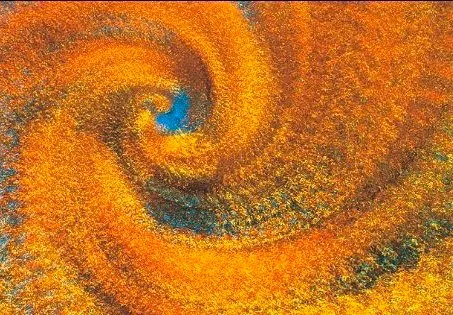
“Maple Spiral” by Freeman Patterson. Please visit the photographer’s website to view his prints, workshops, and books. You can also discover more about his work in this short film.

On a recent trip to New Brunswick, my host arranged for me to meet Freeman Patterson, a world-renown Canadian photographer. 

I confess that I hadn’t heard of him. But my friend knew how I love art, gardens, and theology — and that Freeman’s interests combine all three. And so I did what any decent person would do in advance of such a meeting. I looked him up on the internet. 

Richard was also on this trip. As we pursued Freeman’s website, the photograph above caught his attention. “This looks like an illustration of your work,” Richard said. “You could have used it in your powerpoint in last night’s lecture!” 

He passed me his phone. On the screen was a breathtaking image of a spiral, whirling oranges, yellows, and greens with a single cobalt blue crescent at its center. “You’re right,” I said. “It is stunning. What do you think it is?”

We didn’t know. We couldn’t figure it out. 

The next day, we had the privilege of spending an afternoon at his home and garden in rural New Brunswick. The conversation was delightful and wide-ranging, and, as often happens, we discovered threads that connected our seemingly very distant lives. I finally asked him about the spiral photograph we’d seen online. “What it is? Something like a fiddlehead fern?” 

He laughed. “No. It is a maple tree!”

“A maple tree — one maple tree?” I asked incredulously. “Yes. A maple tree in the autumn, taken in a series of exposures, moving the camera slightly in each frame. The blue is the sky above.”

He shared with us a little bit about how he creates his photographs, with double and multiple exposures, slight camera movements, and widened apertures. We looked at the prints he had displayed in his home, thumbed through his books, and walked in his woodland garden. Inwardly, I marveled. This wasn’t about just making photographs or creating a garden. This was his vision of both everything and himself. It wasn’t just about a camera. It was about his open aperture. He could see deeper and further and differently. The spiral was far more than a cleverly exposed maple tree — it was his journey, wisdom and wonder, and an image of the oneness of all things.

That maple tree was a living spiral, an entirely different vision of the Tree of Life. There, in the garden. 

We didn’t really want to leave. 

*****

Does the Gospel of John ever drive you crazy? 

It probably should because today is one of those days. This is not the work of a linear thinker. The text whirls about with words, pulling ideas from here and there, weaving them together to create an effect, an experience, an uncommunicable vision. The Jesus in John’s story doesn’t tell parables. He doesn’t offer sermons or moral lessons. Instead, he roams about in mystical experiences and waxes poetic. Some scholars refer to John’s style as paroimia (παροιμία), a Greek term for “sideways” truths usually expressed in allegory, riddles, or metaphors.

What is this? All these words about glory and the world and oneness? 

I mean honestly: What is this? 

“All mine are yours, and yours are mine; and I have been glorified in them. 

And now I am no longer in the world, but they are in the world, and I am coming to you. Holy Father, protect them in your name that you have given me, so that they may be one, as we are one.”

You could try to explain that in a thousand ways and probably never come close to what it is. Who is this Jesus? Who is going where? What, truly, is his relationship with “Holy Father”? And who is one with whom? 

I’ve heard genuinely tortured sermons on this text over the years. Some poor pastor trying to make sense of this as narrative, a story with a beginning, middle, and end, with an arc and plot lines, and clearly drawn characters. But it is not that. 

It is, instead, a sideways truth. 

More like a spiral. 

That recent visit, surrounded by photographs and woodlands, books and water vistas, opened my soul-aperture a bit wider. I wasn’t just meeting a well-known photographer; I was encountering a gifted teacher, a seer the world. As we talked about all manner of things and walked in the garden, he was showing me how to appreciate small movements, to see differently, to layer multiple views, and to let more light in. It wasn’t narrative; it wasn’t didactic; it wasn’t polemic. It was sideways. 

A spiral. 

I think that is the Gospel of John. Like “Maple Spiral,” the whole thing is a series of multiple exposures by modest repositioning to create a single image. From John’s magisterial opening:

In the beginning was the Word, and the Word was with God, and the Word was God. He was in the beginning with God. All things came into being through him, and without him not one thing came into being. What has come into being in him was life, and the life was the light of all people. The light shines in the darkness, and the darkness did not overcome it.

To the moment when a grief-stricken Mary tries to embrace her dearest friend:

Jesus said to her, ‘Woman, why are you weeping? For whom are you looking?’ Supposing him to be the gardener, she said to him, ‘Sir, if you have carried him away, tell me where you have laid him, and I will take him away.’ Jesus said to her, ‘Mary!’ She turned and said to him in Hebrew,*‘Rabbouni!’ (which means Teacher).

And the blue clearing in the sky? The central point of the image:

Love

As the Father has loved me, so I have loved you; abide in my love. If you keep my commandments, you will abide in my love, just as I have kept my Father’s commandments and abide in his love.

Love is the oneness, the still center of the spiral. The blue dot. Love, love, love. Love is the origin point of creation; love is Mary reaching to hold the body of Jesus. For God so loved the cosmos that he gave his only Son…. Love is the Alpha and Omega. The “I am” and the “You are.” 

Do you see it? Tilt your gaze sideways, open your eyes just a little wider. One maple tree, spiraling through time and space. One whirl of love sweeping every frame toward the same focal point, the heart of it all. 

One. Love is the center. Love winds to the One. 


=============

Individual Reflection

Where are you being invited to abide rather than to understand?

Group Discussion — choose one:

  • Where do you notice love as the still center in your life — or where do you long for it to be?
  • What does it stir in you to be told to “make your home in this darkness”?
  • What would change if you tilted your gaze sideways at your own life today?

From Fear-Driven to Love-Drawn

May 18th, 2026 by Dave No comments »

Sunday, May 17, 2026

In his book Just This, Father Richard Rohr considers how contemplative prayer allows us to release our thoughts, finding deeper wisdom and guidance:   

Contemplation is a panoramic, receptive awareness whereby we take in all that a situation, moment, or person offers without judging, eliminating, or labeling anything. It is pure and positive gazing that abandons all negative pushback so we can begin to recognize inherent dignity. It takes much practice and a lot of unlearning of habitual responses. 

We have to work at contemplation and develop practices whereby we recognize our compulsive and repetitive patterns. In doing so, we allow ourselves to be freed from the need to “take control of the situation”—as if we ever really could anyway! 

It seems we are addicted to our need to make distinctions and judgments, which we mistake for intelligent thinking. Most of us think we are our thinking, yet almost all thinking is compulsive, repetitive, and habitual. We are forever writing our inner commentaries on everything, commentaries that always reach the same practiced conclusions. That is why all forms of meditation and contemplation teach a way of quieting this compulsively driven and unconsciously programmed mind. 

The desert fathers and mothers wisely called this process “the shedding of thoughts.” We don’t fight, repress, deny, identify with, or even judge them; we merely shed themWe are so much more than our thoughts about things,and we will feel this more as an unlearning than a learning of any new content. [1] 

When we meditate consistently, a sense of our autonomy and private self-importance—what we think of as our “self”—falls away, little by little, as unnecessary, unimportant, and even unhelpful in many cases. The imperial “I,” the self that we likely experience as our only self, reveals itself as largely a creation of our mind. 

Through regular practice of contemplation, we become less and less interested in protecting this self-created, relative identity. We don’t have to attack it; it calmly falls away of its own accord, and we experience a kind of natural humility. 

If our prayer goes deep, “invading” our unconscious, as it were, our whole view of the world will change from fear to connection. We won’t live inside our fragile and encapsulated self anymore, nor will we feel any need to protect it. In meditation, we move from ego consciousness to soul awareness, from being fear-driven to being love-drawn. That’s it in a few words! 

Of course, we only have the courage to do this if Someone Else is holding us, taking away our fear, doing the knowing, and satisfying our desire for a Great Lover. If we can allow that Someone Else to lead us in this dance, we will live with new vitality, a natural gracefulness, and inside of a Flow that we did not create. It is the life of the Trinity, spinning through us

Forgiving Our Thoughts

Monday, May 18, 2026

For Father Richard, true prayer begins with a positive “yes,” a surrender to God and Reality:  

When I entered the Franciscan seminary in 1961, part of our training was learning to avoid, resist, and oppose all distractions. It was such poor teaching, but it was the only way we thought back then. It was all about willpower: celibacy through willpower, poverty through willpower, community through willpower. But willpower isn’t what we need—or it’s not all that we need! We need the power to surrender the will, to face, and even to trust what is. Now, that’s heroic! Anything less is a fruitless and futile effort, because if we start with negative energy, a “don’t,” we won’t get very far (see Romans 7:7–11). That was the extent of the teaching I received, and it was really no teaching at all—just “Don’t!” When we hear that, the ego immediately pushes back. Some days we have strong willpower and we succeed, but most days we barely succeed. [1]

We know the old shibboleth, “Don’t think of an elephant.” If we try not to, that dang elephant invariably sneaks back into our minds! Just wait. To actively oppose something actually engages with it and gives it energy. That’s why so many spiritual teachers say, “What you resist persists.” 

Our first energy has to be “yes” energy, an acceptance of what is. From there we can move, build, and proceed, even if in opposition. We must choose the positive, which is to choose love, and rest there for a minimum of fifteen conscious seconds. It takes that long for positivity to imprint in the neurons, I’m told. [2]

Father Richard advises “neither clinging nor opposing” when it comes to facing distractions in contemplative prayer:  

If I had told my novice master I wasn’t going to fight my distractions, he would have said, “So you’re going to entertain lustful or hateful thoughts?” But that would have missed the major point. The real learning curve happens when we can admit we’re having a thought or feeling and recognize that it’s empty, passing, and part of a fantasy that has no final reality except as a source of information. 

We must listen honestly to ourselves. We must listen to whatever thought or feeling arises long enough to ask, “Why am I thinking this? What is this thought revealing in or about me? Why am I willing to entertain this negative, accusatory, or lustful thought?” 

We don’t have to hate or condemn ourselves for a thought or feeling, but we do have to let it yield its wisdom. Then we will realize it is a wounded or needy part of us that creates these unhealthy thoughts. Our true self, our whole self, doesn’t need them, and will not identify with them. 

If we can allow our thoughts and feelings to pass through us, neither clinging to them nor opposing them—and without ever expecting perfect success—I promise that we will come to a deeper, wider, and wiser place. Even our inability to fully succeed is, in itself, another wonderful lesson. [3]

===============

Individual Reflection

What in you today is fear-driven rather than love-drawn?


Group Discussion — choose one:

  1. What does it look like to be “love-drawn” rather than “fear-driven”?
  2. What thought have you been resisting that might be asking to yield its wisdom?
  3. Where might surrender — not willpower — be what’s being asked of you today?

May 15th, 2026 by JDVaughn No comments »

JULIAN OF NORWICH: A UNIVERSAL MYSTIC

God Dwells in All

Friday, May 15, 2026

Matthew Fox traces the universal nature of Julian’s message of mystical hope and divine love:

Julian makes explicit on many occasions that she is speaking to a very broad audience—one that includes those of us who live 650 years later. It follows, then, that we recognize that sense of inclusion. “In God’s sight, all humanity is one person, and all people are a single humanity.”… [1] For Julian, the traditional teaching of the church as the mystical body of Christ is extended to the entire human race….

When she celebrates the beauty of being human, she again makes explicit that she is talking about all and not some sectarian group. “God made us so rich and noble in our essence that all we can do is strive to enact his will and honor him in all things. When I say ‘we,’ I mean all true spiritual seekers.” [2] When she says “all,” she means all. This would include, in our time, all versions of Christians and all Jews, all Buddhists, Hindus, Taoists, Muslims, goddess worshippers, those of indigenous religions, and those of no religions, whether agnostic or atheist. That is how ecumenical she is—and in the fourteenth century, no less.

When speaking of retreating “into our own souls, which is where our Beloved dwells,” she again speaks out about the universality that encompasses our spiritual search: “Let no man or woman think this truth applies personally to the individual. It does not; it is universal. This beautiful human nature of ours was prepared for our precious Mother Christ.” [3]

Through contemplating her visions over many years, Julian recognized that God’s love wasn’t only for her but for all creation:

In explaining how she came to write her book, she confesses that she first saw [her visions] as a personal thing, but then she came to understand that they applied to humanity as a whole. “At first, I applied this teaching to my individual self, because at the time I was not moved to see it otherwise. But the great and gracious comfort that followed made me realize that God meant this insight for the whole of humanity.” [4] She learned that her work ought to reach a broad audience, “I made the mistake of privatizing this showing instead of taking it to mean loving my fellow Christians better. What could make me love my fellow Christians better than to see that God loves us all as we are all one soul?” [5] …

Such a sense of universality translates into action, for “those who have universal love for all their fellow Christians in God have love towards everything that exists. For in us all is comprehended all, that is, all that is created and the Creator of all.” [6] Creation and cosmos belong to everyone—and no one—and it call us to a larger consciousness of expanded love.

References:
[1] Julian of Norwich, The Showings: Uncovering the Face of the Feminine in Revelations of Divine Love, trans. Mirabai Starr (Hampton Roads, 2022), 133. Selection from chap. 51.

[2] Julian, Showings, 157. Selection from chap. 57.

[3] Julian, Showings, 172. Selection from chap. 62.

[4] Julian, Showings, 212. Selection from chap. 79.

[5] Brendan Doyle, Meditations with Julian of Norwich (Bear & Co., 1983), 64.

[6] Doyle, Meditations, 33.

Matthew Fox, Julian of Norwich: Wisdom in a Time of Pandemic—and Beyond (iUniverse: 2020), xxxii–xxxiii.

===============================================

Jesus Calling – Sarah Young

I AM the Gift that continuously gives — bounteously, with no strings attached. Unconditional Love is such a radical concept that even My most devoted followers fail to grasp it fully. Absolutely nothing in heaven or on earth can cause Me to stop loving you. You may feel more loved when you are performing according to your expectations. But My Love for you is perfect; therefore, it is not subject to variation. What does vary is your awareness of My loving Presence.
     When you are dissatisfied with your behavior, you tend to feel unworthy of My Love. You may unconsciously punish yourself by withdrawing from Me and attributing the distance between us to My displeasure. Instead of returning to Me and receiving My Love, you attempt to earn My approval by trying harder. All the while, I am aching to hold you in My everlasting arms, to enfold you in My Love. When you are feeling unworthy or unloved, come to Me. Then ask for receptivity to My unfailing Love.

RELATED SCRIPTURE:

1st John 4:15-18 (NLT)

15 All who declare that Jesus is the Son of God have God living in them, and they live in God. 16 We know how much God loves us, and we have put our trust in his love.
God is love, and all who live in love live in God, and God lives in them. 17 And as we live in God, our love grows more perfect. So we will not be afraid on the day of judgment, but we can face him with confidence because we live like Jesus here in this world.
18 Such love has no fear, because perfect love expels all fear. If we are afraid, it is for fear of punishment, and this shows that we have not fully experienced his perfect love.

Deuteronomy 33:27 (NLT)


Psalm 13:5 (NLT)
5 But I trust in your unfailing love.
    I will rejoice because you have rescued me.

=======================================

John Chaffee – Five on Friday

1.

“The Christian of the future will be a mystic, or they won’t exist at all.”

– Karl Rahner, German Jesuit Priest

Drop the theo-logic.

Drop the religious tribalism.

Drop the spiritual pride and the moral elitism.

God is not found in any of those things.

Nor is God coerced or impressed by any of those things.

I am convinced that we all have a deep itch and a desire for true transcendence.  However, in pursuit of it, we become more seduced by describing transcendence, dictating who gets to experience it, or trying to manufacture an experience of transcendence.

Let’s be honest, we are all just looking for a life-changing experience of the Divine.

For me, that Divine Presence is truly found in the Blessed Trinity, which invites the whole of everything to join in its Cosmic Dance.

The problem is that people go to church, and we teach them to become members but not mystics.  We invite people to open their hymnals but not open their eyes and see that God-is-in-All-Things and All-Things-are-in-God.

I hope I am not coming across as cynical; I do not mean to do so if I am.  All I want to say is that I hope Christianity can reclaim some of its own contemplative and mystical dimensions.  Unless we reclaim those roots, Christianity in the West will continue to be a cute country club with which to convince ourselves and others that we are good people.  I believe it is so much more than that.  I sincerely believe it is a true expression of devotion to the infinite mystery we call God, revealed in the person of Jesus of Nazareth.

2.

“Vulnerability is the birthplace of love, belonging, joy, courage, empathy, and creativity. It is the source of hope, empathy, accountability, and authenticity. If we want greater clarity in our purpose or deeper and more meaningful spiritual lives, vulnerability is the path.”

– Brene Brown, Researcher and Author

It feels as though a fair amount of energy is spent in our lives just trying to avoid vulnerability.

The problem is that it is exhausting to even try to do that for any duration of time.

There was a whole season of my life when I utterly failed to connect with people, and looking back, I see that is because I primarily did not know how to be vulnerable with myself.

Once I opened that door, or learned that skillset to a sufficient degree, I found the quality of my time and conversations with other people changed dramatically…

Why?

Being closed off tells other people they should be closed off, but being vulnerable invites people to drop their guard and risk being vulnerable themselves.

3.

“Your task is not to seek for love, but merely to seek and find all the barriers within yourself that you have built against it.”

– Rumi, Persian Sufi Poet

Man, that’s a good one.

Here we are, all looking for love.

And yet, the most important thing may not be to look for love, but to remove all the ways in which we are stopped up within ourselves from receiving it from where it is already coming.

4.

“If a church never gets into conflict with the ruling powers, it should question whether it is a church of Jesus Christ.”

– Jon Sobrino, Spanish Priest and Theologian

This coming Sunday, I will be giving a guest sermon at a local church I have known for at least a decade.  It is a lovely little church just about an hour outside of Philly.

I am looking forward to preaching, not merely because I will see familiar faces, but because the text assigned to me is Isaiah 14:1-20.  Since I had never preached on that topic before, I felt as though it would be a unique challenge.

The passage is interesting on the surface because it is often attributed to the downfall of Satan.  The passage describes how Satan will be overthrown due to his oppressive stance towards the faithful and his spiritual pride.

HOWEVER,

The passage, in context, is actually about the King of Babylon.  In fact, Isaiah 14:3-4 says, “On the day the Lord gives you relief from your suffering and turmoil and from the harsh labor forced on you, you will take up this taunt against the king of Babylon.”

It is supposed to be a taunt of the king of Babylon!

God does not suffer tyrants and oppressors for long.  They, too, will have their day.

So, when I came upon the quote above from Jon Sobrino, it resonated with what I was learning myself about the context of Isaiah 14!

5.

“Believe me, don’t wait until tomorrow to begin becoming a saint.  The time is NOW!”

– Therese of Lisieux, French Catholic Mystic

I am not my best self.  Not by a long shot.

Of course, I have better days than others, but that is frighteningly affected by how good a night’s sleep I have had or whether or not people treat me the way I want to be treated.

For about a week now, I have been reading The Story of a Soul, the spiritual autobiography of Therese of Lisieux.  At times, it is a bit saccharine and easy to skim, but there are many pieces within it that completely grab my attention, so I grab my highlighter.

Therese’s life was cut short in her mid-20s because of Tuberculosis.  She suffered greatly and knew that she would likely die an early death because of the amount of blood she would cough up.

As a result, she knew that time was a finite resource.

The stakes are high; the world desperately needs both you and me to become the best, healthiest, and holiest versions of ourselves.  Time waits for no one, and as a result, it benefits us and those around us to do what we can to become saints as soon as possible.

Let us give up our vices, our sarcasm, our despair, our scarcity mindset, our need for approval, etc., and finally and freely embrace lives that live in the Light (as He is in the Light).

Julian of Norwich – A Universal Mystic

May 14th, 2026 by JDVaughn No comments »

Goodness of God

Essential Joy

Thursday, May 14, 2026

Julian of Norwich is without a doubt one of the most wonderful of all Christian voices.
—Thomas Merton, Seeds of Destruction

Dr. Gloria Durka explores Thomas Merton’s love of Julian’s positive theology:

Learning to remain hopeful amidst the darkness of suffering is a struggle in which all of us become engaged from time to time—and it can be a bitter trial. The optimism of Julian can help us as it did Thomas Merton. In his book Conjectures of a Guilty Bystander, Merton wrote the following:

I pray much to have a wise heart, and perhaps the rediscovery of Lady Julian of Norwich will help me. I took her book with me on a quiet walk among the cedars. She is a true theologian…. She first experienced, then thought, and the thoughtful deepening of experience worked it back into her life, deeper and deeper, until her whole life as a recluse at Norwich was simply a matter of getting completely saturated in the light she had received all at once…. Her life was lived in the belief in this “secret,” the “great deed” that the Lord will do on the Last Day, not a deed of destruction and revenge, but of mercy and of life, all partial expectations will be exploded and everything will be made right…. [1]

Julian’s writings are permeated with Christian hope. She experienced all of the aspects of hope in her own spiritual life: the rocklike dependability of God, the God who is always near, the God of the impossible, the God who is Father and Mother to us.

Julian was especially aware of the joyful character of hope…. Human joy is essential to Julian’s spirituality. To her, we are meant to be full of joy because our joy in God reflects the joy of the Trinity. Creation is an act of God’s joy. The more faithfully and hopefully we respond to God’s love in our life, the greater will be the fullness of our joy.

Was Julian ever more relevant? Her message of hope surely lightened the spirits of many in her troubled age. We probably need her message at least as much today. The threat of nuclear holocaust, the possibility of extinguishing all life forms on the planet earth, and deadly violence between warring peoples are daily reminders of the cloud of despair that hovers above us. Great faith and hope are required in order to penetrate the gloom caused by shattering events…. We need great faith and hope to see beyond the darkness of our personal life—our failures, weaknesses, and fears.

But gloom, fear, and anxiety are only one side of reality. The other side is that we are an Easter people. Even though suffering is real, the life, Passion, death, and Resurrection of Jesus have won for each of us the assurance that death is conquered…. Alleluia!

Sarah Young – Jesus Calling

I am with you and for you. You face nothing alone–nothing! When you feel anxious, know that you are focusing on the visible world and leaving Me out of the picture. The remedy is simple: Fix your eyes not on what is seen but on what is unseen. Verbalize your trust in Me, the Living One who sees you always. I will get you safely through this day and all your days. But you can find Me only in the present. Each day is a precious gift from My Father. How ridiculous to grasp for future gifts when today’s is set before you! Receive today’s gift gratefully, unwrapping it tenderly and delving into its depths. As you savor this gift, you find Me.

RELATED SCRIPTURE: 

Romans 8:31 NLT

Nothing Can Separate Us from God’s Love

31 What shall we say about such wonderful things as these? If God is for us, who can ever be against us?

2nd Corinthians 4:18 NLT

18 So we don’t look at the troubles we can see now; rather, we fix our gaze on things that cannot be seen. For the things we see now will soon be gone, but the things we cannot see will last forever.

Genesis 16:13-14

13 Thereafter, Hagar used another name to refer to the Lord, who had spoken to her. She said, “You are the God who sees me.”[a] She also said, “Have I truly seen the One who sees me?” 14 So that well was named Beer-lahai-roi (which means “well of the Living One who sees me”). It can still be found between Kadesh and Bered.