Solidarity Is Our Goal

May 18th, 2023 by JDVaughn No comments »

Father Richard teaches that despite the presence of evil permeating our world, we are invited to commit ourselves to the common good:  

Both Jesus and Paul invite us to live a vulnerable human life in communal solidarity with both sin and salvation

  • Neither sin nor salvation could ever be exclusively mine, but both of them are collectively ours
  • Universal solidarity is the important lesson, not private salvation. 
  • Human solidarity is the goal, not “my” moral superiority or perfection. 

I know that doesn’t at first feel like a strategy for successful living, and it is certainly not one that will ever appeal to the upwardly mobile or pure idealists. It first feels like capitulation, but that is not Jesus’ or Paul’s intention at all—quite the opposite. Paul believes he has found a new kind of victory and freedom. He himself calls it “folly” or “foolishness” (1 Corinthians 1:21, 25, 27; 4:10), as it is for most people to this day. He often calls it a “hidden mystery” that only the wise discover. Paul believes there is a hidden, cruciform shape to reality, even revealed in the geometry of the cross (see Ephesians 2:13–22). The world is filled with contradictions, false alternatives, zero-sum games, paradoxes, and unresolvable evils. It is foundationally unjust, yet we must work for justice in order to find our own freedom and create it for others. 

Paul is an utter realist about life on this planet. We must fully recognize and surrender to this foundational reality before we try to think we can repair the world (tikkun olam in Hebrew) with freedom and love. Paul’s insight is symbolized in the scandalous image of a man on the cross, the Crucified God who fully accepts and transforms this tragic human situation through love. If this is the reality to which even God must submit, then surely we must and can do the same. 

By giving ourselves to this primary human absurdity, which shows itself in patience, love, and forgiveness toward all things, we find a positive and faith-filled way through “the world, the flesh, and the devil.” This is not by resolving it or thinking we can ever fully change it, but by recognizing that we are all complicit in this mixed moral universe. This is perhaps the humility that Christians need in their campaigns for social reform. This is “carrying the cross” with Jesus. 

Through this primal surrender and trust, God can use our own cruciform shape for healing and for immense good—and even victory. True healers are always wounded healers and not those who perfectly triumphed over all evil.  

Humans often end up doing evil by thinking we can and must eliminate all evil, instead of holding it, suffering it ourselves, and learning from it, as Jesus does on the cross. This ironically gives us the active compassion we need to work for social change. My acceptance of a cruciform world mirrors my ability to accept a cruciform me. 

____________________________________________________

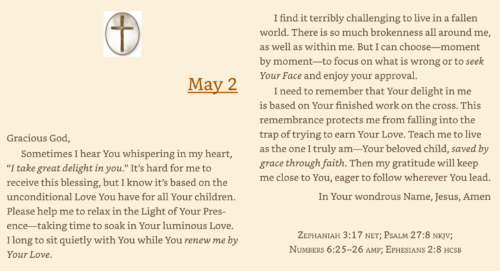
Sarah Young Jesus Listens

My Creator, this is the day that You have made! Help me to rejoice and be glad in it. I begin this day holding up empty hands of faith—ready to receive all that You are pouring into this brief portion of my life. Since You are the Author of my circumstances, I need to be careful not to complain about anything, even the weather. I’ve found that the best way to handle unwanted circumstances is to thank You for them. This act of faith frees me from resentment and enables me to look for blessings emerging from the problems. Sometimes You show me the good that You’re bringing out of the difficulties. At all times, You offer me the glorious gift of Yourself! I realize that living within the boundaries of this day is vital for finding Joy in it. You knew what You were doing when You divided time into twenty-four-hour segments. You have perfect understanding of human frailty, and You know that I can only handle the trouble of one day at a time. I don’t want to worry about tomorrow or get stuck in the past. Instead, I seek to enjoy abundant Life in Your Presence today! In Your joyful Name, Jesus, Amen

PSALM 118:24; This is the day which the Lord hath made. The thanksgiving day is one which has been fore-ordained of God, and brought into existence by him for a special purpose.

HEBREWS 3:13; But exhort one another daily, while it is called To day; lest any of you be hardened through the deceitfulness of sin. But exhort one another daily, while it is called To day; lest any of you be hardened through the deceitfulness of sin.

HEBREWS 4:15 NASB; For we do not have a high priest who cannot sympathize with our weaknesses, but One who has been tempted in all things just as we are, yet without sin.

MATTHEW 6:34; “Therefore do not worry about tomorrow, for tomorrow will worry about itself. Each day has enough trouble of its own.”

Young, Sarah. Jesus Listens (p. 145). Thomas Nelson. Kindle Edition.

Evil Depends upon Disguise

May 17th, 2023 by Dave No comments »

Evil Depends upon Disguise

Father Richard stresses that evil often masquerades as good, and so provides justification for immense injustice:  

The world (or “system” as we say now) is a hiding place for unconsciousness or deadness in the words of Paul. Both Thomas Aquinas and C. S. Lewis taught that the triumph of evil depends entirely on disguise. [1] [2] Our egos must see it as some form of goodness and virtue so that we can buy into it. 

If evil depends on a “good” disguise, cultural virtue and religion are the best covers of all. The leaders of both religion and empire colluded in the killing of Jesus (Matthew 27:1–2). In Luke’s Gospel, Herod and Pilate just passed Jesus back and forth and affirmed whatever the other one said (Luke 23:12). Christians were forewarned that the highest levels of power can and probably will be co-opted by evil. 

Is there a culture in this world that doesn’t operate out of this recipe for delusion? This is what Paul means when he names “the world” (what I call “the system”) as one of the sources of evil. What Paul already recognized, at least intuitively, is that it is almost impossible for any social grouping to be corporately or consistently selfless. It has to maintain and promote itself first at virtually any cost—sacrificing even its own stated ethics and morality. If we cannot see this, it might reveal the depth of the disguise of institutionalized evil. 

Consider the religious rationale for the “Doctrine of Discovery,” which helped to justify the conquest of the Americas and the African slave-trade. Mark Charles and Soong-Chan Rah write: 

The Doctrine [of Discovery] emerged from a series of fifteenth-century papal bulls, which are official decrees by the pope that carry the full weight of his ecclesial office….  

[In 1493], Pope Alexander VI issued the papal bull Inter Caetera … [which] offered a spiritual validation for European conquest, “that in our times especially the Catholic faith and the Christian religion be exalted and be everywhere increased and spread.”  

[The doctrine] gave theological permission for the European body and mind to view themselves as superior to the non-European bodies and minds. The doctrine created … an identity for African bodies as inferior and only worthy of subjugation; it also relegated the identity of the original inhabitants of the land “discovered” to become outsiders, now unwelcome in their own land. [3] [4]

Richard continues: 

Evil finds its almost perfect camouflage in the silent agreements of the group when it appears personally advantageous. Such unconscious “deadness” will continue to show itself in every age, I believe. This is why I can’t throw the word “sin” out entirely. If we do not see the true shape of evil or recognize how we are fully complicit in it, it will fully control us, while not looking the least like sin. Would “agreed-upon delusion” be a better description? We cannot recognize it or overcome it as isolated individuals, mostly because it is held together by the group consensus. 

[29] Presumption “If ye have faith and doubt not, if ye shall say unto this mountain, Be thou removed and cast into the sea, it shall be done.” Good people…have been tempted to tempt the Lord their God upon the strength of this saying…. Happily for such, the assurance to which they would give the name of faith generally fails them in time. Faith is that which, knowing the Lord’s will, goes and does it; or, not knowing it, stands and waits…. But to put God to the question in any other way than by saying, “What wilt thou have me to do?” is an attempt to compel God to declare Himself, or to hasten His work…. The man is therein dissociating himself from God so far that, instead of acting by the divine will from within, he acts in God’s face, as it were, to see what He will do. Man’s first business is, “What does God want me to do?”, not “What will God do if I do so and so?”

Lewis, C. S.. George MacDonald (pp. 16-17). HarperCollins. Kindle Edition.

Taking the Powers Seriously

May 16th, 2023 by Dave No comments »

Theologian Walter Wink (1935–2012) dedicated his scholarship and life to uncovering the biblical meaning of structural evil: 

The writers of the Bible had names that helped them identify the spiritual realities that they encountered. They spoke of angels, demons, principalities and powers, Satan, gods, and the elements of the universe. Materialism had no use for such things and so dismissed them.… “Modern” people were supposed to gag on the idea of angels and demons. The world had been mercifully swept clean of these “superstitions,” and people could sleep better at night knowing that they were safe from spirits.…  

If we want to take the notion of angels, demons, and the principalities and powers seriously, we will have to go back to the biblical understanding of spirits in all its profundity and apply it freshly to our situation today.  

Latin American liberation theology made one of the first efforts to reinterpret the “principalities and powers,” not as disembodied spirits inhabiting the air, but as institutions, structures, and systems. But the Powers … are not just physical. The Bible insists that they are more than that (Ephesians 3:10; 6:12); this “more” holds the clue to their profundity. In the biblical view the Powers are at one and the same time visible and invisible, earthly, and heavenly, spiritual, and institutional (Colossians 1:15–20). Powers such as a lumberyard or a city government possess an outer, physical manifestation (buildings, personnel, trucks, fax machines) and an inner spirituality, corporate culture, or collective personality…. Perhaps we are not accustomed to thinking of the Pentagon, or the Chrysler Corporation … as having a spirituality, but they do. The New Testament uses the language of power to refer at one point to the outer aspect, at another to the inner aspect, and yet again to both together. What people in the world of the Bible experienced as and called “principalities and powers” was in fact the actual spirituality at the center of the political, economic, and cultural institutions of their day. 

Wink considered systemic powers as a mix of good and evil that, like humanity, needs redemption: 

If evil is so profoundly systemic, what chance do we have of bringing [institutions] into line with God’s purpose for them? The answer to that question hinges on how we conceive of institutional evil. Are the Powers intrinsically evil? Or are some good? Or are they scattered all along the spectrum from good to evil? The answer seems to be: none of the above. Rather, they are at once good and evil, though to varying degrees, and they are capable of improvement.  

      Put in stark simplicity:  

      The Powers are good.  

      The Powers are fallen.  

      The Powers must be redeemed.…  

They are good by virtue of their creation to serve the humanizing purposes of God. They are all fallen, without exception, because they put their own interests above the interests of the whole. And they can be redeemed, because what fell in time can be redeemed in time.  

Taking the Powers Seriously

Theologian Walter Wink (1935–2012) dedicated his scholarship and life to uncovering the biblical meaning of structural evil: 

The writers of the Bible had names that helped them identify the spiritual realities that they encountered. They spoke of angels, demons, principalities and powers, Satan, gods, and the elements of the universe. Materialism had no use for such things and so dismissed them.… “Modern” people were supposed to gag on the idea of angels and demons. The world had been mercifully swept clean of these “superstitions,” and people could sleep better at night knowing that they were safe from spirits.…  

If we want to take the notion of angels, demons, and the principalities and powers seriously, we will have to go back to the biblical understanding of spirits in all its profundity and apply it freshly to our situation today.  

Latin American liberation theology made one of the first efforts to reinterpret the “principalities and powers,” not as disembodied spirits inhabiting the air, but as institutions, structures, and systems. But the Powers … are not just physical. The Bible insists that they are more than that (Ephesians 3:10; 6:12); this “more” holds the clue to their profundity. In the biblical view the Powers are at one and the same time visible and invisible, earthly, and heavenly, spiritual, and institutional (Colossians 1:15–20). Powers such as a lumberyard or a city government possess an outer, physical manifestation (buildings, personnel, trucks, fax machines) and an inner spirituality, corporate culture, or collective personality…. Perhaps we are not accustomed to thinking of the Pentagon, or the Chrysler Corporation … as having a spirituality, but they do. The New Testament uses the language of power to refer at one point to the outer aspect, at another to the inner aspect, and yet again to both together. What people in the world of the Bible experienced as and called “principalities and powers” was in fact the actual spirituality at the center of the political, economic, and cultural institutions of their day. 

Wink considered systemic powers as a mix of good and evil that, like humanity, needs redemption: 

If evil is so profoundly systemic, what chance do we have of bringing [institutions] into line with God’s purpose for them? The answer to that question hinges on how we conceive of institutional evil. Are the Powers intrinsically evil? Or are some good? Or are they scattered all along the spectrum from good to evil? The answer seems to be: none of the above. Rather, they are at once good and evil, though to varying degrees, and they are capable of improvement.  

      Put in stark simplicity:  

      The Powers are good.  

      The Powers are fallen.  

      The Powers must be redeemed.…  

They are good by virtue of their creation to serve the humanizing purposes of God. They are all fallen, without exception, because they put their own interests above the interests of the whole. And they can be redeemed, because what fell in time can be redeemed in time.  

[24] Various Kinds of Moth

Nor does the lesson apply to those only who worship Mammon…. It applies to those equally who in anyway worship the transitory; who seek the praise of men more than the praise of God; who would make a show in the world by wealth, by taste, by intellect, by power, by art, by genius of any kind, and so would gather golden opinions to be treasured in a storehouse of earth. Nor to such only, but surely to those as well whose pleasures are of a more evidently transitory nature still, such as the pleasures of the senses in every direction—whether lawfully indulged, if the joy of being is centered in them—do these words bear terrible warning. For the hurt lies not in this—that these pleasures are false like the deceptions of magic, for such they are not;…nor yet in this—that they pass away and leave a fierce disappointment behind; that is only so much the better; but the hurt lies in this—that the immortal, the infinite, created in the image of the everlasting God, is housed with the fading and the corrupting, and clings to them as its good—clings to them till it is infected and interpenetrated with their proper diseases, which assume in it a form more terrible in proportion to the superiority of its kind.

Lewis, C. S.. George MacDonald (pp. 13-14). HarperCollins. Kindle Edition.

Shame Is an Outside Voice

May 12th, 2023 by JDVaughn No comments »

The voice of doubt, shame, and guilt blaring in our heads is not our voice. It is a voice we have been given by a society steeped in shame. It is the “outside voice.” Our authentic voice, our “inside voice,” is the voice of radical self-love! —Sonya Renee Taylor, The Body Is Not an Apology  

CAC teacher and psychotherapist Jim Finley explores how trauma causes us to internalize shame, which keeps us from living from our true identity in God. 

This “you”—this internalized identity formed in trauma and abandonment—you start taking on as identity. You start taking it on as if it has the power to name who you are, which is the shame-based identity.  

It’s bad enough you had to go through the trauma, but what’s worse is we’re punitive with ourselves and … it creates the secrecy of a shame-based identity. One is afraid that if anyone would really see what I’m really like inside, no one would love me. Do you know why? Because I see what I’m really like and I don’t love me. Do you know why? Because I’ve internalized the fact [for example] that my parents didn’t love me…. 

Every trauma survivor knows the issue isn’t what was done to me. The issue is what everything that was done to me did to me and that I’ve internalized it. It’s just endless, the things that hinder us from becoming the person deep down that we really are and long to be…. In a sense, our real Higher Power is [often not God, but is instead] our shame-based belief that our shortcomings and faults and brokenness have the authority to name who we are. It’s the idolatry of brokenness over the Love that loves us as invincibly precious in our brokenness. This is really the key to this whole thing. It isn’t just that I’m broken; I must also admit that I believe I am what’s wrong with me….  

It’s such a powerful experience to be in the presence of someone who sees our brokenness—maybe because they live with us and it’s obvious, or it’s a therapist, or a friend, or at a recovery meeting—and who sees through the brokenness to the invincible preciousness of our self in the midst of our brokenness. When we risk sharing what hurts the most in the presence of someone who will not invade us or abandon us, we can come upon within ourselves the pearl of great price, the invincible preciousness of ourselves in the midst of our brokenness.  

Finley describes the healing impact that such an accepting presence can have for us:  

Through a person’s unconditional positive regard for us, we can start to find our footing in an unconditional positive regard for ourselves. And that unconditional positive regard for ourselves is joining God in seeing who God knows us to be before the origins of the universe as invincibly precious, indestructible in God’s eyes.  

____________________________________________

Sarah Young

Jesus, my Hope, Whenever I’m tempted to indulge in self-pity or escape into unreality, trusting You wholeheartedly is my only hope. In the midst of adversity, I find it hard to think clearly and make wise choices. Sometimes it seems as if a dizzying array of choices is swirling around me—waiting for me to grab on to the right one. But I know there is one choice that’s always appropriate and effective: the decision to trust You with all my heart and mind. If I find myself sliding down into discouragement or self-pity, I can put on the brakes by declaring my trust in You—whispering, speaking, even shouting it! As I think about the many reasons I have for being confident in You, I rejoice in Your unfailing Love. When I’m feeling tempted to numb my pain by escaping into unreality, help me instead to come close to You—expressing my confidence in You. This brings me into contact with ultimate Reality! I love confiding in You because You know everything about me and my circumstances. O Lord, You are infinitely wise and understanding. In Your encouraging Name, Amen

PROVERBS 3:5 AMPC; Lean on, trust in, and be confident in the Lord with all your heart and mind and do not rely on your own insight or understanding.

PSALM 52:8; But I am like an olive tree flourishing in the house of God; I trust in the loving devotion of God forever and ever.

ROMANS 11:33; Oh, the depth of the riches of the wisdom and[ a] knowledge of God! How unsearchable his judgments, and his paths …

Young, Sarah. Jesus Listens (p. 139). Thomas Nelson. Kindle Edition.

May 10th, 2023 by Dave No comments »

Purity Is Not Holiness

Pastor and public theologian Nadia Bolz-Weber describes how emphasizing “purity” leads us away from holiness:  

Our purity systems, even those established with the best of intentions, do not make us holy. They only create insiders and outsiders. They are mechanisms for delivering our drug of choice: self-righteousness, as juice from the fruit of the tree of knowledge of good and evil runs down our chins. And these purity systems affect far more than our relationship to sex and booze: they show up in political ideology, in the way people shame each other on social media, in the way we obsess about “eating clean.” Purity most often leads to pride or to despair, not holiness. Because holiness is about union with, and purity is about separation from….  

To connect to the holy is to access the deepest, juiciest part of our spirits. Perhaps this is why we set up so many boundaries, protections, and rules around both sex and religion…. But when the boundaries, protections, and rules become more important than the sacred thing they are intended to protect, casualties ensue.  

But no matter how much we strive for purity in our minds, bodies, spirits, or ideologies, purity is not the same as holiness. It’s just easier to define what is pure than what is holy, so we pretend they are interchangeable.  

Bolz-Weber points to Jesus’ actions to encourage seeking holiness over purity: 

Jesus seemed to want connection with those around him, not separation. He touched human bodies deemed unclean as if they were themselves holy: dead little girls, lepers, menstruating women. People of his day were disgusted that Jesus’ disciples would eat with unwashed hands, and they tried to shame him for it. But he responded, “It is not what enters the mouth that makes one unclean but what comes out of it that defiles” [Matthew 15:11]. He was loyal to the law, just not at the expense of the people.  

Jesus kept violating boundaries of decency to get to the people on the other side of that boundary, those who’d been wounded by it, those who were separated from the others: the motherless, the sex workers, the victims, and the victimizers. He cared about real holiness, the connection of things human and divine, the unity of sinners, the coming together of that which was formerly set apart.  

When I think of holiness, the kind that is sensual and embodied and free from shame and deeply present in the moment and comes from union with God, I think of a particular scene in the Gospels when, right in the middle of a dinner party, a woman cracks open a jar of myrrh and pours it over Jesus’ feet [Luke 7:37–38]. She then takes her unbound hair and wipes his feet, mixing her mane, her tears, and her offering on the feet of God. Her separateness, from herself and her God, is alleviated in that moment. Holiness braided the strands of her being into their original and divine integrated configuration.  

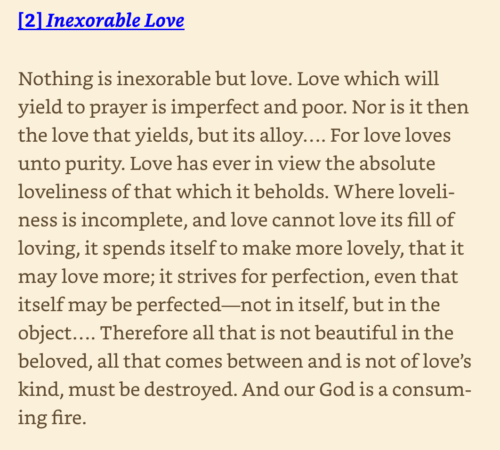
[20] No Comparing

Here there is no room for ambition. Ambition is the desire to be above one’s neighbor; and here there is no possibility of comparison with one’s neighbor: no one knows what the white stone contains except the man who receives it…. Relative worth is not only unknown—to the children of the Kingdom it is unknowable.

Lewis, C. S.. George MacDonald (pp. 11-12). HarperCollins. Kindle Edition.

May 9th, 2023 by Dave No comments »

A Mysterious Gratitude.

Dear David,

On a chilly desert night this past December, we hosted a gathering of Center for Action and Contemplation (CAC) staff, Board, and Faculty at the Norbertine Abbey on the outskirts of Albuquerque. Our gathering was called to review and confirm the big and exciting plans we have for the future of our mission. With what is happening in the world today, we believe that sharing the wisdom and practices of the Christian contemplative traditions is more important now than ever before. 

That night, we also ritually recognized my stepping back from active leadership at the CAC to become Core Faculty Emeritus. To symbolize the crossing of this threshold, I stepped over a smooth piece of piñon pine — leaving behind titles, obligations, and many duties that have kept me so busy for the past 35 years. And on the other side, I stepped into a new phase of life, one filled with trust and acceptance for what is and what will be. There was no magic to this ritual, but the key was to really mean it, and expect that things would be different on the other side.

Line drawing of Richard Rohr stepping over the threshold with Opie by his side

And now, writing this letter to you five months later, I must tell you that things are truly delightful! All feels right and good. I feel a great peace that is run through with what I can only describe as a “mysterious gratitude” — for where I have been, the opportunity before us, and this incredible community. My lymphoma cancer is now in full remission, and it seems God may be giving me more time. I didn’t ask to live longer; I was truly ready to go. I can only imagine there must be something more for me to do. Pray that I listen well. 

Thank you for being on this journey of transition with me, and with us. The entire CAC has crossed an important threshold, and that would not have been possible without your collective support, generosity, and partnership. Our vision of transformed people helping to transform the world is much more than any one person can take on by themselves. But together, I know that we can become a loving force for change of consciousness within each of our communities. We are part of a living tradition of action and contemplation, people who have gone beyond the theoretical and are living out this wisdom in their daily lives. Truly, it will take a movement of such people to create a world where everything belongs.

Twice per year, we pause the Daily Meditations to ask for your support to help continue this work. If you have been impacted by the CAC’s programs (including these Daily Meditations) and are financially able, please consider donating. The CAC is not funded by any large institution or big foundation but by thousands of people who have been impacted by this work — people just like you. We appreciate every gift, regardless of the amount.

Please take a moment to read our Executive Director Michael’s note below about the mission we are all working towards. Tomorrow the Daily Meditations will continue exploring the theme of “Freedom from Shame.”

Peace and Every Good,

Fr. Richard Rohr, O.F.M.

Dear David,

Thirty-five years ago, Fr. Richard concluded a letter to the CAC’s first donors and supporters with this invitation:

Come, build with us in “action and contemplation.” Like Jesus, we know that we have a lot of temples to confront, a lot of desert to walk in. But we also know that “grace is everywhere,” that grace is abundant (Romans 5:21), and that only grace is radical enough to call forth the good, the true, and the beautiful (Ephesians 2:6-10). “Be brave,” He says, “I have overcome the world.” (John 16:33).
—Fr. Richard Rohr (1987)

Thank you for being brave and joining with us to build a world where everything belongs! Everything that you do as a reader, contributor, and financial supporter is part of a collective effort to expand the reach and worldwide impact of the Christian contemplation traditions. This work is not easy, simple, or straightforward. But the trust and partnership that so many of you have shown during this time of transition are truly and deeply appreciated.

Since I joined the team in 2014, our primary task has been to lead a multi-year strategy to transform the CAC into a 21st-century global platform for transformative spiritual teaching that builds upon Fr. Richard’s lifetime of work and carries it forward into the future. The only thing more exciting than our progress so far is the potential we see before us. I believe we are entering a new era of spiritual renewal, and we are moving forward with a mysterious gratitude, knowing that there are hundreds of thousands of people like you who are shoulder-to-shoulder with us in this mission. 

Your financial support and generosity make all this possible. If you are financially able, we ask you to give to support the expansion of CAC’s work. Please consider making your donation a monthly one. Recurring support helps us consistently invest in new and improved offerings, many at no cost. When you give on a recurring basis, you join a community of people committed to supporting the contemplative path by making a meaningful monthly commitment in service to the healing of our world. 

In gratitude for a donation of any size, we will send you a digital version of our new issue of CAC’s biannual journal ONEING with the theme of “Transitions,” featuring a lead article from CAC Faculty Brian McLaren alongside other scholars, teachers, and poets sharing about this timely topic.

Thirty-five years after Father Richard founded the CAC and five months after he crossed the threshold, we say to all of you:

Come, build with us in “action and contemplation.” There is much more sacred work to be done.

In loving gratitude,

Michael Poffenberger, CAC Executive Director

Michael Poffenberger
Executive Director
Center for Action and Contemplation

[18] The Secrets in God

There is a chamber also (O God, humble and accept my speech)—a chamber in God Himself, into which none can enter but the one, the individual, the peculiar man—out of which chamber that man has to bring revelation and strength for his brethren. This is that for which he was made—to reveal the secret things of the Father.

Lewis, C. S.. George MacDonald (pp. 10-11). HarperCollins. Kindle Edition.

Our Original Shame

May 8th, 2023 by Dave No comments »

Father Richard speaks to the pervasive sense of shame that has taken root in our society:   

What we call Original Sin in Genesis perhaps could be better called Original Shame, because Adam and Eve describe themselves as feeling naked. Some of the first words of God to these newly created people are “Who told you that you were naked?” (Genesis 3:11). Next, in a lovely maternal image, God as seamstress sews leather garments for them (3:21). The first thing God does after creation itself is cover the shame of these new creatures.  

This must name something that is fundamental within us. We live, not just in an age of anxiety, but also in a time of significant shame. I find very few people who do not feel inadequate, stupid, dirty, or unworthy. When people come to me for counseling or confession, they always express in one way or another, “If people only knew the things I think, the things I’ve done, the things I’ve said, the things I want to do, who would love me?” We all have that terrible feeling of a fundamental unworthiness. It takes many different forms, but somehow it appears in each of our lives, even if we do not acknowledge it.  

Guilt, I am told, is about things we have done or not done, but our shame is about the primal emptiness of our very being. Shame is not about what we have done, but about who we are and who we are not. Guilt is a moral question. Shame—foundational shame, at least—has to do with our very being itself. It is not resolved by changing behavior as much as by changing our very self-image, our alignment with the universe. Shame is not about what we do, but where we abide.   

God is always the initiator. God is always the Hound of Heaven [1] who goes out after us because God knows our primordial shame. God is always sewing garments of love and protection to cover our immense and intense sense of unworthiness. Our very movements toward God are only because God has first moved toward us.  

People often seem to start with this premise: “If I behave correctly, I will one day see God clearly.” Yet the biblical tradition says the exact opposite: If we see God clearly, we will behave in a good and human way. Our right behavior does not cumulatively lead to our true being; our true being leads to eventual right behavior. Many of us think that good morality will lead to mystical union, but in fact, mystical union produces correct morality—along with a lot of joy left over. The greatest surprise is that sometimes a bad moral response results in the very collapsing of the ego that leads to our falling into the hands of the living God (see Hebrews 10:31).  

Upending the Social Order

Father Richard points out how Jesus upended the social norms of his time by honoring people’s identity as beloved children of God:  

A telling phrase used in the Acts of the Apostles describes the new sect of Judaism that upsets the old-world order in Thessalonica. Christians there were dragged before the city council and referred to as the people who have been turning the whole world upside down…. They have broken Caesar’s edicts” (Acts 17:6–7). No one is called before the city council for mere inner beliefs or new attitudes unless they are also upsetting the social order. The import of Jesus’ teaching and almost all his healing was a rearranging of social relationships and therefore of social order. He could not have gone around eating with the underclass, touching the untouchables, healing on the Sabbath, and collaborating with upstarts like John the Baptist down at the river without turning traditional societies upside down.  

Jesus refuses to abide by the honor/shame system that dominated the Mediterranean culture of his time. He refuses to live up to what is considered honorable and refuses to shame what people consider shameful. (If that is not apparent in our reading of the Gospels, we need to read them again.) This does not gain him many friends. It’s perhaps the thing that most bothers the priests and the elders. In response to his ignoring the debt codes and purity codes, they decided to kill him (see Mark 3:6, 11:18; Matthew 12:14; Luke 19:47; John 11:53).  

In New Testament times, shame and honor were the basis of moral values that people felt compelled to follow. If a situation called for retaliation, people were expected to retaliate. Not to retaliate would have been considered immoral, because they would have abandoned their honor. People were bound to be true to the honor of their village, their family, and themselves. For Jesus to walk into the midst of that cultural system and say, “Do not retaliate” and “Love your enemies” was to subvert the whole honor/shame system itself.  

Once challenged, Jesus’ listeners were given a new place to find their identity: not in their social positions of honor or shame but in God. Who we are in God is who we are. That’s the end of ups and downs. Our value no longer depends upon whether our family or village likes us, or whether we’re good-looking, wealthy, or obedient to the laws. Jesus’ message is incredibly subversive in any honor/shame society. As he takes away old foundations, he offers a new, more solid one: neither shame-based nor guilt-based but based in who we are in God.  

Who we are in God is a beloved child. Our identity is no longer dependent on the estimation of our culture or even on our own estimation of ourselves. Through prayer, and the awareness of God within us, we continually discover our true identity, “life … hidden with Christ in God” (Colossians 3:3).  

[15] The White Stone (Revelations 2:17)

The giving of the white stone with the new name is the communication of what God thinks about the man to the man. It is the divine judgment, the solemn holy doom of the righteous man, the “Come, thou blessed,” spoken to the individual…. The true name is one which expresses the character, the nature, the meaning of the person who bears it. It is the man’s own symbol—his soul’s picture, in a word—the sign which belongs to him and to no one else. Who can give a man this, his own name? God alone. For no one but God sees what the man is…. It is only when the man has become his name that God gives him the stone with the name upon it, for then first can he understand what his name signifies. It is the blossom, the perfection, the completeness, that determines the name: and God foresees that from the first because He made it so: but the tree of the soul, before its blossom comes, cannot understand what blossom it is to bear and could not know what the word meant, which, in representing its own unarrived completeness, named itself. Such a name cannot be given until the man is the name. God’s name for a man must be the expression of His own idea of the man, that being whom He had in His thought when he began to make the child, and whom He kept in His thought through the long process of creation that went to realize the idea. To tell the name is to seal the success—to say “In thee also I am well pleased.”

Lewis, C. S.. George MacDonald (pp. 8-10). HarperCollins. Kindle Edition.

Fly Loose

May 5th, 2023 by JDVaughn No comments »

The Rev. Cameron Trimble is an author, pastor, and leader in the United Church of Christ. As a pilot, she honed her wisdom for navigating the turbulence of transitional times:   

“We are going to hit some turbulence ahead,” [my flying instructor] went on, “and you will learn something about your airplane…. If you tighten your grip on the yoke, you reduce the aerodynamics of your aircraft. You, as the pilot, actually make the flight less safe, steady, and stable. So, remember: When the going gets rough, fly loose….” 

Our world today is nothing if not swirling, turbulent wind tossing us around. [Recently], we have experienced economic meltdown, climate countdown, racial throwdown, political breakdown, technology showdown, and religious letdown. We are living through the breakdown and breaking open of much that has defined modern life.  

In the face of such extraordinary transition, it’s natural to look for solutions to our problems…. We tightly grip the yoke of our families, businesses, government, and communities, trying to regain control of people and systems that feel broken and dangerous to our safety and survival. Of course, no amount of control will create the conditions needed to traverse these rough winds of change. 

Trimble offers challenging yet hopeful advice:  

We must resist looking to the frameworks of the past to lead us into the future. Doing so is a way to pretend to control, to tighten our grip and reduce our cultural aerodynamic flexibility. Instead, perhaps we turn to ways of wisdom that cultivate intuition, patience, and ingenuity. We embrace the ways of a Mystic Wayfinder, one who purposefully gets lost in order to chart new ways forward. By getting lost and welcoming the reality that we do not have the answers or know the way forward, we enter a space of liminality and emergence. We are not attempting to fix “broken systems” but are, instead, summoning entirely new worlds….  

We do not have the answers today. We have the wondering. We have the gifts of being lost to guide us. We must now use the wisdom of our wounds, both caused and carried, as portals into new ways of becoming….  

[Author and public intellectual] Bayo Akomolafe often begins his presentations with this call:  

The times are urgent; let us slow down. Slowing down is losing our way. Losing our way is not a human capacity or human capability. It is about the tensions, the invitations that are now in the world-at-large, inviting us to listen deeply, to be keen and to be fresh and to be quick with our heels, to follow the sights and sounds and smells of the world. [1]   His is an invitation to become fully present to the unfolding wonder of the world around us, to let go of our need to control the narrative and be swept up in the possibility of a more just and generous future ahead…. I hear in these words the invitation to fly loose on the yoke and enjoy the ride.

________________________________

Sarah Young Jesus Listens

Glorious Savior, Help me to live in the present, giving my entire attention to what You are doing right now. I don’t want to get worked up about what may or may not happen tomorrow. Yet I confess that entrusting my tomorrows to You goes against the grain of my human nature—against my strong desire to feel in control. The truth is, I waste a lot of time thinking about the future. I’ve found that trying not to think about something is usually ineffective and counterproductive. My effort to stop thinking about the matter keeps me chained to those thoughts. However, I can break free by focusing my attention on You and on what You’re doing in my life. You are my living Lord, and You’re always doing new things. The main thing that keeps me chained to future thoughts is my fear of what tomorrow may bring—wondering whether or not I’ll be able to cope with it. But Your Word reassures me: You will help me deal with whatever hard things come up—when the time comes. In Your merciful Name, Jesus, Amen

MATTHEW 6:34 THE MESSAGE; “Give your entire attention to what God is doing right now, and don’t get worked up about what may or may not happen tomorrow. God will help you deal with whatever hard things come up when the time comes.

HEBREWS 12:2; Looking unto Jesus the author and finisher of our faith; who for the joy that was set before him endured the cross, despising the shame, and is set down at the right hand of the throne of God.” 

ISAIAH 42:9; See, the former things have taken place, and new things I declare; before they spring into being I announce them to you.”

Young, Sarah. Jesus Listens (p. 132). Thomas Nelson. Kindle Edition.

Holy Transitions

May 3rd, 2023 by Dave No comments »

For Father Richard, liminal space transforms us when we are attentive to the presence of God in times of change: 

The Latin word limen means “threshold.” Liminal space is an inner state and sometimes an outer situation where we can begin to think and act in new ways. It is where we are betwixt and between, in transition, having left one room or stage of life but not yet entered the next. We usually enter liminal space when our former way of being is challenged or changed—perhaps when we lose a job or a loved one, during illness, at the birth of a child, or a major relocation. It is a graced time, but often does not feel “graced” in any way. In such space, we are not certain or in control.  

The very vulnerability and openness of liminal space allows room for something genuinely new to happen. We are empty and receptive—blank tablets waiting for new words. Liminal space is where we are most teachable, often because we are most humbled. Liminality keeps us in an ongoing state of shadowboxing instead of ego-confirmation, struggling with the hidden side of things, and calling so-called normalcy into creative question. 

It’s no surprise then that we generally avoid liminal space. Much of the work of authentic spirituality and human development is to get people into liminal space and to keep them there long enough that they can learn something essential and new. [1] 

We all need to consciously spend time at the thresholds of our lives, and we need wise elders to create and hold such spaces for us. Liminality is a form of holding the tension between one space and another. It is in these transitional moments of our lives that authentic transformation can happen. Otherwise, it is just business as usual and an eternally boring, status quo existence.  

Over the decades, I’ve seen the need for such liminal spaces again and again. Without some sort of guidance and reframing, we don’t understand the necessary ebb and flow of life, the ascents and descents, and the need to embrace our tears and our letting go as well as our successes and our triumphs. Without standing on the threshold for much longer than we’re comfortable, we won’t be able to see beyond ourselves to the broader and more inclusive world that lies before us.  

Revelation 3:20 tells us that Christ stands at the door and knocks. Too many of us want to show up at the doorway looking prim and proper and perfect. We stuff our egos and anxieties in the front hall closet so Christ won’t see them when we open the door. But Christ isn’t showing up to see our perfect selves. Instead, we are invited into a real, deep, transformative conversation, there on the threshold between who we are and who we can become, if we are willing to let go of what holds us back. [2] 

The following is from an anthology composed by CS Lewis of daily snippets from his hero and mentor, George MacDonald.

May 2nd, 2023 by Dave No comments »

Embracing Change

Benedictine and Celtic scholar Esther de Waal finds inspiration to manage life’s transitions in the Scriptures: 

If we are going to see life as a succession of thresholds to be crossed, we are reminded of the journeys of the people of Israel in the desert, and we then find symbols and images that we can apply to our own experience. The very words passover and exodus carry a fullness of meaning as a journey from bondage into freedom. It is important to remember that the Passover was a yearly ritual, so that its memory was kept alive and the cycle lived through time and time again….  

The psalms are the journey songs of the people who made that passage. Time and again they raised a fist to God and shouted angrily at him…. They are the songs of a people who were moving away from a known situation into the unknown, and they were often angry with a God who removed all those certainties, who instead seemed to be leading them along an apparently precarious path. They did not sit down for long beside gently flowing streams or linger in lush meadows….  

In the Gospels we watch a Christ who, in dismissing certainties, shows us what freedom might mean. We watch the way in which he enters into people’s lives and dissolves an existing situation, whatever it might be. The likelihood was that the condition had promised security, safety, but now Christ challenges the people to leave their nets, or to leave a nice safe booth, and follow him. He says to Peter, James, and John, “Come,” and to Matthew, “Stand up, move, walk, come with me.” Our God is a God who moves and he invites us to move with him. [God] wants to pry us away from anything that might hold us too securely: our careers, our family systems, our money making. We must be ready to disconnect. There comes a time when the things that were undoubtedly good and right in the past must be left behind, for there is always the danger that they might hinder us from moving forward and connecting with the one necessary thing, Christ himself.  

De Waal shares how we might navigate the resistance we feel as we stand on the threshold of something unknown:  

Of course there is loss and it is right to grieve and not to pretend otherwise. Insecurity makes certitude attractive, and it is in times like these that I want to harness God to my preferred scheme of things, for it is risky to be so vulnerable. Yet it is this vulnerability that asks for trust and hope in God’s plans, not mine. So I try to learn each time that I am called upon to move forward to hand over the past freely, putting it behind me, and moving on with hands open and ready for the new.