In a dialogue
about spirituality and the Twelve Steps, Father Thomas Keating (1923–2018)
identifies the role of emotional sobriety in recovery:
Emotional sobriety is the same as detachment from our own ideas of happiness and also from our overdependency on the group to which we feel we belong, along with our cultural conditioning, education, personality traits, and emotional patterns.
In other words, all of these interior tendencies and outside influences added up to a false self based on our traumatic experiences from early life that we were trying to run away from . . . rather than face. Now, through the Twelve Steps, you face them all, and as a result they have been relativized. . . .
An enormous freedom has begun to be experienced, expressed in the ability to serve others. . . . We cannot do this without an ever deepening awareness of the motivation that lurks in our unconscious, since the unconscious energy is stored in the body and secretly influences our behavior and decisions. We have to find out what this is in order to be able to let it go. . . .
As we become aware of the shadow side of our personality and how much energy we put into programs for security, power and affection, esteem and approval, we realize that we cannot manage our own lives. In other words, the first step has become an experience even deeper than the original one. Only now it is not a desperate state of mind, but self-knowledge that has grown to include parts of our personality that we didn’t know because often we had projected the shadow side of our personality onto someone else. Now we are confronted with who we actually are with all our brokenness and our weakness.
CAC teacher James Finley
poetically describes the encounter with God that supports our healing from
addiction:
Can I join God in knowing who God knows me to be? Can I join God in seeing who God sees me to be . . . ? This is salvation.
In order to do this, I have to let go of my own present way of seeing things, and I discover I can’t. We’re afraid to lose the control that we think that we have over the life that we think that we’re living, and we’re addicted to what binds us. “Out of the depths I cry unto thee, O Lord!” [Psalm 130:1] This is the cry for salvation. . . . Is this possible, that I could place my life over into your hands?
Then the mystery of the cross is this mystery of being liberated from this deep addiction to the illusion of an ultimately isolated self that has to make it on its own. To realize I’m in the presence of the love that loves us and takes us to itself. Through that inner process of discipleship, or whatever we want to call it, we can come to . . . true sobriety, the peace of God that surpasses understanding.
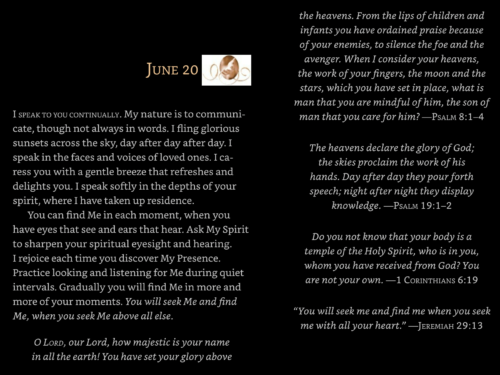
Sarah Young…
Let My love stream through you washing away fear and distrust. Stay surrendered and connected with Me. I look for persistence rather than perfection.
Psalm 52:8 But I am like an olive tree flourishing in the house of God; I trust in God’s unfailing love for ever and ever.
Deuteronomy 37:6 Be strong and of good courage, do not fear nor be afraid of them; for the Lord your God, He is the One who goes with you. He will not leave you nor forsake you.”
Ephesians 4:30 And do not grieve the Holy Spirit of God, with whom you were sealed for the day of redemption.
Blessed are the pure of heart; for they shall see God. —Matthew 5:8
Episcopal priest and CAC teacher emerita Cynthia Bourgeault writes of the difference between our modern understanding of emotions and the teachings of the Desert Fathers and Mothers:
In the psychological climate of our own times, our emotions are almost always considered to be virtually identical with our personal authenticity, and the more freely they flow, the more we are seen to be honest and “in touch.” A person who gravitates to a mental mode of operation is criticized for being “in his head”; when feeling dominates, we proclaim with approval that such a person is “in his heart.”
In the Wisdom tradition, this would be a serious misuse of the term heart. Far from revealing the heart, Wisdom teaches that the emotions are in fact the primary culprits that obscure and confuse it. The real mark of personal authenticity is not how intensely we can express our feelings but how honestly we can look at where they’re coming from and spot the elements of clinging, manipulation, and personal agendas that make up so much of what we experience as our emotional life today. . . .
In the teachings of the Christian Desert Fathers and Mothers, these intense feelings arising out of personal issues were known as the “passions,” and most of the Desert spiritual training had to do with learning to spot these land mines and get free of them before they did serious psychic damage. In contrast to our contemporary usage, which tends to see passion as a good thing, indicating that one is fully alive and engaged, the Desert tradition saw passion as a diminishment of being. It meant falling into passivity, into a state of being acted upon (which is what the Latin passio actually means), rather than clear and conscious engagement. Instead of enlivening the heart, according to one Desert Father, the real damage inflicted by the passions is that “they divide our heart into two.”. . .
The heart, in the ancient sacred traditions, has a very specific and perhaps surprising meaning. It is not the seat of our personal affective life—or even, ultimately, of our personal identity—but an organ for the perception of divine purpose and beauty. . . .
Finding the way to where our true heart lies is the great journey of spiritual life. . . . [1]
Bourgeault describes contemplation and letting go as the pathway back to the heart’s wholeness:
The core practice for cleansing the heart, for restoring the heart to its organ of spiritual seeing, becomes supremely, in Christianity, the path of kenosis, of letting go. The seeing will come, and it’s a part we still have to work on in Christianity, but the real heart of emotion is the willingness to let go, to sacrifice . . . your personal drama, the letting go at that level, so that you can begin to see. [2]
THE GREAT DESCENT
The Law, the Psalms and the Prophets forecast it. The Gospels and the Epistles allude to it. Ancient Christian hymns, liturgies and poetry announce it. It permeates both Eastern and Western theological tradition. It even has its own line in the Apostles’ Creed.
But only recently has Christ’s conquest of Hades caught the attention of moderns. It’s so central to the gospel message that its omission requires correction.
The same events go by various names—the great descent, the harrowing of hades, Christus Victor. But they all refer to the narrative that culminates in the resurrection of Christ before dawn on Easter Sunday.
Here are the bare facts of Easter weekend as I’ve heard them:
Christ suffers, dies and is buried on Good Friday.
The disciples are locked out of the tomb through Black Saturday.
Christ rises and exits the tomb before dawn on Easter Sunday.
That’s all we know. Or so I was taught. But in truth, the apostolic tradition dug deeper, gathering and interpreting their Scriptures and leaving us with this critical extra piece: “He descended into hell” (Latin: Inferno). When? Here’s the order:
He suffered under Pontius Pilate, was crucified, died and was buried; he descended into hell(descendit ad inferos) on the third day he rose again from the dead; he ascended into heaven…
– The Apostles Creed
Translators like to swap in hades or death or the grave, which is all fine but doesn’t get to the heart of the matter. The early church regarded this descent as far more than Jesus being entombed or visiting the place of the dead. They regarded it as Christ’s victorious rescue mission into the kingdom of darkness—“hell” if you like. This is our Lord’s great conquest of the underworld in which Satan is bound, defeated and his captive souls rescued.
The great descent is also called a “harrowing,” not because Christ uses a rake, but because his arrival in hell creates distress for death’s wicked warden. Satan’s reign is over. And then, the King of Life who descends through death also ascends from death, shattering its gates. And he’s not alone! He doesn’t merely leave an empty tomb. Christ leaves the ruins of hades itself, leading its prisoners to freedom—the ultimate exodus.
Yes, it’s an epic drama, adorned with symbolic language and poetic excess. Hades isn’t actually a giant fiery dungeon deep beneath the earth. You won’t find literal gates of bronze or broken dungeon chains down in the magma. It’s unlikely you’ll meet a demi-god named Hades borrowed from Greek mythology.
But that doesn’t make the story untrue. Rather, Christ’s victory is real, told as a theological narrative woven from the Scriptures and proclaimed as gospel truth. What is that gospel truth?
THE GOSPEL TRUTH
First, that in Christ’s death, the power of death is broken. You don’t need to be afraid of it anymore. Death cannot separate you from the love of God and in fact, death as non-being or perpetual torment no longer exists. In Christ, death has become a doorway to eternal life.
Second, that in Christ’s resurrection, we have the assurance of our resurrection. That he’ll raise us up with and to himself.
And third, our rescue from hades and entry into eternal life don’t await the next life or coming age. The gospel is preached today for today. Whatever hell or hades or darkness you experience now … that’s where Christ comes. He descends into our “waterless pit” or “dark abyss,” whatever form that takes. And the eternal life he won is not merely heaven someday when you die. It’s fullness of joy (or life to the full) in this life.
If you’re like me, that’s not a magical snap of some genie’s fingers. I wasn’t given a happy pill at my baptism. It’s a daily journey within the loving grace of a friendship—a living connection with Life himself. But I can testify that despite my circumstances, my melancholy, my haters and my screw-ups, I experience the resurrection (repeatedly) in this life.
Regardless of your faith (and even if you have none), if a deeper living connection is your desire too, may I encourage you to pray a simple prayer? Here’s one: “Find me. Amen.” Or “Yes, please.” Or, “I’m dying here. Help me.” Whatever resonates. And then watch for him. “Christ plays in ten thousand places.” Pay attention. Rinse and repeat.
Buddhist author and speaker Valerie Mason-John found meditation to be integral to her recovery from addiction. She writes:
People say we can’t help how we feel. It’s true we can’t help unpleasant, pleasant, or neutral feelings arising when one or more of the six senses have made contact with an object. We multiply the intensity of feeling every time we move away from something pleasant or unpleasant; we create a vicious cycle of craving and aversion.
Often when people say we can’t help how we feel, they are talking about their emotions. We can help how we experience our emotions. They are created by our unconscious and conscious thinking and conditioning. When we emote our thoughts we are habitually responding and reacting out of our emotions. We are forcibly changing our emotions all the time, by reaching out for external stimuli, or by blaming others when we feel vulnerable or upset. Before we know it, we are angry, resentful, self-righteous, and begin to inhabit a storehouse of toxic thoughts, which suppress our uncomfortable feelings of vulnerability.
By observing our thoughts and emotions, we can witness how they build on each other through our attachment to repetitive inner stories. Such witnessing begins the process of healthy nonattachment:
If we are patient, our feelings will change of their own accord—some quicker than others. Our emotions will begin to deplete; they won’t dominate us, or dictate our behavior. Eventually toxic emotions will disappear and nontoxic thinking will start to arise in our hearts, and one day there will be just thoughts without a thinker. There will be sounds without a hearer, tastes without a taster, smells without a smeller, sights without a seer, and touch without a toucher. What I mean by all of this is that things will arise and we will not identify with them as me, mine, or I. There will be no judgments, interpretations, or stories about what we have just perceived. We will see the bigger picture, and not be caught by the clash of the senses, not react to whatever we have made contact with. We will feel the unpleasantness, pleasantness, neutralness, or even the mixture of all three feelings, and will turn toward it without an agitated mind. The heart and mind will accept all of it without protesting. When we protest, toxic emotions begin to emerge. . . .
Our hearts well up with toxins because we push away our painful feelings. Many of us will do our utmost to push them down. We won’t allow ourselves to stop. Our busy lives don’t seem to give us time to feel our feelings. When we turn toward our experience, we will often find feeling tones or sensations in the body. We turn away from the experience in the body with thoughts and thinking. If we have the courage to face the feeling tone, we will discover there is nothing there, no I or me, just a flow of sensations that may be painful, pleasurable, or neutral.
Father Richard introduces this week’s meditations on emotional sobriety:
Alcoholics Anonymous founder Bill Wilson (1895–1971) viewed emotional sobriety as where the Twelve Steps should finally lead. The goal is not simply to stop drinking, but to become a spiritually awakened person who has found some degree of detachment from their own emotional, narcissistic responses. How is it that all of us get so easily hooked, so easily snagged by often temporary or even irrational things?
Let me try to describe the process. The word “emotion” (from Latin emovere) means a movement. It’s a body-based reaction in the moment that snags me immediately and urgently and feels like “me.” Some people say we should call emotions “narcissistic reactions,” and we have to recognize that they largely are! Since the body carries all our shame, our childhood conditioning and memories, our guilt, and our previous hurts, the addictive patterns of our emotions can be very hard to “unhook.” Emotions feel like truth—but they’re not necessarily.
That doesn’t mean emotions should be ignored. They must be felt; their honest message must be heard. Only then can we release ourselves from their fascination over us. They are necessary weathervanes to help us read situations quickly and perhaps in depth. But they are also learned and practiced neural responses, often ego-based, which have little to do with truth and much more to do with the story lines we have learned and created. The ego loves to hold on to such emotions to justify itself, defend itself, and assert its power. There is nothing like an angry person to control an entire conversation!
Much of the work of emotional maturity is learning to distinguish between emotions that offer a helpful message about ourselves or the moment, and emotions that are merely narcissistic reactions to the moment. I dare to say that, until we have found our spiritual center and ground, most of our emotional responses are usually too self-referential to be helpful or truthful. They read the moment as if the “I,” with its immediate needs and hurts, is the reference point for objective truth. It isn’t. The small, defensive “I” cannot hold that space. Reality/God/Creation holds that space. Persistent use of the small self as an objective reference point will only create deeper problems in the long run; it will not solve them.
If an emotion does not help us read a situation better and more truthfully, we must let it go—for our own well-being. Most of us are naturally good at attachment, but we have very little training in detachment or letting go. We must take the risk of legitimate attachment (fully feeling the emotion), learn its important message, and then have the presence and purpose to detach from that fascinating emotion after it has done its work. This is the gift and power of an emotionally mature person.
A Riverbed of Mercy
Monday, June 20th, 2022
For Father Richard, emotional sobriety is found when we experience life from our True Self:
There is something in us that is not touched by coming and going, by up and down, by for or against, by totally right or totally wrong. This part of us is patient with both goodness and evil, exactly as God is; it does not rush to judgment or demand closure now. Rather, it stands vigilant and patient in the tragic gap that almost every moment offers.
God-in-us is a riverbed of mercy that underlies all the flotsam and jetsam that flows over it and soon passes away. Vast, silent, restful, and resourceful, it receives and also releases all these comings and goings. It is awareness itself (as opposed to judgment), and awareness is not the same as “thinking.” It refuses to be pulled into emotional and mental tugs-of-war that form most of human life. To look out from this untouchable silence is what we mean by contemplation.
St. Teresa of Ávila (1515–1682) writes, “Always visualize [the] soul as vast, spacious, and plentiful . . . The sun at the center of this place radiates to every part. . . . God has given [it] such dignity.” [1] This is your soul. This is God-in-you. This is your True Self.
A person who lives freely from the True Self is present to life and the full range of emotions. Father Richard’s good friend, Enneagram teacher Russ Hudson, writes of the importance of presence:
For me, presence is a grace offered in each moment. It allows whatever I am feeling to be transmuted into something useful, for myself, for the situation I may be in, and perhaps for some greater good. . . .
Most of my spiritual journey has been about learning how to be present and, from that grounding in presence, learning how to allow love to be what moves me. . . . Presence seems to be something received, that comes to us through a kind of willingness more than through some forceful effort. We come to understand that our will does not operate quite as we might imagine. There is an element of grace, of something miraculous arising in us which gives us the capacity to be awake to our experience.
This is hard enough when conditions are favorable—when we are relaxed and not particularly stressed about anything. However, when powerful emotions arise, it is generally much more difficult to find a ground in us that can be compassionately awake with what we are feeling. . . .
In this sense, we naturally come to understand the importance of practices—contemplation, meditation, and prayer—as methods to cultivate in ourselves a capacity to be with larger emotions and bigger triggers in our lives. As I often tell my students, “Practice when it is easy and it will be there for you when it is hard.” [2]
Sister José
Hobday (1929–2009) was a modern Franciscan whose life exemplified her faith
commitment to activism and contemplation. Editor Mary Ford-Grabowsky described
Hobday as:
A Seneca elder, a prominent Roman Catholic leader, and a
Franciscan sister who adheres fully to St. Francis’s radical ideal of holy
poverty. . . . She is also a mystic and contemplative; she is an earth warrior
and elder guide on the wisdom path; and above all, she is an impassioned
servant of the poor, especially poor Native Americans.
Sister José lives in the maximum simplicity of voluntary
poverty in a tiny house in Gallup, New Mexico, surrounded on all sides by
Indian reservations and pueblos. As people once flocked to Julian of Norwich’s
cell or to Dorothy Day’s Hospitality House, so people today come to Sister
José’s warm hearth for spiritual guidance and material help, and no one leaves
without assistance. [1]
Hobday took her Franciscan
vow of poverty seriously; she did not view it as a burden to be endured but as
a pathway to simplicity and freedom:
Simple living is not about elegant frugality. It is not really about deprivation of whatever is useful and helpful for our life. It is not about harsh rules and stringent regulations. To live simply, one has to consider all of these and they may be included to some degree, but simple living is about freedom. It’s about a freedom to choose space rather than clutter, to choose open and generous living rather than a secure and sheltered way.
Freedom is about choices: Freedom to choose less rather than more. It’s about choosing time for people and ideas and self-growth rather than for maintenance and guarding and possessing and cleaning. Simple living is about moving through life rather lightly, delighting in the plain and the subtle. It is about poetry and dance, song and art, music and grace. It is about optimism and humor, gratitude and appreciation. It is about embracing life with wide-open arms. It’s about living and giving with no strings attached. . . .
Simple living is as close as the land on which we stand. It is as far-reaching as the universe that makes us gasp. Simple living is a relaxed grasp on money, things, and even friends. Simplicity cherishes ideas and relationships. They are treasured more because simplicity doesn’t cling nor try to possess things or people or relationships. Simplicity frees us within, but it frees others, too. . . . Simple living is a statement of presence. The real me. This simplicity makes us welcome among the wealthy and the poor alike. . . . We will not be happy living selfishly in a small world. We must live in awareness and in association with the whole real world. Our universe. Our cosmos. Our environment. Our earth. Our air. Our water supply. Our country. Our neighbor. Our car. Our homes. All are part of simple living.
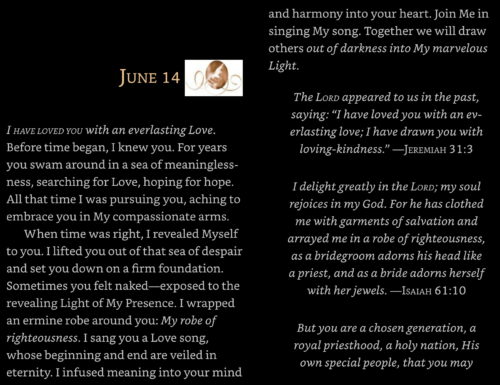
Sarah Young…
Stay on the high road with Me. Many voices call for your attention, but stay with Me, soaking in My presence, live in my peace.
John 14:27 NKJV Peace I leave with you, My peace I give to you; not as the world gives do I give to you. Let not your heart be troubled, neither let it be afraid.
Ephesians 2:10 For we are God’s masterpiece. He has created us anew in Christ Jesus, so we can do the good things he planned for us long ago.
Micah 6:8 He has shown you, O mortal, what is good. And what does the Lord require of you? To act justly and to love mercy
The intuition of St. Francis is that the entire world is a sacrament revealing the presence of God! Here, Franciscan scholars explain how Francis and Angela of Foligno (1248–1309) could come to see such a universal vision of Christ in the created world:
Francis’s world was so imbued by the goodness of God that he was “aroused by everything to divine love.” [1] . . . Thomas of Celano [1185–1260] states: “Fields and vineyards, rocks and woods, and all the beauties of the field, flowing springs and blooming gardens, earth and fire, air and wind: all these he urged to love of God and to willing service.” [2] Francis truly became a lover of God through the beautiful things of creation. . . .
Many Christ-centered mystics, like Francis, have experienced the profound presence of God in creation. To know Christ in human form is to know God in created reality; to see God in the Eucharist is to see God in creation. The great penitent-mystic, Angela of Foligno, while attending Mass one day and seeing the host elevated, exclaimed:
I beheld and comprehended the whole of creation, that is, what is on this side and what is beyond the sea. . . . And my soul in an excess of wonder cried out: “This world is pregnant with God!” Wherefore I understood how small is the whole of creation—that is, what is on this side and what is beyond the sea, the abyss, the sea itself, and everything else—but the power of God fills it all to overflowing. [3]
The idea of the whole earth “pregnant with God” speaks to us of “Mother Earth,” a nourishing and caring Earth that cries out in labor pains, longing for its fulfillment in God (Romans 8:22). Angela’s vision reminds us that the power of spiritual vision and relatedness is made possible by the power of love in union with Christ. To see God present with the eyes of the heart and to love what is seen requires faith in the risen Christ, truly believing that God is present to us in created reality.
Authors Delio, Warner, and Wood press us to struggle with the implications of such an inclusive understanding of God’s presence during a time of environmental catastrophe:
Do we really believe that God dwells with us, in our lives and in the natural world of creation? Does the Body of Christ move us to contemplate God in creation? If so, then how can we say “Amen” to receiving the Body of Christ and perpetrate destruction of the environment? There is a disconnect between what we claim to be or rather what we claim to see and what we actually do. It is an alienation of heart and mind that has rendered a desecration of the environment, as if we take the host, the Body of Christ, and continually stomp on it while saying, “yes, so be it!”
This week’s Daily Meditations focus on the Franciscan unified vision of contemplation and action. Father Richard recounts an early story about Francis of Assisi’s (1182–1226) vocational path:
One of the foundational charisms of St. Francis of Assisi was the way he integrated contemplation and action. Early on, he is attracted to contemplation and to living in silence out in nature. But he’s not sure if this is what God wants him to do. So Francis sends two brothers to Sister Clare and Brother Sylvester to ask each one to pray for an answer: should he live in prayerful seclusion, or should he travel through Italy and minister to people as a preacher?
When the brothers return, Francis is ready to do whatever they say. Both give the same reply: Clare and Sylvester each said that it was God’s will “that the herald of Christ should preach.” Francis gets up, and quickly takes to the roads in obedience to God. [1]
Francis’s eagerness to serve God by preaching did not limit his deep love for meeting God in prayer. When he needed rest from the crowds who gathered to hear him, it was customary for Francis “to divide the time given him . . . to spend some of it to benefit his neighbors and use the rest in the blessed solitude of contemplation.” [2]
Father Richard describes how Francis desired the same combination of contemplative and active ministry for his friars:
The Franciscan worldview is that the Christ is everywhere. In fact, this was my Bachelor of Arts thesis in college. I wrote it on the quote from Francis where he says, “Don’t speak to me of Benedict; don’t speak to me of Augustine! The Lord called me to a different way.” [3]
Francis didn’t need to create a monastery, as the Benedictines and Augustinians had done. He didn’t want us to be enclosed monks. He wanted us to be friars, living in the middle of the people. To this day, Franciscan friaries are in the heart of most major European cities.
Over thirty-five years ago, when we named our organization the Center for Action and Contemplation, I was just being a good Franciscan. It was St. Bonaventure (1221–1274) at the University of Paris who had to debate the secular (diocesan) priests who said that the Franciscan way of putting action and contemplation together would not work. They wanted Franciscans to choose one or the other. The secular priests worked with the people in the parishes, while the “true” religious people went off to monasteries. Francis and his followers thought there had to be a way to do both.
That was unique. It’s almost like human consciousness just couldn’t imagine that anyone could find God except by going into the desert, into the monastery, away from troubles, away from marriage, away from people.
And eight hundred years later, we’re still trying to learn how to balance contemplation and action.
Living the Gospel without Gloss
Father Richard writes about how a radical change in lifestyle is at the heart of Franciscan spirituality and the gospel of Jesus:
Since Jesus himself was humble and poor, Francis made the pure and simple imitation of Jesus his life’s agenda. In fact, he often did it in an almost absurdly literal way. He was a fundamentalist—not about doctrinal Scriptures—but about lifestyle Scriptures: take nothing for your journey; eat what is set before you; work for your wages; wear no shoes. This is still revolutionary thinking for most Christians, although it is the very “marrow of the Gospel,” to use Francis’s own phrase. [1] He knew that humans tend to live themselves into new ways of thinking more than think themselves into new ways of living. (This is one of the CAC’s Core Principles.)
“When we are weak, we are strong” (2 Corinthians 12:10) might have been the motto of the early Franciscans. In chapter nine of his First Rule, Francis wrote, “They must rejoice when they live among people considered of little value. . . .” [2] Biblically, they reflected the primitive and practical Christianity found in the Letter of James and the heart-based mysticism of the Eastern Church. While most male Franciscans eventually became clericalized and proper churchmen, we did not begin that way.
The more radical forms of Christianity have never thrived for long, starting with Pentecost itself and the first “sharing of all things in common” (Acts 2:44–45): the desert fathers and mothers, the early Celtic monastics, and faith communities on through history, down to the Catholic Workers and the Sant’Egidio Community in our own time. Unless such groups become strongly institutionalized—even juridical—they tend to be short-lived or very small, but always wonderful experiments that challenge the rest of us. They are always like a new room with a new view, offering the rest of us an essential viewpoint that we have lost.
The early Franciscan friars and the Poor Clares wanted to be Gospel practitioners instead of merely “inspectors” or “museum curators” as Pope Francis calls some clergy. Both Francis and Clare offered their Rules as a forma vitae, or “form of life,” to use their own words. They saw orthopraxy (“correct practice”) as a necessary parallel, and maybe even precedent, to mere verbal orthodoxy (“correct teaching”) and not an optional add-on or a possible implication. History has shown that a rather large percentage of Christians never get to the practical implications of their beliefs! “Why aren’t you doing what you say you believe?” the prophet invariably asks.
The Franciscan school found a way to be both very traditional and very revolutionary at the same time by emphasizing practice over theory. At the heart of their orthopraxy was the practice of paying attention to different things (nature, people on the margins, humility, itinerancy, mendicancy, mission) instead of shoring up the home base. They tried to live the Gospels “without gloss,” as Francis put it. [3]
The Rev. Dr.
Barbara Holmes shares her experiences of the Holy Spirit and being an “everyday
mystic”:
There is no template; there is no right way to encounter the spirit world. It can occur as a simple understanding of unity, the nonduality of an observer and the observed, oneness, feelings of sacredness, peace, bliss, transcendence, a feeling of changing and transforming time and space, or an intuitive conviction that the experience is a source of objective truth and ultimate reality. The ordinariness of my mystical experiences taught me that being an everyday mystic is not limited to ritual, visitation, and mysterious power. It also just broadens the scope of your personal identity. It includes normal gifts like healing, grounds us in faith, grounds us in our ancestral heritage.
Being an “everyday mystic”
for Dr. Holmes is also connected with her time spent in Pentecostal churches.
She draws upon what Jesuit theologian Karl Rahner (1904–1984) described as
“mysticism of the masses”:
The mysticism of everyday life is an opportunity to deeply mine the depths of human experience, relationships with others, and our encounters with nature. Rahner says to be a mystic is to occupy the core of human experience. . . . Mystery is mysterious. It is! Sometimes it comes in stillness when you’re alone. Sometimes it comes without drama and fanfare. Sometimes it comes as an epiphany, an awakening. And sometimes, it comes while you’re practicing the gifts of the Spirit. . . .
The “mysticism of the masses” [1] that Rahner refers to is a manifestation of charisms, Pentecostalism, dramatic conversions, glossolalia (speaking in tongues), prophecy, being drunk in the Spirit or slain in the Spirit in the language of Pentecostalism. [2] Rahner calls this “noisy mysticism,” and he considers it just fine and real if it increases faith, love, and charity. [3] He urges adherents to self-examine their own enjoyment of the phenomena.
I have inhabited those spaces most of my life. If I had a
choice between a tall steeple church and a pew in a storefront in the middle of
an impoverished neighborhood, I’d pick the storefront, because I’d know that
there’d be more happening in the storefront than in the tall steeple church.
There’d be mysteries inside those walls. . . .
One of the reasons I was attracted to this “mysticism of the masses” is because it was a recovery of Africanism’s long-lost past—in the transport from Africa to the Americas that my ancestors made. We’re always looking for ways to reconnect and this type of worship was very, very stimulating, and given the fact that my profession lawyering and academic work was very cool and wintry, when I came home on weekends and wanted to visit faith spaces, I tried to find the most mysterious, strange, storefront, noisy mystics that I could. . . .
Perhaps I am not the embodiment that Karl Rahner imagined but I am a mystic all the same. . . . Every ordinary thing is infused with mystery.
I am an everyday mystic. So are you.
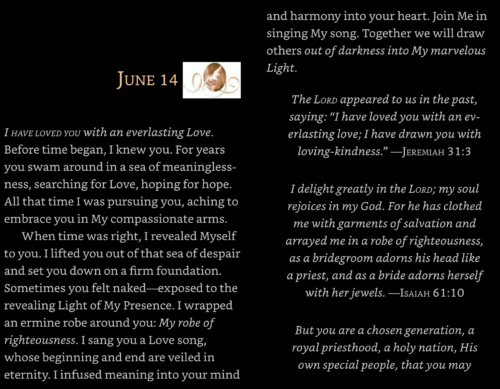
Sarah Young…
Rest in Me my child. Do not try to plan, organize and control your future. Pray instead, asking My Spirit to take over…. then rest in Me.
1 Thessalonians 5:15
Pray without ceasing.
Psalm 139:9-10 If I take the wings of the morning and dwell in the uttermost parts of the sea, even there your hand shall lead me, and your right hand shall hold me.
Psalm 62:5 Yes,my soul, find rest in God; my hope comes from him.
Amos Yong is a
Malaysian-American, Pentecostal theologian. Yong describes how the Spirit’s
coming at Pentecost begins a reconciled way of relating to one another across
divisions:
First-century Palestinian life, in many ways like our global village today, was marked by suspicions about those who . . . spoke other languages, and who represented strange ways of life. It was the work of the Spirit . . . to bring those who were strangers together, and to reconcile those who might have otherwise lived apart from those unlike themselves.
Pentecost thus inaugurates a restored Israel and God’s kingdom by establishing new social structures and relations. Note that the gift of the Spirit was not withheld from any of the 120 men and women who had gathered in the upper room (Acts 1:14–15): the divided tongues of fire rested on each one and enabled each to either speak or be heard in foreign languages (Acts 2:3–4). In order to explain this phenomenon, Peter cites the prophet Joel:
your sons and your daughters shall prophesy,
and your young men shall see visions,
and your old men shall dream dreams.
Even upon my slaves, both men and women,
in those days I will pour out my Spirit;
and they shall prophesy (Acts 2:17–18; compare Joel 2:28–29).
The Spirit’s gifts are not only for individuals; they have social effects challenging the “powers that be”:
Peter clearly understood that, whereas the former Jewish era was patriarchal in character, the restoration of Israel would feature the equality of male and female: both would prophesy under the power of the Spirit. Whereas the former covenant featured the leadership of elders, the restored kingdom would involve the empowering of men and women of all ages. Whatever structures had previously sanctioned the social system of slavery, the outpouring of the Spirit had been and would be indiscriminately upon both free and slave, in effect making them equal. In all of this, the work of the Spirit was heralded in strange tongues, not the conventional languages of the status quo.
In effect, the restoration of the kingdom through the power of the Spirit actually overturned the status quo. As Mary and Zechariah had already foretold, those at the bottom of the social ladder—women, youth, and slaves—would be recipients of the Spirit and vehicles of the Spirit’s empowerment [Luke 1:46–55; 1:67–79]. People previously divided by language, ethnicity, culture, nationality, gender, and class would be reconciled in this new version of the kingdom. Potentially, “all flesh” would be included within this kingdom of the last days (Acts 2:17).
Do these characteristics continue to mark the church as the fellowship of the Holy Spirit? . . . Does the church still speak in the tongues of the Spirit . . . or do we remain captive to the divisive languages, structures, and conventions of the empires of this world? Our prayer should be, “Come Holy Spirit!” so that the proclaimed outpouring of the Spirit on all flesh might indeed still find its fulfillment in our time.
_____________
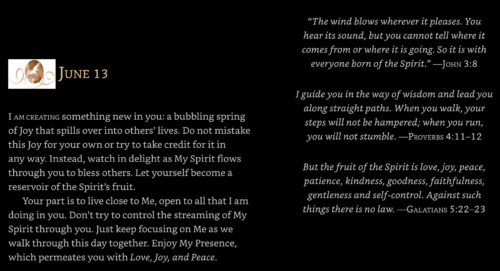
Sarah Young….Wear God’s Love
Seek to live in My Love…..wear My Love like a cloak of light. Look at people through My Lense of love.
1Peter 4:8 Most important of all, continue to show deep love for each other, for love covers a multitude of sins.
1John 4:18 There is no fear in love. But perfect love drives out fear, because fear has to do with punishment. The one who fears is not made perfect in love.
Revelation 2:4 Yet I hold this against you: You have forsaken the love you had at first
Father Richard describes the Holy Spirit as the loving immensity of God’s presence within us:
On one level, soul, consciousness, love, and the Holy Spirit can all be thought of as one and the same. Each of these point to something that is larger than the self, shared with God, and even eternal. That’s what Jesus means when he speaks of “giving” us the Spirit or sharing his consciousness with us. One whose soul is thus awakened actually has “the mind of Christ” (see 1 Corinthians 2:10–16). That does not mean the person is psychologically or morally perfect, but such a transformed person does see things in a much more expanded and compassionate way. St. Paul calls it “a spiritual revolution of the mind” (Ephesians 4:23, Jerusalem Bible)—and it is!
Jesus calls this implanted Spirit the “Advocate” who is “with you and in you,” makes you live with the same life that he lives, and unites you to everything else (John 14:16–20). He goes on to say that this “Spirit of truth” will “teach you everything” and “remind you of all things” (John 14:26) as if you already knew this somehow. Talk about being well-equipped from a Secret Inner Source! It really is too good to believe—so we didn’t believe it.
Consciousness, the soul, love, the Holy Spirit, on both the individual and shared levels, have sadly become largely unconscious! No wonder some call the Holy Spirit the “missing person of the Blessed Trinity.” No wonder we try to fill this radical disconnectedness through various addictions.
There is an Inner Reminder and an Inner Rememberer (see John 14:26, 16:4) who holds together all the disparate and fragmented parts of our lives, who fills in all the gaps, who owns all the mistakes, who forgives all the failures—and who loves us into an ever-deeper life. This is the job description of the Holy Spirit, who is the spring that wells up within us (John 7:38–39)—and unto eternal time. This is the breath that warms and renews everything (John 20:22). These are the eyes that see beyond the momentary shadow and disguise of things (John 9); these are the tears that wash and cleanse the past (Matthew 5:4). And better yet, they are not only our tears but are actually the very presence and consolation of God within us (2 Corinthians 1:3–5).
You must contact this Immensity! You must look back at what seems like your life from the place of this Immensity. You must know that this Immensity is already within you. The only thing separating you from such Immensity is your unwillingness to trust such an utterly free grace, such a completely unmerited gift.
This CO2- (Church Of 2) is where two guys meet each day to tighten up our Connections with Jesus. We start by placing the daily “My Utmost For His Highest” in this WordPress blog. Then we prayerfully select some matching worship music and usually pick out a few lyrics that fit especially well. Then we just start praying and editing and Bolding and adding comments and see where the Spirit takes us.
It’s been a blessing for both of us.
If you’d like to start a CO2, we’d be glad to help you and your partner get started. Also click the link below to see how others are doing CO2.Odds Monkey
Steve Harvey Introduces Jesus To A Secular Audience
About
Change this text in the admin section of WordPress
You are currently browsing the CO2MannaToday blog archives.