Look
with the Eyes of Compassion
Wednesday, July 29, 2020
The
Buddhist monk Thich Nhat Hanh (born 1926) is one of the world’s most
influential spiritual teachers. During the Vietnam War, his work for peace
brought him into friendship with Dr. Martin Luther King, Jr., Thomas Merton,
and other Christians who shared his belief that peace must be who we are, not
just something we demand. Thich Nhat Hanh teaches:
This
capacity of waking up, of being aware of what is going on in your feelings, in
your body, in your perceptions, in the world, is called Buddha nature, the
capacity of understanding and loving. . . . It is with our capacity of smiling,
breathing, and being peace that we can make peace.
Many
of us worry about the world situation. We don’t know when the bombs will
explode. We feel that we are on the edge of time. As individuals, we feel
helpless, despairing. The situation is so dangerous, injustice is so
widespread, the danger is so close. In this kind of situation, if we panic,
things will only become worse. We need to remain calm, to see clearly.
Meditation is to be aware, and to try to help.
I
like to use the example of a small boat crossing the Gulf of Siam. In Vietnam,
there are many people, called boat people, who leave the country in small
boats. Often the boats are caught in rough seas or storms, the people may
panic, and boats can sink. But if even one person aboard can remain calm,
lucid, knowing what to do and what not to do, he or she can help the boat
survive. His or her expression—face, voice—communicates clarity and calmness,
and people have trust in that person. They will listen to what he or she says.
One such person can save the lives of many.
Our
world is something like a small boat. Compared with the cosmos, our planet is a
very small boat. We are about to panic because our situation is no better than
the situation of the small boat in the sea. . . . Humankind has become a very
dangerous species. We need people who can sit still and be able to smile, who
can walk peacefully. We need people like that in order to save us. Mahayana
Buddhism says that you are that person. . . .
The
root-word “budh” means to wake up, to know, to understand. A person who wakes
up and understands is called a Buddha. It is as simple as that. The capacity to
wake up, to understand, and to love is called Buddha nature. [Christians would call this Christ nature, the Christ
self, or the mind of Christ.] . . .
When you understand, you cannot help but love. . . . To develop understanding, you have to practice looking at all living beings with the eyes of compassion. When you understand, you love. And when you love, you naturally act in a way that can relieve the suffering of people.
Nonviolence: A Spiritual Superpower Tuesday, July 28, 2020
Be the change you wish to see in the world. —Gandhi
My good friend, John Dear, is a devoted student of Mohandas Gandhi and has dedicated his life to the promotion of nonviolence through his activism and writing. John writes:
In his search for God and truth, Mohandas Gandhi [1869–1948] concluded that he could never hurt or kill anyone, much less remain passive in the face of injustice, imperialism, and war. Instead, Gandhi dedicated himself to the practice and promotion of nonviolence. He concluded that nonviolence is not only the most powerful force there is; it is the spiritual practice most neglected and most needed throughout the world.
“Nonviolence means avoiding injury to anything on earth, in thought, word, or deed,” Gandhi told an interviewer in 1935. But for Gandhi, nonviolence meant not just refraining from physical violence interpersonally and nationally, but refraining from the inner violence of the heart as well. It meant the practice of active love toward one’s oppressors and enemies in the pursuit of justice, truth, and peace. “Nonviolence cannot be preached,” he insisted. “It has to be practiced.” For fifty years, Gandhi sought to practice nonviolence at every level in life, in his own heart, among his family and friends, and publicly in his struggle for equality in South Africa and freedom for India. It was the means by which he sought the ends of truth; in fact, he later concluded that the ends were in the means, or perhaps they were even the same. In other words, the practice of nonviolence is not just the way to peace; it is the way to God.
Gandhi’s nonviolence was a religious duty. It stood at the center of his spirituality, all his spiritual teachings, and his daily spiritual practice. Gandhi concluded that God is nonviolent, and that God’s reign is the reign of nonviolence. “Nonviolence assumes entire reliance upon God,” Gandhi taught. “When the practice of nonviolence becomes universal, God will reign on earth as God reigns in heaven.” After years of studying the various religions, Gandhi concluded too that nonviolence is at the heart of every religion. It is the common ground of all the world’s religions, the hidden ground of peace and love underlying every religion. . . .
Gandhi thought that the force of nonviolence was more powerful than all nuclear weapons combined and that if we all practiced perfect active nonviolence, we could unleash a spiritual explosion more powerful than the atomic bombing of Hiroshima. “I am certain that if we want to bring about peace in the world,” Gandhi told a group of visitors a few months before his death, “there is no other way except that of nonviolence.”
“Nonviolence is the greatest and most active force in the world,” Gandhi wrote. . . . “My optimism rests on my belief in the infinite possibilities of the individual to develop nonviolence. The more you develop it in your own being, the more infectious it becomes till it overwhelms your surroundings and by and by might oversweep the world.
Story from Our Community: As I read the daily meditation this morning, I felt as if something bigger than me was telling me everything is going to be okay. My kids and I have just moved to a new town after leaving an abusive husband. It was not easy, and these first few days have been a struggle. We are healing, and I see this time in my life as more than just a change of address or a new job but as a transformation. I’ve been through the dark night, the fire, and I will be stronger. I am excited to see what our new lives will include. Thank you for the daily meditations. —Name withheld
Change
Comes from the Inside
Monday, July 27, 2020
As we come to know our soul gift more clearly,
we almost always have to let go of some other “gifts” so we can do our one or
two things with integrity. Such letting go frees us from always being driven by
what has been called the “tyranny of the urgent.” [1] Soon urgency is a way of
life, and things are not done peacefully from within. What if we choose to
simply do one or two things wholeheartedly in our lives? That is all God
expects and all we can probably do well. Too much good work becomes a violence
to ourselves and, finally, to those around us.
Let’s just use our different gifts to create a unity in
the work of service (Ephesians 4:12–13), and back one another up, without
criticism or competition. Only in our peaceful, mutual honoring do we show
forth the glory of God.
The Gospel is not about being nice; it is about being
honest and just, and the world doesn’t like those two things very much. Our job
is to learn how to be honest, but with love and respect. Dr. Martin Luther King,
Jr. taught us that before we go out to witness for justice, we have to make
sure that we can love and respect those with whom we disagree.
Imagine the surrender necessary for those who have been
oppressed for hundreds of years to continue to work peacefully for justice.
Frankly, I don’t know how anyone can do it without contemplation. How do we get
to that deep place where we do not want to publicly expose, humiliate, or
defeat our opponents, but rather work, as King said, for win-win situations?
Seeking win-win solutions, not win-lose, takes a high level of spiritual
development and demands spiritual conversion.
When we are hurt, we want to hurt back. When we are put
down, we want to put down the opponent. This is our ego’s natural defense
mechanism. We all move toward the ego, and we even solidify it as we get older
if something doesn’t expose it for the lie that it is—not because it is bad,
but because it thinks it is the whole and only thing! We change from
inside—from the power position to the position of vulnerability and solidarity,
which gradually changes everything.
True
contemplation is the most subversive of activities because it undercuts the one
thing that normally refuses to give way–our natural individualism and
narcissism. Once we are freed from our narcissism that thinks we are the center
of the world, or that our rights and dignity have to be defended before other
people’s rights and dignity, we can finally live and act with justice and
truth. People don’t really change by themselves. God changes us, if we can
expose ourselves to God at a deep level.
Being Peaceful Change
Inner
Unity
Sunday, July 26, 2020
Before you speak of peace, you must
first have it in your heart. —Francis of Assisi
Generations of Christians seem to have forgotten Jesus’
teachings on nonviolence. We’ve relegated visions of a peaceful kingdom to a
far distant heaven. We hardly believed Jesus could have meant for us to turn
the other cheek here and now. It took Gandhi, a Hindu, to help us apply Jesus’
peace-making in very practical ways. Dr. Martin Luther King, Jr. (1929–1968),
drawing from Gandhi’s writings and example, brought nonviolence to the
forefront of the civil rights movement in the 1960s.
The nonviolence of Gandhi, like that of the civil rights
activists, affirmed a unity of peaceful ends and means. Thomas Merton,
reflecting on Gandhi’s nonviolence, wrote:
Non-violence was
not simply a political tactic which was supremely useful and efficacious in
liberating his people from foreign rule . . . the spirit of non-violence sprang
from an inner realization of
spiritual unity in himself. The whole Gandhian concept of
non-violent action . . . is incomprehensible if it is thought to be a means of
achieving unity rather than as the
fruit of inner unity already achieved. [1]
Training in nonviolence helps us admit that our secret
inner attitudes are often cruel, attacking, judgmental, and harsh. The ego
seems to find its energy precisely by having something to oppose, fix, or
change. When the mind can judge something to be inferior, we feel superior. We
must recognize our constant tendency toward negating reality, resisting it,
opposing it, and attacking it on the level of our mind. This is the universal
addiction.
Authentic spirituality is always first about you—about allowing your own
heart and mind to be changed. It’s about getting your own who right. Who is it that is doing the
perceiving? Is it your illusory, separate, false self; or is it your True Self,
who you are in God?
As Thomas Keating said:
We’re all like
localized vibrations of the infinite goodness of God’s presence. So love is our
very nature. Love is our first, middle, and last name. Love is all; not [love
as] sentimentality, but love that is self-forgetful and free of self-interest.
This is also marvelously exemplified in Gandhi’s life and work. He never tried to win anything. He just tried to show love; and that’s what ahimsa [the Hindu principle of nonviolence out of respect for all living things] really means. It’s not just a negative. Nonviolence doesn’t capture its meaning. It means to show love tirelessly, no matter what happens. That’s the meaning of turning the other cheek [Matthew 5:39]. Once in a while you have to defend somebody, but it means you’re always willing to suffer first for the cause—that is to say, for communion with your enemies. If you overcome your enemies [through force and violence], you’ve failed. If you make your enemies your partners, God has succeeded. [2]
At
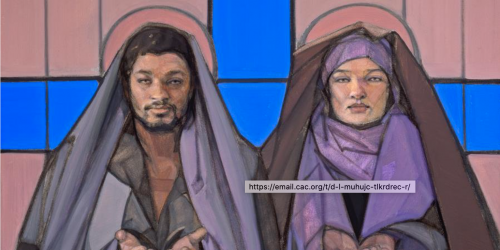
our Universal Christ conference in 2019, artist Janet McKenzie shared her
paintings, including her work “Jesus of the People.” In her presentation, she
shared how rewarding and difficult it can be to disrupt people’s preconceived
notions of who someone is and how they should behave. Our expectations are
often bound by class, race, culture, gender, and in this case, religious
tradition. Any resistance we might feel to changing our perspective of the role
Mary Magdalene played in Jesus’ life or the early church probably stems from
that same discomfort of having our preconceived notions challenged. With that
in mind, I want to share what Janet McKenzie has to say about her painting,
“Mary Magdalene with Jesus, the Christ”—our banner for this week’s meditations.
I
painted Mary Magdalene and Christ seated side by side as visionaries and
spiritual teachers with their hands open in the universal gesture of
prayer—gifts offered and received—as icons of the sacred. Jesus, the Christ,
sent to live among us as the Word Made Flesh, and Mary Magdalene, the first one
sent to proclaim the resurrection, are models for the community of
disciple-companions sent “to the ends of the earth” [Acts 1:8] to tell and
become the Good News for all. [1]
Susan Calef, a
professor of theology at Creighton University, wrote this commentary about
McKenzie’s painting.
The
One Sent: Mary Magdalene with Jesus, the Christ. The very words recall the
climactic scene of the Gospel of John, that of Mary Magdalene’s dawn encounter
with the Secret Gardener. “Mary! . . . Go, tell my brothers and sisters . . .”
(John 20:16‒17). For centuries artists have rendered the scene
familiar: The Risen Christ stands above and Mary kneels below, her outstretched
hand reaching for him as he rebuffs her. “Do not cling to me,” the
image speaks.
In
striking contrast, The One Sent images not a Gospel scene but a vision, a
vision of the Wisdom-Word that dwells in the deep of John’s Gospel. From the
opening words “In the beginning” to its climactic return to a garden, the fourth
Gospel evokes a new creation, worked and signed upon the world by the
Word-Made-Flesh. For those eyed to see by John’s Gospel telling, the image set
before us speaks, not “Do not cling to me,” but “Come and see.” [2]
Spend a few moments simply gazing at
this painting. Is it possible that “Do not cling to me” may not have been a
rebuke but an invitation for Mary Magdalene to see her beloved rabbi and friend
from a new perspective? Could it be that the same invitation applies to us as
well?
One of the lessons we might learn from the Gospel stories of Mary Magdalene is that, in the great economy of grace, all is used and transformed. Nothing is wasted. God uses our egoic desires and identities and leads us beyond them. Jesus’ clear message to his beloved Mary Magdalene in their first post-resurrection encounter is not that she squelch, deny, or destroy her human love for him. He is much more subtle than that. He just says to her “Do not cling to me” (John 20:17). He is saying “Don’t hold on to the past, what you think you need or deserve. We are all heading for something much bigger and much better, Mary.” This is the spiritual art of detachment, which is not taught much in the capitalistic worldview where clinging and possessing are not just the norm but even the goal. In her desire to cling to Jesus and his refusal to allow it, we see ourselves reflected as in a mirror. We are shown that eventually even the greatest things in our lives—even our loves—must be released and allowed to become something new. Otherwise we are trapped. Love has not yet made us free.
Great love is both very attached (“passionate”) and yet very detached at the same time. It is love but not addiction. The soul, the True Self or Whole Self, has everything, and so it does not require any particular thing or person. When we have all things in Christ, we do not have to protect any one thing. The True Self can love and let go. The separate, small self cannot do this. I am told the “do not cling to me” encounter between Jesus and Mary Magdalene is the most painted Easter scene. The artistic imagination knows that a seeming contradiction was playing out here: intense love and yet appropriate distance. The soul and the spirit tend to love and revel in paradoxes; they operate by resonance and reflection. Our smaller egoic selves want to resolve all paradoxes in a most glib way. We only have to look around at all the struggling relationships in our own lives to see that it’s true. When we love exclusively from our small selves, we operate in a way that is mechanical and instrumental, which we now sometimes call codependent. We return again and again to the patterns of interaction we know. This is not always bad, but it is surely limited. Great love—loving from our Whole Selves connected to the Source of all love—offers us so much more.
The ego would like Mary Magdalene and Jesus to be caught up in a passionate love affair. Of course they are, in the deepest sense of the term, but only the True Self knows how to enjoy and picture a love of already satisfied desire. The True Self and separate self see differently; both are necessary, but one is better, bigger, and even eternal.
Story from Our Community: During this global pause, I am navigating a life-threatening illness which brings daily suffering. As I consider the gentle, calm, lifegiving words from James Finley in [a recent] meditation, I am reminded of the power of the breath and each moment even while managing and moving through pain. Inhaling God’s Love in each breath, exhaling love. The atmosphere changes. I am changed. —Michele R.
Faithful
to the End
Wednesday, July 22, 2020 Feast Day of Mary Magdalene
Diarmuid
Ó Murchú is an Irish poet, author, friend, and member of the Sacred Heart
Community. This poem highlights the presence of Mary Magdalene and the women at
Jesus’ death and resurrection and invites us to question why we have not
honored their role more fully. Poetry is so much better heard than simply read,
so for full effect, read these words aloud, perhaps several times.
What
happened [to] the women on the first Easter Day
Breaks open a daring horizon,
Inviting all hearts to discern.
Mid the grieving and trauma of loss,
The horror to stand at the foot of a Cross.
A body we think was buried in haste,
And a tomb that was empty but restless in taste.
Empowering a strange group of women. [stanza 2]
What
happened to those on the first Day of Easter,
The faithful disciples by Magdalene led?
A subverted truth the patriarchs dread.
Beyond all the theories that time has construed,
Beyond the oppression we have too long endured.
The first ones commissioned for Easter proclaim
A woman-led mission we’ve brutally maimed.
But we can’t keep subverting empowerment. [stanza 5]
Resurrection
still flourishes and always it will,
Imbued with a truth that time will fulfil.
What women empowered at the dawning breakthrough
will bear fruit in season
despite all the treason.
’Cos justice will render what deserves to endure.
[1]
Ó Murchú
reflects:
Of
all the Gospel material related to women, none is more enigmatic and empowering
than the role of the women in post-Resurrection space . . . I [wrote of] the
women on Calvary remaining faithful to the end. For those women, it was
anything but an end. Even when the male disciples fled in fear, they remained
to await a new frightening dawn that would propel them into a mission
transcending all other missionary endeavors recorded in Gospel lore. The early
church seemed unprepared for the archetypal breakthrough and proceeded to
consign the women to historical invisibility.
Richard again: I think this is a perfect example of how we cannot see what we aren’t told to look for. For most of history, Christians glossed over the presence of the women at Jesus’ death, burial, and resurrection. We weren’t wrong; we were simply paying attention to what we were told to look at—the men—by other men (priests, theologians, and even the Gospel writers themselves). We skipped over the faithfulness of the women and focused instead on the faithlessness (and the Easter morning foot race) of the men. Mary Magdalene and the other women were the first witnesses to the resurrection because they remained present for the entire process, from death unto new life, exactly what is necessary to witness resurrections in our own lives as well.
One of my favorite things about Cynthia Bourgeault is the way she poses questions that get right to the heart of the matter. Her brilliant scholarship comes from the fullness of her being—body, heart, and mind. Her study of Mary Magdalene is no exception, as evidenced by the questions she asks at the end of this passage. Bourgeault writes:
[After seeing the risen Christ,] Mary went and announced to the disciples, “I have seen the Lord, and this is what he said to me” (John 20:14–18).
It is on the basis of this announcement that Mary earned the traditional title of “Apostle to the Apostles.” The first to witness to the resurrection, she is also the one who “commissions” the others to go and announce the good news of the resurrection. . . .
All four gospels witness to Mary Magdalene as the premiere witness to the resurrection—alone or in a group, but in all cases named by name. Given the shifting sands of oral history, the unanimity of this testimony is astounding. It suggests that among the earliest Christians the stature of Mary Magdalene is of the highest order of magnitude—more so than even the Virgin Mother (mentioned as present at the crucifixion in only one gospel and in none at the resurrection). Mary Magdalene’s place of honor is so strong that even the heavy hand of a later, male-dominated ecclesiology cannot entirely dislodge it.
All four gospels insist that when all the other disciples are fleeing, Mary Magdalene stands firm. She does not run; she does not betray or lie about her commitment; she witnesses. Hers is clearly a demonstration of either the deepest human love or the highest spiritual understanding of what Jesus was teaching, perhaps both. But why, one wonders, do the Holy Week liturgies tell and re-tell the story of Peter’s threefold denial of Jesus, while the steady, unwavering witness of Magdalene is not even noticed?
How would our understanding of the Paschal Mystery change if even that one sentence that I finally heard at Vézelay was routinely included in the Good Friday and Palm Sunday Passion narratives? What if, instead of emphasizing that Jesus died alone and rejected, we reinforced that one stood by him and did not leave?—for surely this other story is as deeply and truly there in the scripture as is the first. How would this change the emotional timbre of the day? How would it affect our feelings about ourselves? About the place of women in the church? About the nature of redemptive love?
And above all, why is the apostle to the apostles not herself an apostle? [1]
Richard again: Let’s hold Cynthia’s questions in our minds and hearts that they might stir us to “epiphanies” of our own on the nature of steadfast love. Mary Magdalene’s love for Jesus shows what it means to have one person hold fast to us in our hour of need, despite the apparent hopelessness of it all.
Today,
Cynthia Bourgeault, a member of the CAC’s teaching faculty, shares an epiphany
she had about the significance of Mary Magdalene’s presence at the death,
burial, and resurrection of Jesus.
I
was spending Holy Week 2005 on a “working retreat” with the Fraternités
monastiques de Jérusalem, the innovative young monastic order in residence at
the basilica in Vézelay [France]. This mixed community of men and women monks
is well known for the imagination and beauty of its liturgy, and toward the end
of the Good Friday liturgy I witnessed an unusual ceremony that changed forever
how I understood my Christianity.
The
liturgy was long and intricate, performed with meticulous reverence by the
brothers and sisters. . . . As sunset fell, one of the monks began to read in
French the burial narrative from the Gospel of Matthew. . . . I allowed the
sonorous French to float by my ears while I drifted in and out, catching what I
could. . . . Out of the haze of words came “et Mary Magdalene et l’autre Marie restaient debout en
face du tombeau . . .”
That’s
when I did my double take. Mary Magdalene was there? That was in the scripture?
Why hadn’t I ever noticed it before?
Thinking
that maybe my French had failed me, I went back to my room that evening, took
out my Bible, and looked it up. But yes, right there in Matthew 27:61 it read:
“And Mary Magdalene and the other Mary remained standing there in front of the
tomb.”
Suddenly
the whole picture changed for me. I’d thought I knew the tradition well. As an
Episcopal priest I’d presided over many Good Friday liturgies, and as a choral
musician, I’d sung my share of Bach Passions. I’d thought I knew the plot
backward and forward. How could this key point have escaped my attention? No
wonder Mary Magdalene came so unerringly to the tomb on Easter morning; she’d
stood by in silent, unflinching vigil the whole time Jesus was being laid to
rest there. Maybe she never left . . . Since that moment I have literally not
heard the Passion story in the same way. It inspired me to go back to the
gospels and actually read the story in a new way. . . .
Like myself, a
great many Christians have absorbed most of what they know about Mary Magdalene
through the dual filters of tradition and the liturgy, which inevitably direct
our attention toward certain aspects of the story at the expense of others.
Mary Magdalene
Love
and Knowing Become One
Sunday, July 19, 2020
This week I’m excited to share another wonderful model of
action and contemplation, Mary Magdalene. One of Jesus’ closest disciples, the
Catholic Church celebrates her feast day on July 22. My friend Cynthia
Bourgeault tells a story about the moment when she told an older priest friend
that she was writing a book about Mary Magdalene. She recounts, “He looked at
me long and hard, as only an old friend can, and then said, ‘Go gently. Try not
to leave me behind.’” [1] I, too, will try to “go gently” in these meditations
on Mary Magdalene, yet at the same time, I want to challenge our preconditioned
and possibly mistaken ideas about who this woman was.
For
over a millennium, Mary of Magdala was misidentified as the woman with the
alabaster jar who was called a “sinner” and who washed Jesus’ feet with her
tears and dried them with her hair (Luke 7:36–50). While we may never know for
certain if those two women were the same or separate individuals, the
conflation has confused Christianity’s view of them. Either way, Jesus shows
both Gospel women nothing but respect, forgiveness, and love.
What
we do know about Mary Magdalene is that she was the woman who was closest to
Jesus. She was “possessed by seven demons” and Jesus healed her (Luke 8:2). She
is mentioned in the Resurrection accounts by name in all four Gospels,
sometimes alone, sometimes in the company of other women. [2] She was the first
to meet the risen Christ. The fact that she immediately went to embrace him is
a testament to the closeness of their relationship, the mutual regard and
affection they must have shared. When Jesus said to her “Don’t cling to me”
(John 20:17), he was indicating that the time for physical closeness was in the
past. Mary’s love had to release the finite in order to reach a more expansive,
spiritual dimension.
Mary
Magdalene is the person in the Gospel who most needs love to be stronger than
death and so she is the first to know it—and perhaps at the deepest level. She
is the first one who symbolically comes to “consciousness,” as it were, of
Jesus as the risen Christ and thus is the clear “witness to the witnesses.” She
is the real knower; in fact, love and knowing have become one in her. Mary is
the archetypal name for all those who have been led by love into awareness of
their True Selves and know its Source.
Mary Magdalene
is the icon and archetype of love itself—needed, given, received, and passed
on. She is a stand-in for all of us who seek an intimate and loving
relationship with the divine. Jesus’ appearance to her first and alone is the
clear affirmation of the wonderful and astounding message that we do not need
to be perfect to be the beloved of Jesus and God.
Everything begins in mysticism and
ends in politics. —Charles Péguy
It seems to me that a
regular practice of contemplation makes it almost inevitable that our politics
are going to change. The way we spend our time is going to be called into
question. Our snug socioeconomic perspective will slowly be taken away from us.
When we practice prayer consistently, the things that we think of as our
necessary ego boundaries fall away, little by little, as unnecessary and even
unhelpful.
Whatever our calling on behalf of the world, it must proceed from a foundational “yes” to God, to life, to Reality. Our necessary “no” to injustice and all forms of un-love will actually become even clearer and more urgent in the silence. Now our work has a chance of being God’s pure healing instead of our impure anger and agenda. We can feel the difference in people on both sides of any issue.
Because contemplation feels
like dying and is, in fact, the experience of the death of our small self, we
can only do this if Someone Else is holding us in in the process, taking away
our fear. If we trust that Someone Else to do the knowing for us, we can go
back to our lives of action with new vitality, but it will now be much
smoother. It will be “no longer we” who act or contemplate, but the Life of the
One who lives in us (Galatians 2:20), now acting for and with and as us!
Henceforth it does not even matter whether we act or contemplate, contemplate or act, because both articulations of our faith will be inside the One Flow, which is still and forever loving and healing the world. Christians would call it the very flow of life that is the Trinity. “We live and move and have our being” (Acts 17:28) inside of this one eternal life and love that never stops giving and receiving. This is how we “die by brightness and the Holy Spirit,” according to Thomas Merton. [1]
Contemplation is no fantasy, make-believe, or daydream,
but the flowering of patience and steady perseverance. When we look at the
world today, we may well ask whether it can be transformed on the global level;
but I believe that there is a deep relationship between the inner revolution of
prayer and the transformation of social structures and social consciousness. We
need only look at the lives of the contemplatives in action that we read about
this week to know that it’s true. Our hope is that contemplation really can
change us, and guide our actions for compassion and justice in the world.
Dorothee Soelle (1929-2003) is an example of a contemplative who finds she must take action. I met her once in Germany at the Kirchentag (an assembly sponsored by the German Evangelical Church) and was deeply impressed. She was a first-rate scholar and noted theological author. I’ve been especially influenced by her book The Silent Cry: Mysticism and Resistance. For today’s meditation, Kerry Walters and Robin Jarrell describe this contemplative activist.
Society’s conventional image of a mystic is that of a person who withdraws from the world in order to journey inward. . . . The mystic is stereotyped as a guru sitting in splendid isolation on a mountaintop, utterly unconcerned with the world’s affairs.
But theologian Dorothee Soelle [Sölle], herself something of a mystic, argued that there’s actually little accuracy in this portrayal. Far from being withdrawn from the world or indifferent to the suffering that goes on in it, the mystic is uniquely motivated and qualified to respond to social and economic injustices. Genuine mystics, like Buddhist bodhisattvas, don’t renounce the world for the sake of a private spiritual illumination. Rather, they use the enlightenment they’ve achieved to do something about the world’s ills.
The reason for this, says Soelle, is that mystics have been liberated from the three powers that typically hold humans in bondage: ego, possession, and violence. They recognize that the standardly accepted division between I and not-I is an artificial one born from overvaluing oneself and competing with others for possessions . . . [which] in turn sets the stage for the “onset of violence.” But the genuine mystic understands that his or her connection with the divine is likewise a connection to all other humans and, indeed, to all of creation—a relationship, as Soelle said, that “borrows the eyes of God.” [1] Patterns of opposition and resistance bred by the division of I and not-I collapse to be replaced by ones of mutuality and community. Violence becomes obsolete, because the conditions necessary for its eruption disappear.
Soelle became interested in questions of religion and politics at an early age. She grew up under the Nazi regime and, like many Germans of her generation, never got over the shame of belonging to a nation that willingly collaborated with mass murderers. She was especially worried by the acquiescence of so many people who claimed to be Christian, and eventually concluded that part of the explanation was that they had compartmentalized their faith, transforming it into a private and “otherworldly” thing. Convinced that such privatization is a perversion of faith, Soelle worked as a theologian to demonstrate the social responsibility of religion and as an activist to put her theology into practice. She became one of the Cold War’s leading anti-nuclear voices, a dedicated opponent of both [U.S.] involvement in [the] Vietnam War and Soviet-style communism, and a proponent of liberation theology. The spiritual fuel of these activities was her conviction that the mystical worldview is revolutionary enough to resist “powerful but petrified institutions” that trade in oppression and violence. Consequently, her “most important concern” was to “democratize mysticism” so that society might be truly democratized as well.
This CO2- (Church Of 2) is where two guys meet each day to tighten up our Connections with Jesus. We start by placing the daily “My Utmost For His Highest” in this WordPress blog. Then we prayerfully select some matching worship music and usually pick out a few lyrics that fit especially well. Then we just start praying and editing and Bolding and adding comments and see where the Spirit takes us.
It’s been a blessing for both of us.
If you’d like to start a CO2, we’d be glad to help you and your partner get started. Also click the link below to see how others are doing CO2.Odds Monkey
Steve Harvey Introduces Jesus To A Secular Audience
About
Change this text in the admin section of WordPress
You are currently browsing the CO2MannaToday blog archives.