Type Six: The Need for Security Thursday, March 12, 2020
Holy Idea: Holy Strength, Holy Faith
Virtue: Courage
Passion: Fear [1]
People who are predominantly type Six have tremendous gifts: they are cooperative, team players, reliable, and loyal. In relationships, one can count on their fidelity. Their friendships are marked by warmhearted and deep feelings. They do their utmost—give body and soul—for the people they love. They are often highly original and witty with a dry sense of humor. Sometimes it takes those around them a moment to catch on to the joke!
Because of their childhood experience, which was often marked by trauma, Sixes have a deep sense of anxiety. They continually sense danger, which makes them fearful and mistrustful. They easily succumb to self-doubt. While most of us experience the aftereffects of a stressful or traumatic event, Sixes feel that kind of anxiety on an almost daily basis. It isn’t the event that has already happened, but the one that could happen at any time that keeps them in a state of high alert.
The lack of genuine self-confidence leads Sixes to look around for authority figures and structures that offer them the security and certainty they crave. At their worst, Sixes can become authoritarians, people who want truth in totalitarian, self-righteous fashion and are loyal to a fault, making choices that are not aligned with their deepest values or wisdom. They often give themselves dangerously to strongmen, hierarchical figures, and absolutely certain groups (fundamentalists) to take away their anxiety.
Sixes used to be categorized into two types: phobic and contraphobic—those who obeyed their fear and those who rebelled against it by taking great risks. But it appears that most Sixes are a combination of both, “playing it safe” or facing their fear head on, depending on the situation. This makes perfect sense according to this description of Sixes from Don Richard Riso and Russ Hudson:
No matter what we say about Sixes, the opposite is often also as true. They are both strong and weak, fearful and courageous, trusting and distrusting, defenders and provokers, . . . aggressive and passive, bullies and weaklings, . . . thinkers and doers, group people and soloists, believers and doubters, cooperative and obstructionistic, . . . —and on and on. It is the contradictory picture that is the characteristic “fingerprint” of Sixes, the fact that they are a bundle of opposites. [2]
Riso and Hudson write this about the emergence of Essence in Sixes:
When their minds become quiet, Sixes experience an inner spaciousness that is the Ground of Being. They realize that Essence is real and is not simply an idea; in fact, it is the thing that is most real in existence, the very foundation of existence itself. People have associated this inner peace with the presence of God, which is manifesting itself at every moment, and which is available at every moment. When Sixes experience this truth, they feel solid, steady, and supported. . . . They realize that this ground is the only real security in life, and it is what gives Sixes immense courage.
This is the real meaning of faith, their particular Essential quality. Faith is not belief, but a real, immediate knowing that comes from experience. . . . Faith with experience brings reliable guidance. [3]
My friend and Enneagram teacher Russ Hudson describes the Head Center, the final Intelligence Center of the Enneagram, in his own unique and “heady” way:
Some of the Eastern religions, particularly Buddhism, did a very thorough investigation of the nature of the Head Center. That’s one of the reasons I think Thomas Merton was drawn to studying certain things about Buddhist practice. What [Eastern traditions] all agree on is the true nature of Mind is complete stillness, silence, and spaciousness. Boundless stillness, peace, clarity, forever and ever, amen. So I would say that the Head Center gives us the possibility of sensing, recognizing the Eternal Presence that’s right here in the midst of phenomena. . . .
There is this process of opening to this stillness, the vast freedom, peace, clarity of the soul, of spirit. . . . You could see your thoughts are happening. [But] what surrounds them and is inside them is this tremendous peace and stillness. And . . . this stillness is not inactive. . . . The stillness . . . brings the sense of knowing, of recognition, of clarity and wisdom. Don [Riso] and I have called it the sense of guidance, where you’re kind of clear it’s not you thinking exactly. It’s like a spontaneous recognition of truth/reality that just comes. You don’t have to plan it. It’s like you just relax and suddenly. . . . Pow. There it is. It’s right in your mind. [1]
Fives, Sixes, and Sevens cannot get their minds to simmer down. This is a problem because the quiet mind allows us to feel profoundly supported: inner knowing and guidance arise from the quiet mind and give us confidence to act in the world. [2]
When you know this Presence directly, you experience it as the ground of everything and especially the ground of you. And when you know that, you know that what you are is just an expression of that, and the core of what you are cannot be harmed or taken away. . . . That presence is the Divine Presence. And it’s not a rumor! It’s not something you have to believe in. . . .
Just land where you are, open to the stillness, and know that what you seek is already here, holding everything you do every step of the way, guiding you, supporting you, in you, around you. You can’t lose it! And it is never failing you.
[The Five, Six, and Seven] in essence are trying to get back to or find this sense of ground, direction, and guidance. That’s what we’re looking for in this triad.
[The Body types] were the “I don’t want to be messed with” types. [The] Heart types were the “See me the way I want to be seen types.” [The Head types] are the “What can I trust?” types. In other words, I’m looking for something to be that orientation, ground, and guidance, which is utterly trustworthy. [3] None of us are the whole Body of Christ, but we each offer part of the Great Gift of God.
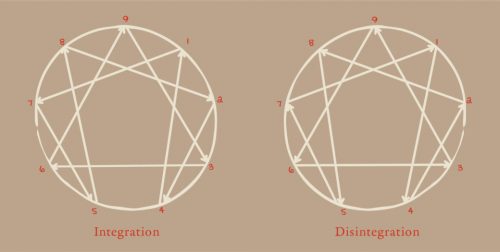
One of the most confusing aspects of the
Enneagram can be the nine lines and “arrows” that seem to crisscross the
Enneagram symbol but are the basis of its foundation and wisdom. In The Sacred
Enneagram, Chris Heuertz explains what these lines mean:
One
fundamental component of understanding [Enneagram] type involves the lines [and
arrows] within the Enneagram’s symbol. These crisscrossing lines show us the
movement of our type when operating in a healthy or unhealthy state.
There
are several schools of thought about the traversing of lines inside the
Enneagram, each with diverging philosophies regarding their implications. For
instance, the Enneagram Institute refers to the lines as the directions
of integration and disintegration; the
Enneagram in the Narrative Tradition refers to them as our Security
Types and Stress Types; the Chilean
grandfather of the modern Enneagram, Claudio Naranjo, used the language Heart
Points and Stress Points; and H. A.
Almaas originated the notion of the Soul Child, which Father
Richard [Rohr] and Sandra Maitri continued to develop. [1]
These
are all different ways of describing the dynamic of each type as it presses
into growth or reverts to patterns of self-sabotage. This is where we encounter
the uniqueness of the Enneagram as a character-structure construct: it offers
both a portrait of healthy and a portrait of unhealthy for each type, and
prompts us to identify honestly where we are functioning on that spectrum. This
might vary from day to day or even hour to hour, but the gift presented to us
is greater awareness that leads to psychological and spiritual growth. . . .
Integration or security allows our dominant
type to borrow the positive traits of another type. For example, a healthy
person dominant in type One integrates or borrows some of the positive traits
of type Seven by relaxing their inner drive for perfection and allowing
themselves to become a little playful and spontaneous. . . .
When
they lose themselves . . . Ones disintegrate toward the Four . . . [and]
believe their own lie that they alone are the only ones who understand and
value excellence—that no one else has the capacity to grasp what is required
for goodness to be actualized in the world.
A
newer theory that I happen to agree with is that our path of disintegration is
that innate
self-survival reflex that stops our fall by reaching out to the
lower-level manipulation techniques of another type as a way of getting our
attention—letting us know we are falling and if we don’t catch ourselves we’ll
“break our arm” or worse.
While
it is helpful to see the full picture of the type from which we borrow in
health, the key for all of us is to focus on health and growth in our [own]
dominant type. To recognize ourselves in integration requires that we accept
the best of ourselves in our dominant type. . . .
Giving
ourselves to this path requires a disciplined cultivation of spiritual depth
accessible only through faithful contemplative practice that brings us into the
transforming presence of a loving God.
If taken seriously and
used responsibly, the Enneagram is a tool that can help us move from dualistic
thinking to nondual consciousness. It helps us recognize and forgive the
paradoxes that we all carry, what we might call our “sins.” The Enneagram shows
us how we continually do things we don’t want to do (our fixations, passions,
and patterns) and can’t quite seem to do the things we want (see Romans
7:15-20).
But the Enneagram also
insists that our virtue and our passion are two sides of one coin. The way to
find our unique gift is often through our flaws. And the way to discover our
flaws is often through our gift. Who would have thought?
Eventually we have to
admit that our mistakes and failures (our “sins”) are our greatest teachers.
The Enneagram taught me that like nothing else in my life. It taught me that
I’m a living paradox. For the first half of my life, even with my theological
training and maybe even because of it, I largely denied that split or avoided
it by confessing my sins too quickly—making them something “out there” I could
get rid of instead of something “in here” from which I could learn.
Most Christians were
trained to think that we would be punished for our sins, but I’ve come
to believe we are punished by our sins. The Enneagram helps me to
recognize the punishment I’m inflicting on myself when I remain unconscious of
the fears and judgments that drive my behavior. When I am not in honest
relationship and present to my whole self, I am much further away from
the Divine Presence who forgives everything.
The work of
spirituality is to make our presence to Presence possible by keeping the heart
space open (through love), the mind space right (through contemplation), and
the body resting in the present moment. Those who are alert and awake in all
these three centers of Intelligence at once can experience Presence. The
Enneagram points out nine particular ways we avoid being present in the moment.
If we deny or
eliminate the mysterious, problematic, negative, or wounded parts of ourselves
or pretend they’re not there, I don’t think we can relate to God very well, because
we will also deny and hide from the mysterious and vulnerable nature of God.
For me, the Enneagram
is about as good a tool as I can find to reveal that we are living contradictions
and we always will be. Don’t try to overcome your contradictions! Learn from
them. Amazingly, that is what makes us compassionate, merciful, forgiving,
sensitive, open-hearted, bridge-building people.
It’s all about love.
It’s not about moral achievements. The goal of the entire spiritual journey is
union in love. And love is not achieved by any performance principle, but it is
something we “fall into” when we are not in full control.
Through the lens of
the Enneagram we have greater self-knowledge and the ability to let go of what
only seems good in order to discover what in us is really good. (Sunday)
Something is clearly
working here, and the enneagram of personality movement seems to be manifesting
the fruits of conscious inner work in ways that are both personally authentic
and statistically significant. —Cynthia Bourgeault (Monday)
Being in touch with
the heart tells us the quality of our existence, tells us how we recognize the
truth. . . . The heart also is the place where we know who we really are. —Russ Hudson (Tuesday)
Twos are healed and
redeemed the more they experience God as the Real Lover and realize that true,
selfless love only comes by sharing in God’s love. (Wednesday)
At their healthiest,
Threes let go of the belief that their value is dependent on the positive
regard of others, thus freeing them to discover their true identity and their
own heart’s desire. —Don Richard Riso and
Russ Hudson (Thursday)
At this [healthy]
stage, Fours no longer need to feel different or special, seeing that, indeed,
the universe has created only one of them, and that they are part of everything
else—not isolated and alone. —Don Richard Riso and Russ Hudson (Friday)
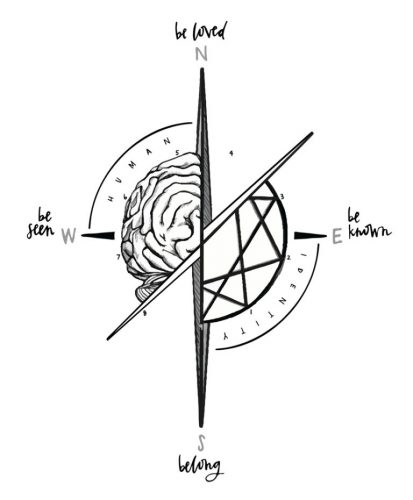
Practice: The
Brain-Based Enneagram
This week’s invitation
to contemplative practice is again drawn from Whole-Identity: A Brain-Based
Enneagram Model for (W)holistic Human Thriving, by Living School student Dr.
Jerome Lubbe. It is certainly a different way of understanding the Enneagram
than I was taught so many years ago, but while the symbol is ancient and
perennial, the wisdom is continually evolving, just like we should be.
“What is your number?”
is the most frequently asked question in regard to the Enneagram. But in the
Brain-Based model, we learn to see ourselves as all nine numbers
simultaneously, and to consider our efficiency in each. For example, instead of
“I am a One” you might say, “I have high efficiency in One,” and then perhaps,
“my Seven nature is strong as well.” That means if you tested as a One you
would not “be” a One but instead would have high efficiency” in the nature of
One. When that is the case, you can further inquire, “. . . and what is
my relationship to the rest of the numbers/natures?” All around the circle, you
witness the efficiency or inefficiency with which you utilize each number and
paint a more (w)holistic picture of your personal neuropsychology.
Efficiency in a number means there is an ease of
relationship with the nature of that number. It means you engage often.
Efficiency by definition is, “accomplishing a task with the least amount of
allocated resources and energy required.” It is important to understand this is
not an indication of health, but of ease of use. Someone who enjoys autonomy is
going to have a high efficiency in Eight, but that doesn’t mean they are
an Eight. They’re multi-faceted. For instance, perhaps they also value clarity
and authenticity, so they’re efficient in Five and Four nature(s) as well. The
analysis should be applied to all nine numbers for a more integrated
perspective of the whole.
Inefficiency in a number means there is less ease in the
relationship with the nature of that number. You don’t often engage. . . .
Accomplishing tasks related to inefficient number/natures requires increased
allocation of resources and utilizes a significant amount of energy. Imagine
the same person who is efficient in Eight struggles to see the value of
serenity. . . . They are likely inefficient in Six and Nine. Instead of turning
Six and Nine away as irrelevant, they can instead expand their capacity. . . .
Every single person
has access to all nine numbers. Based on nature, nurture, and discipline, you
express the values of each number at varying degrees of intensity based on your
lived experience.
You are not one thing;
you are complex and multifaceted; you are interconnected. This is a vital
paradigm shift. When you consider having access to all nine numbers simultaneously,
you increase and expand your capacity for thriving. [1]
Considering what you
know of the Enneagram so far, in what numbers do you experience ease, or in
Lubbe’s language, sense “efficiency”? Where do you feel less efficient? As a
reminder, here are the values Lubbe identifies (as alternatives to “I am”
statements):
Type Four: The
Need to Be Special
Friday, March 6, 2020
Holy Idea: Holy Origin
Virtue: Equanimity, Emotional Balance
Passion: Envy [1]
Fours once lived serenely as an essential part of a
united and beautiful world. But at some point during childhood, the union and
beauty were seemingly broken. So, for much of their lives, Fours desperately
try to create an outer world of balance and symmetry. They put their gifts to
work to awaken a sense of beauty and harmony in their surroundings. They are
highly sensitive and almost always artistically gifted. They grasp the moods
and feelings of other people and the atmosphere of places and events with
uncanny precision.
Fours reject the division of the world into “sacred” and
“profane.” They are more at home in the realm of the unconscious, of symbols
and dreams, than in the real world. Symbols help them to be with and express themselves.
Like others in the Heart center, Fours draw their vital
energy from other people. Their life question is: “What do you think of me? Do
you notice me? Do I catch your eye?” Fours strive to be attractive in some way,
to be exceptional, or, in some cases, to appear eccentric or exotic. Fours
avoid ordinariness. They may panic when expected to look or act like everyone
else.
The life of Fours is primarily shaped by longing—for
beauty, for love, for something lost. They wish that the world and life would
fit together into a harmonic whole. Fours face the temptation to strive
frantically for authenticity. Children, nature, and everything that radiates
originality awakens in them the longing for the simplicity and naturalness that
they lost at some point.
Their root sin or passion is envy. They see immediately
who has more style, talent, and original ideas. They constantly compare
themselves with others, although not necessarily in a selfish way. This
awareness hones their own giftedness.
Fours are better than most types at understanding and
guiding people in psychic distress. They are not intimidated by the difficult,
complicated, or dark feelings of others, since they themselves have lived
through it all. They are perhaps the least scandalized by “sin” in others
because they have learned so much from disorder, asymmetry, suffering, and
failure.
Don Richard Riso and Russ Hudson write:
In the process
of transformation, Fours let go of a particular self-image—that they are more
inherently flawed than others, and that they are missing something that others
have. They also realize that there is nothing wrong with them; they are as good
as anyone else. And if there is nothing wrong with them, then no one needs to
rescue them. They are entirely able to show up for themselves and create their
own lives. . . . At this stage, Fours no longer need to feel different or
special, seeing that, indeed, the universe has created only one of them, and
that they are part of everything else—not isolated and alone.
When Fours abide
in their true nature, they are one with the ceaseless creativity and
transformation that are a part of the dynamics of Essence. [2]
The Three is the central type of the heart group, but this does not mean that Threes manage their emotional world very well. On the contrary, Threes have the greatest difficulties of all the Enneagram types in perceiving their own feelings; at the same time, they are really good at detecting the feelings of other people.
Russ Hudson and Don Richard Riso write:
As children, Threes were not valued for themselves—as very few of us were. Instead, they were valued for being and doing certain things extremely well. They learned to get validation of their worth through achievement and performance. But it never really satisfied them because it was a validation not of them but of something they had done or something they tried to become. [2]
Threes draw their life energy from their successes. Threes are show-people, achievers, careerists, and status-seekers. They are more comfortable in their roles than they are with their True Self, which they scarcely know. They can slip into almost any mask and act the part to perfection because the roles they play protect and motivate them. For Threes, life is a competitive struggle and they want to be winners. Most Threes seem optimistic, youthful, intelligent, dynamic, and productive.
A good friend of mine who is a Three has the nickname Mr. Perfect. Everything he touches seems to succeed. This friend says, “When I walk into a room where there are lots of people, I know in fractions of a second how I have to behave, how I have to appear, how I have to talk to be accepted by everybody present. If I leave the room and go one door down, then I can play the same game and be a completely different person.”
The pressure to succeed that Threes are under leads to their root sin, which is untruth or deceit. In order to win, Threes tend to deal generously with the truth. They seldom tell bald-faced lies; rather, they use subtle nuancing, airbrushing out the problematic side of a project or exaggerating its advantages.
Immature or unhealthy Threes first and foremost deceive themselves. As Riso and Hudson explain:
In the headlong rush to achieve whatever they think will make them more valuable, Threes can become so alienated from themselves that they no longer know what they truly want or what their real feelings or interests are. [3]
At their healthiest, Threes let go of the belief that their value is dependent on the positive regard of others, thus freeing them to discover their true identity and their own heart’s desire. . . . They become self-accepting, genuine, [authentic], and benevolent. . . . When Threes are able to perceive their Essential value directly, they become freed from the ego’s relentless pursuit of self-esteem through achievement. This affords them the time and space to live with a greatness of spirit, a life of love, richness, and wonder. [4]
Type Two: The
Need to Be Needed
Wednesday, March 4, 2020
Holy Idea: Holy Will, Holy
Freedom
Virtue: Humility
Passion: Pride [1]
The heart types—Two, Three, and Four—are “other-directed”
people whose emotional well-being depends on how their environment reacts to
them. The secret goal of their continuous activities is to be acknowledged and
affirmed from the outside.
Twos employ their many gifts to meet the needs of others,
caring for others’ health, nourishment, education, and welfare. They impart a
measure of acceptance and appreciation that can help people believe in their
own value. Twos can share generously and will even give their “last shirt” for
others. They stand by friends and family when they have to endure suffering,
pain, or conflict.
Some Twos recall that early on they had the feeling of
having to support the emotional needs of other family members. They felt they
had to make themselves useful in order to be noticed and loved.
There may have been a role reversal between parent(s) and
child. The child had to “mother” the adults and deny some of their own
legitimate needs. The child got the message: “I am loved when I am tender,
understanding, ready to be helpful, and defer my own needs.” But in this way
the child feels powerful, while grown-ups look weak and needy. This provides
fertile soil for the sort of false pride that is the root sin of Twos. They
secretly look down on those whom they “serve.”
Like all of us, Twos want to be liked, but they also have
an exaggerated desire for external validation. Twos happily spoil and look
after other people, even when unasked, but if their “care” becomes burdensome
or confining and others distance themselves instead of returning this “love,”
the Two feels betrayed and exploited.
The constant and great temptation of Twos is to help
others, and in this way they evade themselves and their own needs. When
immature Twos are hurt, they can suddenly stop being sweet and pliant and lash
out. At such moments they are capable of doing frightful injury to the very
person they supposedly love above all. This is the shadow side of the Two’s
love that may not be recognized at first glance.
Twos are healed and redeemed the more they experience God
as the Real Lover and realize that true, selfless love only comes by sharing in
God’s love. This insight leads through a moment of deep shame to genuine
humility.
Don Richard Riso and Russ Hudson describe what it’s like
for Twos to return to their Essence:
On a very deep
level, Twos remember the Essential quality of unconditional love and the omnipresence of love.
When they remember their Essential nature and the Divine state that it mirrors,
healthy Twos are aware of the presence of love all around them, so there is
quite literally nothing they need to get from anyone—and nothing they can give.
. . . This love is balanced, pure, and nourishing—it allows the soul to relax
on a profound level. [2]
Russ Hudson and I have taught on the Enneagram together on several occasions. As a type Five, his primary Intelligence Center is in his Head, but there is no one whom I trust more than Russ to describe what it means to be in the Heart Center.
What does the heart bring us if we actually do abide in the heart, if we just let ourselves be still, be here? . . . We feel this exquisite sensitivity and delicacy. It’s like the Body establishes “I am. I am here. I exist.” It brings me to . . . the sacred now moment. The Heart then tastes . . . what’s actually here, with exquisite awareness. The Heart knows. . . the taste, the fabric, the texture of this moment.
The heart is the knower of truth. . . . When there is a true moment, when someone’s being authentic and real with you, you know it here in your heart. . . . So being in touch with the heart tells us the quality of our existence, tells us how we recognize the truth. . . .
The heart also is the place where we know who we really are. And knowing who we really are is something wordless. There’s no concept for it. But there is a sense that if you’re actually present with your heart, the magnificent mystery of who you are is just right here. And you know it’s real because it’s true of the other person, too. You are more aware of who you’re with. If I were going to put it in traditional religious language: Anytime I’m here in my heart with another human being, . . . “there I will be also.” It’s true. We can know that directly. . . . [See Matthew 18:20.]
What Twos, Threes and Fours are looking for is attention. If the Body Center is “I don’t want to be messed with,” the Heart Center is “See me the way I want to be seen. See me as I need to see myself.” Psychologically speaking, Two, Three, and Four are looking for mirroring, recognition, validation: “See me and confirm who I want to believe I am.”
When we don’t get the attention and validation, or we get the wrong kind, we have a different emotional reaction. It’s not anger. I’d say . . . it’s shame and hurt.
That deep sense of shame, inadequacy, deficiency, emptiness—like I’m not good enough and I never will be—eats at every ego. The more bravado I see in a person, the more I know that they’re running from this feeling.
How do we cope with that? Well you get three menu choices [the Two, the Three, and the Four]. Three ways to deal with that sense of shame, inadequacy, and hurt inside.
We need to be really kind when we’re looking at this part of ourselves. It takes a lot of patience and gentleness.
Type One: The
Need to Be Perfect
Friday, February 28, 2020
Holy Idea: Holy
Perfection
Virtue: Serenity
Passion: Anger [1]
This is my own type, so it’s easy for me to talk about
it. I just hope I’ve done enough inner work to be able to present a balanced
picture!
Ones are idealists, motivated and driven on by longing
for a true, just, and moral world. They are honest and fair and can spur others
to work and mature and grow. They are often gifted teachers, but they have a
hard time accepting imperfections—other people’s and, above all, their own.
Starting back in their early years they internalized the
voices that demand: “Be good! Behave yourself! Try hard! Don’t be childish! Do
it better!” It is as if they had decided, even then, to earn the love of
everyone around them by meeting such expectations and “being good.” Those
demanding voices within them never fall silent.
Type One children have renounced the development of their
True Selves to please others (in my case, my mother) and earn the love of
people who have sent them the signal “You’re okay only when you’re perfect.”
Ones have the childhood driven out of them; too soon they have to act like
adults.
The search for perfection is the specific temptation of
Ones, and it rules their lives. Ones are always frustrated because life and
people are not what they should be. Ones are conscious of duty and
responsibility and are often compulsively punctual. They are serious people and
seldom tell jokes. They allow themselves relaxation and recreation only when
they have thoroughly and completely finished their tasks. But that seldom
happens because there’s always something or other that could be improved. Above
all, Ones are disappointed by their own imperfection.
Because the world is so imperfect, Ones can be resentful.
At the same time, they avoid acknowledging the anger that often motivates them.
They simply see it as another form of imperfection. They can barely perceive
their own resentments (suppressed anger), but others generally recognize their
sin much more readily than they do. That’s one reason why they need to be in
fellowship with other people.
The special virtue, or fruit of the spirit, that marks
mature persons of any type is always the reverse of the root sin or passion.
The fruit of the spirit of the One is cheerful tranquility or serenity. I hope
I live there now much of the time.
Don Richard Riso and Russ Hudson describe the emergence
of Essence in Ones:
Deep down, Ones
remember the essential quality of perfection.
They know that, at a profound level, the universe is unfolding exactly as it
must. (As in Julian of Norwich’s famous dictum, “All will be well. Every manner
of thing will be well.”) . . .
Staying with
awareness releases a profoundly wise and discerning intelligence that
illuminates all that [they] attend to. When Ones, through patient
self-acceptance and open-mindedness, are able to relax enough to recognize that
this quality is, and always has been, available to them, they become the true
instruments of the Divine will that they have longed to be. [2]
Unlike the strong and often belligerent Eights with whom they share an Intelligence Center, Nines are natural peacemakers. Their gift of accepting others without prejudice makes people feel understood and accepted. Nines can be unbiased arbitrators because they can see and appreciate the positive aspects of all sides. They have an ability to express harsh truths so calmly and matter-of-factly that it’s much easier for others to hear and accept them. We know they mean us no harm.
The temptation of Nines is to downplay their strengths and even belittle themselves. Because they don’t consider themselves important enough to display their talents in front of other people, they tend to stay in the background and cultivate the self-image of not being anything special. They can enter a room and then leave it without anyone taking notice of them.
In distressing situations, Nines often withdraw. The task of Nines consists in discovering and developing feelings of self-worth and their own inner drive.
The gift of the Nine is, surprisingly, decisive action. At first Nines may hesitate and waver, but when they reach a decision, it happens in a moment of utter clarity. Without further considerations, without revision or the least doubt, they know what they want to do, and no one will be able to stop them.
Don Richard Riso and Russ Hudson explain how Nines reconnect with their Essential nature or True Self:
Ultimately Nines reclaim their Essential nature by confronting their Basic Fear of losing connection and by letting go of the belief that their participation in the world is unimportant—that they do not have to “show up.” They realize that the only way to truly achieve the unity and wholeness they seek is not by “checking out” into the realms of the imagination but by fully engaging themselves in the present moment. Doing so requires that they reconnect with their instinctual nature and with their physicality in an immediate way. Often this requires confronting repressed feelings of anger and rage that can be extremely threatening to their ordinary sense of self. But when Nines stay with themselves and are able to integrate their anger, they begin to feel the stability and steadiness that they have been seeking. . . .
Another Essential quality of the Nine is what Oscar Ichazo called “Holy Love.” . . . The Essential love to which we are referring is a dynamic quality of Being that flows, transforms, and breaks down all barriers before it. It overcomes feelings of separateness and isolation within ego boundaries, issues that plague the Instinctive Triad. This is why real love is frightening—it entails the dissolution of boundaries and the death of the ego. Yet as we learn to surrender to the action of Holy Love, we reconnect with the ocean of Being and realize that at our core, we are this Love. We are this endless, dynamic, transforming Presence of loving awareness, and it has always been so. [2]
Type Eight: The
Need to Be Against
Wednesday, February 26, 2020
(Ash Wednesday)
Holy Idea: Holy Truth
Virtue: Innocence
Passion: Lust [1]
My friend Chris Heuertz has a type Eight personality.
Here’s how he describes Eights in his book, The Sacred Enneagram: Finding Your Unique Path
to Spiritual Growth:
Eights are a source of strength and determination, an
initiating and intimidating force of vitality in the world. . . .
You’ll observe Eights being rude or offensive, trying to
get a reaction out of people to see what they’re made of. This behavior is
partly due to their Childhood Wound, an acceleration of maturity as a result of
conflict or harsh environments where they felt they needed to be strong in
order to survive.
The self-survival instinct of Eights informs their Basic
Fear of being destroyed—though I think more accurately it is the fear of not
being in control. . . .
Eights are intense. Eights hate bullies but are the
biggest bullies. Though Eights use their force of personality to try to
convince people of their strongly held opinions, they are not so much emotional
as they are impassioned. Passionate and forceful, Eights are extremists in the
positions they hold, the vocations they’re called to, and the causes they
champion.
The traditional passion of the Eight is lust, not
necessarily sexual lust but more like a lust for intensity, which is aimed
toward everything. . . . Because Eights fear that they will be destroyed, they
overdo everything to make themselves feel alive—even overdoing things that are
harmful to themselves. This often leads to tremendous pain for themselves and
those they love.
Traditionally, the Fixation of the Eight is vengeance,
which is first aimed at themselves. No one can be harder on Eights than
themselves, and in turn Eights can be extremely hard on others—demanding more
than is fair or realistic and making people pay for the ways Eights feel
betrayed by them.
They are intimidating and they know it, but it surprises
even them because inside they know they are using their strength to protect the
vulnerable child within them who never seemed safe enough to grow up. [2]
Don Richard Riso and Russ Hudson describe the emergence
of Essence in the Eight:
When Eights give
up their own willfulness, they discover the Divine Will. Instead of trying to
have power through the assertion of their egos, they align themselves with
Divine Power. . . .
Eights also
remember the omnipotence and strength that comes from being a part of the
Divine reality. The Divine will is not the same as willfulness. As Eights
understand this, they end their war with the world and discover that the
solidity, power, and independence that they have been seeking are already here.
[3]
Richard
again: Because of their passion for justice and truth, healthy Eights often
take the side of the weak and defenseless. For the sake of justice, Eights are
willing to fight the powers that be with every available weapon, and our world
is a better place for it.
This CO2- (Church Of 2) is where two guys meet each day to tighten up our Connections with Jesus. We start by placing the daily “My Utmost For His Highest” in this WordPress blog. Then we prayerfully select some matching worship music and usually pick out a few lyrics that fit especially well. Then we just start praying and editing and Bolding and adding comments and see where the Spirit takes us.
It’s been a blessing for both of us.
If you’d like to start a CO2, we’d be glad to help you and your partner get started. Also click the link below to see how others are doing CO2.Odds Monkey
Steve Harvey Introduces Jesus To A Secular Audience
About
Change this text in the admin section of WordPress
You are currently browsing the CO2MannaToday blog archives.