Carriers of the Gospel
Friday, October 17, 2025
Let us be carriers of the gospel. The gospel of the revolutionary, brown-skinned Palestinian Jew who made it very clear that he didn’t come to be status quo. He wasn’t a chaplain of the empire but a prophet of God.
—Liz Theoharis and Charon Hribar, We Pray Freedom
Rev. Dr. Liz Theoharis and Dr. Charon Hribar describe crises as opportunities to work for justice, as Jesus did:
As our society continues to be engulfed by crises, the time for complacency has passed. From the lack of health coverage for tens of millions of Americans to the tragic death toll of endless wars and environmental disasters; from the assault on democracy to the glaring inequalities laid bare by the pandemic, it is clear we stand at a generational crossroads. This is a kairos moment—a time of crisis and opportunity. In biblical terms, it is a moment when the foundations of injustice are exposed, prophetic voices call for change, and movements for justice take root.
Luke 4:14–30 is known as Jesus’ first sermon, delivered in his hometown of Nazareth. It marks the beginning of his public ministry during a kairos moment not unlike our own…. Jesus announces his mission of societal transformation [quoting the prophet Isaiah]. He proclaims: “The Spirit of the Lord is upon me, because he has anointed me to bring good news to the poor. He has sent me to proclaim release to the captives and recovery of sight to the blind, to set free those who are oppressed, to proclaim the year of the Lord’s favor” (Luke 4:18–19).
Too often, the Bible’s good news is reduced to matters of individual salvation and detached from Jesus’s goal to transform the world. But a close reading of the Bible, including the teachings of Jesus, reveals a vast antipoverty program and social justice mission, which call on us to resist unjust economic practices and build a society in which everyone’s needs are met.
The Freedom Church of the Poor provides resources to empower prophetic and hopeful movements for justice:
Drawing strength from these biblical principles, the Freedom Church of the Poor tradition teaches us to stand up for one another, care for the least of these, and dismantle laws that perpetuate injustice. If we believe that God stands with the oppressed and that Jesus preached liberation, then collective action by those most impacted by injustice is imperative. By taking collective action with and as poor and dispossessed people, we bridge our spiritual convictions and our hunger for transformative change….
In the Freedom Church of the Poor tradition, we envision a world where every life is sacred and every need is met. This vision challenges the normalization of injustice and the valuing of profit over people. Through nonviolent, moral direct action—marches, boycotts, sit-ins, and more—we reject the status quo and reclaim the moral narrative. We create spaces where justice is reimagined and a moral revolution of values becomes irresistible.
_______________________________________________
1.
“On that glad night, in secret, for no one saw me, nor did I look at anything, with no other light or guide than the one that burned in my heart.”
– St. John of the Cross, The Dark Night of the Soul, 3rd Stanza.
The line that gets me is “with no other light or guide than the one that burned in my heart.”
There are whole theologies that I believe are destructive and dehumanizing that not only encourage but make it a matter of piety to disregard our hearts, to discredit the little voice of the genuine within us, to disbelieve what our deepest core might be telling us with sincerity.
Our hearts can indeed be tricked or deceived. I do not discount that possibility. I think one reason this happens is that we do not have many teachers who invite us to listen to the subtle movements within ourselves.
St. John of the Cross’ favorite thing to do was spiritual direction. He found it to be the most rewarding ministry: helping people listen to God for themselves rather than through a proxy— mentor, pastor, or priest.
True spirituality invites and enables people to listen to the Divine for themselves.
2.
“The fly that clings to honey hinders its flight, and the soul that allows itself attachment to spiritual sweetness hinders its own liberty and contemplation.”
– St. John of the Cross, The Sayings of Light and Love, 24.
“Spiritual sweetness” is a term that St. John of the Cross invented. It describes how we each are enamored of and enjoy the things that are next to God, but perhaps not God per se.
I think that one of the most profound wisdoms of St. John of the Cross is that we can become addicted to these forms of “spiritual sweetness.”
It is actually a sign of spiritual immaturity, addiction, or co-dependence that we whine, rage, and question everything as soon as those spiritual sweetnesses are either taken away from us or we find ourselves increasing the effort to try and get the same fix as we used to.
The goal is not to avoid experiencing such sweetness; the goal is to give up our attachment to it. Instead, we can be grateful for when it comes to us and keep on keeping on, even when it does not.
As Meister Eckhart says, we must learn to live, love, and be “without a why,” and stop doing all things for some potential “spiritual sweetness” we might stumble across.
3.
“This change is a surprise to them because everything seems to be functioning in reverse.“
– St. John of the Cross, The Dark Night of the Soul, Book 8.3.
The wisdom of the Dark Night of the Soul is so paradoxical and unsuspecting that it is little wonder it throws people completely off kilter.
When all the world seems to endorse the philosophy that more effort, intentionality, and energy put into something creates a better “return on investment,” St. John of the Cross reminds us that faith has a completely different set of mathematics.
The day may come when it is not more effort that is needed, but less. It is not that we need to engage in prayer more than we need to redefine what we think prayer is. It is not that God is absent because we have done something wrong; it is that God is so furiously present that we are blinded by the sheer volume of activity God is engaged in.
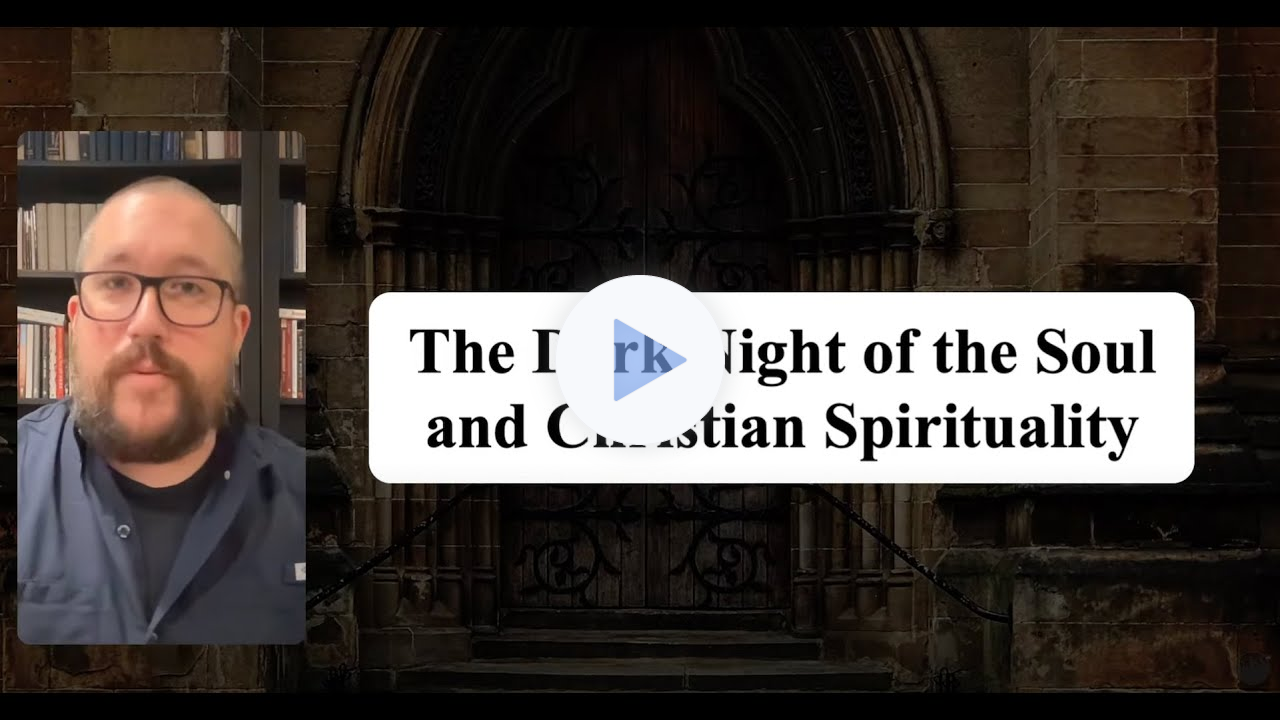
Below is a video I made that explains the Dark Night of the Soul in 4 (or 5) stages. I hope it is a help to you.
4.
“Some spiritual fathers are likely to be a hindrance and harm rather than a help to these souls that journey on this road. Such directors have neither understanding nor experience of these ways.”
– St. John of the Cross, The Ascent to Mount Carmel, Prologue 4.
Man.
I think about this quote often.
It pairs well with the New Testament’s exhortation that not many should take up being leaders because they will be judged more harshly.
There are things I have said from the pulpit that I wish I could take back. The same is also true of my time working at a Christian summer camp. I did not know what I did not know.
Fortunately, the seminary gave a list of names that I should continue learning from after I graduated. And so I did. Not only that, but I began studying outside my home denomination, the Lutheran Church, and turned more toward the Reformers, then the Catholics, then the Patristics, then the Christian mystics, and, more recently, Eastern Orthodoxy.
It is so easy to give bad advice when you are a pastor or priest, and some of that stems from the fact that we are often only taught a small slice of the Christian tradition, when, in reality, there is so much more to it than we ever could imagine.
I was joking with my wife that one of my favorite things about what I do is frequently encouraging people to go back and read the New Testament all over again, or simply giving them permission to dive deeper into this mystery we call “God.”
How wild that my path had such an emphasis on telling people what they needed to know, and now it is so much more about inviting people to listen to their deepest self and to go full tilt into the heart of the Christian tradition for themselves, and to report back to me what they found?
Life is too good to me.
5.
“The soul that journeys to God, but does not shake off its cares and quiet its appetites, is like one who drags a cart uphill.”
– St. John of the Cross, The Sayings of Light and Love, 56.
Note: This does not mean that such a person will not successfully, eventually, journey into God, but that it will involve more struggle, effort, and difficulty.
Which quote jumped out at you?
Reply to this email if one of the quotes above stirred, resonated, or aggravated you!
