Silenced by Shame
Wednesday, March 18, 2026
Author and CAC team member Cassidy Hall reflects on the cost of making choices out of shame and the “toxic silence” it creates:
For over five years, I actively participated in one of the most toxic silences of my life. I was in a romantic relationship with someone who wouldn’t publicly date me because they weren’t open about their sexuality. At the mercy of someone else’s comfort—or lack thereof—I participated in a silencing of myself in public places, around family members, with friends, at work, even at the grocery store…. This kind of silence, brought on by shame, creates long-lasting damage and knots to be untied for years to come. Silence where love cannot prevail is a place of toxicity, a place of stunted existence.
Hall describes the positive effects of “loving silence” cultivated through contemplative practice:
We need to name toxic silence as the silence that causes harm, shame, minimization, and damage to our world. And we need to name loving silence as the silence that is generative and creative, a silence that deepens our unity with self and others—the kind of silence that cultivates a more expansive and loving world….
When I finally stepped away from that relationship’s hamster wheel of toxic silence, I began to see how I had silenced other parts of myself. Beyond the ways I was hiding my sexuality, I also hid parts of myself informed by intuition—places of creativity and aliveness, places of openness and community, places of clarity and calm—ultimately the places where a loving silence thrived….
In the Christian context, the toxicity of silent bystanders creates and feeds countless acts of violence: the sexual abuse in many church settings and its continuation through empty apologies; Christianity’s lack of reckoning with its history of colonization; denominations’ refusal to honor and elevate the leadership and dignity of women, people of color, refugees, people with disabilities, and people from other marginalized communities; churches filling with Christian nationalism and white supremacy culture; the countless times the silent acceptance of bad theology has caused an LGBTQIA+ person to hate or harm themselves; and more. This is the silence of harm, violence, shame, and toxicity….
Toxic silence is embedded in the fabric of our daily lives…. Yet a [contemplative] loving silence can also be pursued, and we can seek and find it even in the chaos of our days. Sometimes it seeps in with our efforts to repeat an internal mantra or take an intentional pause, and other times it pours in like the colorful morning light through the east-facing window. This is the contemplative silence I continually seek and practice. This silence regenerates, regulates, allows for the emergence of loving presence and action. The more we engage in the silences that aren’t toxic—the beautiful, loving, and infinite possibilities of silence—the more we encounter silence as a creative, generative force and not a destructive one.
Is Jonah a historical book? Does it need to be?
| BRADLEY JERSAKMAR 18 |
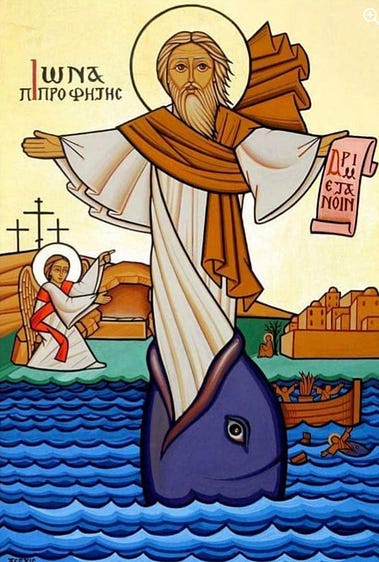
I was grateful for another fascinating discussion with Pete Enns in my “Peace and Violence in the Old Testament” class today at SSU/JFI. One intriguing topic was around legend vs. history in books such as Jonah.
Jonah is a wild ride. I love that book and have some opinions.
Let’s start with a caveat, echoing Pete’s humility. I’m fairly convinced of many things I don’t actually know for a fact to be true. Convictions I don’t feel the need to prove to myself or others with certainty. When it comes to biblical interpretation, I certainly don’t require my friends, colleagues, or students to agree with me. So I won’t impose a theory of Jonah on others as dogma. So I present these thoughts as a thoughts and as a fellow learner.
Is the Person or Book of Jonah History?
One common question: When the NT preachers or authors (Jesus and Paul especially) reference OT characters like Adam or Jonah, did they think they were historical figures? And if they weren’t historical stories, does that negate their argument? And when Jesus associates his resurrection with ‘the sign of Jonah,’ what if Jonah didn’t literally rise from the dead? Even if the story were historical, the prayer from the sea creature still seems obviously poetic. In fact, I don’t know any conservative scholar (even literalists) who argue that Jonah died and was resurrected—even though the song reads that way.
Here is the text from Jonah to which Jesus refers:
Jonah 2:3, 7 “I cried in my affliction to the Lord, my God, and He heard my voice; out of the belly of *hades* [not just the sea creature]: You heard the cry of my voice. I descended into the earth, the bars of which are *everlasting barriers* [supposedly!]; YES let my life ascend from corruption, O Lord, my God.”
Jesus calls this the sign of Jonah. That he would descend to hades and ascend again, puked out from its embittered belly, its so-called *everlasting* [αιώνιοι!!] barred gates be damned… a great text to show how ‘eternal hades’ is undone by the Resurrection).
I don’t think Jesus needs to take Jonah’s poetry literally to make his point about the resurrection. And if Jesus doesn’t need to take Jonah 2 literally, do we need to read the book historically?
Some go so far as to say that if Jonah (or Eden, or Noah, etc.) is a Jewish moral legend, that undercuts my belief in Jesus’ actual resurrection. Does it?
The More-than-Literal Point
I was once very into apologetics (mistaking it for evangelism) and this was all very troubling. I wasted a lot of time trying to find biological evidence of a fish that could swallow a man and spit him out alive for three days. Meanwhile, I missed the more- than-literal point that God is making through Jonah. Which is? That the Jewish revelation that God is gracious, compassionate, slow to anger, and abounding in lovingkindness extends even to our most hated enemy. And at the time, Assyria was at the top of the list. I was inclined to play my apologetics games far more than taking up the cross of loving my enemy. Just like Jonah.
Now, whether to read the story as literal history… we can. But I don’t think we need to be faithful. Whatever Jesus thought about the story, he was already reading the song creatively as poetic prefigurement (foreshadowing his resurrection) to make his point. I see no problem with that. Could Jesus’ point be this simple?
“Just as in the Jonah story, where the song from the sounds like a resurrection,
that language anticipates something surprising I’m about to do in real life.”
It would be a little like me saying to my son (a big Lord of the Rings fan),
“I am going to be at your apartment next month, on this date, for sure. Count on it. Just as Gandalf showed up at dawn for the Battle of Helm’s Deep, expect me to arrive at your place Tuesday morning.”
I’m symbolically referencing a fictional story my son knows and loves. I’m doing so symbolically to illustrate my assured and actual arrival.
- He gets the reference.
- He does not feel the need to remind me that the LOTR is not historical.
- The reference does not raise any doubt that my arrival will happen as promised.
- Whether the Jonah is history or legend has no impact on the promise.
- But neither would I feel any need to prove Jonah IS fictional.
This is where we could learn from Jewish rabbis today. Those I’ve engaged roll their eyes at Christian modernists (liberal or conservative) who obsess over what ‘really happened.’ At last, the right use of the phrase “moot point.”
On Shrines
One student wisely brought up shrines. They are an excellent illustration.
Yes, there is a tomb of Jonah. My student had been there. I haven’t. But I have been to the tombs of the patriarchs at Hebron (Abraham, Sarah, Isaac, Rebekah, Jacob, and Leah). And I’ve also been to the resting place of Mary the Mother of Jesus… both shrines (Gethsemane and Ephesus). I felt the holiness of accumulated devotion in those spaces. But I’m not at all sure that they were buried there. And I don’t need to be. As shrines to their memory, they tell a story. And over time, they have become sacred space where we can experience the beauty and power of their lives (or at least their story).
My Shift
So a shift happened in me along the way. It didn’t occur overnight. But as a young Evangelical with a modernist bent toward literalism, I feared (and was taught to fear) that if I discovered the earth was over 7000 years old, or if the Garden of Eden isn’t somewhere in Iraq, or if Noah’s ark didn’t actually sit on Ararat, or if Job and Jonah were legends, I would diminish or even lose my faith. The motto was, “If the waters did not cover Everest, Christ is not risen.”
No. That doesn’t follow. And weirdly, I didn’t lose my faith—only my ill-gotten certitude. Even better, God got bigger and more mysterious and filled me with more and more wonder … and the Bible became a more intriguing adventure and far richer treasury … and my trust grew dramatically when I didn’t have to believe God slaughtered all those people across the Bible’s pages. The barriers to experiencing Scripture as a place of encounter and communion with God were removed.
And just as importantly to me, when my dear Baptist mom sits in her armchair reading these stories for strength, comfort and encouragement, believing she is immersed in the Word of God, now I know she is. I don’t have to mess with that experience because that IS how the Bible is to be read—as a venue for encounter and communion with and by the Spirit of Christ.
Did Jonah happen? I don’t know.
Is Jonah true? Absolutely.
=========
Individual Reflection Hall talks about how stepping out of one silence revealed other places she’d been hiding. Where have you been living in a silence that feels like safety but is actually a slow shrinking — and what part of yourself has been waiting on the other side of it?
Group Discussion Jersak says he didn’t lose his faith when he loosened his grip on literalism — he lost his “ill-gotten certitude,” and God got bigger. Where has your own faith required you to give something up that you thought was holding it together — and what did you actually find when you let it go?
