Wednesday, June 3, 2026
Everyone carries their own true self in their own way, in their own words, and in their own time.
—Cassidy Hall, Queering Contemplation
CAC team member Cassidy Hall reflects on our impulse to ask questions of those we see as fundamentally different than us:
“When did you know?” “How did you find out you were queer?” “When did you first realize you liked women?”…
We usually ask questions like this—and sometimes over-ask them—because we’re seeking our own comfort or self-understanding. Our questions might come from pondering the vastness of the Divine’s image upon, within, or all around us. But I’m all too familiar with the harm of certitude, assumptions, and internalized dispositions toward norms and expectations.
Even if we let go of the need to know or understand, our society still obsesses about naming, claiming, and defining. As I worked on my documentary film about Thomas Merton, I listened to audio clips of his stream-of-consciousness thoughts from his hermitage, and I especially resonated with this line: “I know in my heart that I do not need to be defined, I do not need to define myself, and yet I have this allergy of definition.”
Like most of us, I’ve spent a large chunk of my life figuring out, naming, and identifying the things around me…. But when we reach to trap anything in definition, we also trap ourselves. A desire to define or know does not give me permission to ask questions simply to satisfy my own curiosity. Rather, the desire to name, define, or identify is a different invitation altogether. It’s an invitation for me to examine and hold openhanded my own definition, my own name, and my own identity, over and over again….
We are ever evolving, ever becoming, and ever unfolding. Identity is an ever-moving target, and any conviction that the self is singular or fixed is limiting and often even harmful. Instead, we can hold what we think we know about ourselves with open hands. We can allow ourselves to become, which offers us room to breathe and blossom…. Contemplative life beckons us to the same: encouraging us to loosen our grip on ourselves, those around us, and the Divine.
Hall encourages us to seek a deeper understanding of ourselves:
Knowing is elusive and closes down potentials outside of certitudes or declarations. What’s more true, more curious, and more exciting is the infinite deep dive into who we are as ever-changing human beings. For those of us who are allergic to definitions: Can we turn inward to unfold our own becoming and blossoming?
This stepping into the spaciousness of our own being will help us hold questions, and also invite questions in. Our curiosity can run wild in the spaciousness of possibility. The infinite expanse of who we are is a place to offer our own unfixed and unmixed attention, a place of prayer, a place where the contemplative life thrives.
=====================
THE STORY. from Dianna Butler Bass
The parable itself is found only in Luke 10: 25-37:
Then a lawyer stood up to test Jesus. ‘Teacher,’ he said, ‘what must I do to inherit eternal life?’ He said to him, ‘What is written in the law? What do you read there?’ He answered, ‘You shall love the Lord your God with all your heart, and with all your soul, and with all your strength, and with all your mind; and your neighbour as yourself.’ And he said to him, ‘You have given the right answer; do this, and you will live.’
But wanting to justify himself, he asked Jesus, ‘And who is my neighbour?’
Jesus replied,
‘A man was going down from Jerusalem to Jericho, and fell into the hands of robbers, who stripped him, beat him, and went away, leaving him half dead.
Now by chance a priest was going down that road; and when he saw him, he passed by on the other side. So likewise a Levite, when he came to the place and saw him, passed by on the other side.
But a Samaritan while travelling came near him; and when he saw him, he was moved with pity. He went to him and bandaged his wounds, having poured oil and wine on them. Then he put him on his own animal, brought him to an inn, and took care of him. The next day he took out two denarii, gave them to the innkeeper, and said, “Take care of him; and when I come back, I will repay you whatever more you spend.”
Which of these three, do you think, was a neighbor to the man who fell into the hands of the robbers?’ He said, ‘The one who showed him mercy.’
Jesus said to him, ‘Go and do likewise.’
WHAT IS THIS STORY ABOUT?
How would you explain this story to someone who had never heard it before? What’s the point? Is there more than one point?
Do you like the story? Do you not like it? Does it puzzle you? Anger you? Make you resentful? What emotions does it stir? Be honest!
THE STORY AND YOUR STORY
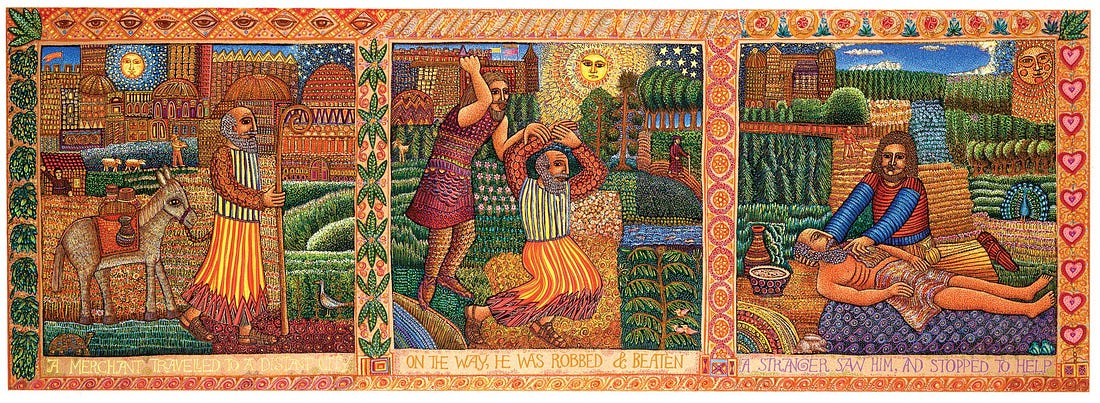
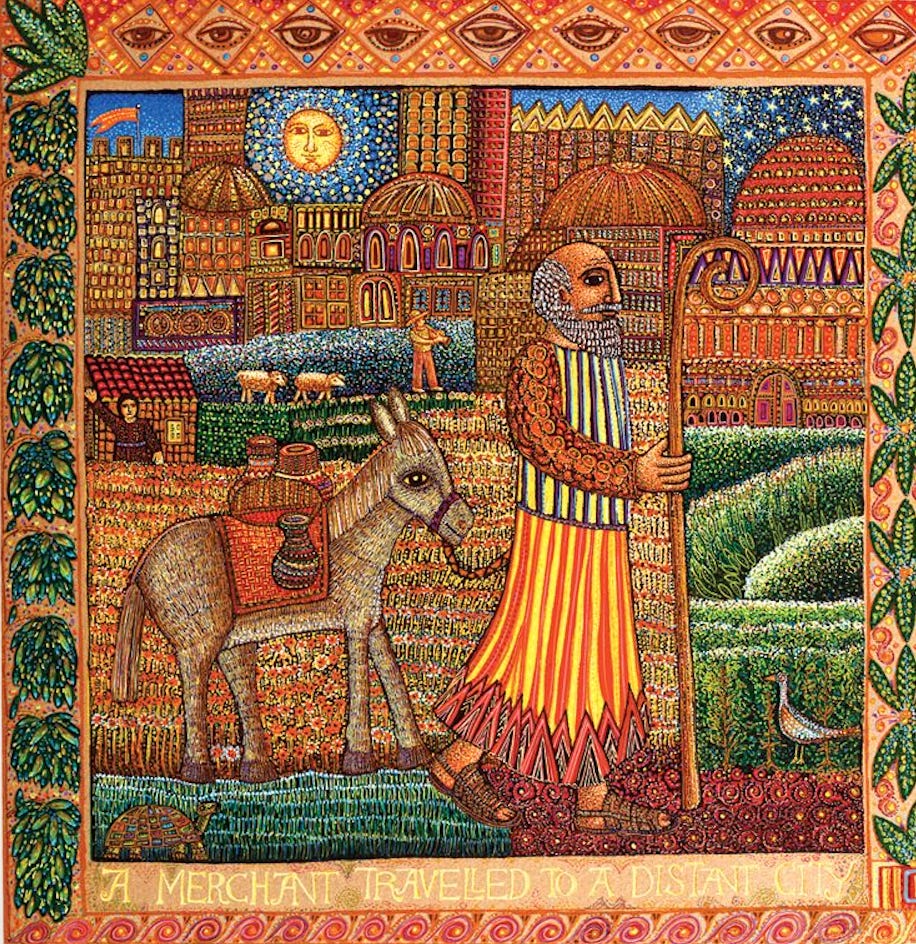
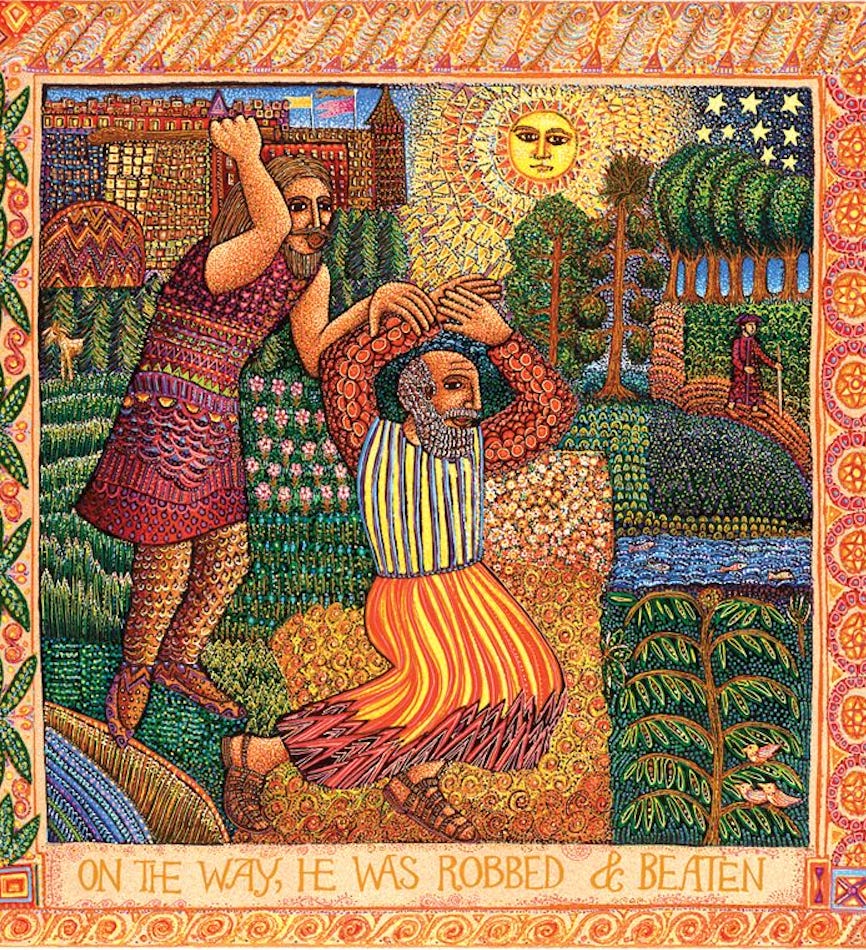
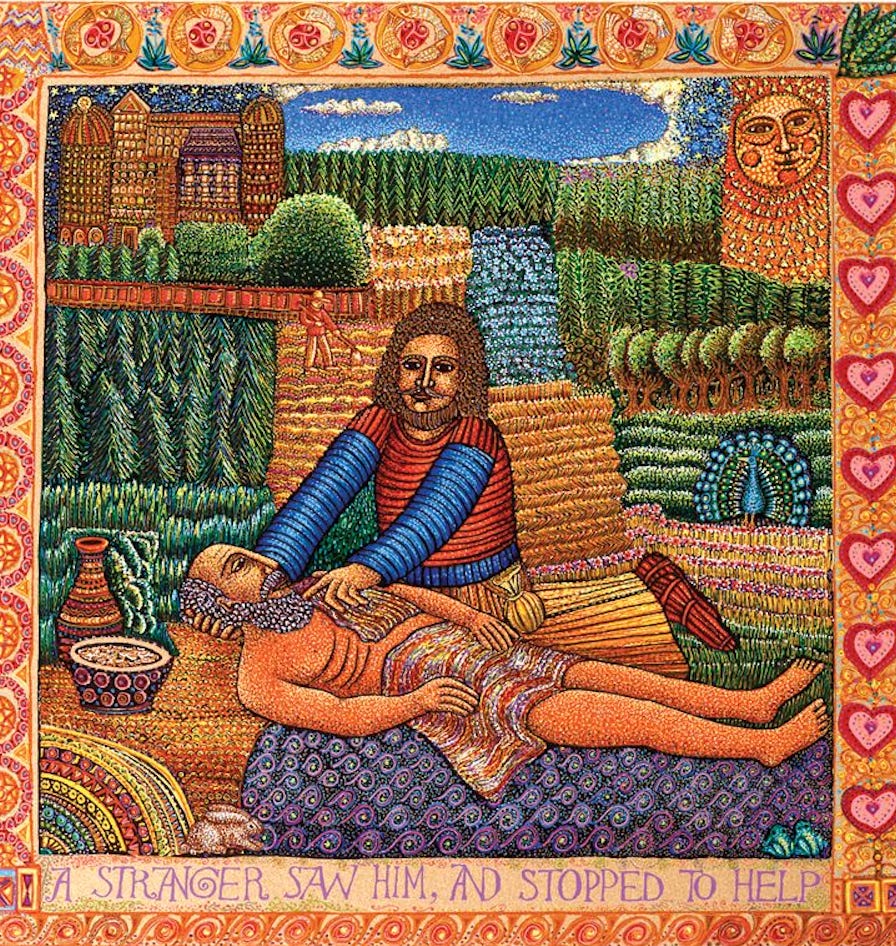
Below is a download of the late John August Swanson’s triptych, “Good Samaritan.”
The triptych is followed by close-ups of the three panels. Swanson first painted the Good Samaritan in 1970. This version was done 32 years later, repainting it as a mature work in a story that he felt called to revisit: “It is remarkable that one can discover many new ideas in an old and familiar story. Sometimes it is necessary to take a long journey to rediscover earlier creative ideas that are so personal and connected to one’s history.”
WHAT DOES THIS STORY MEAN TO YOU NOW?
A few questions to consider: Have you ever been a good Samaritan? One of the passers-by? Or, have you been the person in the ditch?
Do you resonate with John Swanson’s experience of revisiting an “old and familiar story”?
How has your understanding of this story changed over the years? What stands out for you differently today than at other times in your life? As you re-read it or listen to my reflections on it, what surprises you? Is there something you’ve never noticed before?
THE STORY AND OUR STORY
Last Friday, John Dominic Crossan joined with the paid subscriber community in an online conversation about the parables. We focused on how the parables challenged empire, how they present an alternative to Christian nationalism, and how they widen our vision toward evolutionary — and revolutionary — possibilities for a sustainable, non-violent future for humankind.
In his book, The Power of Parable, Crossan wrote:
My conclusion is that the Good Samaritan was not intended by Jesus as a simple example story, a straightforward moral lesson, a positive paradigm for compassionate behavior. The story presumes that compassionate help is the proper response…. Rather, it is better understood as a challenge parable, a story that challenges listeners to think long and hard about their social prejudices, their cultural presumptions, and, yes, even their most sacred religious traditions.
HOW DOES THIS PARABLE CHALLENGE YOU — AND US — AT THIS SPECIFIC MOMENT IN HISTORY?
What do you think about Crossan’s view of the Good Samaritan? Does it resonate with my reflection? With your experience?
Would you rather this be a “simple example story” or, as Crossan suggests, a challenge? What is most challenging for you? For our communities? What’s the challenge for NOW?
What does this parable say to the global rise of authoritarianism and Christian nationalism?
INSPIRATION
An example parable may be good, a challenge parable is a far more importantly subversive operation. Why? Because challenge parables humble our prejudicial absolutes, but without proposing counter-absolutes in their place. They are tiny pins dangerously close to big balloons. They push or pull us into pondering whatever is taken totally for granted in our world.
— John Dominic Crossan
People say you should be a good Samaritan.
You can’t.
Samaritans were despised outsiders.
Good or not,
you have too much privilege to be a Samaritan.
That’s for the queers, the immigrants,
the trans, the blacks, the homeless.
You can be good,
you can be generous to strangers,
even to your enemy.
But you are not the hero of this story.
You can’t be.
You’re the one in the ditch.
Your neighbor is the other one.
You call them rapists and they pick your fruit.
You call them shiftless and dangerous
and they build your economy.
You abhor them and they bless you.
Stop making it about you.
Confess your dependence.
Receive your neighbor’s grace.
Be humbly grateful.
Let yourselves be neighbors.
— Steve Garnaas-Holmes, “Good Samaritan”
On the parable of the Good Samaritan: I imagine that the first question the priest and Levite asked was: “If I stop to help this man, what will happen to me?” But by the very nature of his concern, the good Samaritan reversed the question: “If I do not stop to help this man, what will happen to him?”
That’s the question before you tonight. Not, “If I stop to help the sanitation workers, what will happen to my job. Not, “If I stop to help the sanitation workers what will happen to all of the hours that I usually spend in my office every day and every week as a pastor?” The question is not, “If I stop to help this man in need, what will happen to me?” The question is, “If I do not stop to help the sanitation workers, what will happen to them?” That’s the question.
Let us rise up tonight with a greater readiness. Let us stand with a greater determination. And let us move on in these powerful days, these days of challenge to make America what it ought to be. We have an opportunity to make America a better nation.
― Martin Luther King Jr., “I’ve Been to the Mountaintop” April 3, 1968
=============
Individual Reflection
Where in your life are you currently more like the priest or Levite — not out of malice, but because stopping would cost you something?
Group Discussion — choose one:
Who in your world right now is “the Samaritan” — the one you’re tempted to dismiss but who may be carrying something you need?
What would it mean today to hold your identity — your sense of who you are and what you stand for — with open hands rather than as a fixed possession?
Crossan says the parable doesn’t replace one absolute with another, just punctures the balloon — what balloon in you needs puncturing right now?
