Thursday, June 4, 2026
The Rev. Dr. Jacqui Lewis reflects on the liberating impact of receiving unconditional love:
If you are a parent, you’re present at important moments of discovery and growth all along the way…. You get to be wise and also glean wisdom from that person forming right before your eyes. Watch, observe, see what is becoming; celebrate the mystery of what is unfolding. Guide as best you can, to keep your child safe, while creating a brave space where they can experiment and become…. Your love—your lavish, fierce love, will surround your child with permission and confidence to be their best self. He will bask in your love; it will morph into love for his own unique and wonderful self. Your love, taken in deeply, will enable your child to stand on his feet and say, “I am enough; I am loved.”
In any relationship, fierce love causes us to cross boundaries and borders to discover one another, to support one another, to heal one another. When we do this, when we go crazy with affection, and offer wild kindness to our neighbor across the street or across the globe, we make a new kind of space between us. We make space for discovery and curiosity, for learning and growing. We make space for sharing stories and being changed by what we share. This is the space of the border, of mestizaje, of both/and. It’s the kind of space where we can enhance our knowing with what the other knows; we can develop this kind of knowing, which W. E. B. Du Bois called “double consciousness.” We can learn to see the world not only through our own stories, through our own eyes, but also through the stories and worldview of the so-called other. This is the kind of space that changes us, that grows empathy, this is ubuntu…. We simply must open our eyes, look across the room, the street, the division, the border—and reach out to that neighbor, offering our hand, our compassion, and our heart.
Lewis acknowledges that it can be a struggle to love even those closest to us when they do not conform to our expectations:
You know what might be the riskiest, most uncomfortable, heart-expanding, border- crossing work of all? Loving those impossible people who are related to you might be what tests you most. Right there in your home, where your closest neighbors live, are folks who can get on your last nerve. Your teenaged child, who is conflicted every day about who she is, so much so that you want to throttle her. Your back-in-the-nest-again son, who can’t afford his own place…. Your spouse, who is showing you parts of their personality that make you want to pack your bags and leave…. These intimate neighbors also need to be loved. Even though you disagree with them, even though you can’t fix them, when you love them across the borders of difference, when you hold them with grace, you are loving them fiercely
============================
The Doctrine of the Trinity is a Mighty Angel
a post-script homily for Trinity Sunday
| CHRIS EW GREEN JUN 4 |
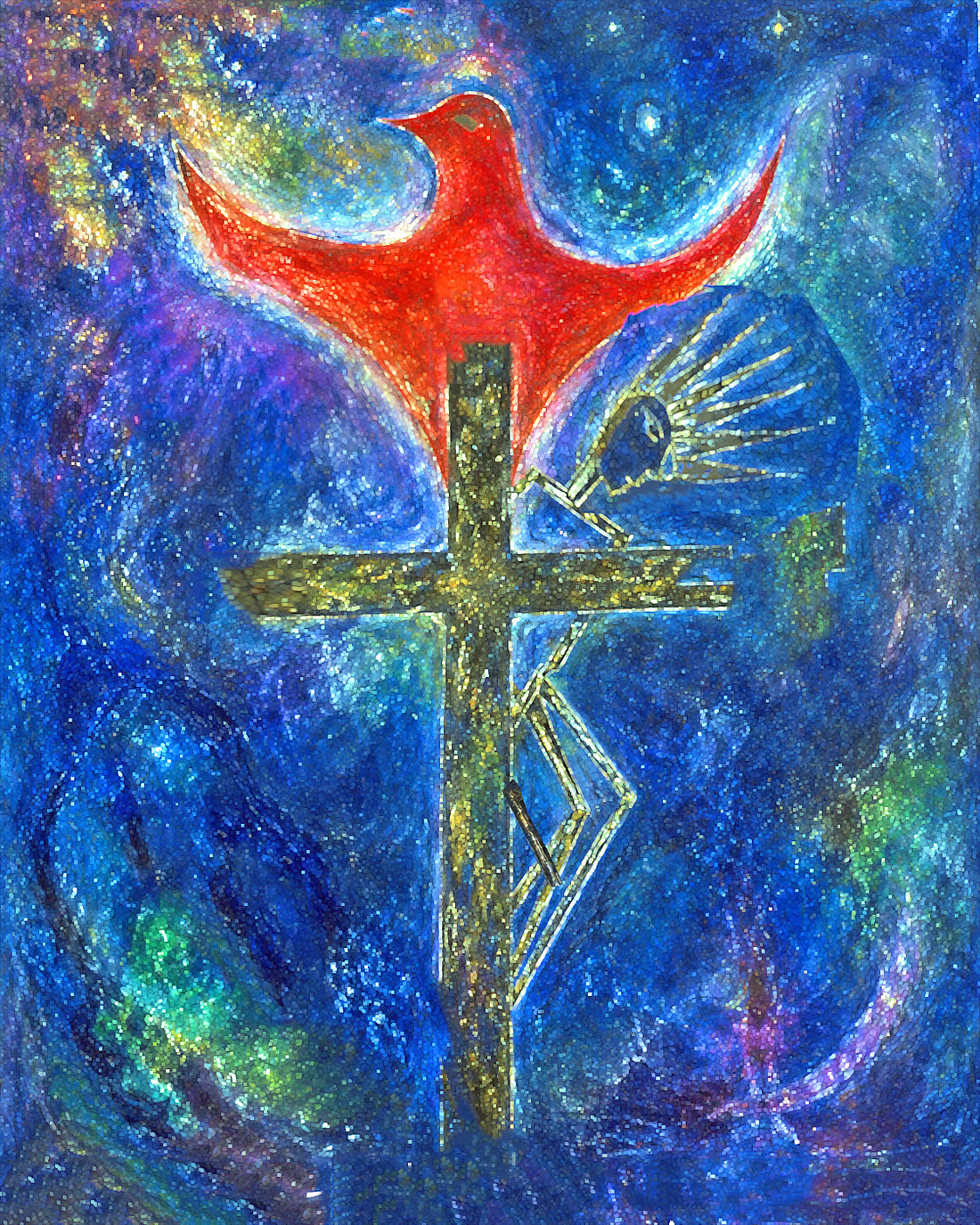
In the Name of the Father, of the Son, and of the Spirit.
In her funny (and not-so-funny) book, An Unauthorized Guide to Choosing a Church, Carmen Renee Berry offers this (cringe) account of the much-misunderstood doctrine of the Trinity:
In the Old Testament God’s identity was clear—there was one and only one God—the God of Abraham, Isaac, and Jacob. With the appearance of Jesus, and later the Holy Spirit, the Christian concept of God got a little more complicated. Christians retained the “one God” idea from Judaism, but now had three variations of God to deal with.
Berry is convinced that no one “really understands the mystery of divinity in general, let alone fully grasps a three-in-one God.” Everyone struggles to hold “irreconcilable concepts in perfect balance.” Yet Christians have no choice, ultimately: “this unfathomable God is at the heart of Christianity—an unsolvable mystery who asks for our devotion.”
To cope with this, Christians default, Berry suggests, into identification with one member of the Trinity or another. That should not be surprising, because “it’s just human nature to have a favorite.” So, she argues, the surest way to find out which church suits you best is to see if their “Trinity affinity” matches your own. Some (Episcopalians, for example, and Methodists) will speak mostly to and about God, not Jesus or the Spirit. Others (Evangelicals, especially) will be Christ-centered. Still others—the Pentecostals, surprise, surprise—will focus their attention mainly on the Spirit.
This is all wrong, of course. And not only theologically. Sociologically, it distorts the lived truth of each tradition beyond all recognition. But it does gesture toward something we all sense, I think, although it too is wrong. We have been left to feel the doctrine of the Trinity is hopelessly complex—and entirely beside the point, anyway. Not just unnecessarily difficult but flat-out unnecessary. Extra. Something for scholars to worry over, while those in real ministry attend to truly important matters. But what if the doctrine is neither nonsense nor excessive, of concern only for intellectuals and heresy-hunting theobros? What if it’s the rule of faith, necessary and life-giving?
Today’s Gospel reminds us that Jesus says we are to use this name to form the Church. And today’s Epistle is sealed with the same blessing: “the grace of the Lord Jesus Christ, the love of God, and the communion of the Holy Spirit be with you all.” I suspect such uses seem to us mere formalities, flourishes—something fancy added on to make whatever we’re doing seem important. But again: what if not?
The doctrine of the Trinity is not a mystery. It is a witness to, a servant of the mystery. It is an angel with a golden trumpet and a flaming sword, announcing the arrival of God, guarding the way so that we do not turn away from God to our own hurt.
Despite what Berry said, then, to talk about the Trinity is not to try and fail to hold together irreconcilable ideas; it is to direct our attention toward the one who holds all things together and reconciles them in himself for good. Remember: this doctrine is not something we devised for ourselves. It is the way the Spirit and the Church have given us of talking about God, so that we know what it means to have been befriended by Christ, claimed by his love.
God cannot be explained. But God can be experienced. Indeed, we are never not experiencing God. If for a moment God were to cease being there for us, we would cease to be at all—cease ever to have been. So, when we say God is mystery, ineffable and incomprehensible, we are not speaking nonsense about God; we are reminding ourselves that there is so much sense to God that we could never say it all. And in that way, we are reminding ourselves of our own essence. We are remembering that we are not God, that we do not and cannot create ourselves or make ourselves good. And we are remembering that we do not need to do any of that—life and all that is good about life is given to us freely, lavished on us in love, simply because God rejoices to share it with us.
We are also saying that God’s goodness and delight are almighty—wholly unconditioned and therefore wholly unconditional. And by confessing that, we are reminding ourselves that nothing can keep God from being God for us. God is beyond being, beyond knowing, beyond every name that can be named, angelic or human, infinitely exceeding all that is and all that could be, real or imagined, an infinite number of times. Eriugena, wonderfully, says that even God does not know what God is, because God is not a “what,” not a something, not even the greatest of all somethings. God is, as Nicholas of Cusa says, Not-Other—not a being in contrast with other beings, but the beginning, middle, and end of all beings from beyond being—inconceivably good, indescribably generous, inexhaustibly merciful and compassionate, exceedingly, abundantly beyond all we could ever ask or think. All to say: we cannot get our minds around how it is that God is God. But we can touch and be touched by him. Indeed, in a moment, at the altar, he will kiss us.
It is in this sense that the doctrine is an angel with a flaming sword. We are, as Nicholas Lash says, tempted to make idols of what we cannot understand, of what lies beyond the reach of our grasp or even of the darkness itself. And we are tempted to make idols of what we do understand, of the mastery and control our knowledge affords us—the light we consider our own. And we are tempted to worship the natural order, its beauty or its terror. But the rule of faith, standing sentinel, keeps us from idols. It will not let us settle for regarding God as sheerly “Father,” or “Majesty,” or “Other,” utterly unlike and beyond us; or as only “Son” or “Friend”—near to us, in our likeness; or only “Spirit,” the wild, ungovernable forces that energize and overwhelm us, carrying us away from ourselves, bringing life and death to bear on us suddenly. Instead, the doctrine of the trinity, that ministring spirit,
prevents us from fixing our eyes on these shadow-figures, turning us away from the lure of false gods back onto the path God has taken ahead of us into the dark.
It does so by directing our attention to Jesus Christ. He is not one-third of God, doing part of what God wants done, leaving other things for the Father and the Spirit to do, each in their own way. He is the fullness of God, very God of very God, Light from Light, consubstantial with the Father. And he fulfills God’s will fully. He is the one to say both “Let there be” and “It is finished.” There is nothing in him, nothing, that is not identical with the Father in every way. Seeing him, the one who does only what he sees the Father doing, we see the Father. Can you see that that, finally, is what the doctrine of the Trinity is for? It teaches us that there is no God other than the God we meet in the life of this man from Galilee, shuddering his last breaths out on that Roman tree.
So, no, the coming of Jesus and the outpouring of the Spirit do not muddy the clear picture of the God of the Old Testament. They open up for us the life of the one and only true God; creator of all things, seen and unseen; the God of Abraham, Isaac, and Jacob; the God who spoke by the prophets—so that we are included in his life, made to share in all he is and does. Drowned in the waters of his goodness. Swallowed up by the consuming fires of his love.
In the words of Craig Keen, a Nazarene theologian, the doctrine of the Trinity serves us by training our awareness on the gape of agape love, the opening that is the room God is for us, the space that opens between the unspeakable exaltation of the Father and the unspeakable abasement of the Son. That space opens by the breathe, the wind, the storm, the sigh, the outcry, the rupturing outgoing of the Holy Spirit, the one who holds exaltation and abasement apart and together.
We never stand outside or apart from the mystery, not at any moment, not even for even a breath. We live in the space opened up in God by God’s going out from God to God—and that space lives in us. We live within the sacrament the Son is, caught up in the move of the Spirit that draws us magnetically to the Father and the Father to us, so we become his as surely as Jesus is. This doctrine, then, in all its glories, is a mighty angel—it tells us not only who our God is but also that we are always already en-Godded. That, nothing less, is the blessing spoken over us, and I speak it over you, now: May the grace of our Lord Jesus Christ, the love of God, and the communion of the Holy Spirit be with you all.
Amen.
====================
Individual Reflection
Where in your life right now is Love holding you in place — not letting you go — even as part of you strains against it?
Group Discussion — choose one:
- Lewis describes fierce love as what crosses borders and changes us — where have you experienced being genuinely changed by someone across a line of difference?
- Green says we are “always already en-Godded” — we never stand outside the mystery. What would it mean to actually live from that, rather than toward it?
- Both pieces suggest love is less about our reaching and more about being held. Where does that feel like relief, and where does it feel like a threat?
