Tuesday, June 23, 2026
At the CAC’s virtual gathering “How Do We Find Hope in Hard Times?,” Grammy Award–winning artist and musician Jon Batiste joined the CAC team in conversation. Dean of Faculty Carmen Acevedo Butcher asked Batiste about joy and celebration as a way to affirm our humanity amid circumstances that dehumanize us: “Where are you seeing that dehumanization right now, and how might we lean into joy as an act of resistance?” Batiste responded:
There are so many things that we can say about the times we’re in, and so many ways to look at it. In general, I like to look at things as happening on different axes. There are all these things happening at once from the perspective of your own life, the perspective of observing the world around you, and ultimately, observing history. We can see the ebbs and flows of time, and how we’ve gone through all of these different phases within the course of our generation and generations past.
So you have to start by finding a rooting that is true and meaningful for you. That’s ultimately where we begin to find authentic joy, because joy comes from pain. It’s a transmutation and an alchemizing of pain. It shifts it into a space that is true and authentic for you, even if the circumstances around you don’t change. Deep hope can’t be suppressed by bad circumstances. Hope transcends the conditions of your circumstances.
We [can] lose hope when we don’t believe or see evidence of a positive outcome anymore, but the deepest hope is this inner knowing that the brightest light can come from the darkest moments. You find that hope … by first questioning, “What are the things that I’m hoping for? Who are they for? Who is in control of hope? What is my hope rooted in? What is my belief about the ultimate outcome?”
I’ve started to learn that hope transcends the physical. Hope is the language of the invisible. It transcends circumstances because it transcends physicality. It’s spiritual. It’s the language of the invisible realm, which is just as real, if not more real, than the things we can see and touch. Hope is the deep inner knowing that comes from building that [foundation]. That’s why I like to say that hope is like a contact sport. You work on it. You get better at it. My house could be flooded, and the roof could be on fire, and still, there’s a sense of hope I can have. I’m going to stay in that boat.
This isn’t easy all the time, but it’s a choice that—once we make it and we root ourselves in the deepest, most authentic place in our life, however we arrived there—then we can truly live that out. We can build on that, and it compounds, no matter what the circumstances surrounding us are, no matter what they could be, and whether we have control of them or not
============
Welcome to Bradley Jersak’s Substack! In the parable of the prodigal son(s), I love the verse, “And while he was still a long way off, his father saw him and was filled with compassion for him; he ran to his son, threw his arms around him and kissed him.” That’s my story. I hope that in the posts to follow, you’ll see it shine through.
Open Arms, Open Heart
With Wisdom from Volf and Kierkegaard
| BRADLEY JERSAK. JUN 21 |
I’m just in the editing process of my next book, to be published by Brazos next year, titled Christ in Unexpected Places. It features a lot of stories about encountering Jesus in the people we tend to overlook or even avoid. That requires something of us: the need for open arms and open hearts that embrace the other—including those Jesus called “the least of these.” We offer loving hugs literally and metaphorically to represent the open arms of God here on earth. I wrote something about this twenty years ago while co-pastoring a church of precious misfits:
Whenever we open our arms to welcome the very least and the most lost, we imitate God in four ways outlined in theologian Miroslav Volf’s must-read text on justice and reconciliation, Exclusion and Embrace:
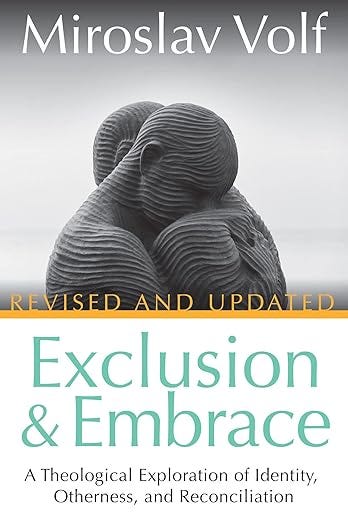
1. Open arms are a gesture of reaching for the other. They signal discontent with my self-enclosed identity and suggest desire for the other.
2. Open arms say that I have created space in myself for the other to come in. No longer “full of myself,” I set out on a journey toward the other, moving beyond my own fortified boundaries.
3. Open arms suggest a fissure in myself—an open door into my space through which the other might enter. They signify an aperture in the boundary of my self.
4. Open arms are a gesture of invitation, like an open door to an expected friend that beckons, come in. But unlike the open door, open arms are also a soft knock on the other’s door, politely asking if I might enter their space.
We open our arms to the world to proclaim the message of reconciliation—the open temple, the open table, the open arms, the open heart—limited only by what we offer, i.e. the extravagant love of Christ. To those who respond, to those we receive, we become the Bethlehem innkeeper who might have made room for Christ and his family. If only we have eyes wet enough to see.
I don’t know if I could have written that even two years later—I went through a rough patch—but two decades later, I do still believe it, even with a lot less energy and zeal. But I’m pretty sure Jesus believed it, and I believe him.
So did Sören Kierkegaard, though far more boldly than me. I’ll leave you with his ever-probing words!
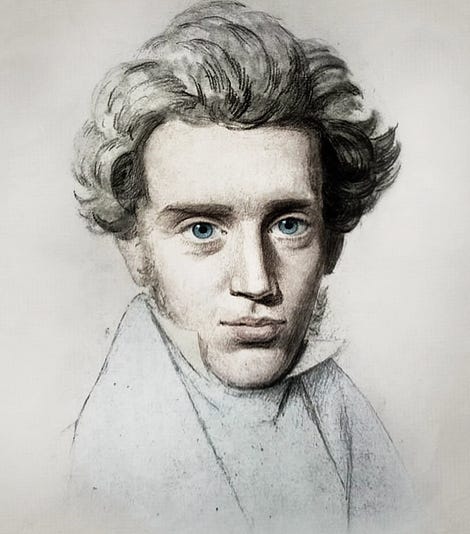
Sören Kierkegaard
THE INVITATION – II
Training in ChristianityCome here all, all, all of you, with Him is rest, and He makes no difficulties, He does but one thing, He opens His arms.
He will not first (as righteous people do, alas, even when they are willing to help)—He will not first ask thee, “Art thou not after all to blame for thy misfortune? Hast thou in fact no cause for self-reproach?”
It is so easy, so human, to judge after the outward appearance, after the result—when a person is a cripple, or deformed, or has an unprepossessing appearance, to judge that ergo he is a bad man; when a person fares badly in the world so that he is brought to ruin or goes downhill, then to judge that ergo he is a vicious man. Oh, it is such an exquisite invention of cruel pleasure to enhance the consciousness of one’s own righteousness in contrast with a sufferer, by explaining that his suffering is God’s condign punishment, so that one hardly even… dares to help him; or by challenging him with that condemning question which flatters one’s own righteousness in the very act of helping him.
But He will put no such questions to thee, He will not be thy benefactor in so cruel a fashion. If thou thyself art conscious of being a sinner, He will not inquire of thee about it, the bruised reed He will not further break, but He will raise thee up if thou wilt attach thyself to Him. He will not single thee out by contrast, holding thee apart from Him, so that thy sin will seem still more dreadful; He will grant thee a hiding-place within Him, and once hidden in Him He will hide thy sins. For He is the friend of sinners: When it is a question of a sinner He does not merely stand still, open His arms and say, “Come here”; no, He stands there and waits, as the father of the lost son waited, rather He does not stand and wait, He goes forth to seek, as the shepherd sought the lost sheep, as the woman sought the lost coin. He goes—yet no, He has gone, but infinitely farther than any shepherd or any woman, He went, in sooth, the infinitely long way from being God to becoming man, and that way He went in search of sinners.
After Kierkegaard, do I say “Enjoy”? Well, at least feel free to subscribe and share.
==========
Individual Reflection:
Where in your life right now is hope something you’re practicing rather than something you feel?
Group Discussion — choose one:
What does it mean to you that the Father in this story doesn’t wait but goes looking?
What has hope cost you?
Where have you found that brightness Batiste describes emerging from a dark moment — and did you trust it?
