Wednesday, June 24, 2026
Father Richard reflects on the shared hope that characterized the first community he founded in the late 1970s:
I will always cherish my early years among the youth of the New Jerusalem Community in Cincinnati, Ohio. If nothing else, we were enthusiastic! With the help of the Holy Spirit, there was belief, there was trust, there was hope, there was positive energy. We didn’t immediately critique or analyze everything. We didn’t call everything into question right away.
I believe we must be free to say “yes” before we say “no,” but most of us aren’t that free. Our first response is normally dualistic, negative, and probably even fear based. We often respond initially with something like: “I don’t trust that. I don’t like that. I don’t want that.” The word “yes” before “no” allows for some enthusiasm (en-theos in Greek), which means “filled with God.” I’m encouraging an enthusiasm that is based on intelligence, wisdom, and the great gift of hope.
Hope is a participation in the very life of God. It has nothing to do with circumstances or events going well. It can even thrive in the midst of adversity and trial. True faith, which always includes hope and love, is a predisposition to “yes.” I would go so far as to say that a foundational “yes” is the most distinguishing element between an ego- and fear-based agenda and a Spirit-guided one. As Paul writes of Jesus, “With him it was always ‘yes,’ and however many the promises God made, the ‘yes’ to them all is in him” (2 Corinthians 1:19–20).
Deconstruction comes naturally to most of us, but deconstruction is rather useless without reconstruction and a positive vision. It’s the easiest thing in the world to stand on a pedestal of superiority and point out who and what is wrong—without doing anything positive or becoming a positive answer ourselves. After we criticize and deconstruct, what are we actually for? An awful lot of activists on the left and reactionaries on the right have no positive vision, nothing they believe in, no one they are in love with. They are just overwhelmed with what’s wrong and think that by eliminating the so-called “contaminating element,” the world will be just, peaceful, and right again.
The book of Proverbs says that without a positive vision the people will perish (see 29:18). What the gospel, true religion, and true mythology give us is a cosmic and positive vision, inside of which the soul can live safely. That’s the only place from which lasting change ever comes. Jesus’s term for that totally positive vision—not against anybody or expelling anything—is the reign of God.
==================
The Parable of the Wicked Tenants
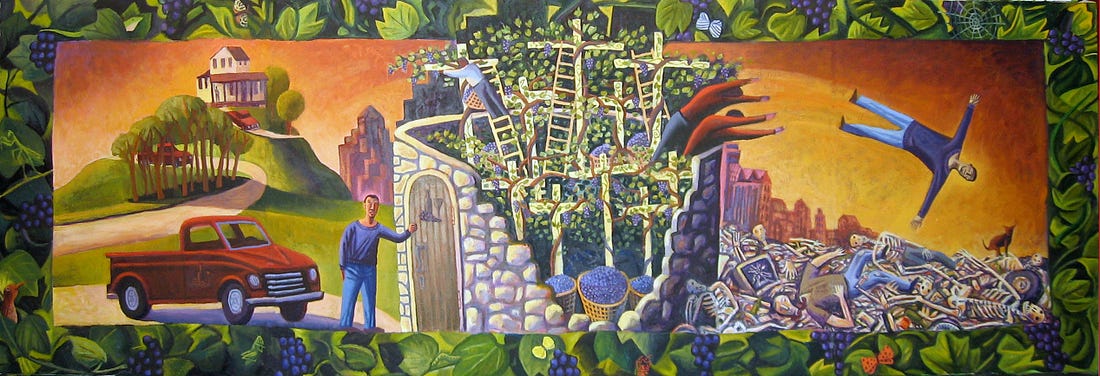
The Paradigm Shift
| DIANA BUTLER BASS JUN 24 |
WELCOME TO THE SUMMER SERIES WEDNESDAY!
This year, unlike past years, the Cottage Summer special — Parables & Pentecost — is open to all subscribers (paid and free) to nurture your spirit this season.
In addition to these Wednesday posts on the parables in A Beautiful Year, paid subscribers have access to weekly recorded conversations during Parables & Pentecost. Last week’s recording can be found HERE.
Today, we explore the story of the Wicked Tenants in our summer series on Parables and Pentecost.
A wee reminder: the word “parable” means to “overturn” or “cast aside.” The parables are STORIES told by Jesus and intended to upset what we think!
A few readers have written to say they were upset with some of last week’s suggestions for reading the parable. Well, my friends, that’s what a parable is supposed to do — overturn conventional wisdom. Indeed, the Gospel of Matthew itself says that these Jesus stories set “the whole city … in turmoil.”
Today’s parable continues the task of casting off convention.
***
The above audio excerpt is courtesy of my publisher from the audiobook version of A Beautiful Year, “The Parable of the Wicked Tenants.” If you are reading the book, it is found on pages 242-246; in the e-book, this parable is in the Pentecost section.
Read and reflect on this parable. How do you feel about this story? Where are you in the story? Does this parable challenge you — and us — at this moment in history?
Explore the suggestions below for further reflection and understanding — as you choose.
This isn’t a homework assignment! This is an invitation and a guide. Think about all three topics or pick one. Leave comments and observations. Read the comments of others and learn from the community. Reply to each other. I’ll jump into the thread a few times during the day.
Ask questions, wonder together.
THE STORY
The parable itself is found in Matthew, Mark, Luke, and the non-canonical Gospel of Thomas. This version is from Matthew 21:33-44
Listen to another parable.
There was a landowner who planted a vineyard, put a fence around it, dug a wine press in it, and built a watchtower. Then he leased it to tenants and went to another country.
When the harvest time had come, he sent his slaves to the tenants to collect his produce.
But the tenants seized his slaves and beat one, killed another, and stoned another. Again he sent other slaves, more than the first; and they treated them in the same way.
Finally he sent his son to them, saying, “They will respect my son.” But when the tenants saw the son, they said to themselves, “This is the heir; come, let us kill him and get his inheritance.” So they seized him, threw him out of the vineyard, and killed him.
Now when the owner of the vineyard comes, what will he do to those tenants?’ They said to him, ‘He will put those wretches to a miserable death, and lease the vineyard to other tenants who will give him the produce at the harvest time.’
Jesus said to them, ‘Have you never read in the scriptures:
The stone that the builders rejected
has become the cornerstone;
this was the Lord’s doing,
and it is amazing in our eyes?
Therefore I tell you, the kingdom of God will be taken away from you and given to a people that produces the fruits of the kingdom. The one who falls on this stone will be broken to pieces; and it will crush anyone on whom it falls.
WHAT IS THIS STORY ABOUT?
How would you explain this story to someone who had never heard it before? What’s the point? Is there more than one point to this parable?
Do you like the story? Do you not like it? Does it puzzle you? Anger you? Make you resentful? What emotions does it stir? Be honest!
What do you think a person who had never heard this story before would make of it?
Do you think it is better described as a moral parable, an example parable, or a challenge parable? It is tempting to say “all three,” but which of these styles is most prominent?
THE STORY AND YOUR STORY
WHAT DOES THIS STORY MEAN TO YOU?
When did you first hear this story? How many times do you think you’ve heard it? Have you heard it in other forms (film, novel, poetry, art, music) in addition to the biblical story?
To which character do you most relate? Who garners your sympathy? Who is the hero of this story? The villain? Who do you like the most?
How has your understanding of this story changed over the years? What stands out for you differently today than at other times in your life? As you re-read it or listen to my reflections on it, what surprised you? Is there something you’ve never noticed before?
THE STORY AND OUR STORY
During the first week of this series, John Dominic Crossan joined with the paid subscriber community in an online conversation about the parables.
We focused on how the parables challenged empire, how they present an alternative to Christian nationalism, and how they widen our vision toward evolutionary — and revolutionary — possibilities for a sustainable, peaceable future for humankind.
In his book, The Power of Parable, Crossan interprets this parable as a very particular kind of challenge parable — a “paradigm shift” parable of the Kingdom of God.
Crossan explains that Jesus, in his parables, transformed expectations of the Messiah. According to many scholars, at the time of Jesus, the Jewish people generally expected a “Davidic Messiah,” a warrior king who would restore the kingdom of Israel and defeat the enemies of God. Crossan argues that “Jesus proclaimed nonviolent resistance to the injustice of Roman imperialism in a world that belonged to a just and nonviolent God.”
This biblical shift seems, in retrospect, obvious — and central to the nascent Christian message. But at the time, it wasn’t. Jesus told stories to invite hearers into a different vision of the Messiah and the Kingdom, and this was the “kingdom paradigm-shift.”
Now, with the shift in mind, imagine you are a first-century Jew. It would be easy to think that the landowner was Rome. Because the land was owned by Roman colonizers and flunkies! They might have thought of themselves as the tenants, those who had to work the vineyard (rather like sharecroppers) and turn the profits over to this distant absentee owner. When the slaves show up to collect on the master’s behalf, the workers rebel and kill the slaves. And when the master sends his son, well, they kill him, too.
See what this sounds like? Enslaved people on a plantation killing their enslavers? A colonial uprising? The rightful overturning of injustice?
If you heard this parable and you were being forced to hand over the work of your hands to Roman authorities, you’d probably be siding with the tenants! They wouldn’t seem so wicked. They’d seem like their cause was just.
Here’s Professor Crossan’s view:
Think about the parable of the Wicked Tenants … imagine a first-century Galilean audience hearing (this) story.
Would some find that murder acceptable — even by divine law? Would they agree the tenants were, as we say, “wicked”? Would others find it understandable, but not prudent — the authorities would surely exact vengeance? Would some, many, or even most find it unacceptable on moral grounds?
Jesus could not have known their reactions beforehand and neither can we afterward.
But, the story holds another possibility (indeed, more than one additional possibility!). My sense — and I think Crossan’s as well — is that the landowner (in this particular parable) may well be God. The tenants aren’t all Jews; rather, they are Jews who are collaborating with Roman colonizers (they “work” Rome’s vineyard on behalf of the imperialists). The “slaves” are God’s faithful servants and prophets (like John the Baptist). And the son is the Messiah who, in this case, does not respond with violence to the tenants’ murderous intent. Instead, he dies revealing the wickedness of the collaborators of empire.
Ouch. That must have hurt. And it surely shocked them.
That’s the power of a paradigm shift.
HOW DOES THIS PARABLE CHALLENGE YOU — AND US — AT THIS SPECIFIC MOMENT IN HISTORY?
Can you imagine how a first-century Jew in Galilee, a region occupied by Rome, might have felt about this story? Might they have sympathized more with the landowner, the tenants, or the slaves? Do you understand how shocking this parable may have been in its original context?
Crossan claims, “Jesus is not just announcing to his audience that God’s kingdom is now present. He is announcing that is only present if and when it is accepted, entered into, and taken upon oneself.” The question, “Where are you in this parable?” is an invitation to change, to shift your consciousness about the meaning and nature of the Kingdom of God. Can you grasp that? (Hint: some of the collaborators couldn’t!)
What is most challenging for you? For your community? What’s the challenge for NOW — socially, politically, or economically?
Is this Kingdom paradigm-shift needed now? What if Christian nationalists changed their vision of the kingdom from a warrior-king Messiah to a nonviolent, non-imperial, self-giving one? What if people like, say, Pete Hegseth, shifted from collaborating with a violent empire to co-creating the Kingdom? Can you imagine? Is this parable speaking to people like him?
Maybe we humans always collaborate. The question is: With which paradigm do you collaborate?
An example parable may be good, a challenge parable is a far more importantly subversive operation. Why? Because challenge parables humble our prejudicial absolutes, but without proposing counter-absolutes in their place. They are tiny pins dangerously close to big balloons. They push or pull us into pondering whatever is taken totally for granted in our world.
— John Dominic Crossan
INSPIRATION
Jesus tells a story about wicked tenants
who want to take over a vineyard.
A vineyard would have been repossessed land
taken from farmers, turned to an export crop,
where they are now sharecroppers.
The story is a commentary on economic systems
that use people.
And also a hit at leaders
who are doing a lousy job.
But what if it’s also about us,
about our urge to take over religion
and make it ours?
God, I confess
sometimes I want to possess your vineyard,
to make my religion work out for me,
not merely to receive it but to control it,
to manage your grace,
to center it on me.
I repent of my mutiny.
I will let this be yours,
and I will work your fields.
— Steve Garnaas-Holmes, “Wicked Tenants”
In a room where
people unanimously maintain
a conspiracy of silence,
one word of truth
sounds like a pistol shot.
― Czesław Miłosz
