Wednesday, August 5, 2026
There is only one question which really matters: why do bad things happen to good people?
—Rabbi Harold Kushner
Through his classic exploration of the book of Job, Rabbi Harold Kushner (1935–2023) questions the common belief that God is all-powerful:
The author of the Book of Job … believes in God’s goodness and in Job’s goodness, and is prepared to give up his belief … that God is all-powerful. Bad things do happen to good people in this world, but it is not God who wills it….
There may be a sense of loss at coming to this conclusion. In a way, it was comforting to believe in an all-wise, all-powerful God who guaranteed fair treatment and happy endings, who reassured us that everything happened for a reason…. But it was comforting the way the religion of Job’s friends was comforting: it worked only as long as we did not take the problems of innocent victims seriously. When we have met Job, when we have been Job, we cannot believe in that sort of God any longer without giving up our own right to feel angry, to feel that we have been treated badly by life.
From that perspective, there ought to be a sense of relief in coming to the conclusion that God is not doing this to us. If God is a God of justice and not of power, then He can still be on our side when bad things happen to us. He can know that we are good and honest people who deserve better. Our misfortunes are none of His doing, and so we can turn to Him for help. Our question will not be Job’s question “God, why are You doing this to me?” but rather “God, see what is happening to me. Can You help me?” We will turn to God, not to be judged or forgiven, not to be rewarded or punished, but to be strengthened and comforted.
Kushner describes the divine intimacy we can experience when we are released from the belief that God is responsible for our suffering:
We will be able to turn to God for things He can do to help us, instead of holding on to unrealistic expectations of Him which will never come about….
We can maintain our own self-respect and sense of goodness without having to feel that God has judged us and condemned us. We can be angry at what has happened to us, without feeling that we are angry at God. More than that, we can recognize our anger at life’s unfairness, our instinctive compassion at seeing people suffer, as coming from God who teaches us to be angry at injustice and to feel compassion for the afflicted. Instead of feeling that we are opposed to God, we can feel that our indignation is God’s anger at unfairness working through us, that when we cry out, we are still on God’s side, and He is still on ours.
=============
Haiti 1992 – Loosing the Chains of Injustice
Ode to Lilut, the Bluntchlis, and Justice Bradley
| BRADLEY JERSAK AUG 4 |
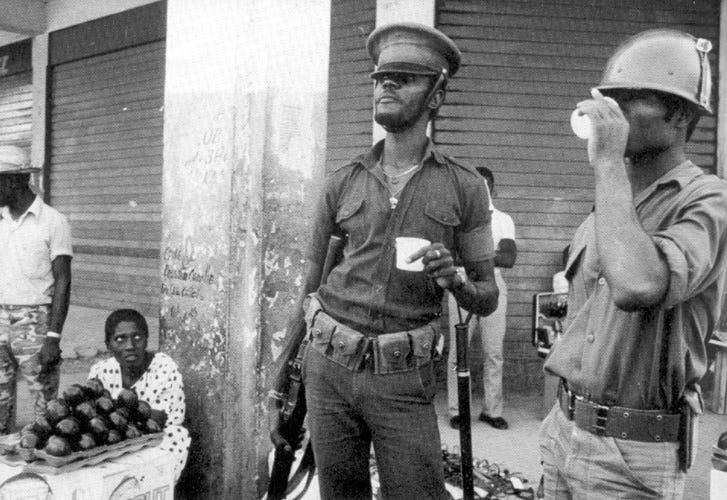
THE SOLDIER PLAYED with the safety of his M-16 assault rifle, and I thought I was going to be sick. It seemed like an awful nightmare, but I was awake—more fully awake than at any previous moment of my life.

It was November 1992. Desarmes, Haiti. After a coup d’etat, the paramilitary Macoutes no longer merely terrorized the countryside; they were actually running it. And they wielded an iron fist in this village in the Haitian outback. Groups larger than three could not meet without a permit. Youth groups and farmers’ co-ops were forbidden, their leaders arrested. Checkpoints monitored traffic on the dirt roads.
Lares, a Haitian national serving the Mennonite Central Committee (MCC) as an agricultural trainer, had been arrested for allegedly distributing a disparaging letter against the local military chief. The soldiers had hog-tied him and beaten him with clubs about the head, ears, back, and thighs. We tried to bribe them but now they also declared their true intentions: “Tonight, we will get drunk and beat him to death. By morning, he will be dead. No bribes.”
Now Ron Bluntchli, our MCC host and guide, was standing face-to-face with an armed guard and speaking boldly in Creole: “God is your judge, and he is watching you! You will stand before him one day. He sees you now, and you will answer to him. He will hold you to account for this! God will not tolerate this injustice. Set this man free now!”
Questions began to race through my mind: Would they really kill Lares? Would they kill Ron? Would they dare? What about me? Could I escape with my wife, now six months pregnant? God? Where are you? What are you doing? What should we do?
As I listened, the Lord spoke to my heart:
“Is not this the kind of fasting I have chosen: to loose the chains of injustice and untie the cords of the yoke, to set the oppressed free and break every yoke? Is it not to share your food with the hungry and to provide the poor wanderer with shelter—when you see the naked, to clothe him, and not to turn away from your own flesh and blood?” (Isaiah 58:6–7)
I could longer spiritualize those verses away. This is very real, and in this context, it is exactly what Isaiah was talking about.”
But how?
How could we liberate this actual prisoner—bound in actual nylon cords—from an armed, flesh and-blood oppressor? To break this stalemate could easily escalate the crisis, right?
I watched and waited, focusing on keeping my head and my churning bowels together. Ron would not back down. He believed that without witnesses, the Macoutes would stir up the courage to kill Lares. A crowd began to gather. Mugginess and tension pressed in. We cried out to the Lord in prayer, but despair threatened to win the day.
I was beginning to see through the blindness of those Christians who accuse organizations like MCC and Christian Peace Maker Teams of being “too political.” I had heard it before and even wondered myself: “Shouldn’t they stick to relief work or channeling their energies into ‘soul-winning’? Why do they have to get so political?” In the Haitian context, where life and death stand in stark contrast every day, souls are people. And the people are naked, starving, and oppressed. There is no fence of ambiguity to straddle. The choice was as simple as it was hard: we could either walk away now in silent acquiescence to the misery and evil or we could speak out and act for justice and mercy, hoping to overcome evil with good. To follow Christ in the moment left us no choice, regardless of what the critics believe.
In North America, people in my demographic rarely understand this. Dom Helder Camara, the former Archbishop of Recife, Brazil once lamented, “When I gave food to the poor, they called me a saint. When I ask why the poor have no food, they call me a communist.”
Now I was getting a crash-course on kingdom justice and mercy. I was coming to realize these are not merely temporal matters of politics or philanthropy that can be isolated from one’s spiritual life. They are of eternal importance and will be addressed when Christ renders verdicts on Judgment Day. (cf. Matthew 25)

When the Day of Judgment comes, what we have done or neglected to do for the naked, the hungry, the prisoner, the sick, and the oppressed will be identified with what we did or did not do for the King. He will ask:
“Did you feed me and clothe me or did you not? Did you welcome me, visit me, comfort me, free me, or not? You either came to me or abandoned me. If you helped them, you helped me. If not, I don’t believe I know you.”
On that day, whether we were “left” or “right” in our earthly politics will matter little when the divine judge beckons us to his left or his right. Whether we were conservative or liberal in our theology will flee from our minds. Even whether we said “the magic prayer” will ring shallow in that moment. But whether or not we did justice, loved mercy, and walked humbly with God will be of paramount concern (Micah 6:8). The New Testament teaches that we are saved by faith in the grace of God and not by performative works (Ephesians 2:8–9). However, it also states that a truly living faith will not fail to reproduce the character of Christ in our lives, by which I mean our actions(James 2:26).
The ministries of Matthew 25 are not afterthoughts of Christian charity held in place with refrigerator magnets. They are the foundation of the very throne of God!
“Righteousness and justice are the foundation of your throne; love and faithfulness go before you. Blessed are those who have learned to acclaim you, who walk in the light of your presence, O LORD” (Psalm 89:14).
Once we have heard, we must follow through with action.
Back to Haiti. As I stood there trembling, a little boy with a bright white, perfectly ironed shirt approached me. The boy, Lilut, was eleven years old, with very dark skin and bright white teeth. In the middle of this moment of hell, he smiled comfort at me and began to rub my back. I saw Jesus looking at me through those big eyes. They said, “It’s going to be okay.”
Ron continued to lay his life on the line, demanding immediate release of the prisoner. The guard rebutted: “We cannot release him without a court order.” What an odd “justice” system. You could arrest, sentence, and punish a man without so much as a warrant or any shred of evidence, but to free him required a trial.
“Then let’s go to the judge,” Ron countered.
“The judge is in the next town,” the guard replied.
“Then we’ll go to the next town.”
“We have no truck.”
Ron pulled out his keys. “We’ll take my truck.”
Under the unrelenting pressure from Ron, foreign witnesses, and the entire village, the chief ran out of excuses. They loaded the prisoner and a handful of soldiers into the back of Ron’s pick-up and disappeared with Ron at the wheel down the riverbed road. Eden and I waited anxiously and prayed through the night. What would happen? What if they didn’t return? What would happen to Ron? What if the soldiers came for us next? How would I get Eden back to Port-au-Prince? What if…?
Eventually, God broke through my troubled thoughts with a measure of peace. I found some dry bread with avocado to settle my stomach and was finally able to get a little sleep.
The next morning, we heard the truck returning. Villagers poured out of their homes and lined the dusty road. The whole crew was returning, but now the ropes had been removed from Lares. He stood in the truck box smiling and waving at the crowds in this impromptu remake of Jesus’ triumphal entry into Jerusalem. He was free! Men, women, and children began to chant in unison, “God is able! God is able!”
Apparently, the courthouse in the next town had put Lares in custody for the night (which likely saved his life) and the judge had thrown out the case for absence of evidence.
And there was Lilut, bright white eyes, teeth, and shirt, smiling at me through the dust—little Jesus in our midst.

P.S. Immediately after our Isaiah 58 encounter, I wrote in my journal, “If the child in Eden’s womb is a boy, name him “Justice.” Three months later, Justice Bradley Jersak was born.
