
Have you been around?
Have you done your share of comin’ down
On different things that people do?
Have you been aware?
You got brothers and sisters who care
About what’s gonna happen to you
In a year from now
Maybe I’ll be there to shake your hand (Shake your hand)
Maybe I’ll be there to share the land (Share the land)
That they’ll be givin’ away
When we all live together, we’re talkin’ ’bout together, now
Maybe I’ll be there to shake your hand (Shake your hand)
Maybe I’ll be there to share the land (Share the land)
That they’ll be givin’ away
When we all live together, we’re talkin’ ’bout together, now
Did you pay your dues?
Did you read the news
This morning when the paper landed in your yard?
Do you know their names?
Can you play their games
Without losin’ track
And coming down a bit too hard?
Maybe I’ll be there to shake your hand (Shake your hand)
Maybe I’ll be there to share the land (Share the land)
That they’ll be givin’ away
When we all live together, we’re talkin’ ’bout together, now
Maybe I’ll be there to shake your hand (Shake your hand)
Maybe I’ll be there to share the land (Share the land)
That they’ll be givin’ away
When we all live together, we’re talkin’ ’bout together, now
Maybe I’ll be there to shake your hand (Shake your hand)
Maybe I’ll be there to share the land (Share the land)
That they’ll be givin’ away
When we all live together, we’re talkin’ ’bout together, now
Maybe I’ll be there to shake your hand (Shake your hand)
Maybe I’ll be there to share the land (Share the land)
That they’ll be givin’ away
When we all live together, together together
(Shake your hand, share the land)
You know I’ll be standing by to help you if you worry
(Shake your hand, share the land)
No more sadness, no more sorrow, and no more bad times
(Shake your hand, share the land)
Everyday comin’ sunshine, everyday everybody laughin’
(Shake your hand, share the land)
Walkin’ together by the river, walkin’ together and laughin’
(Shake your hand, share the land)
Everybody singin’ together, everybody singin’ and laughin’
(Shake your hand, share the land)
Good times, good times, everybody walkin’ by the river now
(Shake your hand, share the land)
Walkin’, singin’, talkin’, smilin’, laughin’ diggin’ each other
(Shake your hand, share the land)
Everybody happy together, I’ll be there to worry you if you need-a me
(Shake your hand, share the land)
Call on me, call on me, call my name, I’ll be runnin’ to help you
(Shake your hand, share the land)
Everybody walkin’ by the river now, everyday everybody laughin’
(Shake your hand, share the land)
Everybody singin’ and talkin’, smilin’, laughin’, diggin’ each other
Listen, Learn, and Contribute
Friday, October 9, 2026
Cherokee descendant Randy Woodley responds to Francis of Assisi’s deathbed invitation, “I have done what was mine to do. May Christ teach you what is yours”:
My Keetoowah ancestors had a concept that I think gets at what this question really means. They understood that every person, every being, every element of creation has a particular responsibility—a role to play in the harmony of the whole. Not everyone had the same role. Some were healers, some were warriors who protected the people, some were farmers, some were storytellers. But everyone had something that was theirs to do, and the community couldn’t function without all of it.
An old Indian saying puts it more bluntly: The worst thing that can be said about a person is, “He acts like he has no relatives.”
To act as if you have no relatives means to live as though your actions don’t ripple outward. It means to treat the world as though you’re the only one in it. It means to extract what you want without asking what you owe.
Sound familiar? This is essentially the operating system of Western capitalism—the worldview that treats land as inventory, water as delivery system, people as labor units, and the sick as revenue streams. Take what you can, discard the rest, and never ask who’s downstream.
What my ancestors practiced was the opposite. They understood that humans are the younger siblings in creation—that the plants, animals, waters, and stones have been here longer and know how things work. Our job is not to dominate but to listen, learn, and contribute to the wellbeing of the whole. That’s not metaphor. That’s a survival strategy developed over thousands of years of living in reciprocal relationship with the land.
The mystics have always known that the separate self is an illusion—that we are woven into one another and into creation. That what we do to the least of these, we do to the Sacred. Indigenous peoples have been practicing that truth in daily life for millennia, not as theology to be debated but as a way of being to be lived. It goes by various names, but I call it the Harmony Way….
This is what contemplation should lead to—vulnerability. Not withdrawal from the world but deeper engagement with it. Not escape from suffering but the willingness to sit with it long enough to see clearly what is ours to do. Vulnerability requires living reflectively with yourself but also living deeply into the whole community of creation—all your relatives.
Reference:
Randy S. Woodley, “Planting for the Seventh Generation: What Is Ours to Do” ONEING 14, What Is Ours to Do?” (CAC Publishing, 2026): 100–101, 102.
Image credit and inspiration: Nina Plobner, untitled (detail), 2020, photo. Unsplash. Click here to enlarge image. The mystery of creation reveals itself most fully when we pause to notice something small and simple, like dew caught on a single blade of grass.
More on “Freed Will” & Apokatastasis
Lecture at Love Wins Conference by Bradley Jersak – Excerpt
| BRADLEY JERSAKSEP 12 |
“Freed Will” – Bradley Jersak
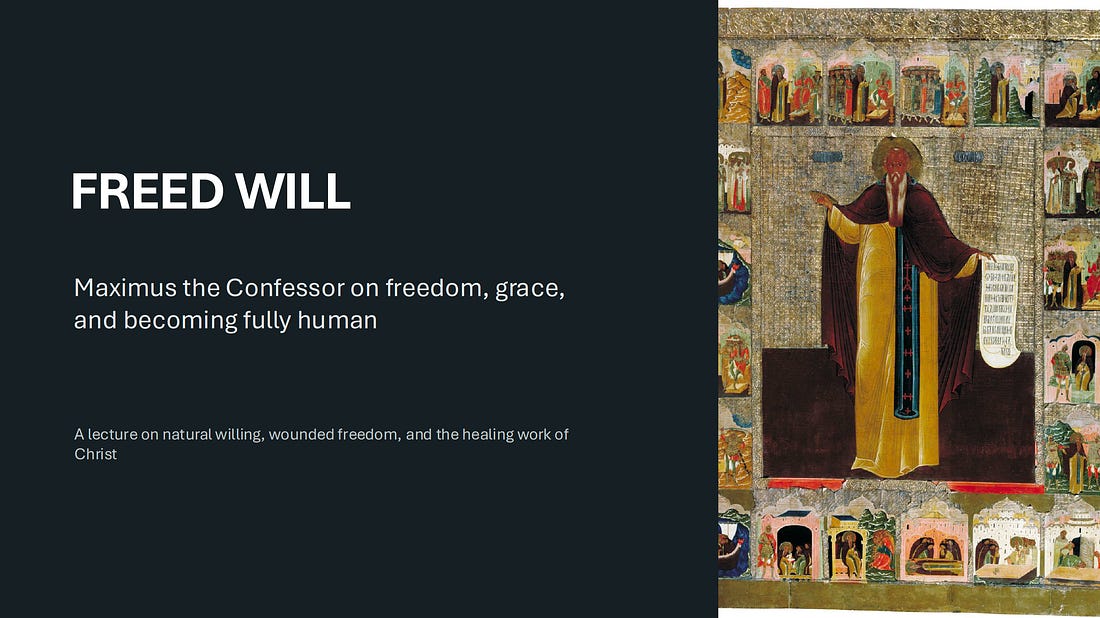
Maximus the Confessor on Freedom Grace and Becoming Fully Human
Love Wins Conference – PPT Lecture Notes (without footnotes)
Perhaps you have seen the familiar exchange. Someone asks, “If God is all-powerful and all-loving, why doesn’t God save everyone?” The answer comes back: “Because God respects our free will.”
That answer presents a serious challenge to apokatastasis, the early Christian hope that God will finally restore all things in Christ. If someone refuses God until the day they die, what can God do? Would saving that person require God to overpower the will? Must a loving God permit the refusal to continue forever?
C. S. Lewis gave this argument its most memorable image: “The gates of hell are locked on the inside.” He meant that hell is finally self-chosen. God does not keep people out; they refuse to come in
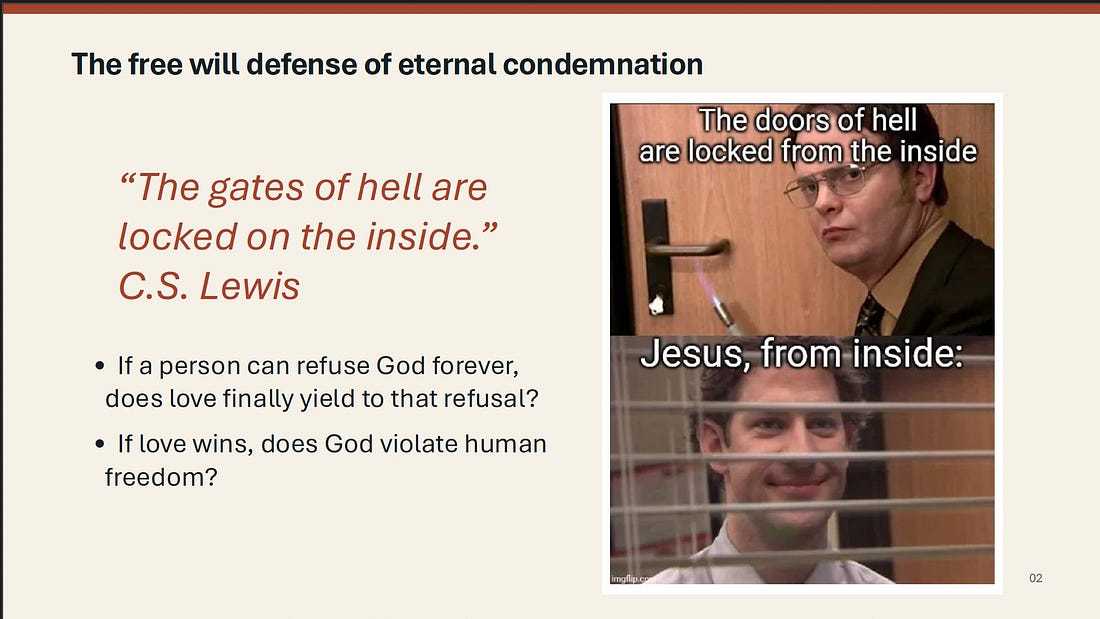
.The image has real moral force. It reminds us that love does not treat persons as objects. Even so, it assumes that we already know what a free will is and how it works. Maximus the Confessor gives us reason to look more carefully.
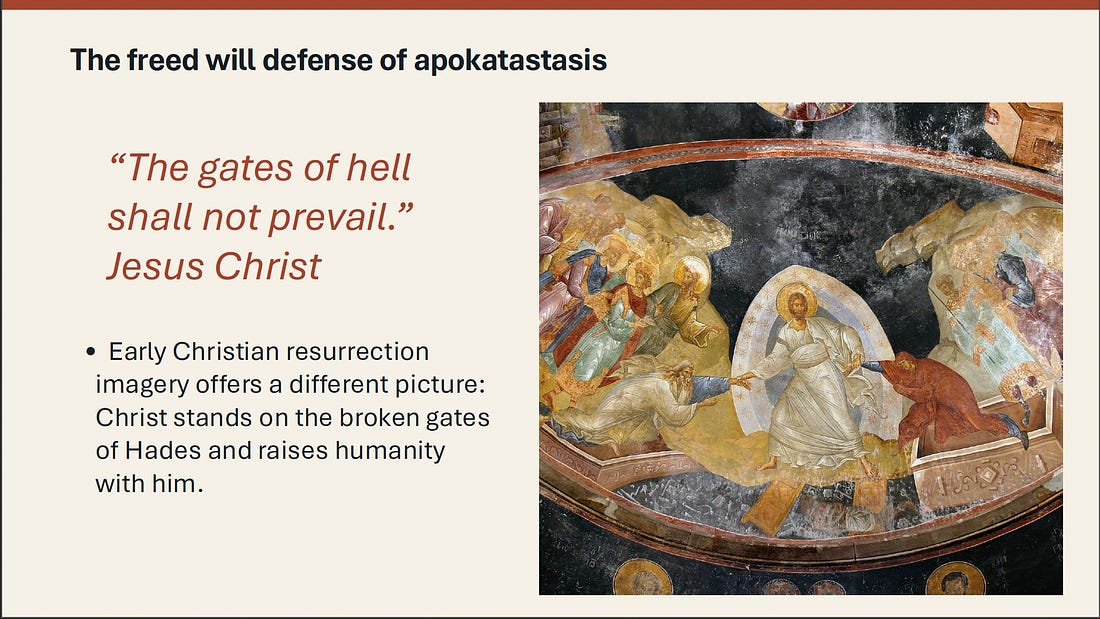
But first Christians never portrayed Christ standing outside the door of Hades, waiting for its inhabitants to unlock it. In the traditional icon of the resurrection, Christ stands on the broken gates and reaches into the grave. He takes Adam and Eve by the wrists and raises them with him.
So too the hymns of the ancient church. Two angles:
The Gates of Hades are Opened — Canon of the Cross & Resurrection
Having been tested by wounds, by Your suffering of the Cross,
You raised up with Yourself those wounded by hades.
Wherefore, I cry out: Lead up my life from corruption,
O You who loves mankind.The gates of hades opened to You in fear,
And the vessels of the enemy were plundered.
Wherefore, the women met You, receiving joy instead of grief.
The Gates of Hades are Broken — Kontakion, in Tone I
As God, You arose from the tomb in glory,
and with Yourself, raised up the world;
Human nature hymns You as God, and death has vanished,
Adam dances, O Master, and Eve, delivered from bonds, now rejoices, Crying aloud: You are He, O Christ, Who grants resurrection to all!Let us hymn as God the Almighty Who rose on the third day,
Who broke down the gates of hades,
Who raised up from the grave those held there from ages past,…Hades groans and death utters lamentation;
the world is filled with gladness, and all rejoice with it,
for You, O Christ, granted resurrection unto all.
The image does not settle the theological question, but it does suggest a different place to begin. Perhaps salvation depends less on God’s ability to persuade an untouched, self-contained will and more on Christ’s power to free a will that has become bound.
This brings us to Maximus. His account of freedom starts with a simple distinction that modern discussions often miss. The ability to choose is real, but choice and freedom are not identical.
When Choosing Is Not Freedom
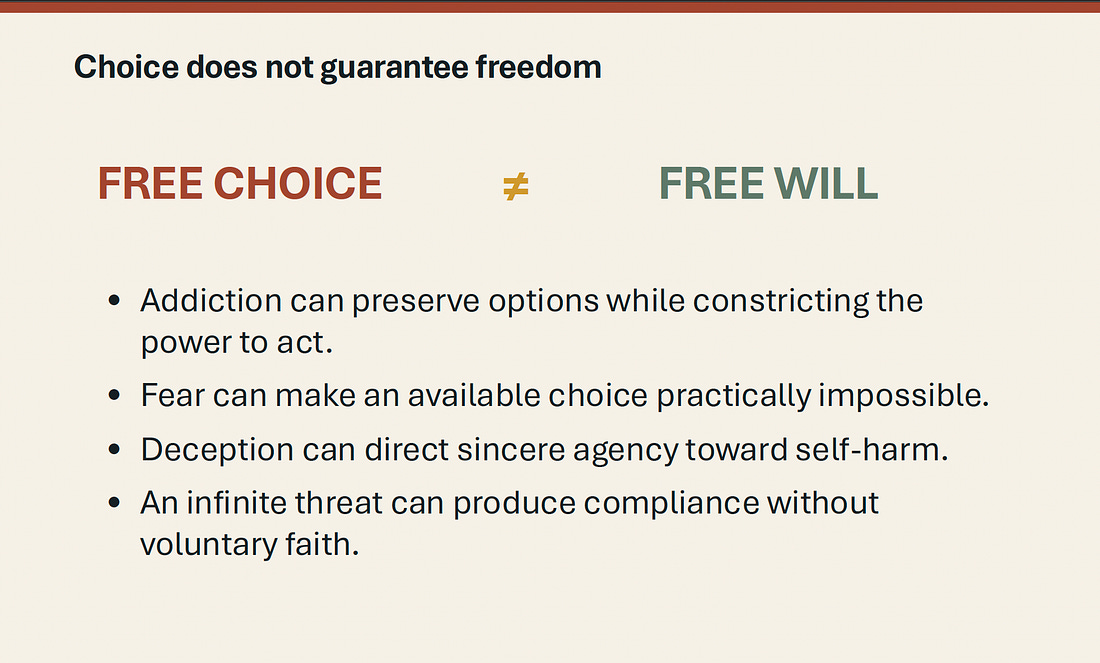
Consider a person living with an addiction. There may come a point when the person understands the harm and wants to stop, yet repeatedly returns to the same behaviour. In one sense, the person still chooses. In another, we can see that freedom has narrowed. The will operates under a form of bondage.
Fear can do something similar. A person who is terrified of flying can decide whether to board the plane, but one option may feel almost impossible. Deception complicates matters further. People can act voluntarily on the basis of propaganda or manipulation and sincerely believe that they are choosing for themselves. The decision belongs to them, but a false picture of reality has shaped it.
Religious coercion belongs in this conversation too. If a preacher says, “Accept our gospel freely or suffer forever,” the resulting confession may be a choice, but the threat makes its voluntary character difficult to judge.
These examples are different, and none of them removes personal responsibility. They do show why bare choice is an inadequate definition of freedom. A decision can arise from fear, ignorance, compulsion, or a badly distorted sense of what is good. The will is active, though it is not necessarily well.
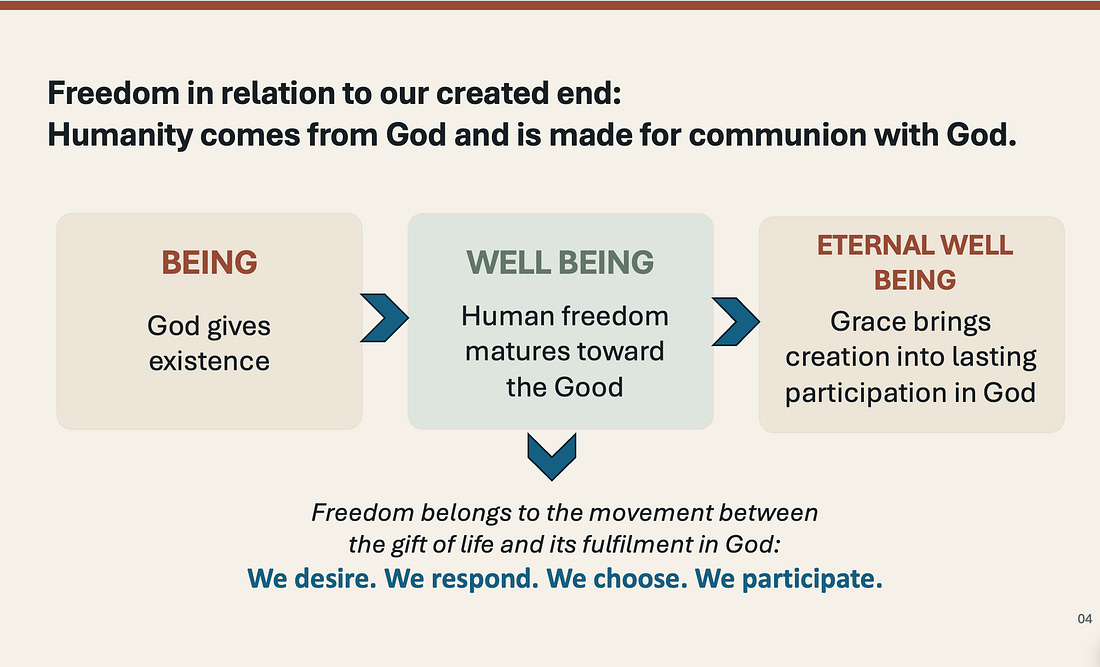
Maximus understands freedom in relation to our created end. Human beings come from God and are made for communion with God. Our natural will is the movement of human nature toward life and goodness. We do not begin as neutral creatures with an equal appetite for good and evil. We desire what appears good to us because desire itself belongs to the good creation of God.
This is easier to see in Maximus’s account of being, well-being, and eternal well-being. Being is the gift of existence. Well-being is our life developing according to its proper end. Eternal well-being is the fulfilment of creaturely life in communion with God, which Maximus calls deification. Deification does not mean that we stop being human or become God by nature. It means that grace brings human nature into full participation in the life of God.
Freedom belongs within this movement. It is not simply a possession handed to us in complete form at birth. It is our capacity to become what we were created to be.
